# Spanish Medical Terms Guide for Healthcare Professionals
> Learn Spanish medical vocabulary as healthcare professionals. Body parts, symptoms, emergency phrases, and patient communication strategies explained.
**URL:** https://migaku.com/blog/spanish/spanish-medical-vocabulary
**Last Updated:** 2026-04-04
**Tags:** vocabulary, phrases
---
[Learning Spanish](https://migaku.com/learn-spanish) medical [vocabulary](https://migaku.com/blog/spanish/best-spanish-learning-apps) can feel overwhelming when you're staring at lists of body parts, symptoms, and procedures. But here's the thing: if you work in healthcare or plan to, being able to communicate with Spanish-speaking patients isn't just a nice bonus anymore. With over 40 million Spanish speakers in the U.S. alone, you'll likely encounter situations where knowing the right medical terms could genuinely improve patient care. This guide breaks down the essential Spanish medical vocabulary you actually need, organized by real-world scenarios you'll face in clinical settings.
----
## Essential body parts and anatomy terminology
Before you can discuss symptoms or diagnose conditions, you need to know how to talk about the human body. Here are the most common anatomical terms you'll use daily:
**Head and face:**
| Spanish | English |
| - | - |
| la cabeza | Head |
| los ojos | Eyes |
| los oídos | Ears |
| la nariz | Nose |
| la boca | Mouth |
| los dientes | Teeth |
| la garganta | Throat |
**Torso and organs:**
| Spanish | English |
| - | - |
| el pecho | Chest |
| el corazón | Heart |
| los pulmones | Lungs |
| el estómago | Stomach |
| el hígado | Liver |
| los riñones | Kidneys |
| la espalda | Back |
**Limbs:**
| Spanish | English |
| - | - |
| el brazo | Arm |
| la mano | Hand |
| los dedos | Fingers |
| la pierna | Leg |
| el pie | Foot |
| la rodilla | Knee |
When asking a patient where it hurts, you'll combine these terms with simple phrases like **"¿Dónde le duele?" ** (Where does it hurt?) or **"¿Le duele aquí?" ** (Does it hurt here?). The verb "doler" (to hurt) is your best friend in medical Spanish.
----
## Common symptoms and complaints in Spanish medical settings
Patients describe symptoms in pretty predictable ways across languages. These Spanish terms come up constantly in clinical environments:
**Pain descriptors:**
| Spanish | English |
| - | - |
| el dolor | Pain |
| agudo | Sharp |
| sordo | Dull |
| constante | Constant |
| intermitente | Intermittent |
**Common symptoms:**
| Spanish | English |
| - | - |
| la fiebre | Fever |
| la tos | Cough |
| la náusea | Nausea |
| el vómito | Vomiting |
| el mareo | Dizziness |
| la diarrea | Diarrhea |
| el estreñimiento | Constipation |
| la hinchazón | Swelling |
| el sangrado | Bleeding |
**Severity phrases:**
| Spanish | English |
| - | - |
| leve | Mild |
| moderado | Moderate |
| grave / severo | Severe |
A typical exchange might sound like: "¿Tiene fiebre?" (Do you have a fever?) followed by "¿Desde cuándo?" (Since when?). These basic medical Spanish vocabulary phrases form the foundation of patient assessment.
----
## Emergency room medical Spanish vocabulary
Emergency situations require quick, clear communication. You can't waste time fumbling through a dictionary when someone's in crisis. Here's the critical emergency vocabulary every healthcare professional should memorize:
**Emergency phrases:**
- Es una emergencia.
*It's an emergency.*
- ¿Qué pasó?
*What happened?*
- ¿Está consciente?
*Are you conscious?*
- ¿Puede respirar?
*Can you breathe?*
- ¿Tiene alergias?
*Do you have allergies?*
- ¿Toma medicamentos?
*Do you take medications?*
**Injury terms:**
| Spanish | English |
| - | - |
| la herida | Wound |
| la fractura | Fracture |
| la quemadura | Burn |
| el corte | Cut |
| el golpe | Blow / Hit |
| la caída | Fall |
**Urgent instructions:**
- No se mueva.
*Don't move.*
- Respire profundo.
*Breathe deeply.*
- Necesito examinarlo / examinarla.
*I need to examine you.*
- Vamos a hacerle una radiografía.
*We're going to do an X-ray.*
In emergency settings, even a nurse with basic medical Spanish skills can gather crucial information while waiting for an interpreter. Time matters, and being able to communicate directly with Spanish-speaking patients can literally save lives.
----
## Medical procedures and treatments explained in Spanish
Once you've assessed a patient, you need to explain what happens next. These medical terms help you describe common procedures and treatments:
**Diagnostic procedures:**
| Spanish | English |
| - | - |
| el análisis de sangre | Blood test |
| la radiografía | X-ray |
| el ultrasonido | Ultrasound |
| la resonancia magnética | MRI |
| el electrocardiograma | EKG |
**Treatments:**
| Spanish | English |
| - | - |
| la receta | Prescription |
| la inyección | Injection |
| la cirugía | Surgery |
| los puntos | Stitches |
| el vendaje | Bandage |
| la medicina | Medicine |
**Instructions:**
- Tome esto.
*Take this.*
- Una vez al día.
*Once a day.*
- Dos veces al día.
*Twice a day.*
- Con comida.
*With food.*
- En ayunas.
*On an empty stomach.*
Being able to explain "Necesita tomar esta medicina dos veces al día con comida" (You need to take this medicine twice a day with food) ensures better patient compliance and outcomes.
----
## Specialized medical Spanish terms by department
Different medical specialties require specific terminology. Here's a breakdown by common departments:
**Cardiology:**
| Spanish | English |
| - | - |
| el infarto | Heart attack |
| la presión arterial | Blood pressure |
| el ritmo cardíaco | Heart rate |
| la arritmia | Arrhythmia |
**Obstetrics/Gynecology:**
| Spanish | English |
| - | - |
| el embarazo | Pregnancy |
| el parto | Childbirth |
| las contracciones | Contractions |
| la cesárea | C-section |
| la menstruación | Menstruation |
**Pediatrics:**
| Spanish | English |
| - | - |
| el niño / la niña | Child |
| el bebé / la bebé | Baby |
| las vacunas | Vaccines |
| el desarrollo | Development |
**Pharmacy:**
| Spanish | English |
| - | - |
| la dosis | Dose |
| los efectos secundarios | Side effects |
| la etiqueta | Label |
| el frasco | Bottle |
Each specialty has its own set of Spanish medical terms that professionals in that field should prioritize learning. A nurse working in labor and delivery needs different vocabulary than someone in orthopedics.
----
## Resources for learning Spanish medical terminology
So where do you actually learn this stuff? There are tons of options, but quality varies wildly.
**[Textbook](https://migaku.com/blog/spanish/best-spanish-shows-guide)s and workbooks:**
Traditional medical Spanish textbooks provide structured learning with exercises. They're comprehensive but can feel dry. Popular options include "Spanish for Health Care Professionals" and "Medical Spanish Made Incredibly Easy."
**Spanish medical vocabulary PDFs:**
Free downloadable PDFs with medical terms lists are everywhere online. They're useful as quick references, but they won't teach you how to actually use the vocabulary in conversation. Keep a PDF handy for reviewing terminology, but don't rely on it as your only learning tool.
**Online courses:**
Platforms like Coursera and specialized medical Spanish programs offer video lessons and interactive exercises. These tend to be more engaging than textbooks and include audio pronunciation, which is crucial for learning [correct Spanish pronunciation](https://migaku.com/blog/spanish/spanish-alphabet-pronunciation-guide) of medical terms.
**[Flashcard apps](https://migaku.com/blog/spanish/best-spanish-anki-decks):**
Creating digital flashcards with medical Spanish vocabulary helps with memorization. Space repetition systems work well for building long-term retention of medical terminology.
**Immersion practice:**
The most effective method? Using Spanish in actual clinical settings. Shadow Spanish-speaking healthcare providers if possible, or volunteer at clinics serving Spanish-speaking patients. Real-world practice beats any textbook.
----
## Should Spanish medical vocabulary be capitalized
Generally, Spanish uses less capitalization than English. Disease names, symptoms, and most medical conditions are NOT capitalized in Spanish unless they're derived from proper nouns. So you write "diabetes," "hipertensión," and "neumonía" in lowercase.
However, you DO capitalize:
- Names of specific syndromes named after people (síndrome de Down)
- Proper names of organizations (Organización Mundial de la Salud)
- Beginning of sentences (obviously)
- Acronyms (VIH for HIV, SIDA for AIDS)
Medical Spanish vocabulary follows standard Spanish capitalization rules. Don't overthink it. When in doubt, use lowercase for general medical terms.
----
## Working with professional interpreters alongside your Spanish skills
Even with solid medical Spanish vocabulary, you'll still need professional interpreters for complex situations. Legal consent forms, detailed diagnoses, and complicated treatment plans require precision that goes beyond basic conversational Spanish.
Think of your medical Spanish skills as complementary to interpreter services. Use your Spanish for:
- Building initial rapport
- Gathering basic information
- Providing simple instructions
- Emergency situations when interpreters aren't immediately available
Rely on interpreters for:
- Informed consent discussions
- Complex diagnoses
- Mental health assessments
- Legal or sensitive matters
- Any situation where miscommunication could have serious consequences
A good professional interpreter does more than translate words. They bridge cultural differences and ensure accurate communication of medical concepts. Your Spanish vocabulary helps fill gaps and speeds up routine interactions, but it doesn't replace professional interpretation services.
----
## Making Spanish medical phrases stick long-term
Learning medical Spanish vocabulary once isn't enough. Without regular practice, you'll forget terms quickly. Here are strategies that actually work for long-term retention:
1. Use it or lose it. Actively seek opportunities to practice Spanish with patients, even if interpreters are present. The more you use medical terms in real contexts, the better they stick.
2. Create associations. Link Spanish medical vocabulary to English cognates when possible. "Fractura" and "fracture," "infección" and "infection." These connections make recall easier.
3. Study in context, not isolation. Instead of memorizing "el dolor," learn the full phrase "¿Dónde le duele?" You'll remember vocabulary better when it's part of a functional phrase you can actually use.
4. Review regularly. Set aside 10 minutes a few times a week to review medical Spanish terms. Consistency beats cramming.
5. Consume Spanish media related to medicine. Medical dramas, health documentaries, or news about healthcare in Spanish expose you to terminology in natural contexts.
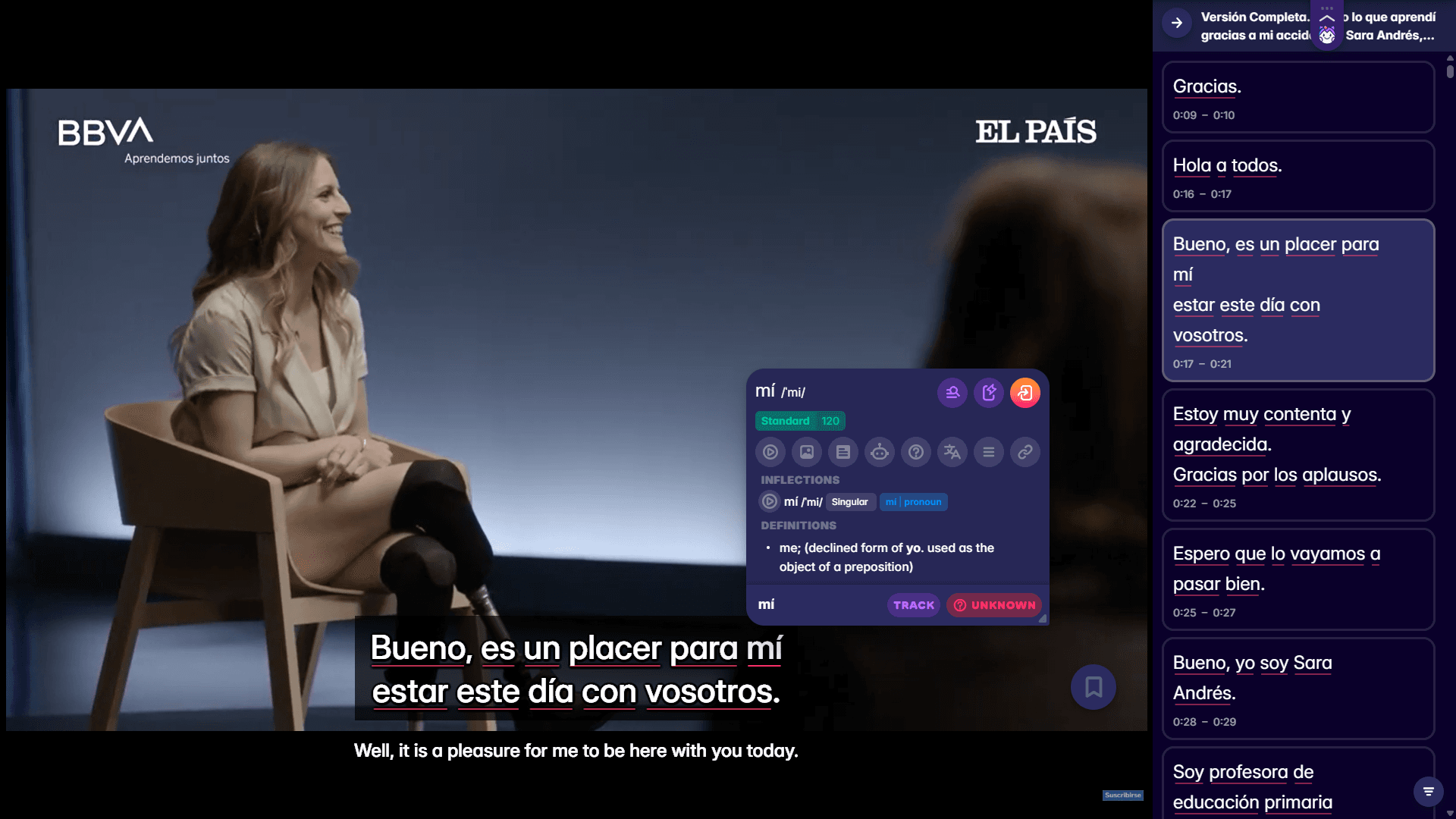
If you want to accelerate your [Spanish learning beyond medical vocabulary](https://migaku.com/blog/spanish/how-long-does-it-take-to-learn-spanish), Migaku's browser extension and app let you look up words instantly while watching Spanish shows or reading articles. Makes picking up natural phrases and pronunciation way more practical. There's a 10-day free trial if you want to check it out.
 ----
## Your path to confident medical communication with patients
Whether you're a doctor, nurse, or other healthcare professional, building your Spanish medical vocabulary opens doors to better patient care and stronger professional relationships. Actively recite the terms and collect any relevant medical terms from media to expand your vocabulary. As your vocabulary grows, so will your ability and confidence.
> If you consume media in Spanish, and you understand at least some of the messages and sentences within that media, you will make progress. *Period*.
Keep learning, no matter where you are in life!
----
## Your path to confident medical communication with patients
Whether you're a doctor, nurse, or other healthcare professional, building your Spanish medical vocabulary opens doors to better patient care and stronger professional relationships. Actively recite the terms and collect any relevant medical terms from media to expand your vocabulary. As your vocabulary grows, so will your ability and confidence.
> If you consume media in Spanish, and you understand at least some of the messages and sentences within that media, you will make progress. *Period*.
Keep learning, no matter where you are in life!