Spanish Passive Voice: How to Form and Use the Passive Voice Correctly
Last updated: April 1, 2026

The passive voice trips up a lot of Spanish learners because it works differently than in English. You've got two main ways to form it, and honestly, one of them gets used way more than the other in everyday conversation. If you're coming from English, where passive constructions pop up constantly, you'll need to adjust your thinking a bit. Spanish speakers prefer active sentences most of the time, but knowing how to recognize and use the passive voice will level up your comprehension when reading formal texts or news articles.
- What is the passive voice in Spanish
- How to form the passive voice with ser
- How to use the passive voice across different tenses
- The passive se construction
- When to use passive se versus the ser passive
- Grammar details that matter
- Common mistakes English speakers make
- Learning the passive sentences effectively
What is the passive voice in Spanish
💡 Definition 💡
The passive voice flips the normal sentence structure so the action's receiver becomes the grammatical subject . Instead of saying "The dog ate the cake," you'd say "The cake was eaten by the dog." The thing getting acted upon takes center stage.
In Spanish, this works similarly but with some key differences. You've got two main constructions:
- the traditional passive with ser plus a past participle,
- and the passive se (also called pasiva refleja).
Both exist, but Spanish speakers lean heavily toward the se construction in spoken language.
Active voice is more commonly used in Spanish language
Here's the thing: Spanish uses passive voice way less frequently than English does. Where English speakers might naturally say "The house was built in 1920," a Spanish speaker would more likely say "They built the house in 1920" using an active construction. This preference shapes how you should approach learning the passive voice. You need to recognize it when reading, but you'll probably use it sparingly in conversation.
How to form the passive voice with ser
💡The traditional passive voice in Spanish follows this pattern: ser (conjugated) + past participle + por + agent. This looks pretty similar to English's "to be" + past participle structure.
Let's break down an example:
- Active: Los estudiantes escribieron el libro. (The students wrote the book.)
- Passive: El libro fue escrito por los estudiantes. (The book was written by the students.)
The verb ser gets conjugated to match whatever tense you need. The past participle (escrito in this case) has to agree in gender and number with the subject. Since "libro" is masculine singular, we use "escrito." If the subject were "las cartas" (the letters), you'd need "escritas" to match feminine plural.
The word por introduces the agent (the person or thing performing the action). In English, we use "by" for this same purpose. Sometimes you'll see the agent omitted entirely if it's unknown or unimportant: "El libro fue escrito en 2020" (The book was written in 2020).
Past participle agreement rules
This trips people up constantly. The past participle in a passive construction acts like an adjective, so it must agree with the subject in both gender and number.
- Masculine singular: El coche fue reparado. (The car was repaired.)
- Feminine singular: La casa fue construida. (The house was built.)
- Masculine plural: Los documentos fueron firmados. (The documents were signed.)
- Feminine plural: Las ventanas fueron abiertas. (The windows were opened.)
You form regular past participles by dropping the infinitive ending and adding -ado for -ar verbs or -ido for -er and -ir verbs. Of course, Spanish has irregular past participles you'll need to memorize: escrito (written), hecho (done/made), dicho (said), visto (seen), puesto (put), abierto (opened), roto (broken), muerto (died), and a few others.
How to use the passive voice across different tenses
You can form the passive voice in any tense by conjugating ser appropriately. The past participle stays the same, just agreeing with the subject.
- Present: La carta es enviada. (The letter is sent.)
- Preterite: La carta fue enviada. (The letter was sent.)
- Imperfect: La carta era enviada. (The letter was being sent.)
- Future: La carta será enviada. (The letter will be sent.)
- Conditional: La carta sería enviada. (The letter would be sent.)
- Present perfect: La carta ha sido enviada. (The letter has been sent.)
The tense of ser determines when the action happened. This works exactly like English, which makes it relatively straightforward once you get the hang of participle agreement.
The passive se construction
Here's where things get interesting. The passive se (or pasiva refleja) is way more common in everyday Spanish than the ser construction. It uses the pronoun se plus a verb in the third person (singular or plural depending on the subject).
💡The basic pattern: se + verb (3rd person) + subject
Examples:
- Se vende la casa.
The house is sold. / The house is for sale. - Se vendieron los coches.
The cars were sold. - Se habla español aquí.
Spanish is spoken here. - Se necesitan empleados.
Employees are needed.
Notice there's no agent mentioned with por. The passive se construction doesn't typically include who's performing the action. That's actually part of its appeal. It keeps things simple and focuses on the action itself rather than who's doing it.
The verb agrees with the subject in number. If the subject is singular (la casa), use the singular form (vende). If it's plural (los coches), use the plural form (vendieron). This agreement is crucial for getting the construction right.
You'll see passive se everywhere in Spanish: on signs, in advertisements, in news articles, and in conversation.
- Se alquila apartamento.
Apartment for rent. - Se prohibe fumar.
Smoking is prohibited. - Se hablan varios idiomas.
Several languages are spoken.
When to use passive se versus the ser passive
The passive se construction dominates in spoken Spanish and informal writing. It sounds more natural and less stuffy than the ser passive. Spanish speakers reach for it automatically when the agent isn't important or is unknown.
The ser passive shows up more in formal writing, academic texts, legal documents, and journalism. It's useful when you specifically want to mention the agent or when you need to emphasize who performed the action.
Compare these:
- Se publicó el artículo ayer.
The article was published yesterday. (Common, natural) - El artículo fue publicado ayer por el periódico.
The article was published yesterday by the newspaper. (Formal, includes agent)
Both work grammatically, but the first one sounds way more natural in everyday Spanish. The second one reads like newspaper language or academic writing.
Here's a practical tip: if you can leave out the agent without losing important information, go with passive se. If you need to specify who did something, use the ser construction with por.
Grammar details that matter
The preposition por introduces the agent in ser passive constructions, but sometimes you'll see de instead. This happens with certain verbs expressing emotions or states: "La casa está rodeada de árboles" (The house is surrounded by trees). This uses estar rather than ser, creating a different nuance (describing a state rather than an action).
Speaking of which, don't confuse ser passive with estar plus participle. "La puerta fue cerrada" (The door was closed - action) differs from "La puerta está cerrada" (The door is closed - state). The first uses ser and describes the action of closing. The second uses estar and describes the resulting state.
In passive se constructions with human objects, Spanish sometimes uses a different structure to avoid confusion. Instead of "se buscan empleados," you might see "se busca a empleados" or rephrase entirely. This gets into advanced grammar territory, but it's worth knowing that passive se works best with non-human subjects.
Common mistakes English speakers make
- English speakers tend to overuse the passive voice when speaking Spanish because it feels natural from their native language. You might instinctively want to say "fue hecho" (was done) when "lo hicieron" (they did it) would sound more natural.
- Another common error involves forgetting past participle agreement. English participles don't change, so it's easy to forget that Spanish participles need to match the subject. Saying "las casas fueron construido" instead of "las casas fueron construidas" marks you as a learner immediately.
- Mixing up when to use passive se versus the ser passive also trips people up. Using "fue vendido el coche" in casual conversation sounds overly formal when "se vendió el coche" would flow better.
- Some learners also struggle with the verb agreement in passive se constructions. Remember: the verb agrees with the grammatical subject (the thing being acted upon), not with any implied agent.
Learning the passive sentences effectively
- Start by recognizing passive constructions when you encounter them in reading. Spanish news sites, Wikipedia articles, and formal blogs use passive voice regularly. Notice when writers choose passive over active and try to understand why.
- Practice converting active sentences to passive and vice versa. Take a simple active sentence like "El profesor explicó la lección" and transform it: "La lección fue explicada por el profesor." Then try the passive se version: "Se explicó la lección."
- Pay attention to past participle agreement. Create flashcards with different subjects and practice matching the correct participle form. This kind of drilling helps the agreement rules become automatic.
- When consuming Spanish media, notice how rarely native speakers use the ser passive in conversation compared to writing. This observation will help you develop a natural feel for when passive voice fits and when it sounds awkward.
If you're serious about learning Spanish through real content, Migaku's browser extension and app let you look up words and save examples while watching shows or reading articles in Spanish. You'll see passive constructions in context and build your understanding naturally. There's a 10-day free trial if you want to check it out.
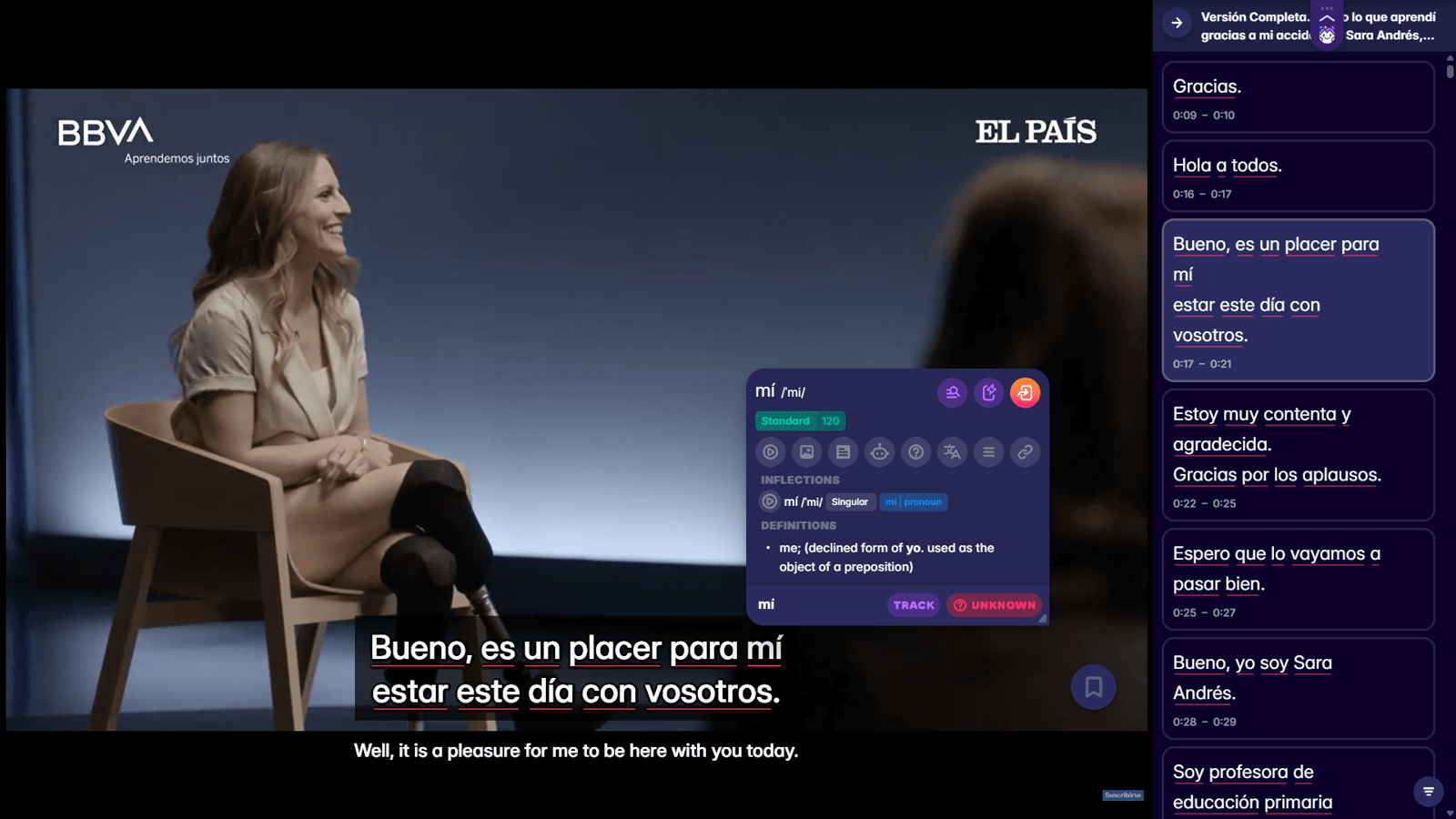
Immersion gives you context to learn Spanish passive voice
Focus on recognizing both forms when reading, and practice the passive se construction since you'll encounter it constantly. The ser passive will come in handy for formal writing and specific contexts where mentioning the agent matters. To master both forms, it basically means that you need to consume both casual media content, like dramas and movies, and formal content, like news articles and academic texts.
If you consume media in Spanish, and you understand at least some of the messages and sentences within that media, you will make progress. Period.
True fluency means knowing how to speak in different situations.