Spanish Phone Conversation Phrases That Native Speakers Use
Last updated: March 27, 2026

Phone conversations in Spanish can feel intimidating, even if you're comfortable reading or writing in the language. You can't see the person's face, there's no time to look up words, and everyone seems to talk faster on the phone. Here's the thing though: Spanish speakers use the same phrases over and over in phone calls, so once you learn the standard patterns in Spanish, you'll handle most conversations without breaking a sweat.
- Why phone conversations in Spanish feel harder
- How to answer the phone in Spanish
- Starting a phone conversation in Spanish
- Asking for someone on the phone
- Leaving a message in Spanish
- Phrases in Spanish for asking someone to repeat or clarify
- Ending the call in Spanish
- Regional differences in Spanish phone etiquette
- Practice makes phone conversations easier
Why phone conversations in Spanish feel harder
Talking on the phone in Spanish strips away all the visual cues you normally rely on. You can't see someone's mouth moving, you can't read their body language, and the audio quality sometimes makes everything sound like mush. Pretty frustrating when you're trying to understand someone asking you a question.
The good news? Phone calls in Spanish follow predictable scripts. People use the same greeting when they answer the phone, the same phrases to ask who's calling, and the same ways to end the conversation. Learn these patterns, and you'll sound natural, even if your overall Spanish isn't perfect yet.
How to answer the phone in Spanish
Different Spanish-speaking countries use completely different greetings when they pick up the phone.
- In Spain, people typically say "¿Diga?" or "¿Dígame?" which literally means "speak" or "tell me."
- In Mexico, you'll hear "¿Bueno?"
- In Argentina, it's "¿Hola?" or "¿Sí?"
- Cuba uses "¿Oigo?"
- Parts of Colombia prefer "¿Aló?"
The phrase you choose depends on where you're learning Spanish or who you're talking to. If you're studying Mexican Spanish, stick with "¿Bueno?" If you're learning Castilian Spanish, go with "¿Diga?" For a safe option that works everywhere, "¿Hola?" does the job just fine.
When you answer the phone in a business context, you'd typically add more information:
- Buenos días, habla María
Good morning, María speaking. - Oficina de ventas, ¿en qué puedo ayudarle?
Sales office, how can I help you?
The verb "hablar" shows up constantly in Spanish phone conversations. It means "to speak," and you'll use it to identify yourself or ask for someone specific.
Starting a phone conversation in Spanish
When you're the one making the call, you need to introduce yourself and state your purpose quickly. Here's how native speakers do it:
- Hola, soy Carlos. ¿Está Ana?
Hi, I'm Carlos. Is Ana there? - Buenos días, habla Lucía de la empresa XYZ. Llamo para...
Good morning, this is Lucía from XYZ company. I'm calling to... - Buenas tardes, quisiera hablar con el señor Rodríguez, por favor.
Good afternoon, I'd like to speak with Mr. Rodríguez, please.
The greeting you use depends on the time of day.
- "Buenos días" works until around 2 PM
- "Buenas tardes" from 2 PM until evening
- "Buenas noches" once it gets dark
After your initial greeting, state why you're calling. Keep it simple:
- Llamo para confirmar mi cita.
I'm calling to confirm my appointment. - Te llamo porque necesito preguntarte algo.
I'm calling because I need to ask you something. - Llamaba para ver si...
I was calling to see if...
Asking for someone on the phone
When you need to speak to a specific person, these phrases work in pretty much every situation:
- ¿Está (name)?
Is (name) there? - ¿Puedo hablar con (name)?
Can I speak with (name)? - Quisiera hablar con (name), por favor.
I'd like to speak with (name), please. - ¿Se encuentra (name)?
Is (name) available?
If the person isn't available, you might hear:
- No se encuentra en este momento.
He/she isn't available right now. - Ha salido.
He/she has gone out. - Está en una reunión.
He/she is in a meeting. - No está disponible.
He/she isn't available.
Leaving a message in Spanish
When someone offers to take a message, they'll usually say "¿Quiere dejar un mensaje?" or "¿Desea dejar algún recado?" Here's how to respond:
- Sí, por favor. ¿Puede decirle que llamó (your name)?
Yes, please. Can you tell him/her that (your name) called? - Dígale que me llame cuando pueda, por favor.
Tell him/her to call me when possible, please. - El mensaje es que...
The message is that... - ¿Puede pedirle que me devuelva la llamada?
Can you ask him/her to return my call?
If you don't want to leave a message, just say "No, gracias. Volveré a llamar más tarde" (No, thank you. I'll call back later) or "Llamo luego, gracias" (I'll call later, thanks).
The word "gracias" appears constantly in phone conversations. Spanish speakers use it more frequently than English speakers use "thanks," so sprinkle it throughout your calls to sound polite and natural.
Phrases in Spanish for asking someone to repeat or clarify
Phone connections can be terrible, people talk fast, and sometimes you just don't catch what someone said. Don't panic. Use these phrases to ask for repetition or clarification:
- ¿Perdón? / ¿Cómo?
Pardon? / What? - ¿Puede repetir, por favor?
Can you repeat, please? - No le escucho bien.
I can't hear you well. - ¿Puede hablar más despacio?
Can you speak more slowly? - No entendí.
I didn't understand. - ¿Puede deletrear eso?
Can you spell that?
If the connection is really bad, you might need to say "Se corta la llamada" (The call is cutting out) or "Hay mucha interferencia" (There's a lot of interference).
When you need someone to hold while you grab something or check information, say "Un momento, por favor" (One moment, please) or just "Un momentito."
Ending the call in Spanish
Spanish phone conversation etiquette requires a proper goodbye. Just hanging up after getting your information would seem rude. Here's how to wrap things up:
- Bueno, te dejo.
Well, I'll let you go. - Nada más era eso.
That was all. - Gracias por tu ayuda.
Thanks for your help. - Hablamos pronto.
We'll talk soon. - Cualquier cosa me avisas.
Let me know if anything comes up.
Then add your goodbye phrase:
- Adiós.
Goodbye. - Hasta luego.
See you later. - Chao. / Chau.
Bye. (common in Latin America.) - Nos vemos.
See you. - Cuídate.
Take care.
In more formal contexts, you might say "Que tenga un buen día" (Have a good day) or "Gracias por llamar" (Thanks for calling).
Regional differences in Spanish phone etiquette
The way people talk on the phone varies across Spanish-speaking countries. In Spain, conversations tend to be more direct, and people get to the point faster. In Latin America, especially Mexico and Colombia, phone conversations include more pleasantries and small talk before business.
The Spanish greeting "¿Diga?" sounds totally normal in Madrid but weird in Mexico City. Meanwhile, "¿Bueno?" works perfectly in Mexico but would confuse someone in Barcelona. If you're learning Spanish to use in a specific country, learn that region's phone habits.
Some countries use "vos" instead of "tú" (Argentina, Uruguay, parts of Central America), which changes how you conjugate verbs during phone calls. "¿Cómo estás?" becomes "¿Cómo estás vos?" with different verb endings.
Practice makes phone conversations easier
Reading phrases helps, but actually using them makes the difference.
- If you have Spanish-speaking friends, ask them to do phone call practice with you. Even five-minute role-play conversations build your confidence fast.
- Listen to how native speakers handle phone calls in Spanish shows and movies. Pay attention to the rhythm and tone, not just the words. Phone conversations have a specific flow that you pick up through exposure.
- When you do need to make a real call in Spanish, write down the key phrases you'll need beforehand. Having "¿Puede repetir, por favor?" written in front of you takes away the panic if you don't understand something.
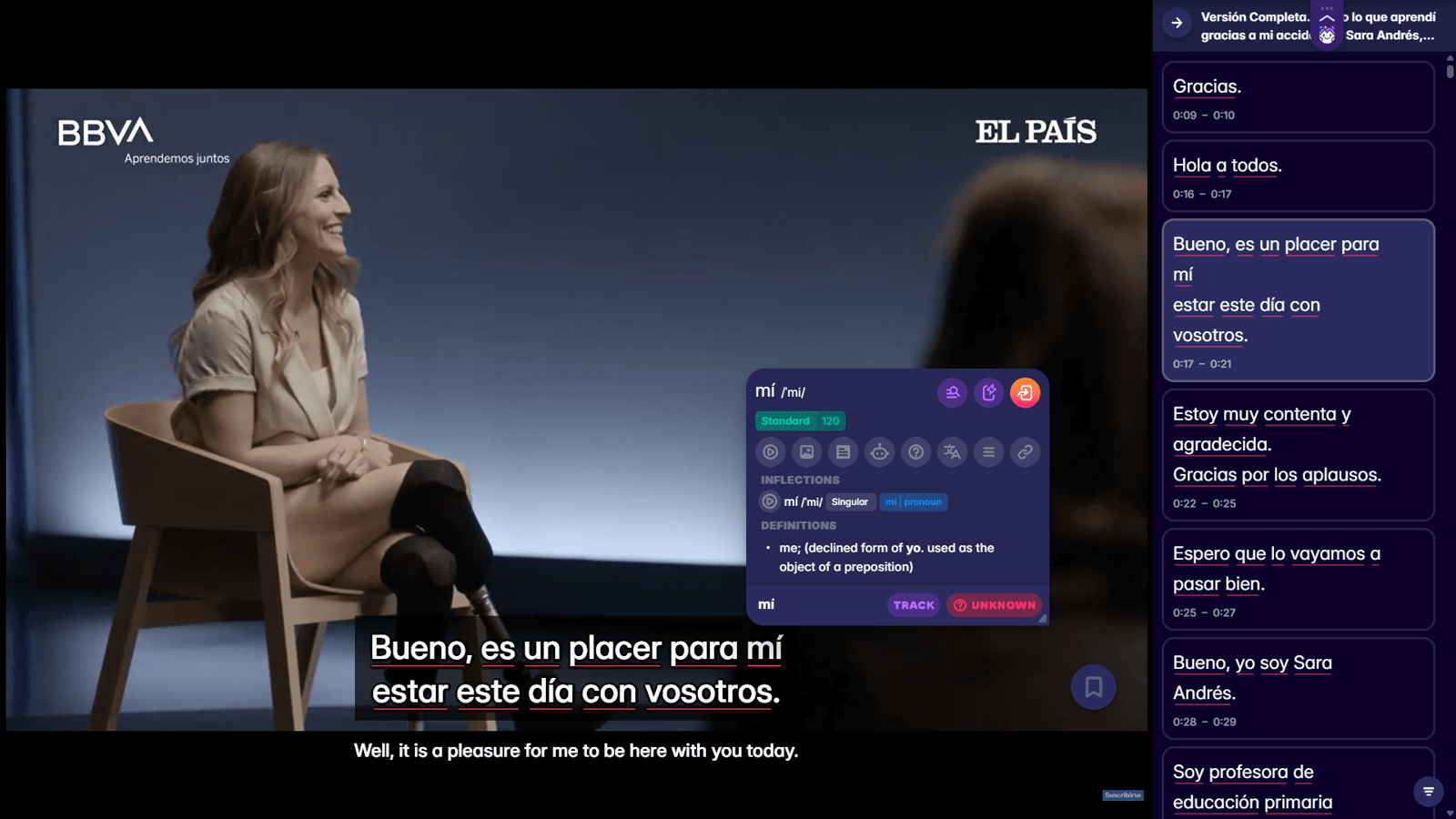
Anyway, if you want to hear these phrases in actual context, Migaku's browser extension and app let you look up words and phrases instantly while watching Spanish shows or listening to podcasts. Makes learning from real conversations way more practical. There's a 10-day free trial if you want to check it out.
It takes time to start a phone conversation confidently
Your first few Spanish phone conversations might feel awkward, but by the tenth one, you'll be using these phrases without thinking about it. But before that, try to remember the useful phrases listed in this article and review them using your flashcards. Go through vlogs and other Spanish media about making phone calls. Every time you see something about phone calling that you are not familiar with yet, pause and add that to your notes.
If you consume media in Spanish, and you understand at least some of the messages and sentences within that media, you will make progress. Period.
The more calls you make, the more automatic these phrases become.