# Spanish Relative Pronouns: Que, Quien, Cual, Donde Guide
> Spanish relative pronouns que, quien, cual, and donde work differently from the English ones. Master the rules to connect clauses like a native speaker.
**URL:** https://migaku.com/blog/spanish/spanish-relative-pronouns-que-quien-cual-donde
**Last Updated:** 2026-03-30
**Tags:** fundamentals, grammar
---
Spanish relative pronouns can feel tricky at first, but once you [learn the Spanish](https://migaku.com/learn-spanish) que, quien, cual, and donde, you'll notice them everywhere in native content. These little words connect ideas and add detail to sentences, making your Spanish sound way more natural. The good news? You're already familiar with this concept from English (words like "who," "that," "which"). The challenge is learning when to use each Spanish relative pronoun and understanding how they differ from their English counterparts. Let's break down exactly how these pronouns work so you can start using them confidently.
----
## What are Spanish relative pronouns
> 💡 Definition 💡
A relative pronoun **connects two parts of a sentence by referring back to a noun that was just mentioned**. That noun is called the **antecedent**. In English, we use words like "who," "that," "which," and "where" to do this job. Spanish has its own set of relative pronouns that work similarly but follow different rules.
Here's a quick example in English: "The book that I bought is great." The word "that" connects "the book" to the rest of the sentence and refers back to "the book" (the antecedent).
Spanish relative pronouns do the same thing. They help you avoid repetition and make your sentences flow better. Instead of saying two choppy sentences like "I have a friend. The friend lives in Madrid," you can connect them: "I have a friend who lives in Madrid."
The main relative pronouns in Spanish are que, quien/quienes, el cual/la cual/los cuales/las cuales, donde, and cuyo/cuya. Each one has specific situations where it works best.
----
## Que as the most versatile relative pronoun
> 💡**Que ** is hands down the most common relative pronoun in Spanish. You'll see it everywhere because it can refer to **people, things, or ideas.** It translates to "that," "which," "who," or "whom" in English, depending on the context.
The beauty of que is its simplicity. It doesn't change based on gender or number like some other pronouns. Whether you're talking about one masculine noun or multiple feminine nouns, que stays the same.
Check out these examples:
- El libro que compré es interesante.
*The book that I bought is interesting.*
- La mujer que vive aquí es profesora.
*The woman who lives here is a teacher.*
- Los estudiantes que estudian mucho aprenden rápido.
*The students who study a lot learn quickly.*
In all these sentences, que connects the relative clause to the antecedent. It works as both the subject and object of the relative clause, making it super flexible.
One thing to remember: in English, we can sometimes drop the relative pronoun. You might say "The book I bought" without "that." In Spanish, you can't do this. You always need que in the sentence.
**When que follows a preposition**, things get a bit more specific.
- For short prepositions like a, de, con, or en, you can use que when referring to things but not people.
- For people after a preposition, you need quien or quienes instead.
"La casa en que vivo es pequeña." (The house in which I live is small.) This works fine because "casa" is a thing. But if you're talking about people, you'd switch to quien.
----
## Quien and quienes for referring to people
> 💡**Quien ** (singular) and **quienes ** (plural) are relative pronouns used specifically for **people**. While que can also refer to people, quien becomes necessary in certain situations, especially after prepositions.
The main rule: use quien or quienes when you have a preposition before the relative pronoun and the antecedent is a person.
- El hombre con quien hablé es mi vecino.
*The man with whom I spoke is my neighbor.*
- Las personas para quienes trabajo son amables.
*The people for whom I work are kind.*
You can also use quien in non-restrictive clauses, which are clauses that add extra information but aren't essential to the sentence's meaning. These clauses usually appear between commas.
- Mi hermana, quien vive en Barcelona, viene mañana.
*My sister, who lives in Barcelona, is coming tomorrow.*
In this sentence, "quien vive en Barcelona" adds bonus information about your sister, but the main point is that she's coming tomorrow.
Here's something interesting: quien can sometimes appear at the beginning of a sentence without a clear antecedent when making general statements.
- Quien estudia, aprende.
*He who studies, learns. / Whoever studies, learns.*
This construction is more formal and you'll see it in proverbs or written Spanish more than in everyday conversation.
----
## El que, la que, los que, and las que indicating the gender and number
> 💡These compound relative pronouns combine the definite article (el, la, los, las) with que. They're more specific than plain que because they indicate the **gender** and **number** of the antecedent.
You'll use el que and its variations in a few specific situations. First, they're helpful when you need to clarify which noun you're referring to, especially when there might be confusion.
- Hablé con el hermano de María, el que vive en Chile.
*I spoke with Maria's brother, the one who lives in Chile.*
Using el que here makes it crystal clear you're talking about the brother, not Maria.
These forms also come in handy after prepositions, giving you an alternative to quien for people or replacing que for things.
- La tienda en la que compro es barata.
*The store in which I shop is cheap.*
- El amigo con el que salí es divertido.
*The friend with whom I went out is fun.*
El que can also stand alone without an antecedent when it means "the one who" or "the one that."
- El que llegue primero gana.
*The one who arrives first wins.*
----
## Lo que for abstract ideas and concepts
> 💡**Lo que ** is a special relative pronoun that refers to **abstract ideas, situations, or entire clauses** rather than specific nouns. It translates to "what" or "that which" in English.
This pronoun is super useful when you want to talk about concepts rather than concrete objects or people.
- Lo que dijiste es verdad.
*What you said is true.*
- No entiendo lo que pasa.
*I don't understand what's happening.*
In these examples, lo que doesn't refer to a specific noun. Instead, it refers to the entire idea of "what you said" or "what's happening."
----
## Cual and its forms for formal contexts
> 💡**Cual **, along with its plural form **cuales **, works as a relative pronoun mainly in formal or written Spanish. It's less common in everyday conversation, but you'll definitely encounter it in literature, news articles, and formal writing.
The forms are el cual, la cual, los cuales, and las cuales. They agree in gender and number with their antecedent, making them very specific.
These pronouns typically appear after prepositions, especially longer prepositions or prepositional phrases.
- La razón por la cual vine es importante.
*The reason for which I came is important.*
- El edificio detrás del cual está el parque es nuevo.
*The building behind which the park is located is new.*
Using cual in these contexts sounds more formal and precise than using que. In casual conversation, most Spanish speakers would just use que, but cual adds a level of formality that's appropriate for professional or academic settings.
You might also see cual in non-restrictive clauses as an alternative to que.
- Mi coche, el cual compré el año pasado, ya tiene problemas.
*My car, which I bought last year, already has problems.*
----
## Donde for places and locations in Spanish grammar
> 💡**Donde ** functions as a relative pronoun specifically for **places**. It means "where" and connects a clause to a location mentioned earlier in the sentence.
- La ciudad donde nací es pequeña.
*The city where I was born is small.*
- El restaurante donde comimos estaba lleno.
*The restaurant where we ate was full.*
Donde is straightforward because it only refers to places. You don't need to worry about gender or number agreement.
You can also use donde after prepositions to be more specific about location relationships.
- La casa de donde vengo está lejos.
*The house from where I come is far away.*
- El lugar hacia donde vamos es bonito.
*The place toward where we're going is pretty.*
In modern Spanish, especially in conversation, people often use que instead of donde after a place noun, though donde is technically more correct.
- La tienda donde compro está cerca.
*The store where I shop is nearby.*
Both versions work, but donde is clearer and more precise.
----
## Cuyo for showing possession
> 💡**Cuyo ** (and its forms cuya , cuyos , cuyas ) is the relative pronoun that shows possession. It means "whose" in English and agrees in gender and number with the thing possessed, not the possessor.
This is a bit different from English and trips up a lot of learners at first.
- El autor cuyo libro leí es famoso.
*The author whose book I read is famous.*
Here, cuyo agrees with "libro" (masculine singular), even though it refers back to "autor."
- La mujer cuyas hijas estudian aquí es profesora.
*The woman whose daughters study here is a teacher.*
Cuyas is feminine plural because it agrees with "hijas," not with "mujer."
Cuyo is pretty formal and more common in writing than speech. In everyday conversation, Spanish speakers often avoid it by restructuring sentences.
Instead of "El hombre cuyo coche es rojo," you might hear "El hombre que tiene el coche rojo" (The man who has the red car).
----
## Getting comfortable with relative pronouns takes practice
The best way to really internalize Spanish relative pronouns is seeing them in context over and over.
1. When you're [watching Spanish shows](https://migaku.com/blog/spanish/best-spanish-shows-guide) or reading articles, pay attention to how native speakers connect their ideas. You'll start noticing patterns, like how often que appears compared to other options, or when someone chooses quien instead.
2. Try creating your own sentences using relative pronouns to describe things around you. "El café que bebo es fuerte." "La persona con quien trabajo es amable." Making these constructions yourself helps them become automatic.
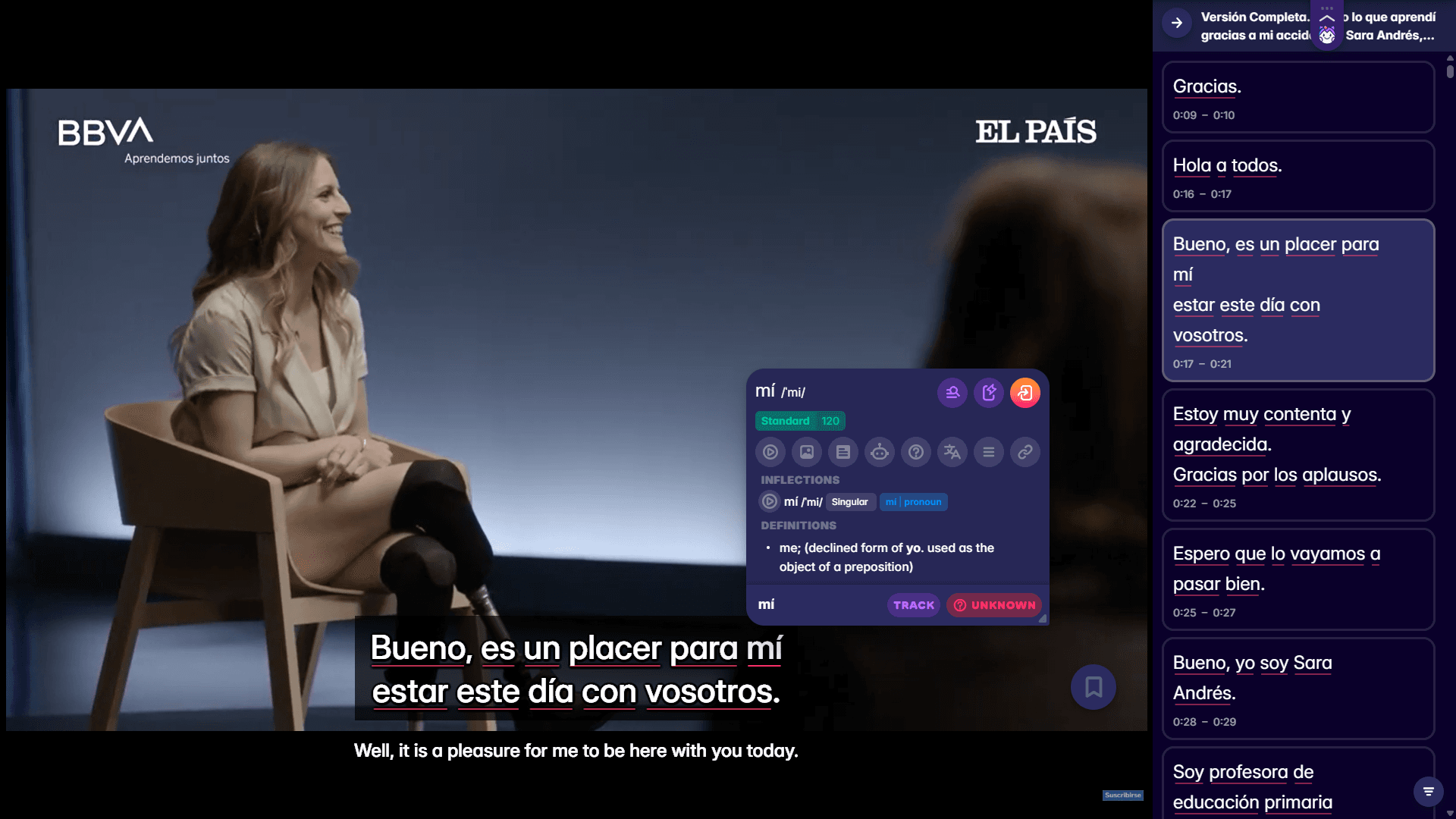
If you're serious about [learning Spanish through real content](https://migaku.com/blog/spanish/get-started-in-spanish), Migaku's browser extension and app let you look up words and save sentences while watching shows or reading articles. Makes the whole immersion process way smoother. There's a 10-day free trial if you want to check it out.
 ----
## Learning languages takes time
Don't stress about memorizing every rule perfectly before you start using them. Pick up content you enjoy, notice how the pronouns work in real sentences, and gradually you'll develop an intuition for which one fits each situation.
> If you consume media in Spanish, and you understand at least some of the messages and sentences within that media, you will make progress. Period.
Every language comes with its own challenges.
----
## Learning languages takes time
Don't stress about memorizing every rule perfectly before you start using them. Pick up content you enjoy, notice how the pronouns work in real sentences, and gradually you'll develop an intuition for which one fits each situation.
> If you consume media in Spanish, and you understand at least some of the messages and sentences within that media, you will make progress. Period.
Every language comes with its own challenges.