How to Conjugate the Spanish Subjunctive Mood (Complete Guide)
Last updated: April 27, 2026

Learning Spanish subjunctive freaks out a lot of Spanish learners. I get it. You're cruising along with your present and past tense verbs, feeling pretty good about your progress, and then someone tells you there's this whole other verb mood that follows completely different rules. Fun times, right? I'm going to show you exactly how to conjugate the present subjunctive in Spanish, give you the conjugation charts you need, and explain which verbs follow the regular patterns and which ones do their own weird thing. By the end, you'll have a solid foundation for using subjunctive forms in real Spanish conversations.
What is the subjunctive anyway
Before we dive into conjugation tables, let's talk about what the subjunctive actually does. In Spanish, the subjunctive is a verb mood (not a tense) that you use to express things that aren't concrete facts. Subjunctive is used to express desires, doubts, emotions, possibilities, and hypothetical situations.
The indicative mood, which is what you've been using for most of your Spanish learning, deals with facts and certainty. "Ella habla español" (She speaks Spanish) uses the indicative because it's stating a fact. But "Espero que ella hable español" (I hope that she speaks Spanish) uses the subjunctive "hable" because we're expressing a hope, not a confirmed reality.
The subjunctive shows up in four main forms: present tense, imperfect tense, present perfect subjunctive, and pluperfect subjunctive. This guide focuses on the present subjunctive since that's what you'll use about 80% of the time.
How to conjugate verbs for Spanish present subjunctive mood
Here's your step-by-step process for conjugating regular verbs in the present subjunctive. This works for the vast majority of Spanish verbs:
- Step 1: Take the present indicative "yo" form of the verb
- Step 2: Drop the final "o"
- Step 3: Add the subjunctive endings
The trick here is that the endings basically flip. Verbs ending in -ar take endings that look like -er/-ir verbs, and -er/-ir verbs take endings that look like -ar verbs.
Conjugation endings for -ar verbs
💡Let's start with "hablar" (to speak). The "yo" form in present indicative is "hablo." Drop the "o" and you get "habl-" as your stem.
Now add these endings:
- yo hable
- tú hables
- él/ella/usted hable
- nosotros/nosotras hablemos
- vosotros/vosotras habléis
- ellos/ellas/ustedes hablen
Notice that "yo" and "él/ella/usted" forms are identical. You'll need context to tell them apart in actual sentences.
Conjugation endings for -er and -ir verbs
💡For -er verbs like "comer" (to eat), take the "yo" form "como," drop the "o," and add these endings to "com-":
- yo coma
- tú comas
- él/ella/usted coma
- nosotros/nosotras comamos
- vosotros/vosotras comáis
- ellos/ellas/ustedes coman
💡For -ir verbs like "vivir" (to live), take "vivo," drop the "o," and add the same endings to "viv-":
- yo viva
- tú vivas
- él/ella/usted viva
- nosotros/nosotras vivamos
- vosotros/vosotras viváis
- ellos/ellas/ustedes vivan
The -er and -ir verbs use identical endings in the subjunctive. That's one less thing to memorize, at least.
Why starting from the “yo” form matters
You might be wondering why we start with the "yo" form of the present indicative. Can't we just use the infinitive?
Nope. Starting from the "yo" form is crucial because it captures any irregularities or stem changes that carry over into the subjunctive. This rule saves you from having to memorize separate irregular subjunctive forms for tons of verbs.
Take "tener" (to have). The "yo" form is "tengo," which is irregular. When you form the subjunctive, you keep that "g": tenga, tengas, tenga, tengamos, tengáis, tengan. If you tried to form it from the infinitive "tener," you'd get the wrong forms.
Same deal with "conocer" (to know). The "yo" form is "conozco" with that "zc" insertion. The subjunctive becomes: conozca, conozcas, conozca, conozcamos, conozcáis, conozcan.
This pattern works for the majority of Spanish verbs, which is honestly pretty convenient.
Stem changes when conjugating verbs in the present subjunctive
Stem-changing verbs (also called boot verbs because of how the changes look in conjugation charts) need some extra attention. Most stem changes from the present indicative carry through to the present subjunctive, but with a twist for -ir verbs.
-ar and -er stem-changing verbs
For -ar and -er stem-changing verbs, the stem change happens in all forms except "nosotros" and "vosotros," just like in the indicative.
"Pensar" (to think) changes e to ie. The subjunctive forms are:
- yo piense
- tú pienses
- él/ella/usted piense
- nosotros/nosotras pensemos (no stem change)
- vosotros/vosotras penséis (no stem change)
- ellos/ellas/ustedes piensen
"Volver" (to return) changes o to ue:
- yo vuelva
- tú vuelvas
- él/ella/usted vuelva
- nosotros/nosotras volvamos (no stem change)
- vosotros/vosotras volváis (no stem change)
- ellos/ellas/ustedes vuelvan
-ir stem-changing verbs
Here's where things get interesting. With -ir stem-changing verbs, you get the normal stem change in most forms, but the "nosotros" and "vosotros" forms have their own special stem change.
"Sentir" (to feel) changes e to ie in most forms, but e to i in the nosotros and vosotros forms:
- yo sienta
- tú sientas
- él/ella/usted sienta
- nosotros/nosotras sintamos (i, not ie)
- vosotros/vosotras sintáis (i, not ie)
- ellos/ellas/ustedes sientan
"Dormir" (to sleep) changes o to ue in most forms, but o to u in nosotros and vosotros:
- yo duerma
- tú duermas
- él/ella/usted duerma
- nosotros/nosotras durmamos (u, not ue)
- vosotros/vosotras durmáis (u, not ue)
- ellos/ellas/ustedes duerman
"Pedir" (to ask for) changes e to i in all forms:
- yo pida
- tú pidas
- él/ella/usted pida
- nosotros/nosotras pidamos
- vosotros/vosotras pidáis
- ellos/ellas/ustedes pidan
Irregular verbs in the present subjunctive in Spanish
Some verbs just refuse to play by the rules. There are six truly irregular verbs in the present subjunctive that you need to memorize separately because they don't follow the "yo form minus o" pattern.
Ser (to be)
The subjunctive forms of "ser" are:
- yo sea
- tú seas
- él/ella/usted sea
- nosotros/nosotras seamos
- vosotros/vosotras seáis
- ellos/ellas/ustedes sean
Estar (to be)
"Estar" looks like this:
- yo esté
- tú estés
- él/ella/usted esté
- nosotros/nosotras estemos
- vosotros/vosotras estéis
- ellos/ellas/ustedes estén
Notice the accent marks on all forms. Those are important for pronunciation.
Ir (to go)
"Ir" has these forms:
- yo vaya
- tú vayas
- él/ella/usted vaya
- nosotros/nosotras vayamos
- vosotros/vosotras vayáis
- ellos/ellas/ustedes vayan
Saber (to know)
"Saber" verb to:
- yo sepa
- tú sepas
- él/ella/usted sepa
- nosotros/nosotras sepamos
- vosotros/vosotras sepáis
- ellos/ellas/ustedes sepan
Haber (to have, auxiliary verb)
The subjunctive conjugation of "haber" is:
- yo haya
- tú hayas
- él/ella/usted haya
- nosotros/nosotros hayamos
- vosotros/vosotras hayáis
- ellos/ellas/ustedes hayan
You'll use "haya" constantly for forming perfect tenses in the subjunctive, like "Espero que hayas comido" (I hope you have eaten).
Dar (to give)
"Dar" is weird because it's an -ar verb but takes -er/-ir endings in the subjunctive:
- yo dé (with accent to distinguish from "de")
- tú des
- él/ella/usted dé
- nosotros/nosotras demos
- vosotros/vosotras deis
- ellos/ellas/ustedes den
When to use subjunctive mood
Knowing how to conjugate these forms is one thing. Knowing when to use them is another. The subjunctive appears in specific grammatical situations, usually in dependent clauses after certain triggers.
Desire and influence
When you want someone to do something or hope for an outcome, you use the subjunctive after verbs like "querer" (to want), "desear" (to wish), "esperar" (to hope), "preferir" (to prefer), and "necesitar" (to need).
Example:
- Quiero que hables más despacio.
I want you to speak more slowly. (The main clause "quiero" triggers the subjunctive "hables" in the dependent clause)
Doubt and denial
Expressions of doubt, uncertainty, or denial trigger the subjunctive. This includes "dudar" (to doubt), "no creer" (to not believe), "no pensar" (to not think), and "negar" (to deny).
Example:
- Dudo que él venga mañana.
I doubt that he's coming tomorrow. (The doubt expressed by "dudo" requires the subjunctive "venga")
Emotion
When you express emotion about something, the subjunctive follows. This includes "alegrarse de que" (to be happy that), "temer que" (to fear that), "estar triste de que" (to be sad that), and "sorprender que" (to surprise that).
Example:
- Me alegro de que estés aquí.
I'm happy that you're here. (The emotion "me alegro" triggers the subjunctive "estés")
Impersonal expressions
Phrases like "es importante que" (it's important that), "es necesario que" (it's necessary that), "es posible que" (it's possible that), and "es mejor que" (it's better that) require the subjunctive.
Example:
- Es importante que estudies para el examen.
It's important that you study for the exam.
Common mistakes to avoid
- One mistake I see all the time is learners trying to form the subjunctive directly from the infinitive instead of the "yo" form. This leads to incorrect forms for verbs with irregular "yo" forms. Always start with that present indicative "yo" form.
- Another issue is forgetting that -ir stem-changing verbs have that extra stem change in the nosotros and vosotros forms. "Sintamos" and "durmamos" trip people up constantly.
- Also, don't forget that there are regular and irregular verbs. "Ser," "estar," "ir," "saber," "haber," and "dar" just have to be memorized. There's no shortcut.
- Finally, remember that the subjunctive is a mood, not a tense. You can have present subjunctive, past subjunctive, and perfect forms. This lesson covered the present subjunctive, which is the most common form, but the other forms exist too.
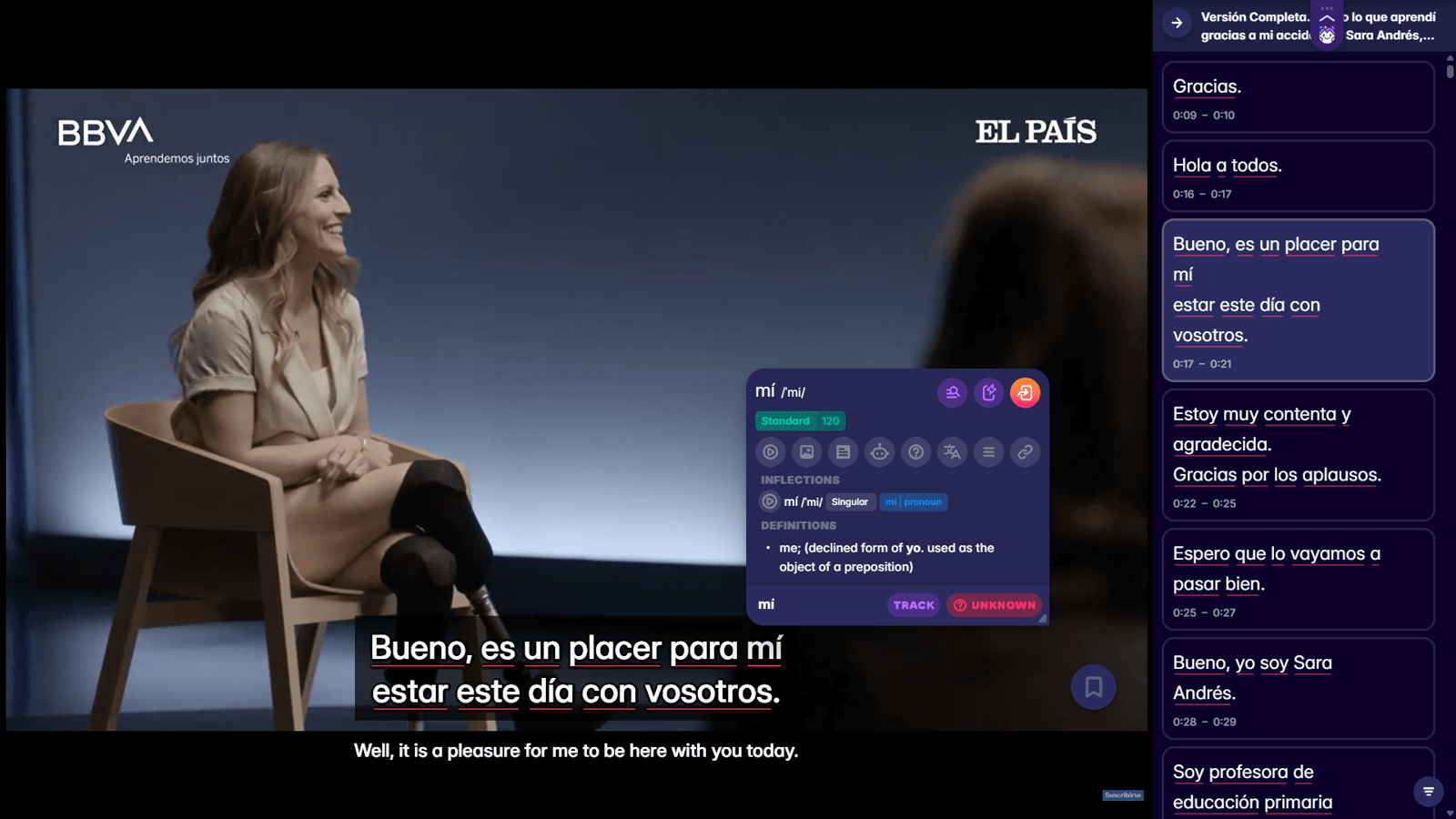
Anyway, if you want to learn Spanish through real content while getting instant help with verb forms and conjugations, Migaku's browser extension and app let you look up any word in English and Spanish while watching Spanish shows or reading articles. You can see subjunctive verbs in context and save them for review later. There's a 10-day free trial if you want to check it out.
Spanish subjunctive takes time to feel natural
When you're learning Spanish through immersion, you'll start noticing these verb conjugations everywhere. Pay attention to them in context and everyday conversations. See how native speakers use "quiero que," "espero que," and "es importante que" in real conversations. The grammar rules give you the foundation, but actual exposure to Spanish content is what makes these patterns stick. You need to see hundreds of example sentences before your brain stops having to consciously think about whether to use subjunctive or indicative.
If you consume media in Spanish, and you understand at least some of the messages and sentences within that media, you will make progress. Period.
Nothing beats consistent action!💪