All Spanish Verb Tenses Explained Simply (Complete Guide)
Last updated: April 28, 2026

Spanish has around 14 to 18 verb tenses, depending on how you count them (some people split hairs over what counts as a separate tense versus a mood). The good news? You'll use maybe 6 of them in everyday conversation, and those are more important in Spanish learning. The rest show up in writing, formal situations, or specific contexts. Let me break down every Spanish tense in a way that actually makes sense. I'll organize them by mood because that's how Spanish grammar works, and honestly, understanding moods makes everything click into place way faster.
Understanding moods in Spanish
Before we dive into individual tenses, you need to know about moods. A mood (modo in Spanish) is basically the speaker's attitude toward what they're saying. Spanish has three main moods:
- Indicative mood is for facts, certainty, and things that definitely happen or happened. When you say "I eat tacos" or "She went to Madrid," that's indicative. Most of your Spanish conversations will use the indicative mood.
- Subjunctive mood expresses doubt, wishes, emotions, possibilities, and hypothetical situations. This is the one that freaks people out, but it follows clear rules. You'll use the subjunctive mood when you're talking about things that might happen, things you hope for, or things that depend on conditions.
- Imperative mood is for commands and direct instructions. "Close the door!" or "Don't run!" That's imperative.
Indicative mood tenses
The indicative mood contains most of the tenses you'll use. Let's go through them.
Present tense (Presente)
The present tense in Spanish works similarly to English. You use it for things happening now, habits, and general truths.
For regular verbs, you conjugate based on the ending: -ar, -er, or -ir.
- Hablar (to speak): hablo, hablas, habla, hablamos, habláis, hablan
- Comer (to eat): como, comes, come, comemos, coméis, comen
- Vivir (to live): vivo, vives, vive, vivimos, vivís, viven
The present tense gets used constantly. "Hablo español" means "I speak Spanish." Simple enough.
Preterite tense (Pretérito)
The preterite is one of two main past tenses in Spanish. You use it for completed actions in the past, things that happened at a specific time and are done.
- Hablar: hablé, hablaste, habló, hablamos, hablasteis, hablaron
- Comer: comí, comiste, comió, comimos, comisteis, comieron
- Vivir: viví, viviste, vivió, vivimos, vivisteis, vivieron
"Ayer hablé con María" means "Yesterday I spoke with María." The action is finished, it happened at a specific time (yesterday), so you use preterite.
Imperfect tense (Imperfecto)
Here's where Spanish gets interesting. The imperfect is the other past tense, but it describes ongoing actions in the past, habits you used to have, or background information.
- Hablar: hablaba, hablabas, hablaba, hablábamos, hablabais, hablaban
- Comer: comía, comías, comía, comíamos, comíais, comían
- Vivir: vivía, vivías, vivía, vivíamos, vivíais, vivían
"Cuando era niño, hablaba mucho" means "When I was a child, I used to talk a lot." The action was ongoing and habitual, so imperfect wins.
The preterite versus imperfect distinction trips up English speakers because we don't make this grammatical difference as clearly. But once you get it, your Spanish sounds way more natural.
Future tense (Futuro simple)
The future tense describes what will happen. Spanish actually has two ways to talk about the future, but this is the "official" one.
- Hablar: hablaré, hablarás, hablará, hablaremos, hablaréis, hablarán
- Comer: comeré, comerás, comerá, comeremos, comeréis, comerán
- Vivir: viviré, vivirás, vivirá, viviremos, viviréis, vivirán
"Mañana hablaré con el jefe" means "Tomorrow I will speak with the boss."
Honestly though? Most Spanish speakers use "ir + a + infinitive" for the future in conversation. "Voy a hablar con el jefe" sounds more natural. The simple future tense shows up more in writing or formal speech.
Conditional tense (Condicional simple)
The conditional expresses what would happen under certain conditions. Think of it as the "would" tense.
- Hablar: hablaría, hablarías, hablaría, hablaríamos, hablaríais, hablarían
- Comer: comería, comerías, comería, comeríamos, comeríais, comerían
- Vivir: viviría, vivirías, viviría, viviríamos, viviríais, vivirían
"Hablaría español mejor si practicara más" means "I would speak Spanish better if I practiced more."
The conditional tense pairs beautifully with the imperfect subjunctive for hypothetical situations. You'll see this combo all the time.
Compound tenses in the indicative
Compound tenses use a helping verb (haber) plus a past participle. These let you express more complex time relationships.
Present perfect (Pretérito perfecto compuesto)
This tense connects past actions to the present. You form it with the present tense of haber plus the past participle.
- Haber (present): he, has, ha, hemos, habéis, han
- Past participle: hablado (spoken), comido (eaten), vivido (lived)
"He hablado con María hoy" means "I have spoken with María today." The action happened recently and feels relevant to now.
Past perfect (Pluscuamperfecto)
The past perfect describes what had happened before another past action. You use the imperfect of haber plus the past participle.
"Había comido antes de llegar" means "I had eaten before arriving."
Future perfect
The future perfect expresses what will have happened by a certain future point. You use the future tense of haber plus the past participle.
"Para mañana, habré terminado el proyecto" means "By tomorrow, I will have finished the project."
Conditional perfect (Condicional compuesto)
This describes what would have happened. You use the conditional of haber plus the past participle.
"Habría hablado contigo, pero estabas ocupado" means "I would have spoken with you, but you were busy."
Spanish subjunctive mood tenses
Alright, here's the subjunctive. People panic about the subjunctive mood, but it follows patterns. You trigger the subjunctive in specific situations: after expressions of doubt, emotion, desire, possibility, or in dependent clauses after certain conjunctions.
Present subjunctive (Presente de subjuntivo)
The present subjunctive shares the present time frame but expresses uncertainty or subjectivity.
- Hablar: hable, hables, hable, hablemos, habléis, hablen
- Comer: coma, comas, coma, comamos, comáis, coman
- Vivir: viva, vivas, viva, vivamos, viváis, vivan
"Espero que hables español" means "I hope that you speak Spanish." The speaking hasn't happened yet or might not happen, so subjunctive.
You'll use the present subjunctive after phrases like "es posible que" (it's possible that), "quiero que" (I want that), or "dudo que" (I doubt that).
Imperfect subjunctive (Imperfecto de subjuntivo)
The imperfect subjunctive works like the present subjunctive but in past contexts or with conditional statements.
- Hablar: hablara, hablaras, hablara, habláramos, hablarais, hablaran (or hablase forms)
- Comer: comiera, comieras, comiera, comiéramos, comierais, comieran
- Vivir: viviera, vivieras, viviera, viviéramos, vivierais, vivieran
"Si hablara español, viajaría a España" means "If I spoke Spanish, I would travel to Spain." This is a hypothetical situation, so you need the imperfect subjunctive.
Present perfect subjunctive (Pretérito perfecto de subjuntivo)
This combines the present subjunctive of haber with a past participle. You use it when you need subjunctive mood but the action might have already happened.
"Espero que hayas comido" means "I hope that you have eaten."
Past perfect subjunctive (Pluscuamperfecto de subjuntivo)
The past perfect subjunctive uses the imperfect subjunctive of haber plus a past participle. This shows up in complex hypothetical past situations.
"Si hubiera sabido, habría venido" means "If I had known, I would have come."
Progressive tenses: Estar + gerundio
Spanish has progressive tenses for ongoing actions, formed with estar plus a gerund (the -ing form).
The gerund ends in -ando for -ar verbs and -iendo for -er/-ir verbs: hablando (speaking), comiendo (eating), viviendo (living).
You can make progressive forms in any tense:
- Present progressive: "Estoy hablando" (I am speaking)
- Past progressive: "Estaba comiendo" (I was eating)
- Future progressive: "Estaré viviendo" (I will be living)
Progressive tenses emphasize that an action is actively happening at a specific moment. Spanish uses them less frequently than English uses -ing forms, though.
Imperative mood: Commands in Spanish grammar
The imperative mood gives direct commands. Spanish has different forms for formal versus informal commands, and affirmative versus negative commands.
- Informal affirmative (tú): habla, come, vive
- Informal negative (tú): no hables, no comas, no vivas
- Formal (usted): hable, coma, viva
"Habla más despacio" means "Speak more slowly." That's an informal command.
"No hables tan rápido" means "Don't speak so fast." Negative informal commands use the present subjunctive form.
The imperative mood also has forms for nosotros (let's do something) and vosotros (you all, in Spain).
How to learn Spanish verb tenses
Learning all these tenses takes time.
- Start with the present tense and get comfortable with regular verb conjugation. Once you can handle -ar, -er, and -ir verbs in the present, add the preterite and imperfect. These three tenses cover most basic conversations.
- Practice with real content, not just conjugation drills. Read Spanish articles, watch shows, listen to podcasts. Notice which tenses native speakers actually use and in what contexts.
- Write short paragraphs about your day using different tenses. "This morning I ate breakfast (preterite). I was tired (imperfect). Now I am studying Spanish (present). Tomorrow I will practice more (future)."
- Use spaced repetition for irregular verbs. Verbs like ser, ir, hacer, and tener show up constantly and don't follow regular patterns. You need these memorized cold.
- The subjunctive mood needs special attention because English speakers don't have a direct equivalent. Make a list of trigger phrases that require subjunctive (espero que, es posible que, cuando, antes de que) and practice using them until it becomes automatic.
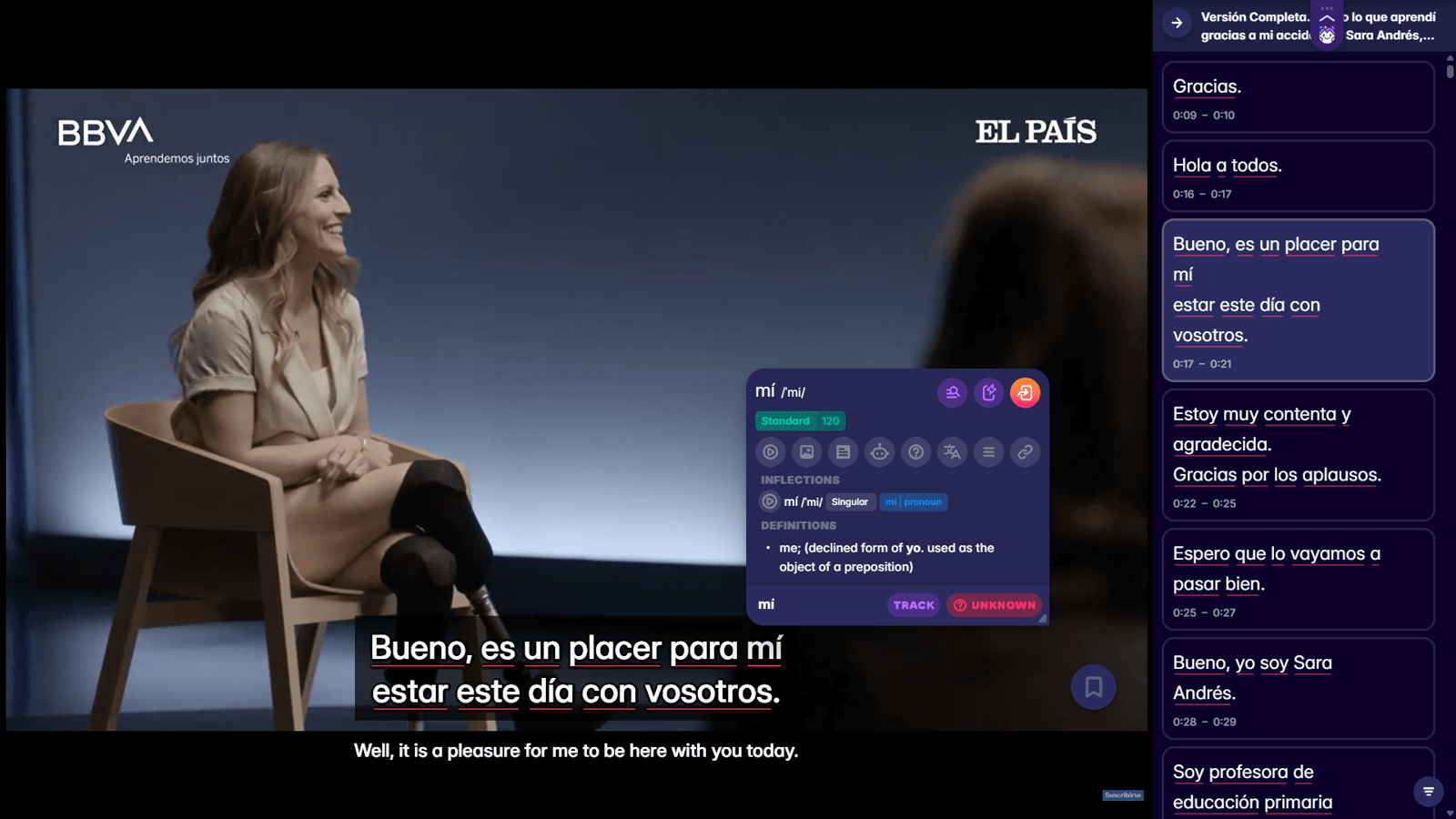
Anyway, if you want to see these tenses in action with real Spanish content, Migaku's browser extension and app let you look up verb conjugations instantly while watching shows or reading articles. You can practice recognizing different tenses in context, which beats memorizing conjugation charts any day. There's a 10-day free trial if you want to check it out.
The Spanish tenses and moods look overwhelming for beginners
The truth is, you don't need to master all 14-plus tenses simultaneously to learn Spanish effectively. One step at a time. Start with the most commonly used tense. And after learning one, you'll start recognizing it in reading, watching, and listening, and gradually incorporate it into your own Spanish.
If you consume media in Spanish, and you understand at least some of the messages and sentences within that media, you will make progress. Period.
With time and patience, nothing is out of reach!