Tener Preterite Conjugation: Complete Spanish Guide
Last updated: April 26, 2026

So you're learning Spanish and you've hit one of those verbs that just refuses to play by the rules. Welcome to tener in the preterite tense. This verb means "to have" in English, and honestly, it's one of the most useful verbs you'll ever learn. Let me walk you through everything you need to know about the tener preterite conjugation, complete with pronunciation guides, example sentences, and some tips that'll help you actually remember this stuff.
- What is the preterite tense
- The tener preterite conjugation chart
- Common uses of tener in the preterite
- Example sentences using tener in the preterite
- Tener preterite vs. Imperfect: When to use which
- Other tenses of tener: Quick overview
- Common mistakes to avoid
- Tips for memorizing tener preterite conjugation
What is the preterite tense
Before we dive into conjugating tener, let's quickly cover what the preterite actually is. The preterite (el pretérito in Spanish) is one of the two main past tenses in Spanish. You use it to talk about completed actions in the past, things that happened at specific times and are done.
Think of it this way: if you're talking about something that happened and finished, you're probably using the preterite. "I had a dog when I was ten." "We had dinner at 8 pm." "She had a cold last week." All preterite territory.
The other past tense in Spanish is the imperfect, which you use for ongoing or habitual past actions. We'll touch on the difference later, but for now, just know that the preterite is your go-to for completed past events.
The tener preterite conjugation chart
Alright, let's get to the main event. Here's the complete conjugation of tener in the preterite tense:
Person | Conjugation | Pronunciation |
|---|---|---|
yo | tuve | TOO-veh |
tú | tuviste | too-VEES-teh |
él/ella/usted | tuvo | TOO-voh |
nosotros/nosotras | tuvimos | too-VEE-mohs |
vosotros/vosotras | tuvisteis | too-VEES-tays |
ellos/ellas/ustedes | tuvieron | too-VYEH-rohn |
Yeah, these forms look nothing like the infinitive tener. That's because this verb has what's called a preterite stem change. Instead of starting with "ten," all the preterite forms use the stem "tuv." Pretty annoying when you're first learning Spanish, but you'll get used to it.
Common uses of tener in the preterite
The Spanish verb tener gets used in way more situations than just possession. Here are the main contexts where you'll need the preterite forms:
Possession: Talking about having something at a specific time in the past.
- Tuve un coche rojo cuando tenía veinte años.
I had a red car when I was twenty.
Obligations: Using "tener que" to express past obligations.
- Tuvimos que salir temprano.
We had to leave early.
Age: Expressing how old someone was.
- Mi abuelo tuvo ochenta años cuando murió.
My grandfather was eighty years old when he died.
Physical sensations: Describing temporary physical states.
- Tuve hambre después del partido.
I was hungry after the game. - Tuvieron frío durante la caminata.
They were cold during the hike.
Emotional states: Expressing emotions or feelings.
- Tuvo miedo de hablar en público.
He was afraid to speak in public. - Tuviste celos de tu hermano.
You were jealous of your brother.
Idiomatic expressions: Spanish has tons of expressions with tener.
- Tuve suerte en el examen.
I was lucky on the exam. - Tuviste razón sobre el clima.
You were right about the weather. - Tuvo éxito en su carrera.
She was successful in her career.
Example sentences using tener in the preterite
Let me give you some real context for how you'd use these forms. Reading example sentences helps way more than just staring at conjugation tables.
Yo tuve (I had):
- Tuve un examen difícil ayer.
I had a difficult exam yesterday. - Tuve que trabajar todo el fin de semana.
I had to work all weekend. - Tuve mucha suerte en el casino.
I had a lot of luck at the casino.
Tú tuviste (You had):
- ¿Tuviste tiempo para estudiar?
Did you have time to study? - Tuviste razón sobre el restaurante.
You were right about the restaurant. - No tuviste miedo durante la película.
You weren't scared during the movie.
Él/Ella/Usted tuvo (He/She had, You formal had):
- Mi hermana tuvo un bebé en marzo.
My sister had a baby in March. - El profesor tuvo paciencia con nosotros.
The professor had patience with us. - ¿Tuvo usted problemas con el vuelo?
Did you have problems with the flight?
Nosotros tuvimos (We had):
- Tuvimos una fiesta increíble anoche.
We had an incredible party last night. - Tuvimos que cancelar el viaje.
We had to cancel the trip. - No tuvimos suficiente dinero.
We didn't have enough money.
Vosotros tuvisteis (You all had, used in Spain):
- ¿Tuvisteis un buen día?
Did you all have a good day? - Tuvisteis mucha suerte de encontrarlo.
You all were very lucky to find it. - Tuvisteis la oportunidad perfecta.
You all had the perfect opportunity.
Ellos/Ellas/Ustedes tuvieron (They/You all had):
- Mis padres tuvieron tres hijos.
My parents had three children. - Tuvieron que esperar dos horas.
They had to wait two hours. - ¿Tuvieron ustedes algún problema?
Did you all have any problem?
Notice how tener appears in tons of expressions in Spanish. "Tener que" (to have to), "tener suerte" (to be lucky), "tener razón" (to be right), "tener miedo" (to be afraid). All of these use tener, and when you're talking about the past, you need these preterite forms.
Tener preterite vs. Imperfect: When to use which
This trips up so many Spanish learners. Both the preterite and the imperfect are past tenses, but they're used in different situations. Understanding when to use the preterite conjugation of tener versus the imperfect is super important.
Use the preterite (tuve, tuviste, tuvo, etc.) when:
- The action happened at a specific time and is completed
- You're emphasizing the beginning or end of an action
- The action occurred a specific number of times
Examples:
- Tuve gripe la semana pasada.
I had the flu last week. (Specific time, completed) - Tuvo un accidente el martes.
He had an accident on Tuesday. (Specific event) - Tuvimos tres reuniones ayer.
We had three meetings yesterday. (Specific count)
Use the imperfect (tenía, tenías, tenía, etc.) when:
- The action was ongoing or habitual in the past
- You're describing background information or setting
- The action had no specific beginning or end
Examples:
- Tenía un perro cuando era niño.
I had a dog when I was a kid. (Ongoing state) - Tenía hambre todos los días a las tres.
I was hungry every day at three. (Habitual) - La casa tenía tres dormitorios.
The house had three bedrooms. (Description)
Sometimes the tense you choose actually changes the meaning. Compare these:
- Tuve miedo.
I got scared, became afraid. (Preterite focuses on the moment it started) - Tenía miedo.
I was scared. (Imperfect describes an ongoing state)
Getting this distinction down takes practice. Read lots of Spanish and pay attention to which tense native speakers choose in different contexts. It'll start to feel natural eventually.
Other tenses of tener: Quick overview
Since we're talking about conjugating tener, let me quickly show you how this verb looks in other common tenses. This gives you the full picture and helps you see patterns.
Present tense:
- tengo, tienes, tiene, tenemos, tenéis, tienen
- Also irregular! The yo form is "tengo" and there's a stem change (e to ie) in most forms.
Imperfect tense:
- tenía, tenías, tenía, teníamos, teníais, tenían
- Regular formation, thankfully. Uses the standard -ía endings.
Future tense:
- tendré, tendrás, tendrá, tendremos, tendréis, tendrán
- Irregular stem "tendr" plus future endings.
Conditional tense:
- tendría, tendrías, tendría, tendríamos, tendríais, tendrían
- Same irregular stem "tendr" as the future, with conditional endings.
Present subjunctive:
- tenga, tengas, tenga, tengamos, tengáis, tengan
- Irregular, based on the yo form of the present tense.
Imperfect subjunctive:
- tuviera/tuviese, tuvieras/tuvieses, tuviera/tuviese, tuviéramos/tuviésemos, tuvierais/tuvieseis, tuvieran/tuviesen
- Based on the preterite stem "tuv".
See how the preterite stem "tuv" shows up again in the imperfect subjunctive? Once you learn the preterite forms well, you've already got a head start on the subjunctive.
Common mistakes to avoid
Let me save you from some errors I see Spanish learners make all the time with tener in the preterite:
- Using regular endings: Don't say "tení" or "tenió." The forms are completely irregular, remember? It's "tuve" and "tuvo."
- Adding accent marks: The irregular preterite forms don't have accents. It's "tuvo," not "tuvó."
- Confusing preterite and imperfect: Think about whether the action was completed or ongoing. "Tuve un perro" (I had a dog, but don't anymore) versus "Tenía un perro" (I had a dog, background info).
- Forgetting the irregular stem: The stem is "tuv" for all forms. Don't try to use "ten" from the infinitive.
Tips for memorizing tener preterite conjugation
Okay, so how do you actually get these forms to stick in your brain? Here are some strategies that work:
- Practice with flashcards: Make cards with the subject pronoun on one side and the conjugation on the other. Review them daily. Spaced repetition works really well for verb conjugations.
- Write out the conjugation: Seriously, just write it by hand multiple times. The physical act of writing helps with memorization.
- Use it in context: Make up sentences about your own life using each form. Personal connections make things more memorable.
- Group similar verbs: Learn tener alongside estar, poder, and poner since they follow the same irregular preterite pattern. Your brain will recognize the pattern.
- Listen to native speakers: Watch Spanish shows or videos and listen for these forms. Hearing them in context reinforces what you've learned.
- Practice speaking: Say the conjugations out loud, use them in conversation practice, talk to yourself in Spanish. Output matters just as much as input.
- Focus on the most common forms: You'll use "tuve," "tuvo," and "tuvimos" way more often than "tuvisteis" (unless you're in Spain). Prioritize what you'll actually need.
Anyway, if you want to learn Spanish through real content while getting instant translations and grammar help, Migaku's browser extension and app let you look up words and phrases while watching Spanish shows or reading articles. Makes the whole immersion process way more practical. There's a 10-day free trial if you want to check it out.
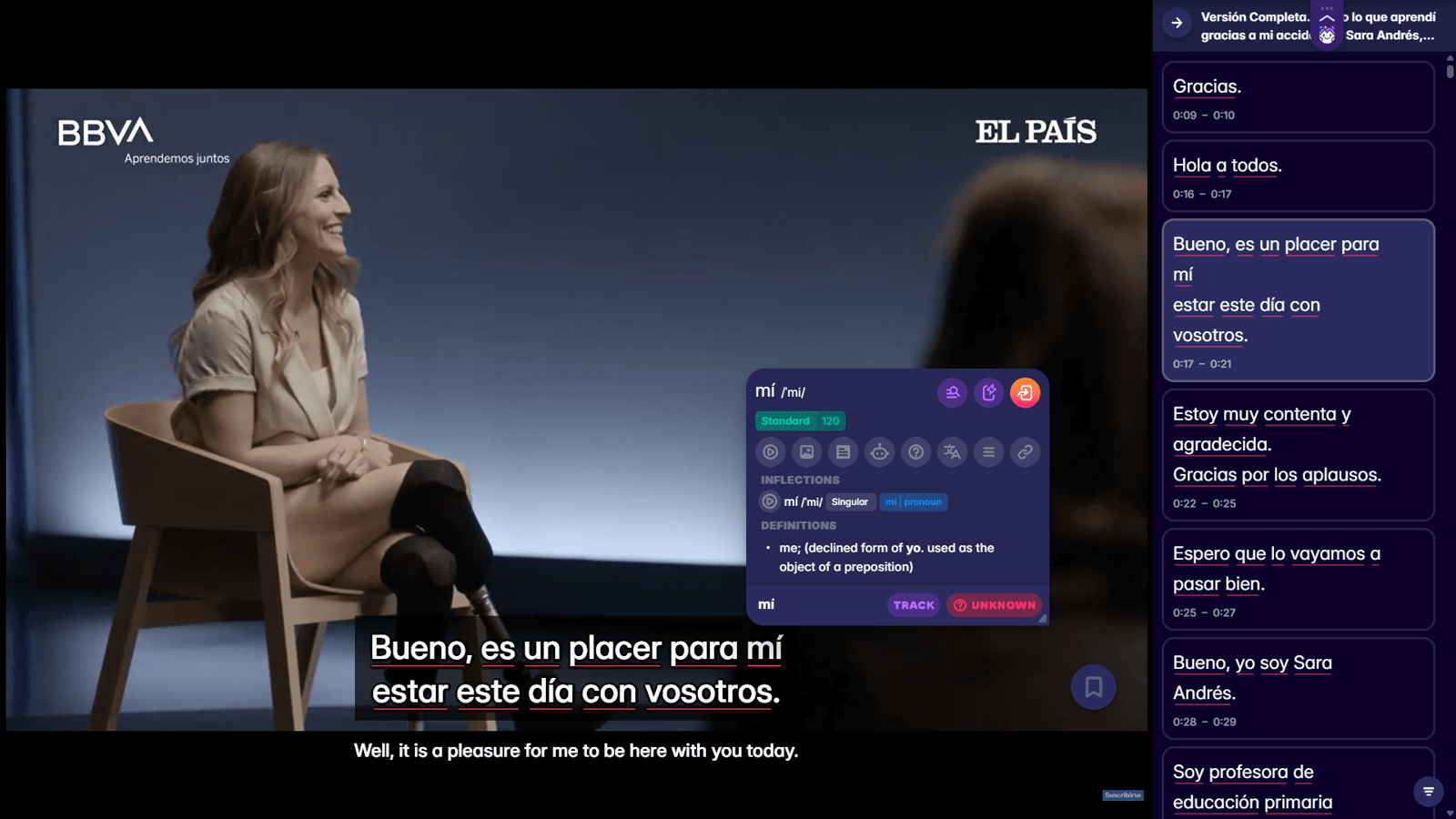
Keep practicing with real Spanish content
The best way to really internalize these conjugations is to see them used naturally in real Spanish. Read articles, watch shows, listen to podcasts, whatever interests you. When you encounter "tuve" or "tuvieron" in context, it reinforces what you've learned here and shows you how native speakers actually use the verb.
If you consume media in Spanish, and you understand at least some of the messages and sentences within that media, you will make progress. Period.
Everything will click into place with practice!