Complete Ver Conjugation Chart: All Spanish Tenses
Last updated: April 15, 2026

So you're learning Spanish and you've hit the verb ver. Here's the thing: this little verb means "to see" and you'll use it constantly. Like, every single day if you're speaking Spanish. The problem? Ver is irregular, which means it doesn't follow the nice, predictable patterns that regular -er verbs do. I'm going to walk you through every tense you need for ver conjugation, with charts you can reference.
- Present tense: Ver in the here and now
- Preterite tense: What you saw
- Imperfect tense: Ongoing seeing in the past
- Future tense: What you’ll see
- Conditional tense: What you would see
- Present subjunctive: Hopes and doubts about seeing
- Imperfect subjunctive: Past subjunctive forms
- Imperative: Commands with ver
- Compound tenses: Ver with haber
- Regional notes: Vosotros vs. Ustedes
- How about giving this set of exercises a go
- Common mistakes and tips about ver in Spanish verb conjugation
Present tense: Ver in the here and now
The present tense is where you'll start. Good news: ver is mostly regular here, except for the yo form.
Person | Conjugation | English Translation |
|---|---|---|
yo | veo | I see |
tú | ves | you see (informal) |
él/ella/usted | ve | he/she sees, you see (formal) |
nosotros/nosotras | vemos | we see |
vosotros/vosotras | veis | you all see (Spain) |
ellos/ellas/ustedes | ven | they see, you all see |
The yo form "veo" is the irregular one. If ver followed regular -er patterns, it would be "vero," but that's not a thing. You just have to memorize veo.
Example sentences:
- Veo la televisión cada noche.
I watch television every night. - ¿Ves ese edificio?
Do you see that building? - Vemos muchas películas juntos.
We watch many movies together.
Pretty straightforward for present tense usage. The verb ver works perfectly for both "to see" and "to watch" in Spanish, which is handy.
Preterite tense: What you saw
Here's where ver gets interesting. The preterite tense talks about completed actions in the past. Ver is irregular here, and it looks a lot like the verb ir (to go) in preterite, which confuses people.
Person | Conjugation | English Translation |
|---|---|---|
yo | vi | I saw |
tú | viste | you saw |
él/ella/usted | vio | he/she saw, you saw |
nosotros/nosotras | vimos | we saw |
vosotros/vosotras | visteis | you all saw |
ellos/ellas/ustedes | vieron | they saw, you all saw |
Notice something? No accent marks. That's unusual for preterite conjugation, but ver just doesn't use them. The forms viste, vimos, visteis, and vieron are super common in everyday Spanish.
Examples:
- Vi a tu hermano ayer.
I saw your brother yesterday. - ¿Viste la película nueva?
Did you see the new movie? - Vieron el accidente en la calle.
They saw the accident on the street.
Imperfect tense: Ongoing seeing in the past
The imperfect tense describes ongoing or repeated actions in the past. This is where ver really shows its irregular side. Instead of the expected "vía" pattern, you get veía.
Person | Conjugation | English Translation |
|---|---|---|
yo | veía | I was seeing/used to see |
tú | veías | you were seeing/used to see |
él/ella/usted | veía | he/she was seeing, you were seeing |
nosotros/nosotras | veíamos | we were seeing/used to see |
vosotros/vosotras | veíais | you all were seeing |
ellos/ellas/ustedes | veían | they were seeing, you all were seeing |
The forms veía, veíamos, and veían all have that accent mark on the i. This is because ver is so short that it needs the accent to maintain proper pronunciation. When ver conjugations are in imperfect, you're usually talking about habitual actions or setting scenes.
Examples:
- Veía ese programa todos los días.
I used to watch that show every day. - Veíamos las estrellas cada noche.
We would see the stars every night. - Ellos veían muchas películas cuando eran jóvenes.
They used to watch many movies when they were young.
Future tense: What you’ll see
Future tense is easier because ver follows regular patterns here. You take the infinitive ver and add future endings.
Person | Conjugation | English Translation |
|---|---|---|
yo | veré | I will see |
tú | verás | you will see |
él/ella/usted | verá | he/she will see, you will see |
nosotros/nosotras | veremos | we will see |
vosotros/vosotras | veréis | you all will see |
ellos/ellas/ustedes | verán | they will see, you all will see |
This tense is pretty straightforward for verb conjugation. The phrase "veremos" (we'll see) is super common in Spanish conversations when you're being noncommittal about plans.
Examples:
- Veré el resultado mañana.
I'll see the result tomorrow. - Veremos qué pasa.
We'll see what happens. - ¿Verás a tus padres este fin de semana?
Will you see your parents this weekend?
Conditional tense: What you would see
The conditional works like future tense but expresses what would happen. Ver stays regular here too.
Person | Conjugation | English Translation |
|---|---|---|
yo | vería | I would see |
tú | verías | you would see |
él/ella/usted | vería | he/she would see, you would see |
nosotros/nosotras | veríamos | we would see |
vosotros/vosotras | veríais | you all would see |
ellos/ellas/ustedes | verían | they would see, you all would see |
The conditional tense is great for polite suggestions or hypothetical situations.
Examples:
- Vería esa película, pero no tengo tiempo.
I would see that movie, but I don't have time. - ¿Verías un doctor si te sintieras mal?
Would you see a doctor if you felt bad?
Present subjunctive: Hopes and doubts about seeing
The subjunctive mood expresses uncertainty, desires, or emotions. Is ver an irregular verb in subjunctive? Yes, definitely. The present subjunctive uses "vea" as its stem, which is totally different from the infinitive.
Person | Conjugation | English Translation |
|---|---|---|
yo | vea | (that) I see |
tú | veas | (that) you see |
él/ella/usted | vea | (that) he/she sees, you see |
nosotros/nosotras | veamos | (that) we see |
vosotros/vosotras | veáis | (that) you all see |
ellos/ellas/ustedes | vean | (that) they see, you all see |
The subjunctive takes practice. You use it after expressions of doubt, desire, or emotion.
Examples:
- Espero que veas la verdad.
I hope that you see the truth. - Dudo que vean la diferencia.
I doubt that they see the difference. - Quiero que veamos la casa antes de comprarla.
I want us to see the house before buying it.
Imperfect subjunctive: Past subjunctive forms
The imperfect subjunctive has two forms in Spanish, and both are correct. For ver, you'll see viera/viese patterns.
Form 1 (more common):
Person | Conjugation | English Translation |
|---|---|---|
yo | viera | (that) I saw/would see |
tú | vieras | (that) you saw/would see |
él/ella/usted | viera | (that) he/she saw, you saw |
nosotros/nosotras | viéramos | (that) we saw/would see |
vosotros/vosotras | vierais | (that) you all saw |
ellos/ellas/ustedes | vieran | (that) they saw, you all saw |
Form 2 (less common, more literary):
Person | Conjugation |
|---|---|
yo | viese |
tú | vieses |
él/ella/usted | viese |
nosotros/nosotras | viésemos |
vosotros/vosotras | vieseis |
ellos/ellas/ustedes | viesen |
Most Spanish speakers use the -ra endings (viera, vieras) in everyday conversation. The -se endings (viese, vieses) show up more in formal writing or literature.
Example:
- Si viera ese problema, lo resolvería.
If I saw that problem, I would solve it. - Me pidió que viera el documento.
He asked me to see the document.
Imperative: Commands with ver
The imperative mood gives commands. Ver has both regular and irregular forms here.
Positive commands:
Person | Conjugation | English Translation |
|---|---|---|
tú | ve | see! (informal) |
usted | vea | see! (formal) |
nosotros/nosotras | veamos | let's see! |
vosotros/vosotras | ved | see! (Spain, informal plural) |
ustedes | vean | see! (formal plural) |
Negative commands:
Person | Conjugation | English Translation |
|---|---|---|
tú | no veas | don't see! |
usted | no vea | don't see! |
nosotros/nosotras | no veamos | let's not see! |
vosotros/vosotras | no veáis | don't see! |
ustedes | no vean | don't see! |
The informal tú command "ve" looks identical to the él/ella present tense form, which can be confusing. Context helps you figure out which one is being used.
Examples:
- Ve esa película, es muy buena.
See that movie, it's very good. - Veamos qué podemos hacer.
Let's see what we can do. - No veas ese programa, es aburrido.
Don't watch that show, it's boring.
Compound tenses: Ver with haber
Compound tenses use the auxiliary verb haber plus the past participle. For ver, the past participle is visto.
Present Perfect (have seen):
- yo he visto (I have seen)
- tú has visto (you have seen)
- él/ella ha visto (he/she has seen)
- nosotros hemos visto (we have seen)
- vosotros habéis visto (you all have seen)
- ellos han visto (they have seen)
Past Perfect/Pluperfect (had seen):
- yo había visto (I had seen)
- tú habías visto (you had seen)
- él/ella había visto (he/she had seen)
- nosotros habíamos visto (we had seen)
- vosotros habíais visto (you all had seen)
- ellos habían visto (they had seen)
Future Perfect (will have seen):
- yo habré visto (I will have seen)
- tú habrás visto (you will have seen)
- él/ella habrá visto (he/she will have seen)
- nosotros habremos visto (we will have seen)
- vosotros habréis visto (you all will have seen)
- ellos habrán visto (they will have seen)
The past participle visto never changes in these compound tenses. You conjugate haber, and visto stays the same.
Examples:
- He visto esa película tres veces.
I have seen that movie three times. - Habíamos visto las señales, pero no entendimos.
We had seen the signs, but we didn't understand. - Para mañana, habré visto todos los episodios.
By tomorrow, I will have seen all the episodes.
Regional notes: Vosotros vs. Ustedes
Quick note about vosotros: this form is used in Spain for informal "you all." In Latin America, everyone uses ustedes for both formal and informal plural "you." So forms like veis and veáis are Spain-specific.
If you're learning Latin American Spanish, you can basically ignore the vosotros row in every chart. Focus on the ustedes forms instead (ven, vean, verán, etc.).
Some regions also use "vos" instead of "tú," which has its own conjugation patterns, but that's a whole other topic.
How about giving this set of exercises a go
Are you prepared to challenge your conjugation abilities? Try translating these sentences:
- I see the problem now.
- We saw your sister yesterday.
- They used to watch television every evening.
- I hope you see the difference.
- If I saw him, I would say hello.
Answers:
- Veo el problema ahora.
- Vimos a tu hermana ayer.
- Veían (or Ellos veían) la televisión cada tarde.
- Espero que veas la diferencia.
- Si lo viera, lo saludaría.
How'd you do? The verb ver shows up in so many contexts that practicing these conjugations will pay off quickly.
Common mistakes and tips about ver in Spanish verb conjugation
When ver conjugations are being learned, people mess up in predictable ways. Here are the big ones:
- Mixing up preterite and imperfect: Vi means "I saw" (one time, completed action). Veía means "I was seeing/used to see" (ongoing or repeated). The translation matters for understanding which tense to use.
- Forgetting the irregular yo form in present: You say veo, never "vero." This trips up beginners who want to apply regular -er patterns.
- Confusing ver with mirar: Ver means "to see" (perceiving with your eyes). Mirar means "to look at" or "to watch" (directing your attention). Both work for watching TV, but ver is more common.
- Dropping accent marks in imperfect: Veía, veíamos, and veían all need that accent on the i. Without it, the pronunciation changes.
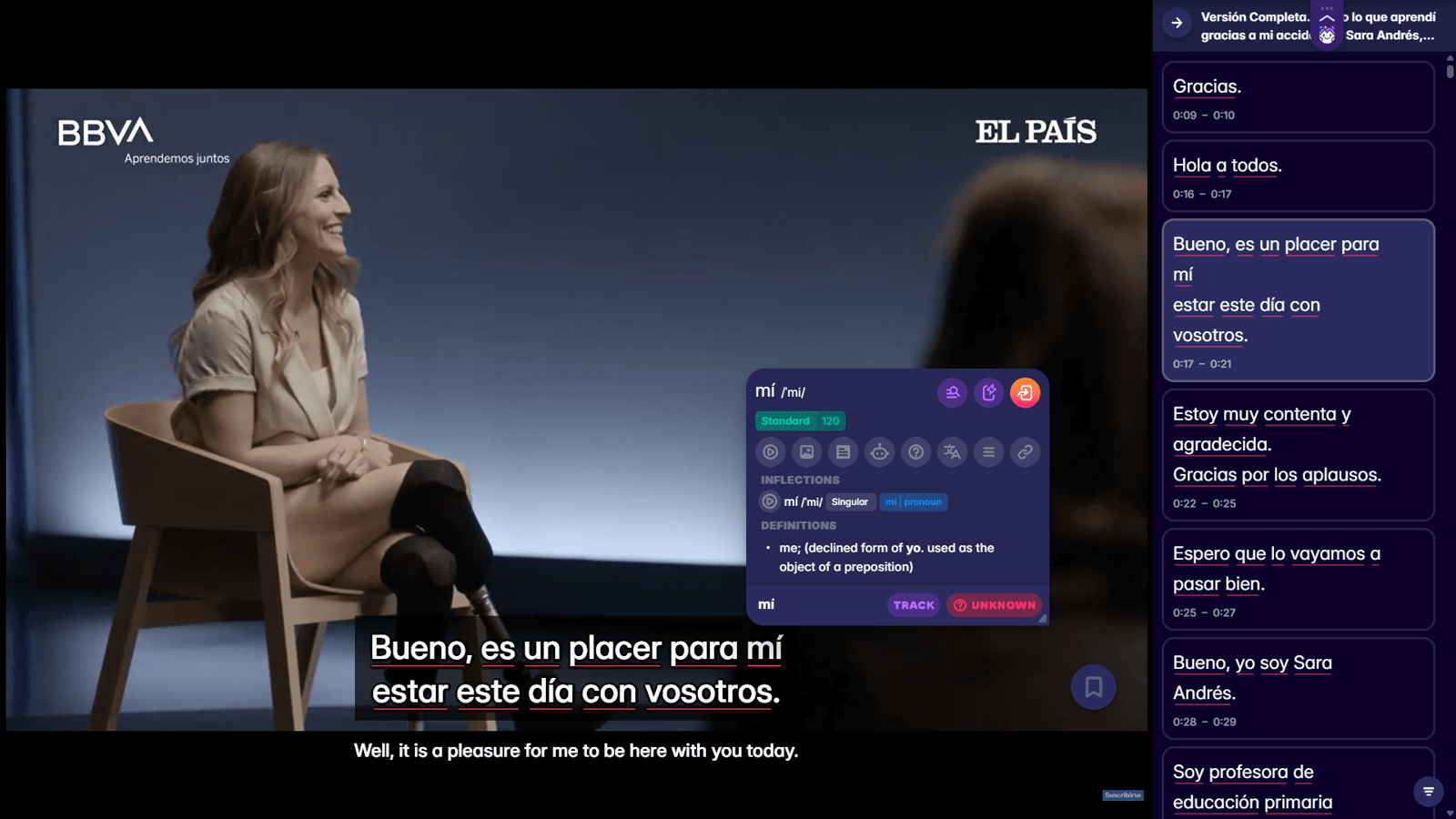
Anyway, if you want to practice Spanish with real content, Migaku's browser extension and app let you look up verb conjugations instantly while reading articles or watching videos. You can click on any form of ver and see the full conjugation table right there. There's a 10-day free trial if you want to check it out.
Ver conjugation covers a lot of ground
You've got irregular forms in present (veo), preterite (vi, viste, vio), imperfect (veía), and all subjunctive tenses (vea, viera). The future, conditional, and compound tenses follow regular patterns, which is nice. The key is exposure. Read Spanish content, watch Spanish shows, and pay attention when ver shows up. You'll start recognizing the patterns without consciously thinking about conjugation charts. Veo, vi, veía, vea – these forms will become automatic with enough practice.
If you consume media in Spanish, and you understand at least some of the messages and sentences within that media, you will make progress. Period.
Step by step, you'll get there.🚶♀️