Best Neighborhoods in Barcelona for Foreigners: El Born, Gràcia, Eixample, and Beyond
Última actualización: 15 de mayo de 2026
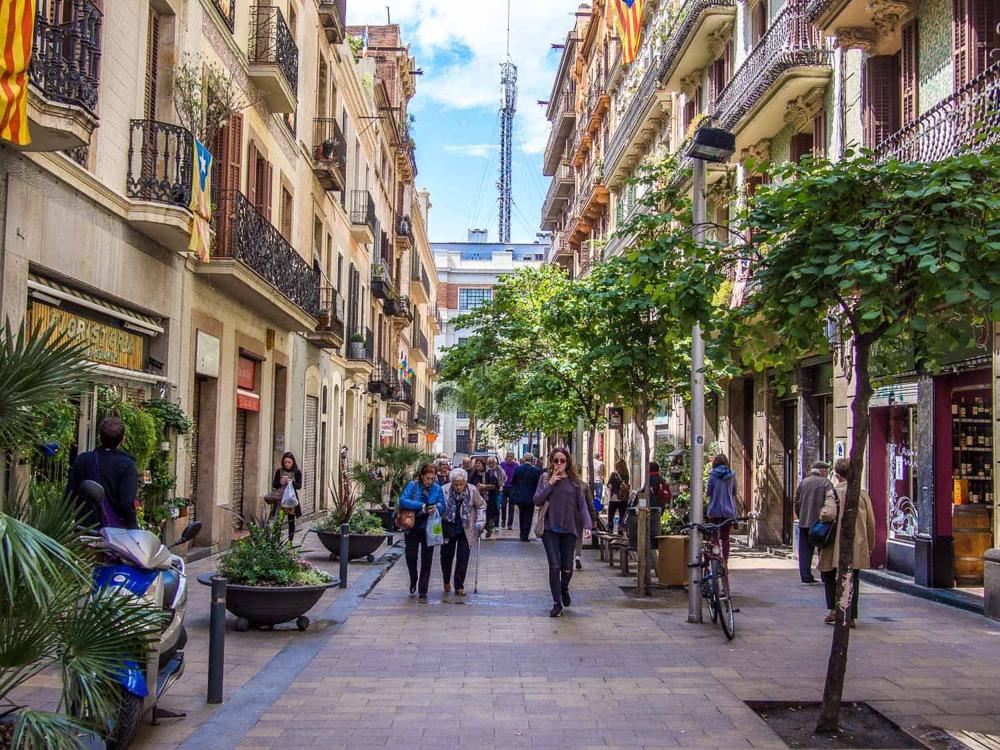
Barcelona's livability for foreigners comes down to picking the right neighborhood: each district has its own rent level, vibe, transport access, and quirks. This guide breaks down where international residents actually settle in 2026, what it costs, and what to watch out for.
Last updated: May 15, 2026
- How to Think About Barcelona's Districts
- Eixample: The Default Choice for Most Expats
- El Born and the Gothic Quarter: Historic Center Living
- Gràcia: The Village Inside the City
- Poblenou: Beach-Adjacent and Tech-Heavy
- Sarrià-Sant Gervasi: Quiet, Green, and Expensive
- Affordable Alternatives Worth Considering
- Quick Comparison Table
- Visas, Registration, and Practical Setup
- Common Pitfalls When Choosing a Neighborhood
How to Think About Barcelona's Districts
Barcelona is split into 10 administrative districts, but expats usually talk in terms of neighborhoods (barrios). The city is compact, walkable, and well-served by the metro, so your choice is less about commute time and more about lifestyle, budget, and noise tolerance.
A few citywide facts shape every decision in 2026:
- The average asking rent reached around €15.87/m²/month in Q3 2025, roughly €952 for a 60 m² flat, per the Generalitat de Catalunya's INCASOL data. Asking rents rose about 3% year-over-year into early 2026.
- Barcelona is officially a "stressed residential market area" under Spain's Law 12/2023, meaning new rental contracts are generally capped at the previous contract's price.
- The IRAV index (Índice de Referencia de Arrendamientos de Vivienda) caps annual rent increases at 2.14% for 2026, fixed by Royal Decree-Law 8/2026.
- Catalonia's Law 11/2025, in force since 1 January 2026, closed the loophole that let landlords bypass rent caps using seasonal or room rentals.
- Barcelona's 10,101 tourist apartment (HUT) licenses will not be renewed when they expire in November 2028, so short-stay options are shrinking and long-term inventory should slowly grow.
With that backdrop, here are the neighborhoods foreigners gravitate toward, plus a few alternatives worth a serious look.
Eixample: The Default Choice for Most Expats
Eixample is the grid of wide avenues laid out by Ildefons Cerdà in the 19th century. It wraps around the old city and contains landmarks like Passeig de Gràcia, Sagrada Família, and most of Gaudí's modernist work. Foreign professionals, couples without kids, and digital nomads cluster here because it offers light-filled apartments, great transport, and walking-distance access to almost everything.
Eixample splits into two main halves expats should know:
- Dreta de l'Eixample: upscale, full of architecture, close to Passeig de Gràcia shopping. Quieter on residential blocks.
- Esquerra de l'Eixample: more local feel, plenty of cafés and small restaurants. Often slightly cheaper.
- Sant Antoni: a sub-neighborhood that became a magnet for younger foreigners thanks to its renovated market, brunch spots, and bars.
Eixample is the most expensive district for rentals in early 2026 at around €26.0/m². Expect roughly €1,500–€2,200 for a typical one-bedroom in good condition. The trade-off: you can live without a car, walk to the office, and never feel cut off.
El Born and the Gothic Quarter: Historic Center Living
El Born and the Gothic Quarter (Barri Gòtic) sit inside Ciutat Vella, the old city. Narrow medieval streets, terraces under stone arches, the Picasso Museum, the Cathedral. It is the postcard Barcelona, and for some foreigners that is exactly the point.
Who it suits:
- Younger professionals, creatives, and remote workers who want atmosphere over space.
- Short to medium-term stays (1 to 3 years) where the novelty outweighs the downsides.
- People who do not own a car and rarely need one.
What to know before signing:
- Ciutat Vella is the second-most expensive district for rentals at around €25.3/m². Apartments tend to be small, old, and sometimes dark.
- According to Mossos d'Esquadra data, El Raval (the western side of Ciutat Vella) has the highest crime rate of any Barcelona neighborhood, and La Barceloneta and the Gothic Quarter also rank in the top 10. El Born itself is calmer than El Raval but still busy with tourists.
- Pickpocketing dominates Barcelona crime statistics: roughly 94,517 petty thefts were reported in 2024, about 259 per day, concentrated in tourist-heavy areas.
- Citywide crime fell 8.8% in the first half of 2025 versus 2024, and residential burglaries dropped 31.4%, so the trend is moving in the right direction.
El Born is the most balanced pocket here: medieval streets, independent shops, the Santa Maria del Mar basilica, and easier access to the beach than the Gothic Quarter.
Gràcia: The Village Inside the City
Before being annexed in 1897, Gràcia was its own town, and it still feels like one. Small plazas, low-rise buildings, indie bookshops, vermouth bars, and a Catalan-leaning identity. It is the neighborhood foreigners pick when they want community over spectacle.
Gràcia attracts:
- Long-term expats and families with young kids who want a slower pace.
- People studying Catalan, since the language is more present in daily life here than in the center.
- Creative freelancers who like cafés with actual regulars.
Practical notes:
- Gràcia is the third-most expensive district at around €23.4/m², so it is not cheap, but apartments tend to be larger and quieter than Eixample for similar money.
- The Festa Major de Gràcia in mid-August is loud, joyous, and unavoidable. Plan around it.
- Metro lines L3 and L4 plus FGC trains make the rest of the city easy to reach.
If you want "Barcelona but not touristy," Gràcia is usually the right answer.
Poblenou: Beach-Adjacent and Tech-Heavy
Poblenou, in the Sant Martí district, is the former industrial zone now branded as the 22@ innovation district. Tech companies, coworking spaces, design studios, and a long stretch of beach. Apartments tend to be newer, with elevators and actual closets, things older Barcelona buildings often lack.
It works well for:
- Digital nomads and tech workers, especially those on the Spain Digital Nomad Visa.
- Families wanting a quieter, more modern feel and outdoor space.
- Anyone who actually uses the beach instead of just visiting it.
Downsides: parts of Poblenou still feel transitional, with construction zones and uneven streetscapes. The far end near the Forum is less lively at night.
For a closer look at the rental market mechanics across these areas, see this guide on renting in Barcelona for foreigners.
Sarrià-Sant Gervasi: Quiet, Green, and Expensive
Sarrià-Sant Gervasi sits in the hills above Diagonal. It is leafy, residential, and family-oriented, with many of Barcelona's international schools nearby. It also has the lowest crime rate per capita of any Barcelona district.
What to expect:
- Purchase prices of €6,000 to €8,000+ per square meter in 2026, far above the city average. Rentals follow accordingly.
- A more car-dependent lifestyle than central districts, though FGC trains and several metro lines connect well to the center.
- A different social scene: less nightlife, more weekend lunches, parks, and tennis clubs.
This is the typical pick for diplomats, senior corporate transfers, and families with school-age children.
Affordable Alternatives Worth Considering
If central rents feel out of reach, look at:
- Sants and Hostafrancs: solid working-class neighborhoods with good transit (Sants Estació is the main train hub) and noticeably lower rents.
- Poble-sec: between Montjuïc and the center, with the lively Carrer Blai tapas strip. Still affordable relative to neighbors.
- Horta-Guinardó and Nou Barris: further from the center but much cheaper. Nou Barris is the most affordable district at €12.22/m² in Q3 2025, and purchase prices stay around €2,600 to €3,300/m².
- Sant Andreu: a quiet, almost suburban district with a real neighborhood feel and lower prices.
These areas are realistic if you are committing to Barcelona for the long term and willing to trade a bit of commute for a bigger flat.
Quick Comparison Table
Neighborhood | Best for | Approx. rent level (2026) | Vibe |
|---|---|---|---|
Eixample | Most expats, professionals | High (~€26/m² district avg) | Walkable, central |
El Born / Gothic | Short-medium term, atmosphere | High (~€25/m² district avg) | Historic, touristy |
Gràcia | Long-term, families, Catalan immersion | High (~€23/m² district avg) | Village feel |
Poblenou | Tech, nomads, beach lovers | Mid-high | Modern, beachside |
Sarrià-Sant Gervasi | Families, schools, high budgets | Very high | Quiet, leafy |
Sants / Poble-sec | Budget-conscious centralists | Mid | Local, lively |
Nou Barris / Sant Andreu | Long-term budget | Low (~€12/m² in Nou Barris) | Residential |
For a deeper breakdown of monthly budgets across these zones, see this guide on the cost of living in Barcelona.
Visas, Registration, and Practical Setup
Where you live also depends on what brings you here. The most common 2026 paths for non-EU foreigners are:
- Spain Digital Nomad Visa (DNV): requires a minimum income of €2,849/month (€34,188/year), which is 200% of Spain's 2026 SMI, confirmed on 29 January 2026. A spouse or partner adds €1,125/month to the threshold, and each dependent child adds €375/month. Processing takes around 4 months. Applying at a Spanish consulate abroad grants a 1-year visa; applying inside Spain grants a 3-year residence permit. Government fees: €80 consular, €9.84 NIE, €73.26 residence card.
- Beckham Law for DNV holders: a flat 24% tax rate on income up to €600,000/year for up to 6 years, claimed by filing Form 149 within 6 months of social security registration.
- Golden Visa: ended in April 2025. Buying property no longer provides a residency route.
Once you have an address, you must register on the Padrón Municipal (empadronamiento) if you live in Spain more than 6 months. It is free. In-person registration at an OAC office usually issues the certificate the same day; online applications resolve in about 7 working days, with a legal maximum of 3 months. Non-EU foreigners without long-stay residence renew every 2 years; EU nationals every 5 years.
Other practical numbers for 2026:
- T-Usual 30-day unlimited transit pass: €22.80 (Zone 1), keeping the 30% government subsidy and 20% ATM discount.
- T-Jove card for under-30s, 90 days unlimited: €45.50.
- Single airport metro ticket: €5.90.
- Non-EU property owners pay 24% tax on rental income; EU/EEA residents pay 19% and can deduct expenses.
Common Pitfalls When Choosing a Neighborhood
- Underestimating noise. Central Barcelona is loud at night, especially Ciutat Vella, Sant Antoni, and parts of Gràcia near plazas. Visit your prospective street after 11 p.m. before signing.
- Ignoring the building. A 1900s building with no elevator on a 5th floor is a different life from a 1980s building with a lift. Ask.
- Assuming short-term and long-term rentals are the same market. Since Catalonia's Law 11/2025 took effect on 1 January 2026, total room rents cannot exceed the maximum applicable to a single residential lease, and a State Register of Rental Contracts (mandatory since 2 January 2025) requires platforms to verify registration numbers. Unregistered listings are a red flag.
- Misreading the rent cap. The 2.14% IRAV cap applies to annual increases on existing contracts. New contracts in stressed areas like Barcelona are generally capped at the previous tenant's rent, with exceptions for landlords classified as large property holders (5+ dwellings in stressed areas).
- Skipping the empadronamiento. Without it you cannot enroll kids in public school, access subsidized healthcare smoothly, or complete several immigration steps.
- Picking a neighborhood based on a tourist visit. El Born in October on a sunny Saturday is not the same as El Born in August at 2 a.m.
FAQs
Which Barcelona neighborhood is best for digital nomads?
Poblenou and Sant Antoni are the most common picks. Poblenou offers modern flats, coworking, and the beach; Sant Antoni offers a central location and walkable cafés.
Where do families with children usually live?
Sarrià-Sant Gervasi for proximity to international schools and quiet streets, Gràcia for a community feel at lower prices, and parts of Poblenou for newer apartments with space.
Is Barcelona safe for foreigners?
Violent crime is low and citywide crime fell 8.8% in the first half of 2025. The main risk is pickpocketing, which accounted for 48.1% of reported crime in 2023 and is concentrated in tourist areas (Ciutat Vella, La Rambla, metro lines near Sagrada Família). Sarrià-Sant Gervasi has the lowest crime rate per capita.
How much should I budget for rent?
For a 60 m² flat in a central neighborhood, plan on €1,200 to €1,800/month in 2026. Outer districts like Nou Barris or Sant Andreu can drop that to €700 to €1,000.
Do I need to speak Spanish or Catalan?
Spanish is essential for daily life and bureaucracy. Catalan is not required but is widely used, especially in Gràcia, Sarrià, and with schools and local administration. Even a working level helps a lot.
How does Barcelona compare to Madrid?
Barcelona has the beach, milder winters, and a more international street feel. Madrid has cheaper rent on average, a denser professional scene, and a different nightlife rhythm. If you are weighing both, see this guide on the best neighborhoods in Madrid for expats.
Can I still buy property to get residency?
No. Spain's Golden Visa program ended in April 2025. Property purchase no longer leads to a residence permit.
Spanish (and a bit of Catalan) will open doors in every neighborhood on this list, from negotiating a lease to making friends at the plaça. If you want to learn from Spanish TV, films, and YouTube instead of textbooks, try Migaku and turn the content you already watch into your study material.