JavaScript is required

Basic Italian Phrases Every Beginner Should Learn First

Última actualización: April 27, 2026

Basic Italian phrases every beginner should learn first - Banner

Basic Italian Phrases Every Beginner Should Learn First

So you're heading to Italy, or maybe you just want to learn some basic Italian before your trip. Good call. Knowing even a handful of phrases can completely change your experience from awkward pointing and Google Translate fumbling to actual human connection.

Here's the thing: you don't need to master Italian grammar or memorize thousands of words to get by. You just need the right phrases that'll actually come up in real situations. I'm talking about ordering food, asking for directions, being polite, and handling those small daily interactions that make travel way more enjoyable.

Learning Italian doesn't have to be this massive undertaking. Start with these essential phrases, and you'll be surprised how far they'll take you.

Why These Basic Italian Phrases Actually Matter

Look, plenty of people in Italian tourist areas speak some English. But showing up with zero effort to speak the local language? That's kind of lazy, honestly. Italians appreciate when you at least try, even if your pronunciation is rough.

Plus, there's something pretty cool about using an actual Italian phrase in the right moment and having someone understand you. It builds confidence fast. You go from feeling like a complete outsider to someone who can handle basic interactions.

The phrases I'm covering here are the ones you'll actually use. Not random stuff like "Where is the library?" that shows up in textbooks but never in real life. These are the words and phrases that'll help you eat, navigate, shop, and connect with people.

Greeting and Basic Introductions

Let's start with how to actually say hello. You probably know ciao (ciao) already. It's casual and works for both hello and goodbye with friends or people your age. Pretty versatile.

But here's what trips people up: ciao is too casual for certain situations. If you're talking to someone older, in a formal setting, or meeting someone for the first time in a professional context, you want buongiorno (buongiorno). This means "good morning" or "good day" and works until late afternoon.

After about 4 or 5 PM, switch to buonasera (buonasera), which means "good evening." This is your formal greeting for later in the day. You'll hear this constantly in shops, restaurants, and hotels.

For a more casual "good morning," you might hear buon giorno (buon giorno) split into two words, though it's the same thing. Similarly, buona sera (buona sera) can appear as two words. Don't stress about this, both versions work fine.

When introducing yourself, keep it simple: Mi chiamo your name (mi chiamo) means "My name is" or literally "I call myself." Follow up with Piacere (piacere), which means "pleasure" or "nice to meet you."

If someone asks Come ti chiami? (come ti chiami?), they're asking "What's your name?" in an informal way. The formal version is Come si chiama? (come si chiama?), which you'd use with older people or in professional settings.

Want to ask how someone is? Come stai? (come stai?) is the casual "How are you?" and Come sta? (come sta?) is the formal version. The response is usually Bene, grazie (bene, grazie), meaning "Well, thanks." You can add E tu? (e tu?) for "And you?" informally, or E Lei? (e lei?) formally.

Here's one more that's super useful: Sei di qui? (sei di qui?) means "Are you from here?" Great for starting conversations or asking locals for recommendations.

Essential Courtesy Phrases

Politeness goes a long way in Italy. These are the phrases that show you're making an effort and aren't just another tourist barking demands.

Per favore (per favore) means "please." Use it constantly. Stick it at the end of requests, and people will be way more helpful. Un caffe, per favore (un caffe, per favore) gets you a coffee with a smile.

Grazie (grazie) is "thank you," and you already know this one. But here's a level up: Grazie mille (grazie mille) means "thanks a thousand" or "thanks so much." It's more enthusiastic and Italians use it all the time.

When someone thanks you, respond with Prego (prego). This word does a lot of heavy lifting in Italian. It means "you're welcome," but also "please" in the sense of "please, go ahead" or "after you." You'll hear it constantly.

Scusi (scusi) is "excuse me" in the formal sense. Use this to get someone's attention politely, apologize for bumping into someone, or interrupt politely. The informal version is scusa (scusa), but when in doubt, go formal.

Mi dispiace (mi dispiace) means "I'm sorry" for actual apologies. If you mess up, this is your go-to phrase.

Dining and Ordering Food

Food is serious business in Italy, so you'll use these phrases constantly. Restaurant interactions follow a pretty standard pattern once you know the basics.

When you walk into a restaurant, the host might ask Quanti siete? (quanti siete?), which means "How many are you?" Hold up fingers if your Italian fails you here.

To get the waiter's attention (politely), use Scusi (scusi) and wait for them to come over. Don't snap or wave frantically, that's rude everywhere.

Vorrei (vorrei) means "I would like" and it's your best friend for ordering. Vorrei un caffe (vorrei un caffe) gets you a coffee. Vorrei questa (vorrei questa) while pointing means "I'd like this one."

If you're not sure what something is, ask Cos'e questo? (cos'e questo?), meaning "What is this?" Point at the menu and you're golden.

Il conto, per favore (il conto, per favore) means "The check, please." This is how you signal you're ready to pay. In Italy, servers won't rush you or bring the check until you ask for it.

Water is acqua (acqua). Specify acqua naturale (acqua naturale) for still water or acqua frizzante (acqua frizzante) for sparkling. They'll usually ask which you want.

Buon appetito (buon appetito) is what people say before eating, like "enjoy your meal." If someone says it to you, you can say it back or just smile and nod.

Here's a useful one: Sono vegetariano (sono vegetariano) if you're a male vegetarian, or Sono vegetariana (sono vegetariana) if you're female. This helps when asking about menu options.

Delizioso (delizioso) means "delicious," perfect for complimenting the food. Italians appreciate when you acknowledge good cooking.

Shopping and Directions

Getting around and shopping requires a different set of phrases. These will save you so much confusion.

Quanto costa? (quanto costa?) means "How much does it cost?" Essential for markets, shops, anywhere without clear prices. You can also say Quanto costa questo? (quanto costa questo?) while pointing, meaning "How much does this cost?"

Troppo caro (troppo caro) means "too expensive." Useful in markets where haggling is acceptable, though less common in regular shops.

For directions, start with Dov'e (dov'e), which means "Where is." Dov'e il bagno? (dov'e il bagno?) is "Where is the bathroom?" and you'll probably use this one a lot. Dov'e la stazione? (dov'e la stazione?) means "Where is the station?"

A destra (a destra) means "to the right" and a sinistra (a sinistra) means "to the left." Dritto (dritto) or sempre dritto (sempre dritto) means "straight ahead" or "keep going straight."

Vicino (vicino) means "near" or "nearby," while lontano (lontano) means "far." If you ask for directions and someone says E lontano (e lontano), it's far away. E vicino (e vicino) means it's close.

Posso provare? (posso provare?) means "Can I try?" Perfect for trying on clothes or tasting food at markets.

Numbers in Italian

You need at least basic numbers for prices, times, and addresses. Here are the essentials:

Uno (uno) is one, due (due) is two, tre (tre) is three, quattro (quattro) is four, cinque (cinque) is five. Keep going: sei (sei) for six, sette (sette) for seven, otto (otto) for eight, nove (nove) for nine, dieci (dieci) for ten.

For larger numbers, venti (venti) is twenty, trenta (trenta) is thirty, quaranta (quaranta) is forty, cinquanta (cinquanta) is fifty, cento (cento) is one hundred.

Honestly, if you can count to ten and know the tens up to one hundred, you can handle most price situations. People will often write down prices or show you on a calculator if there's confusion.

Asking for Help and Emergencies

Hope you never need these, but knowing emergency phrases gives you peace of mind.

Aiuto (aiuto) means "help." Yell this if you're in trouble and people will come running.

Ho bisogno di aiuto (ho bisogno di aiuto) means "I need help," which is more specific and useful for non-emergency situations where you're stuck or lost.

Non capisco (non capisco) means "I don't understand." Super useful when someone's speaking too fast or using words you don't know. Follow it up with Parla inglese? (parla inglese?), which asks "Do you speak English?"

Puo aiutarmi? (puo aiutarmi?) means "Can you help me?" More polite than just saying you need help.

Sono perso (sono perso) if you're a guy or Sono persa (sono persa) if you're a girl means "I'm lost." This gets people's attention and they'll usually try to help with directions.

Chiama la polizia (chiama la polizia) means "Call the police" and Chiama un'ambulanza (chiama un'ambulanza) means "Call an ambulance." Hopefully you'll never need these, but they're critical to know.

Common Italian Expressions That Make You Sound Natural

These phrases don't fit neatly into categories but they'll make you sound way more natural and less like you're reading from a phrasebook.

Va bene (va bene) means "okay" or "alright." You'll hear this constantly and use it just as much. Someone suggests a meeting time? Va bene. Waiter asks if everything's good? Va bene.

Perfetto (perfetto) means "perfect." Use it to enthusiastically agree with something or confirm plans.

Certo (certo) means "certainly" or "of course." More emphatic than just si (si) for "yes."

Andiamo (andiamo) means "let's go." Use it when you're ready to leave somewhere or want to get moving.

Basta (basta) means "enough" or "stop." If a waiter's pouring wine and you want them to stop, basta does the trick. Works for kids too if they're being annoying.

Mamma mia (mamma mia) is the classic Italian expression of surprise, frustration, or amazement. Yes, people actually say this, though maybe not as much as movies suggest.

Che bello (che bello) means "how beautiful" or "how nice." Great for reacting to something impressive or complimenting someone's home, city, or possession.

Do Basic Italian Phrases Change?

Yeah, they do, depending on who you're talking to and the situation. Italian has formal and informal ways of speaking, which affects your phrase choice.

The informal "you" is tu (tu), used with friends, family, kids, and peers. The formal "you" is Lei (lei), used with strangers, older people, professionals, and anyone you want to show respect toward.

This changes verb forms and pronouns. Come stai? (come stai?) is informal, while Come sta? (come sta?) is formal. Same question, different level of politeness.

Regional variations exist too. Southern Italy tends to be more formal and traditional, while Northern cities like Milan can be more relaxed. When in doubt, start formal. If someone wants you to be more casual, they'll tell you.

Gender also affects Italian phrases. Adjectives and some nouns change based on whether you're male or female. Sono stanco (sono stanco) means "I'm tired" if you're a guy, Sono stanca (sono stanca) if you're a girl. The ending vowel changes.

Why Basic Italian Phrases Can Feel Hard to Learn

Pronunciation trips people up. Italian pronunciation is actually pretty consistent once you know the rules, but English speakers struggle with certain sounds.

The rolled R sound in words like grazie (grazie) or prego (prego) takes practice. Don't stress if you can't do it right away. Italians will still understand you.

Double consonants matter in Italian. Sono (sono) with a single N means "I am," but sonno (sonno) with double N means "sleep." The double consonant is held longer, which changes the word completely.

Gendered nouns throw people off too. Every Italian noun is either masculine or feminine, affecting the articles and adjectives used with it. Il conto (il conto) uses the masculine article, while la stazione (la stazione) uses the feminine. You'll pick this up with exposure.

The bigger challenge is actually remembering to use the phrases in the moment. You might know per favore (per favore) perfectly well, but when you're stressed or rushed, your brain defaults to English. This gets easier with practice.

Learning Italian Phrases That Actually Stick

Flashcards help, but context helps more. When you learn buongiorno (buongiorno), picture yourself walking into an Italian cafe and greeting the barista. Attach the phrase to a specific scenario.

Practice out loud, even if you feel silly. Your mouth needs to get used to making these sounds. Pronunciation improves way faster when you actually speak instead of just reading.

Group phrases by situation. Keep your greeting phrases together, your restaurant phrases together, your emergency phrases together. Your brain retrieves information better when it's organized by context.

Don't try to memorize everything at once. Pick five to ten phrases, use them until they feel automatic, then add more. Building gradually beats cramming a hundred phrases and forgetting them all.

Listen to native speakers whenever possible. YouTube, language apps, Italian movies with subtitles, whatever works. Hearing how Italians actually use these phrases teaches you rhythm and intonation that textbooks can't.

What to Focus on First

If you're short on time, prioritize greetings, courtesy phrases, and restaurant language. These three categories cover probably 80% of tourist interactions.

Master buongiorno (buongiorno), grazie (grazie), per favore (per favore), scusi (scusi), and il conto, per favore (il conto, per favore). With just those five phrases, you can be polite, greet people properly, and handle restaurant basics.

Add dov'e il bagno? (dov'e il bagno?) because you'll need it, and quanto costa? (quanto costa?) for shopping. Now you've got seven phrases that'll carry you through most situations.

From there, build out based on your specific needs. Staying in Airbnbs? Learn phrases for checking in and asking about amenities. Planning to use public transport? Focus on direction and location phrases.

A Quick Note on What Italians Actually Say

Textbooks and apps sometimes teach phrases that sound weirdly formal or outdated. Real Italians use shortcuts and casual expressions that don't always make it into learning materials.

For example, instead of a full Come stai? (come stai?), you might just hear Come va? (come va?), which means "How's it going?" More casual, very common.

Tutto bene? (tutto bene?) means "Everything good?" and works as both a greeting and a way to check if someone's okay. Super common in everyday conversation.

Young Italians especially use a lot of shortened words and slang, but the basic phrases I've covered here work across all age groups and situations. They're the foundation that everyone understands and uses.

The Italian Word for Grandma and Other Cultural Notes

Since people often ask, an Italian grandma is called nonna (nonna). Grandpa is nonno (nonno). These are terms of endearment and respect in Italian culture.

A very Italian thing to say, beyond the phrases here, would be something like Che bella figura (che bella figura), referring to making a good impression, or Dolce far niente (dolce far niente), meaning "the sweetness of doing nothing." These expressions capture Italian cultural values around appearance, leisure, and enjoying life.

But honestly, for basic Italian as a beginner, focus on the practical stuff first. You can dive into cultural expressions and idioms once you're comfortable with essential communication.

Actually Using What You've Learned

The gap between knowing phrases and using them in real situations is bigger than you'd think. You might have per favore (per favore) memorized perfectly, but freeze up when actually ordering coffee.

Start small. Use one or two phrases per day if you're in Italy. Just buongiorno (buongiorno) when you enter shops. That's it. Once that feels natural, add grazie (grazie) when leaving. Build gradually instead of trying to speak full Italian sentences right away.

People are generally patient and encouraging when you're clearly trying to learn. Most Italians appreciate the effort, even if your pronunciation is rough or you mix up formal and informal.

If someone responds in English after you use an Italian phrase, don't get discouraged. They might just be trying to help or practice their own English. You can keep responding in Italian if you want the practice.

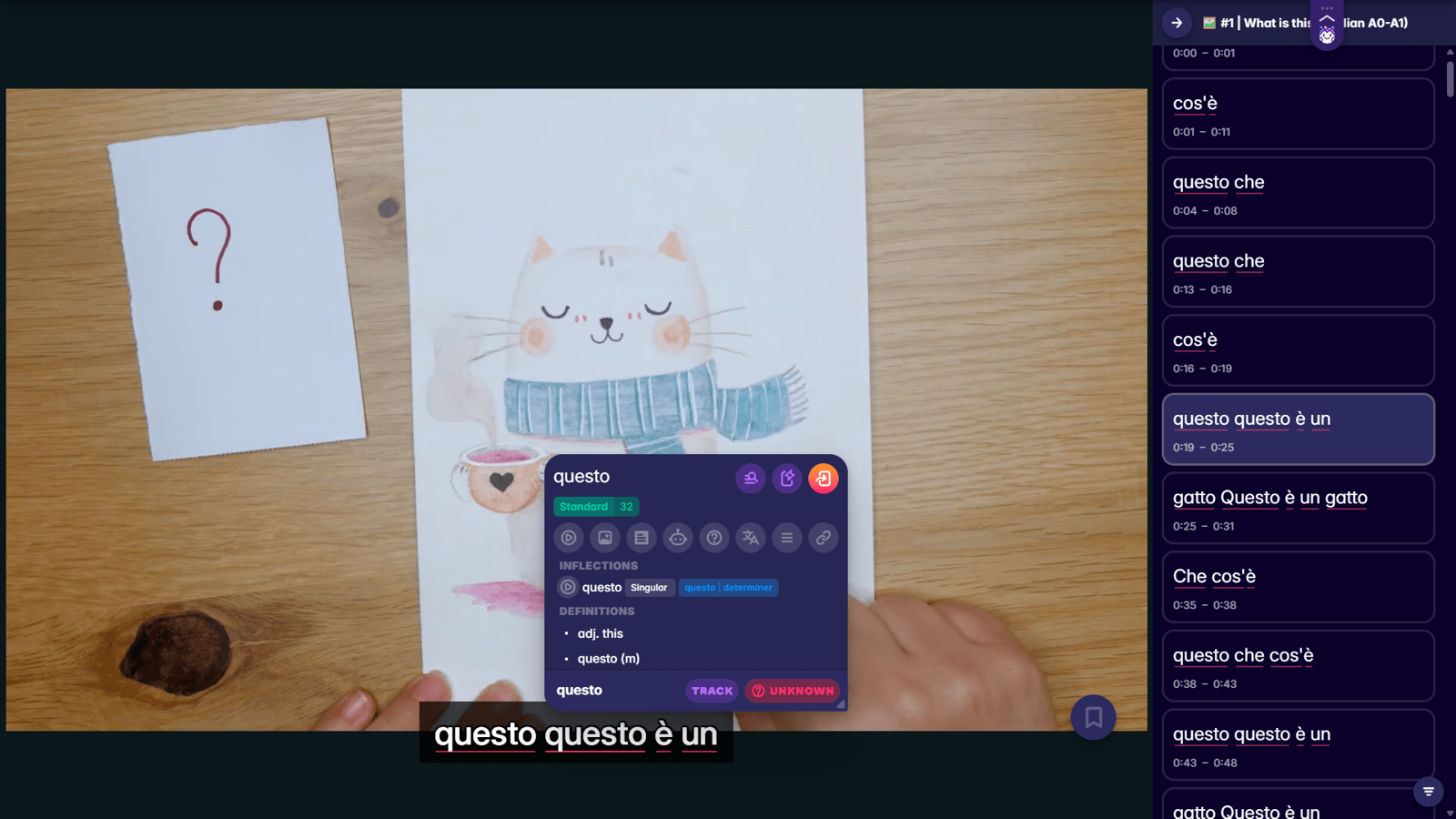
Anyway, if you're serious about learning Italian beyond tourist phrases, Migaku's browser extension lets you learn from actual Italian content like shows, articles, and videos. You can look up words instantly and build your vocabulary with stuff you actually care about. Way more effective than drilling random phrases. There's a 10-day free trial if you want to check it out.
Learn Italian with Migaku