Italian Verbs: Essential Conjugation Guide & Practice Tips for Learners
Última actualización: 29 de abril de 2026

Verbs are basically the engine of any sentence, and Italian is no exception. You can't really say much without them. Italian verb conjugation gets a reputation for being complicated, and yeah, there are a lot of forms to learn. But if you focus on the most common verbs first, you'll be able to express a ton of ideas pretty quickly. In this post, I'll walk you through the essential Italian verbs, show you how the conjugation system works, and give you the patterns you need to start using these verbs right away.
- Understanding Italian verb groups
- The 10 most common Italian verbs
- How Italian verb conjugation works
- The big three irregular verbs
- Modal verbs: Potere, dovere, and volere
- Reflexive verbs in Italian
- Auxiliary verbs and past tenses
- Italian verb tenses beyond the present
- The history of Italian verb forms
- How to memorize Italian verbs
Understanding Italian verb groups
Italian verbs fall into three main conjugation groups based on their infinitive endings. Every Italian verb ends in either -are, -ere, or -ire. This matters because each group follows its own conjugation pattern.
- The -are verbs are the most common group. Think parlare (to speak), mangiare (to eat), and amare (to love). About 80% of Italian verbs belong to this group, which is pretty convenient for learners.
- The -ere verbs are the second group. Examples include vedere (to see), leggere (to read), and prendere (to take). These are less common but still super important.
- The -ire verbs split into two subgroups. Some conjugate like dormire (to sleep), while others add -isc- in certain forms, like capire (to understand) becomes capisco (I understand). You just have to memorize which ones do this, honestly.
The 10 most common Italian verbs
Let me give you the absolute essentials. These are the verbs you'll hear and use constantly:
# | Italian Verb | English |
|---|---|---|
1 | Essere | To be |
2 | Avere | To have |
3 | Fare | To do / To make |
4 | Andare | To go |
5 | Potere | Can / To be able to |
6 | Dovere | Must / To have to |
7 | Volere | To want |
8 | Dire | To say / To tell |
9 | Sapere | To know |
10 | Venire | To come |
Pretty much every Italian conversation will include at least a few of these verbs. Master these ten, and you'll have a solid foundation.
How Italian verb conjugation works
When you conjugate an Italian verb, you're changing its form to match the subject (who's doing the action) and the tense (when it happens). Let's start with the present tense because that's where everyone begins.
For regular -are verbs, you drop the -are and add these endings:
- io (I): -o
- tu (you, informal): -i
- lui/lei (he/she): -a
- noi (we): -iamo
- voi (you all): -ate
- loro (they): -ano
So parlare (to speak) becomes: parlo, parli, parla, parliamo, parlate, parlano.
For regular -ere verbs, drop the -ere and add:
- io: -o
- tu: -i
- lui/lei: -e
- noi: -iamo
- voi: -ete
- loro: -ono
So vedere (to see) becomes: vedo, vedi, vede, vediamo, vedete, vedono.
For regular -ire verbs (without -isc-), drop the -ire and add:
- io: -o
- tu: -i
- lui/lei: -e
- noi: -iamo
- voi: -ite
- loro: -ono
So dormire (to sleep) becomes: dormo, dormi, dorme, dormiamo, dormite, dormono.
For -ire verbs with the -isc- insertion, you add that extra bit in the io, tu, lui/lei, and loro forms:
Capire (to understand) becomes: capisco, capisci, capisce, capiamo, capite, capiscono.
Notice how noi and voi don't get the -isc-? Yeah, Italian likes to keep you on your toes.
The big three irregular verbs
Essere, avere, and fare are completely irregular. You just have to memorize them because they don't follow the normal patterns at all.
Essere (to be) in present tense:
- io sono
- tu sei
- lui/lei è
- noi siamo
- voi siete
- loro sono
Avere (to have) in present tense:
- io ho
- tu hai
- lui/lei ha
- noi abbiamo
- voi avete
- loro hanno
Fare (to do/make) in present tense:
- io faccio
- tu fai
- lui/lei fa
- noi facciamo
- voi fate
- loro fanno
These three verbs appear in practically every conversation, so drill these forms until they're automatic. There's no shortcut here.
Modal verbs: Potere, dovere, and volere
Modal verbs in Italian work similarly to English. They're followed by an infinitive verb and modify its meaning.
Potere (can/to be able to):
- io posso
- tu puoi
- lui/lei può
- noi possiamo
- voi potete
- loro possono
Example:
- Posso parlare italiano.
I can speak Italian.
Dovere (must/to have to):
- io devo
- tu devi
- lui/lei deve
- noi dobbiamo
- voi dovete
- loro devono
Example:
- Devo studiare.
I must study.
Volere (to want):
- io voglio
- tu vuoi
- lui/lei vuole
- noi vogliamo
- voi volete
- loro vogliono
Example:
- Voglio mangiare.
I want to eat.
These modal verbs are irregular, but they're worth memorizing early because they let you express so much with just a basic vocabulary.
Reflexive verbs in Italian
Reflexive verbs are verbs where the subject performs an action on themselves. In Italian, these verbs include reflexive pronouns: mi (myself), ti (yourself), si (himself/herself), ci (ourselves), vi (yourselves), si (themselves).
Common reflexive verbs include chiamarsi (to call oneself/to be named), alzarsi (to get up), and lavarsi (to wash oneself).
Here's chiamarsi conjugated:
- io mi chiamo (I call myself/my name is)
- tu ti chiami
- lui/lei si chiama
- noi ci chiamiamo
- voi vi chiamate
- loro si chiamano
The reflexive pronoun always comes before the conjugated verb. So you'd say "Mi chiamo Marco" (My name is Marco), literally "I call myself Marco."
Reflexive verbs are super common in Italian for daily routines and actions. Svegliarsi (to wake up), vestirsi (to get dressed), and divertirsi (to have fun) all follow this pattern.
Auxiliary verbs and past tenses
When you want to talk about the past in Italian, you'll use compound tenses that require an auxiliary verb. The two auxiliaries are essere and avere.
Most verbs use avere as their auxiliary. For example, parlare (to speak) in the past becomes "ho parlato" (I spoke/I have spoken).
But verbs of movement and reflexive verbs typically use essere. Andare (to go) becomes "sono andato" (I went/I have gone). When you use essere, the past participle has to agree with the subject in gender and number, which adds another layer.
- For a masculine subject: sono andato
- For a feminine subject: sono andata
- For masculine plural: siamo andati
- For feminine plural: siamo andate
Italian verb tenses beyond the present
I've focused mainly on the present tense here because that's where you need to start. But Italian has several other tenses you'll want to learn eventually:
- The passato prossimo (present perfect) for completed past actions. This is the most common past tense in spoken Italian.
- The imperfetto (imperfect) for ongoing or habitual past actions.
- The futuro (future) for talking about what will happen, though Italians often use the present tense for near future events.
- The condizionale (conditional) for polite requests and hypothetical situations.
- The congiuntivo (subjunctive) for doubts, wishes, and uncertain situations. This one trips up a lot of learners, but you can communicate fine without it initially.
Each tense has its own set of endings and rules. Take them one at a time. Master the present tense first, then move to the past tenses, then future, and so on.
The history of Italian verb forms
Italian verb forms have definitely evolved from Latin, but the modern conjugation system has been pretty stable for centuries. The biggest changes happened during the transition from Vulgar Latin to early Italian dialects between the 6th and 14th centuries.
Modern standard Italian is based largely on the Tuscan dialect, thanks to writers like Dante. Since the standardization of Italian in the 19th and 20th centuries, verb conjugations have remained consistent. You might find some regional variations in spoken Italian, but the written forms you learn today would be recognizable to Italians from hundreds of years ago.
The conjugation patterns themselves are inherited from Latin's complex verb system, though Italian simplified some aspects. Latin had more tenses and moods that Italian either dropped or combined.
How to memorize Italian verbs
Look, memorizing verb conjugations takes repetition. There's no magic trick. But here are some approaches that actually work:
- Start with the most common verbs. Don't try to learn every verb at once. Focus on those top 10 verbs and drill them until they're solid.
- Practice in context, not in isolation. Don't just memorize conjugation tables. Make sentences. Say them out loud. Write them down. Your brain remembers things better when they're connected to meaning.
- Use spaced repetition. This is where tools like flashcard apps come in handy. Review verbs at increasing intervals to move them into long-term memory.
- Group verbs by pattern. Once you know the regular -are, -ere, and -ire patterns, you can apply them to hundreds of verbs. Learn the pattern once, use it everywhere.
- Pay attention to irregular verbs separately. The most common verbs tend to be irregular (because they're used so much that they resist regularization over time). These you just have to memorize individually.
- Listen to native speakers. Hearing verbs used naturally helps cement the forms in your mind. Watch Italian shows, listen to podcasts, find Italian content online.
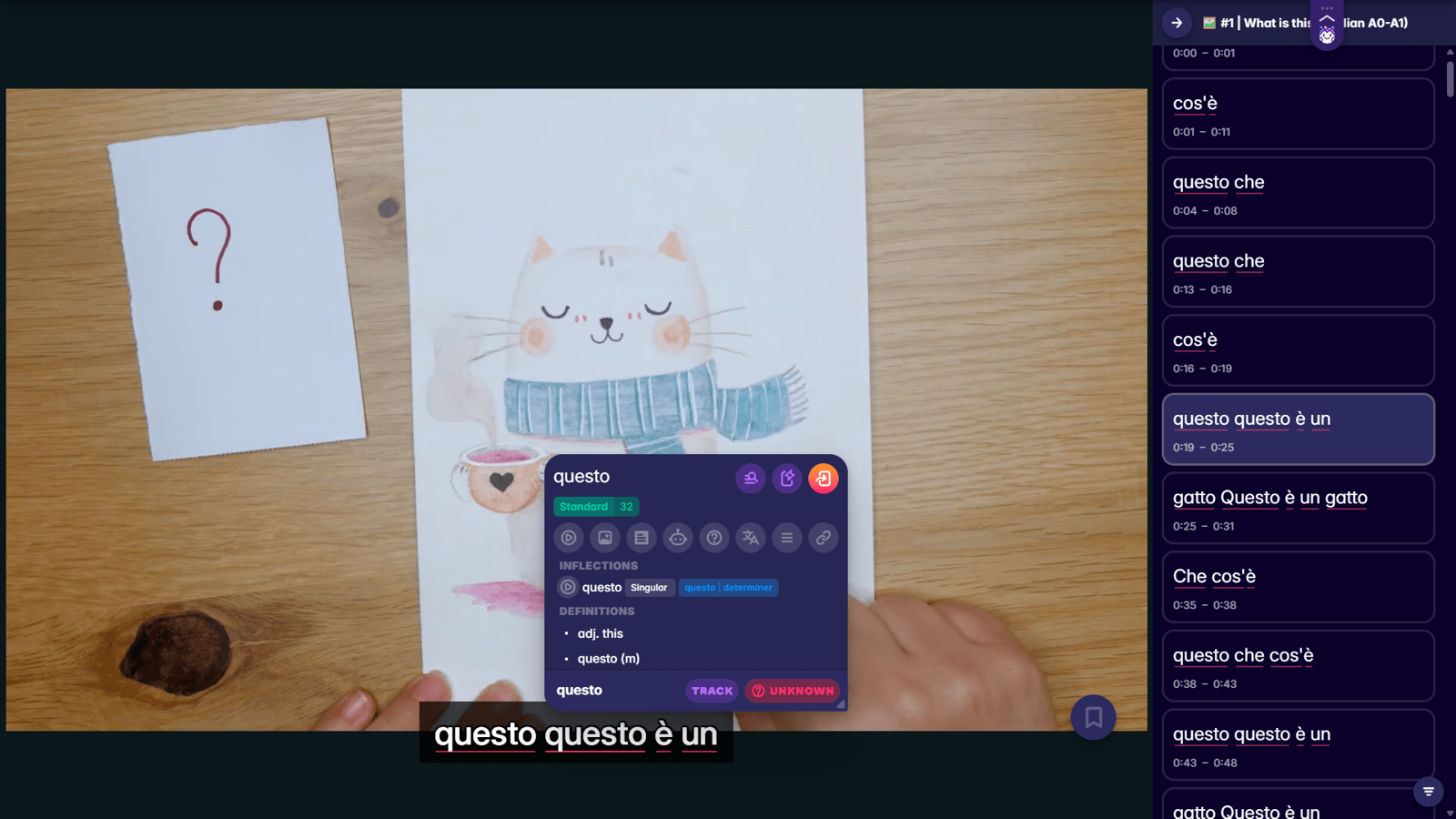
Anyway, if you want to learn Italian through actual content instead of just conjugation tables, Migaku's browser extension and app let you look up verbs and other words instantly while watching Italian shows or reading Italian articles. Makes it way easier to learn from real context. There's a free trial if you want to check it out.
Learning Italian language takes time and consistent practice
Don't get overwhelmed by all the forms. Every Italian learner has been where you are right now. The conjugations that seem impossible today will become automatic with enough exposure and practice. Find Italian content you actually enjoy, whether that's music, shows, books, or conversations with native speakers. The more you encounter these verbs in real contexts, the faster they'll stick.
If you consume media in Italian, and you understand at least some of the messages and sentences within that media, you will make progress. Period.
A teacher can help guide you, but ultimately, you learn verbs by using them over and over.