Portuguese Shopping Vocabulary: Essential Market Phrases for Grocery Shopping and More
最終更新日: 2026年4月6日

If you're planning a trip to Brazil or Portugal, you'll probably spend a good chunk of your time shopping for groceries, picking up souvenirs, or just browsing local markets. And here's the thing: knowing the right Portuguese shopping vocabulary makes everything smoother. You won't be awkwardly pointing at items or fumbling through payment. This guide covers everything from supermarket basics to market haggling, so you can learn some basic Portuguese and shop like a local whether you're in Lisbon or São Paulo.
- Essential shop types you need to know
- Navigating supermarket sections like a pro
- Food vocabulary for grocery shopping
- Action verbs and phrases you'll actually use
- Quantities and measurements that matter
- Payment and checkout phrases you can't skip
- Online shopping terms for modern learners
- Your shopping vocabulary lesson plan
- FAQs
Essential shop types you need to know
Before you can shop anywhere, you need to know where you're going. Portuguese has specific words for different types of shops, and using the right one helps locals point you in the right direction.
- The most common word you'll hear is "loja" (shop or store). It's your general term for any retail space.
- When you're looking for a supermarket, you'll want "supermercado" in both Brazilian and European Portuguese.
- For a smaller grocery store, Brazilians often say "mercado" or "mercearia," while Portuguese speakers in Portugal might use "mercearia" or "mini-mercado."
Markets are huge in Portuguese-speaking countries.
- "Feira" refers to an outdoor market, usually selling fresh produce, and these happen weekly in most neighborhoods.
- The "mercado municipal" is the municipal market building, often a permanent structure with multiple vendors. Pretty cool places to practice your Portuguese, actually.
Other useful shop vocabulary includes:
Portuguese | English |
|---|---|
padaria | Bakery |
açougue (Brazil) / talho (Portugal) | Butcher shop |
farmácia | Pharmacy |
shopping | Mall (borrowed from English, used in Brazil) |
Navigating supermarket sections like a pro
Once you're inside a supermarket, you need to know where things are. Portuguese supermarkets organize sections similarly to what you'd find elsewhere, but the vocabulary differs.
Portuguese | English |
|---|---|
seção / secção | Section |
seção de frutas e verduras / seção de hortifrutigranjeiros | Produce section (Brazil uses this mouthful sometimes) |
açougue (Brazil) / talho (Portugal) | Meat section |
laticínios | Dairy products |
congelados | Frozen foods |
padaria | Bakery section (within a supermarket) |
bebidas | Beverages |
refrigerantes | Soft drinks |
produtos de limpeza | Cleaning supplies |
higiene pessoal / produtos de higiene | Personal care items |
Food vocabulary for grocery shopping
Let's get specific about what you're actually buying. Fruits and vegetables form the core of most shopping trips.
Common fruits include:
Portuguese | English |
|---|---|
maçã | Apple |
banana | Banana |
laranja | Orange |
uva | Grape |
morango | Strawberry |
melancia | Watermelon |
abacaxi (Brazil) / ananás (Portugal) | Pineapple |
For vegetables, you'll want:
Portuguese | English |
|---|---|
tomate | Tomato |
alface | Lettuce |
cenoura | Carrot |
batata | Potato |
cebola | Onion |
alho | Garlic |
pimentão | Bell pepper |
brócolis | Broccoli |
Meat vocabulary varies between Brazil and Portugal.
Portuguese | English |
|---|---|
frango | Chicken |
carne de vaca / carne | Beef |
carne de porco | Pork |
peixe | Fish |
filé | Filet |
costela | Ribs |
picanha | A Brazilian cut of beef |
Dairy products include:
Portuguese | English |
|---|---|
leite | Milk |
queijo | Cheese |
manteiga | Butter |
iogurte | Yogurt |
creme de leite | Cream |
Action verbs and phrases you'll actually use
Knowing nouns helps, but you need verbs to communicate what you want to do. Here are the essential shopping verbs in Portuguese.
- "Comprar" means to buy or to shop. You'll say "Vou comprar frutas" (I'm going to buy fruits).
- "Procurar" means to look for, as in "Estou procurando o açúcar" (I'm looking for sugar).
- "Precisar" means to need: "Preciso de leite" (I need milk).
- "Levar" means to take, as in taking items with you. "Vou levar este" (I'll take this one).
- "Pesar" means to weigh, important for produce: "Pode pesar as maçãs?" (Can you weigh the apples?).
When you want to ask if they have something, use "Tem...?" (Do you have...?). This works everywhere: "Tem pão integral?" (Do you have whole wheat bread?). In Portugal, you might hear "Há...?" instead, which means the same thing.
"Quanto custa?" means "How much does it cost?" You'll use this constantly. The response will include "custa" (costs) or "são" (are, for plural items). "Custa cinco euros" (It costs five euros) or "São dez reais" (They are ten reais).
Quantities and measurements that matter
Shopping requires talking about amounts. Portuguese uses both metric measurements and traditional units depending on the region.
The basic quantity words are:
Portuguese | English |
|---|---|
um quilo / um kilo | One kilogram |
meio quilo | Half a kilo |
um litro | One liter |
cem gramas | 100 grams |
duzentos gramas | 200 grams |
You'll say "Quero meio quilo de tomates" (I want half a kilo of tomatoes).
In markets, especially in Brazil, you might hear "uma dúzia" (a dozen) for eggs or "meia dúzia" (half a dozen). Some vendors still use "arroba" for larger quantities of certain products, though this is becoming less common.
For packaged goods, you'll see:
Portuguese | English |
|---|---|
pacote | Packet |
caixa | Box |
lata | Can |
garrafa | Bottle |
pote | Jar / Container |
saco | Bag |
"Quero uma caixa de leite" (I want a box of milk) or "Duas garrafas de água" (Two bottles of water).
When asking for quantities, use "Quanto?" (How much?) for uncountable items and "Quantos?" (How many?) for countable ones. "Quanto açúcar?" (How much sugar?) versus "Quantas maçãs?" (How many apples?).
Payment and checkout phrases you can't skip
Getting to the checkout is where things get real. You need specific vocabulary to complete your purchase smoothly.
The checkout is "caixa" in both Brazil and Portugal. You might see signs saying "Caixa rápido" (express checkout) for fewer items. The cashier is "caixeiro" or "caixeira," though most people just interact without using this term.
When asked how you'll pay, you'll hear "Como vai pagar?" The options are:
- "dinheiro" (cash)
- "cartão de crédito" (credit card)
- "cartão de débito" (debit card)
- "Pix" (Brazil's instant payment system, super popular since 2020).
"Precisa de sacola?" means "Do you need a bag?" In many places, bags cost extra now, so you might say "Não, obrigado" (No, thank you) if you brought your own. Your reusable bag is "sacola reutilizável" or "ecobag."
The receipt is "recibo" or "nota fiscal" (in Brazil, this is the official tax receipt). You might be asked "Quer a nota?" (Do you want the receipt?).
The total is "total" or "o valor total," and you'll hear "São vinte reais no total" (It's twenty reais in total).
If you're paying cash and need change, that's "troco." "Tem troco?" means "Do you have change?" If you don't have exact change, say "Não tenho troco" (I don't have change).
Online shopping terms for modern learners
Shopping has moved online everywhere, and Portuguese-speaking countries are no exception. Learning these terms helps you navigate e-commerce sites.
Portuguese | English |
|---|---|
compras online / compras pela internet | Online shopping |
carrinho de compras / carrinho | Shopping cart |
adicionar ao carrinho | Add to cart |
finalizar compra | Checkout / Complete purchase |
entrega / frete | Shipping |
frete grátis | Free shipping |
entrega expressa | Express delivery |
endereço de entrega | Delivery address |
prazo de entrega | Estimated delivery time |
boleto bancário | Brazilian payment slip (paid at banks or lottery shops) |
carteira digital | Digital wallet |
rastreamento / rastrear | Tracking |
código de rastreamento | Tracking code |
confirmação de pedido | Order confirmation |
devoluções | Returns |
trocas | Exchanges |
política de devolução | Return policy |
Your shopping vocabulary lesson plan
Now that you know what vocabulary you need, how do you actually learn it? Here's a practical approach that works.
- Start with the 20 most common items you personally buy. Don't waste time learning "rutabaga" in Portuguese if you never eat rutabaga. Focus on your actual shopping list: bread, milk, eggs, coffee, whatever you buy weekly. Learn those words first with pronunciation.
- Next, add the essential phrases for transactions. "Quanto custa?", "Quero...", "Tem...?", and payment terms. These five phrases plus your 20 items already enable basic shopping.
- Then expand by categories. Pick one category per week: fruits one week, vegetables the next, then meats, dairy, and so on. This focused approach beats trying to memorize 200 words at once.
- Practice with real content. Watch Brazilian or Portuguese cooking shows on YouTube. Browse online supermarket websites like Pão de Açúcar (Brazil) or Continente (Portugal). Read recipes in Portuguese. This shows you the vocabulary in context, not just isolated lists.
- Finally, use it in real situations as soon as possible. If you live near a Brazilian or Portuguese market or restaurant, shop there. If not, practice with language exchange partners through role-play. The vocabulary only sticks when you actually use it.
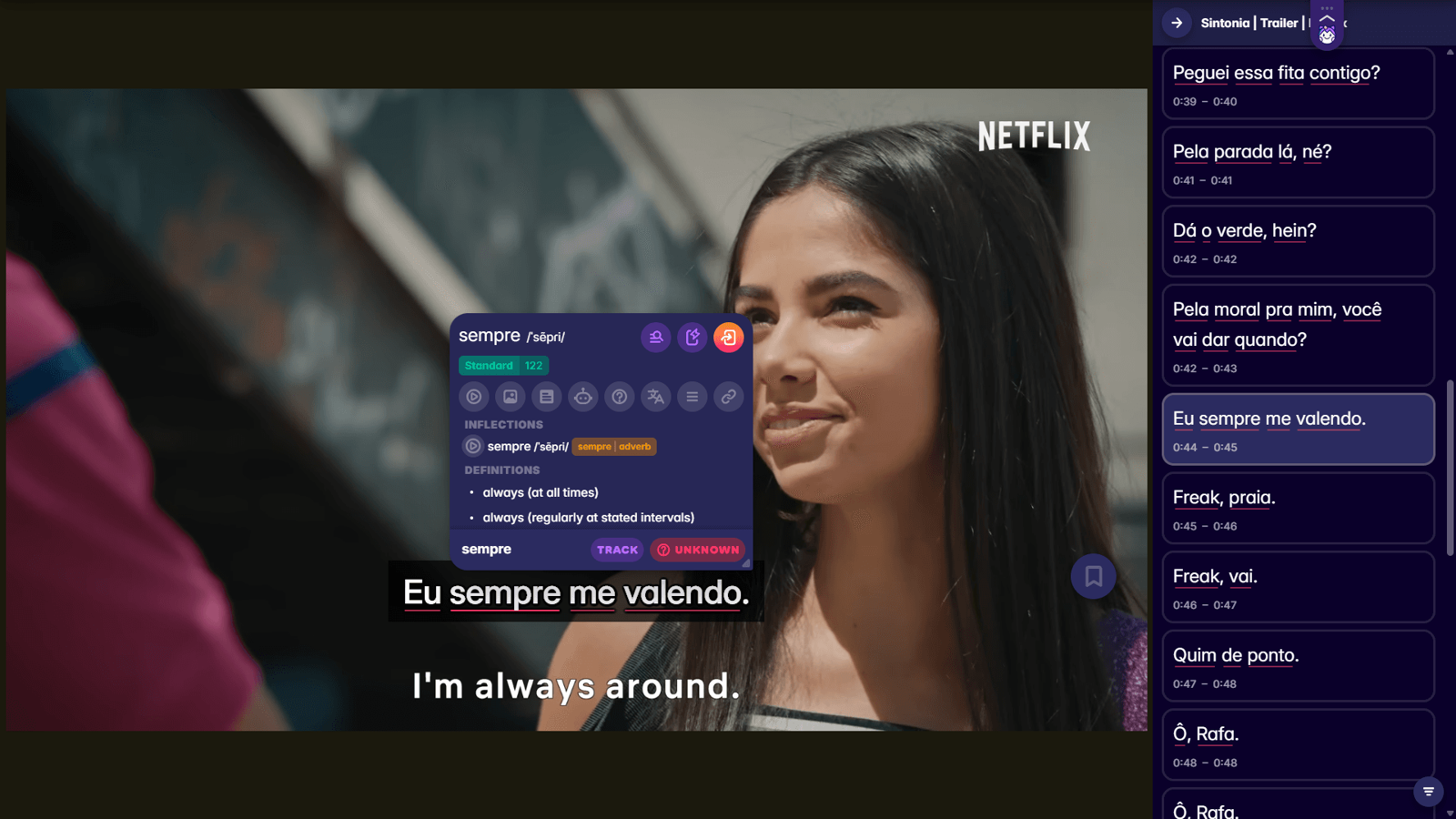
If you want to learn shopping vocabulary through actual Portuguese content, Migaku's browser extension and app let you look up words instantly while watching videos or reading articles about food, cooking, or shopping. You can save the words you need and review them later. There's a 10-day free trial if you want to check it out.
FAQs
Portuguese vocabulary that sticks through immersion
Immersion doesn't require living in Brazil or Portugal. You can create immersion at home through media. Watch grocery haul videos from Brazilian YouTubers. Follow Portuguese recipe blogs. Listen to podcasts about food and cooking. Every exposure reinforces the vocabulary in authentic contexts. The key is comprehensible input at your level. If you're a beginner, watching a fast-paced cooking competition might overwhelm you. Start with slower, clearer content like children's cooking shows or basic recipe videos with captions.
If you consume media in Portuguese, and you understand at least some of the messages and sentences within that media, you will make progress. Period.
The right study method is personal, not universal.