Riding the Osaka Subway as a Foreigner: A Beginner's Guide
最終更新日: 2026年5月23日
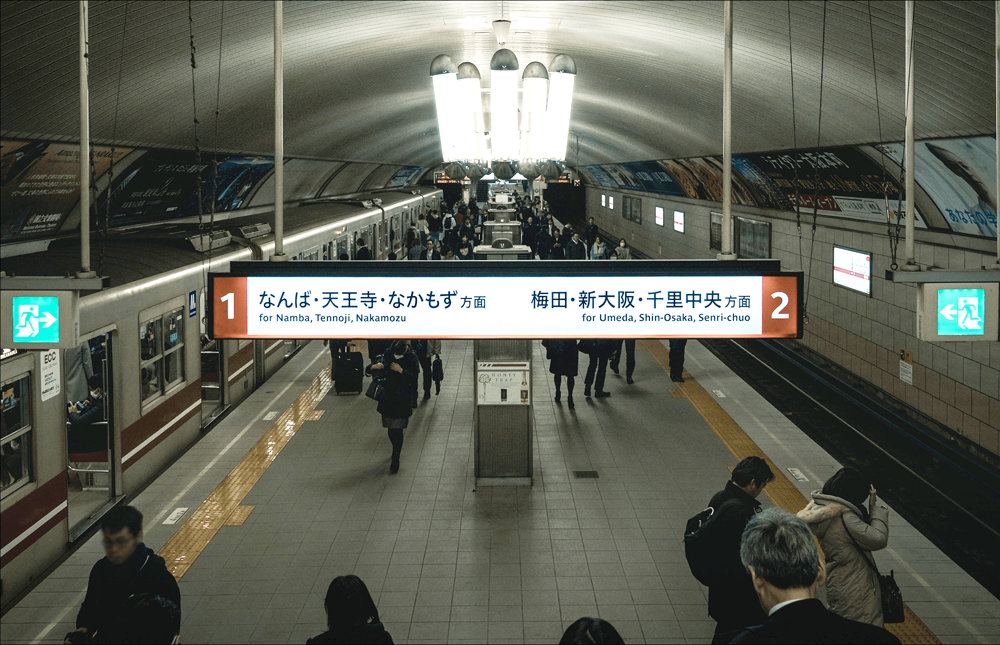
The Osaka Metro is the easiest way to move around Osaka, with nine color-coded lines, English signage at every station, and fares that start at ¥190. To use it, tap an ICOCA IC card or buy a paper ticket from a machine, follow the line color and station number to your platform, and tap or insert again at the exit gate.
Last updated: May 23, 2026
What the Osaka Metro Actually Is
Osaka Metro Co., Ltd. has run the network as a private corporation since April 2018, when the city government privatized the former municipal subway. As of 2026 the system covers nine lines (eight underground lines plus the automated New Tram) serving 134 stations across roughly 141 km of track, carrying around 2.37 million passenger trips per day. That makes it one of Japan's busiest urban rail networks, but also one of the more foreigner-friendly: signs are bilingual, announcements are in Japanese and English, and every station and line has a number and color code so you can navigate without reading any kanji.
The nine lines you'll see on the map:
- M Midosuji (red): the main north-south spine through Shin-Osaka, Umeda, Shinsaibashi, Namba, Tennoji
- T Tanimachi (purple)
- Y Yotsubashi (blue)
- C Chuo (green): runs east-west to Cosmosquare and now Yumeshima
- S Sennichimae (pink)
- K Sakaisuji (brown)
- N Nagahori Tsurumi-ryokuchi (yellow-green)
- I Imazatosuji (orange)
- P Nanko Port Town Line / New Tram (light blue)
Each station has a code like M16 (Namba on the Midosuji Line) or Y15 (Namba on the Yotsubashi Line). When in doubt, follow the letter-number rather than trying to pronounce the name.
Operating Hours and When to Avoid Riding
Trains run roughly from 5:00 a.m. to around midnight, with no service between approximately 00:30 and 05:00. During the day, frequencies on busy lines like Midosuji and Chuo drop to every 2 to 5 minutes, so you almost never need to check a timetable.
Weekday peak hours are roughly 7:30 to 9:00 a.m. and 5:30 to 8:00 p.m. These trains get genuinely packed, especially Midosuji between Umeda and Namba. If you have luggage, a stroller, or any anxiety about crowds, ride before 7:30 a.m., between 10:00 a.m. and 4:00 p.m., or after 8:30 p.m. Last trains depart earlier than you might expect, sometimes before 11:30 p.m. on outer-line stations, so check the posted final-train time at the station before going out for the night.
One current quirk worth knowing: Yumeshima Station, the new Chuo Line terminus that opened January 19, 2025 for Expo 2025, dropped to less than half of its Expo-period frequency from October 14, 2025. Many Chuo Line trains now terminate at Cosmosquare, so if Yumeshima is your destination, double-check that the train you're boarding actually runs all the way there.
Fares and How They're Calculated
Osaka Metro uses distance-based pricing. As of 2026:
Passenger type | Fare range (single ride) |
|---|---|
Adult | ¥190 to ¥420 |
Child (age 6–11) | Half adult fare |
Under 6 | Free |
An accessibility (barrier-free) fee is now baked into the official fares, shown in parentheses on the fare tables at the station. You don't pay it separately.
A few automatic discounts apply when you tap an IC card:
- Transferring between Osaka Metro and an Osaka City Bus knocks ¥100 off the adult fare (¥50 for children).
- Connecting between Osaka Metro and a short section of a private railway via PiTaPa or an ordinary connecting ticket gives a ¥20 adult discount (¥10 child).
For reference on what counts as current, the official fare table lives at subway.osakametro.co.jp. Confirm before buying multi-day products if exact yen amounts matter to you.
IC Cards: ICOCA Is the Default
Unless you're only riding the subway once or twice, get an IC card. In Kansai the local card is ICOCA, but Suica, PASMO, and the other regional IC cards all work identically on Osaka Metro.
ICOCA basics as of 2026:
- Purchase price: ¥2,000, which includes a refundable ¥500 deposit plus ¥1,500 in usable balance
- Maximum top-up: ¥20,000
- Validity: 10 years from last use
- Commuter passes can be loaded onto an existing ICOCA without paying a new ¥500 deposit
- Refunds: deposit plus remaining balance minus a ¥220 handling fee, processed only at JR West ticket offices in Kansai (you can't refund an ICOCA in Tokyo)
Buy ICOCA from the ticket machines marked with the ICOCA logo at any JR West station, including JR Shin-Osaka, JR Osaka, and Kansai Airport. Mobile ICOCA also exists on iPhone and Android and is the more flexible option if your phone supports it, since you can top up by credit card without standing at a machine.
At the gate: tap on entry, tap on exit. The fare deducts automatically based on the distance traveled. If your balance is too low to exit, use a fare adjustment machine (yellow, near the exit gates) before retrying.
Paper Tickets and Day Passes
If you don't want an IC card, you can still buy a single paper ticket at the vending machines. Switch the screen to English, look up your destination's fare on the map above the machines, insert coins or bills, and grab the ticket and change. Insert the ticket at the gate, take it back, and insert it again at the exit (the gate keeps it).
Day passes worth knowing about:
Pass | Adult price | What it covers |
|---|---|---|
Osaka Metro 1-Day Pass | ¥880 | All Osaka Metro lines |
Enjoy Eco Card (weekday) | ¥820 | All Osaka Metro lines (excl. Yumeshima) + Osaka City Bus |
Enjoy Eco Card (weekend/holiday) | ¥620 | Same as above |
Enjoy Eco Card (child) | ¥310 | Same as above |
Osaka Metro & Bus 1-Day Pass (tourist) | ¥1,200 | Metro + bus, includes Yumeshima |
Osaka Metro & Bus 2-Day Pass (tourist) | ¥1,800 | Metro + bus, includes Yumeshima |
Osaka Amazing Pass 1-day (digital) | ¥3,500 | Metro, bus, and free entry to 40+ attractions |
Osaka Amazing Pass 2-day (digital) | ¥5,000 | Same as above |
The tourist 1-Day and 2-Day passes are restricted to overseas visitors. If you live in Japan, you're not eligible, and you'll be asked for a passport at purchase.
The Osaka Amazing Pass prices above apply to the sales period from March 25, 2026 to March 31, 2027. An Itami Airport version costs ¥3,800 (1-day) and ¥5,400 (2-day). The 2-day Amazing Pass is no longer sold as a physical card, only as a digital QR ticket. If you're planning to visit Osaka Castle, the Umeda Sky Building, and a couple of museums on the same day, the Amazing Pass usually pays for itself.
A quick refund note: an unused Enjoy Eco Card can only be refunded at the place of sale, with a ¥220 fee per ticket. Don't buy more than you'll use.
Step-by-Step: Your First Ride
- Find the station. Subway entrances are marked with a stylized M (for Metro) and the line color. Larger hubs like Umeda, Namba, and Tennoji have many entrances, often hundreds of meters apart. Pick an entrance close to your direction of travel.
- Get past the first gate. If you have ICOCA, tap the blue panel. If you have a paper ticket, insert it into the slot and grab it as it pops up on the other side.
- Follow the line color. Walk toward signs in the color of your line. The line letter and direction (e.g. "M Midosuji Line / for Namba, Tennoji") will be posted overhead.
- Pick the right platform. Check the next-station name on the platform sign to confirm direction. Lines are bidirectional, so getting the wrong platform means a free ride to the wrong place.
- Board. Stand in the marked queue lines on the floor. Let passengers off first. Move to the middle of the car during peak hours.
- Track your stop. Each car has an LED display cycling through the next station in Japanese and English. Announcements are bilingual on the Midosuji, Chuo, and other major lines.
- Exit. Tap your IC card or insert your ticket at the exit gate. Multiple exits at large stations are numbered (Exit 1, Exit 5, etc.). Check signs for which exit is closest to your destination before going up the stairs.
Common Pitfalls Foreigners Run Into
- Confusing Umeda with Osaka Station. Umeda (Osaka Metro) and JR Osaka Station are technically separate stations connected by an underground maze. Allow 10 to 15 minutes to transfer.
- Wrong Namba. Namba exists on Midosuji, Yotsubashi, and Sennichimae lines, plus separately as Nankai Namba and JR Namba. They're all walkable but not the same platform.
- Buying an Enjoy Eco Card on a weekend and not using it. The weekend price (¥620) is great value, but the ¥220 refund fee makes unused tickets painful.
- Forgetting that Yumeshima is excluded from the Enjoy Eco Card. If you're going to the former Expo site, use a Metro & Bus 1-Day Pass or pay the regular fare.
- Trying to refund an ICOCA in Tokyo. It won't work. Refunds are JR West only, so do it before you leave Kansai, or just keep the card (it stays valid 10 years).
- Eating or making phone calls onboard. Both are considered rude in Japan. Set your phone to silent ("manner mode") and skip the snack until you're off the train.
- Standing on the wrong side of the escalator. In Osaka, stand on the right and walk on the left. This is the opposite of Tokyo, and locals will notice.
Luggage, Accessibility, and Useful Extras
Coin lockers are available at most stations, including Shin-Osaka, Namba, and Tennoji, at roughly ¥400 to ¥800 for 24 hours depending on size. They're a lifesaver on arrival or departure days. Larger stations also have staffed luggage storage counters with longer hours.
All Osaka Metro stations have elevators, and the gap between platform and train is small. Station staff are happy to help with ramps for wheelchairs or oversized luggage; just approach the gate window and point to the train or platform you need.
If you're staying long-term, a daytime-discount commuter pass (valid 10 a.m. to 4 p.m., all lines) costs ¥4,500 per month as of 2026. There's no 3-month, 6-month, or children's version of that particular pass. Regular commuter passes are sold from up to 14 days before the start date.
FAQs
Do I need cash to ride? No. ICOCA, Suica, PASMO, and credit cards via mobile wallets all work. Yumeshima Station even has gates that accept contactless credit cards and one with facial-recognition authentication.
Can I use my Suica from Tokyo? Yes. All major Japanese IC cards are interoperable on Osaka Metro.
Is the subway 24 hours? No. Service stops between roughly 00:30 and 05:00. Take a taxi or stay out until first train.
Are there women-only cars? Yes, on some lines during weekday morning peak. Look for the pink stickers on the platform floor.
Is the Osaka Amazing Pass worth it? If you'll visit two or more paid attractions in a day, almost always yes. If you're just riding the subway, the ¥880 Metro 1-Day Pass or pay-as-you-go ICOCA is cheaper.
How does Osaka Metro compare to other Japanese cities? It's smaller and simpler than Tokyo's network and very tourist-friendly. For comparison, see How to Use the Tokyo Metro as a Tourist. And if you're planning travel beyond Osaka, JR Pass Alternatives in 2026 covers regional rail options that pair well with city subway passes.
If you're settling into life in Osaka, picking up enough Japanese to read station announcements, ask staff for help, and chat with neighbors will change your day-to-day experience. Try Migaku to learn Japanese from the shows, manga, and YouTube videos you already watch.