Cantonese Family Vocabulary: How to Call Every Family Member
Last updated: April 1, 2026

Learning Cantonese family vocabulary can feel overwhelming at first because the language makes incredibly specific distinctions that English just doesn't bother with. You can't just say "aunt" and call it a day. You need to know if she's on your mom's side or your dad's side, whether she's older or younger than your parent, and if she's married to your blood relative or is the blood relative herself. Pretty intense, right? But here's the thing: once you understand the system, it actually makes talking about family way more precise and interesting.
Why Cantonese family terms are so specific
The Chinese kinship system reflects thousands of years of cultural importance placed on family hierarchy and lineage. Cantonese, like other Chinese dialects, preserves these distinctions in everyday speech. When you're learning the language, you'll quickly notice that every family member gets their own specific title based on multiple factors.
💡 The Main Factors 💡
The main factors that determine which word you use are: paternal versus maternal side, age relative to your parent, gender, and sometimes whether the person is a blood relative or married into the family.
This might seem complicated compared to English, but it actually prevents a lot of confusion. When someone mentions their "gū mā" (姑媽), you immediately know they're talking about their father's sister, not just any aunt.
Immediate family members
Let's start with the basics.
Cantonese | Jyutping | English |
|---|---|---|
爸爸 | baa1 baa1 | Father (informal, everyday) |
媽媽 | maa1 maa1 | Mother (informal, everyday) |
父親 | fu6 can1 | Father (formal) |
母親 | mou5 can1 | Mother (formal) |
哥哥 | go1 go1 | Older brother |
弟弟 / 細佬 | dai6 dai6 / sai3 lou2 | Younger brother |
姐姐 | ze2 ze2 | Older sister |
妹妹 | mui6 mui6 | Younger sister |
仔 | zai2 | Son |
女 | neoi5 | Daughter |
Grandparents and the paternal versus maternal divide
Here's where things get really specific. Your grandparents have completely different names depending on which side of the family they're on.
Cantonese | Jyutping | English |
|---|---|---|
爺爺 | je4 je4 | Grandfather (father's side) |
嫲嫲 | ma4 ma4 | Grandmother (father's side) |
公公 | gung1 gung1 | Grandfather (mother's side) |
婆婆 | po4 po4 | Grandmother (mother's side) |
Extended family gets complicated in Cantonese culture
Aunts and uncles in Cantonese require you to be super precise. Let's break this down by side of the family.
Cantonese | Jyutping | English |
|---|---|---|
伯伯 | baak3 baak3 | Father's older brother |
姆 | m5 | Father's older brother's wife |
叔叔 | suk1 suk1 | Father's younger brother |
嬸 | sam2 | Father's younger brother's wife |
姑媽 | gu1 maa1 | Father's sister (married) |
姑姐 | gu1 ze2 | Father's sister (unmarried) |
姑丈 | gu1 zoeng2 | Father's sister's husband |
舅父 | kau5 fu6 | Mother's brother |
舅舅 | kau5 kau5 | Mother's brother (more casual) |
舅母 | kau5 mou5 | Mother's brother's wife |
姨媽 | ji4 maa1 | Mother's sister |
姨丈 | ji4 zoeng2 | Mother's sister's husband |
Yeah, it's a lot to remember. But once you use these terms a few times in real conversations, they start sticking pretty naturally.
Cousins and the age factor
English just has "cousin" for everyone, but Cantonese keeps the specificity going. The word you use for your cousin depends on which side of the family they're from and whether they're older or younger than you.
Cantonese | Jyutping | English |
|---|---|---|
堂哥 | tong4 go1 | Older male cousin (father's brothers) |
堂弟 | tong4 dai6 | Younger male cousin (father's brothers) |
堂姐 | tong4 ze2 | Older female cousin (father's brothers) |
堂妹 | tong4 mui6 | Younger female cousin (father's brothers) |
表哥 | biu2 go1 | Older male cousin (father's sisters or mother's siblings) |
表弟 | biu2 dai6 | Younger male cousin (father's sisters or mother's siblings) |
表姐 | biu2 ze2 | Older female cousin (father's sisters or mother's siblings) |
表妹 | biu2 mui6 | Younger female cousin (father's sisters or mother's siblings) |
The character "tòhng" (堂) indicates they share your surname (paternal line), while "biu" (表) indicates they have a different surname.
In-laws and marriage connections
When you get married, a whole new set of family vocabulary opens up.
Cantonese | Jyutping | English |
|---|---|---|
岳父 | ngok6 fu6 | Father-in-law (husband's term for wife's father) |
岳母 | ngok6 mou5 | Mother-in-law (husband's term for wife's mother) |
家翁 | gaa1 kau1 | Father-in-law (wife's term for husband's father) |
家婆 | gaa1 po4 | Mother-in-law (wife's term for husband's mother) |
嫂姐 / 嫂嫂 | sou2 ze2 / sou2 sou2 | Older brother's wife |
弟婦 | dai6 fu5 | Younger brother's wife |
姐夫 | ze2 fu1 | Older sister's husband |
妹夫 | mui6 fu1 | Younger sister's husband |
Learning strategies for family terms in Cantonese
Here's my honest take: trying to memorize all these terms from a vocabulary list is pretty brutal. The distinctions are too subtle, and there are too many similar-sounding words. What actually works is learning them in context.
- Watch Cantonese family dramas or variety shows where people interact with relatives. Pay attention to how characters address their family members. When you hear "gūng gūng" in a scene with a maternal grandfather, that context makes the word stick way better than any flashcard.
- Create a family tree for yourself with all the Cantonese terms labeled. Even better, create one for a fictional family from a show you're watching. Actually using the terms to describe specific people makes them concrete rather than abstract vocabulary.
- Practice with native speakers if you can. Ask your Cantonese-speaking friends about their families and pay attention to which terms they use. Most people are happy to explain the distinctions because they know it's complicated for learners.
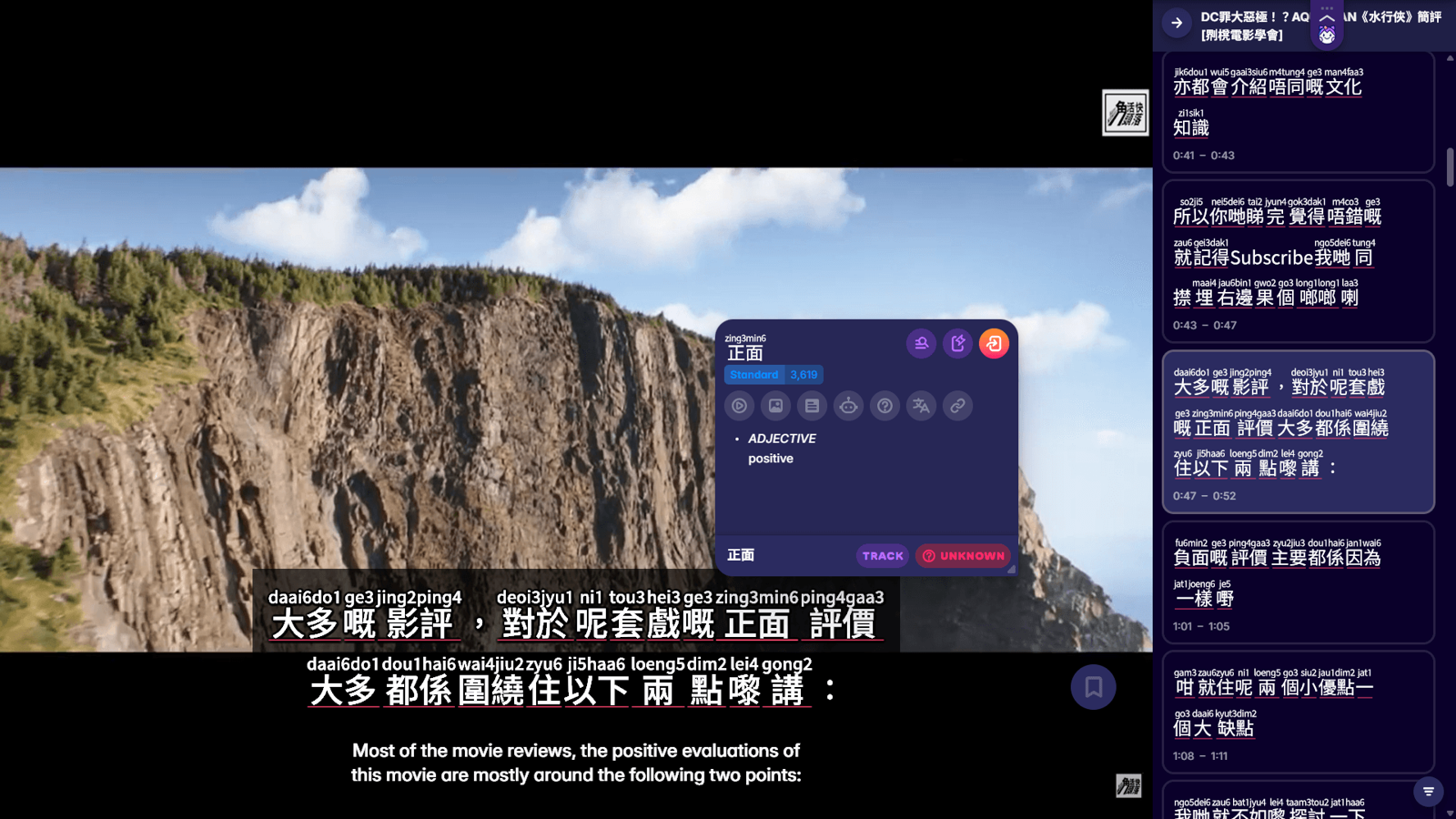
If you're serious about learning these terms through actual Cantonese content, Migaku's browser extension and app let you look up family vocabulary instantly while watching Hong Kong dramas or reading articles. Way more effective than grinding flashcards. There's a 10-day free trial if you want to check it out.
Learning how to refer to family members in Cantonese takes a lot
Don't stress about memorizing everything at once. Start with immediate family terms, add grandparents, then gradually expand to aunts, uncles, and cousins as you encounter them in real content. One of the best resources to learn family terms is to watch sitcoms like Kang's Family, in which most scenes happen in a family setting.
If you consume media in Cantonese, and you understand at least some of the messages and sentences within that media, you will make progress. Period.
Practice and repeat. That's how things become easy!