# Chinese Character Components: Learn the Basics of Radicals and Common Components
> Chinese character components give you a hint at the meanings and sounds of the character. Unlock the ability to analyze and look up characters here!
**URL:** https://migaku.com/blog/chinese/chinese-character-components
**Last Updated:** 2025-12-16
**Tags:** vocabulary, discussion, grammar
---
You’ve stared at a Chinese character and seen a tangled mess of lines when [learning Chinese](https://migaku.com/learn-chinese).😣 What if I told you there’s a simple, structured map hidden in that so-called mess? Here's something I've learned after years of wrestling with characters: they’re not random drawings. They’re built from reusable, meaningful pieces called components. And yes, memorizing thousands of unique squiggles sounds impossible. But breaking them down into a few hundred components? That’s a game-changer. Basically, components are your decoder ring.
---
## What exactly are Chinese character components?
When I was in China, we had foreign English teachers for our English-speaking sessions. That's when I get the opportunity to observe how people who know nothing about Chinese to write Chinese characters on the blackboard. As a native Chinese, I've grown used to the strokes and stroke order; sometimes we do not realize how difficult it is for an English speaker to write, or "draw", Chinese characters!
But with the knowledge about the components, things can be changed! A component is any distinct part that makes up a character.
1. Some carry meaning, some hint at sound.
2. And some are just there for structural balance.
3. Some characters have very simple strokes and structures that are considered to have only one component.
Let’s get concrete.
Take the character for “good,” which is . It’s not just a pretty shape. It’s made of two parts: (Woman) and (Child / Son). The ancient idea was that a woman having both daughters and sons represents “goodness.”
Now, you’ll love this: those components and appear everywhere. shows up in (Mother), (Older sister), and (Surname). Once you know it means “female,” you get a clue in every character it’s in.
If we dive in further, is a Chinese character on its own, meaning women. Because it features a simple structure and cannot be dissected further, learners can look up this kind of character in a dictionary directly by counting the strokes, without going through the radicals and other component sections.
The truth is, you’re not learning thousands of characters from scratch. You’re learning a core set of building blocks and seeing how they combine. The upside to this is massive efficiency, and you need to shift your mindset from “drawing” to “assembling meaning.”
---
## The superpowers of meanings and sounds: radicals and phonetic components
[Components](https://migaku.com/blog/chinese/chinese-radicals) basically have two main jobs, more or less. The first is to give a semantic hint, called a **radical**. The second is to sometimes suggest the pronunciation, called a **phonetic component**.
Here is an example for you to learn four simplified characters in one go: (Clear), (Sunny), (To ask), and (Feeling).
We can analyze them this way:
1. They all share the sound component (which itself means “blue/green”). While the pronunciation isn’t always exact, it’s a powerful clue.
2. Paired with different meaning components — 氵(Water) for clear water, 日(Sun) for sunny weather, 讠(Speech) for asking, and 忄(Heart) for feeling — the system starts to make sense.
You’re not memorizing four characters; you’re learning one sound cluster and four meaning categories. If you're a logical thinker, you'll thrive on these patterns.
However, not every character follows this rule, and some simple characters do not have radicals or components at all. That's why we need to adjust our expectations on how much this rule can help us, and combine this rule with simple memorization when learning Chinese characters!
---
## How to actually learn and use the components?
Alright, so how do you start? Don’t just stare at lists. The biggest mistake beginners make is treating components as another flashcard chore. Instead, see them in action.
Here’s my straightforward advice:
1. Start with the most frequent 100-150 components. Focus on the ones that are characters themselves, like (Water), (Fire), (Speech).
2. When you learn a new character, immediately break it down. Ask: What are its parts? Does one look familiar? For instance, (To rest) is (Person) next to (Tree). A person leaning against a tree — to rest. That image sticks. Create your own mental stories. The character (To fear) is (Heart) plus (White). Picture your heart turning white with fear. It’s cheesy, but it works.
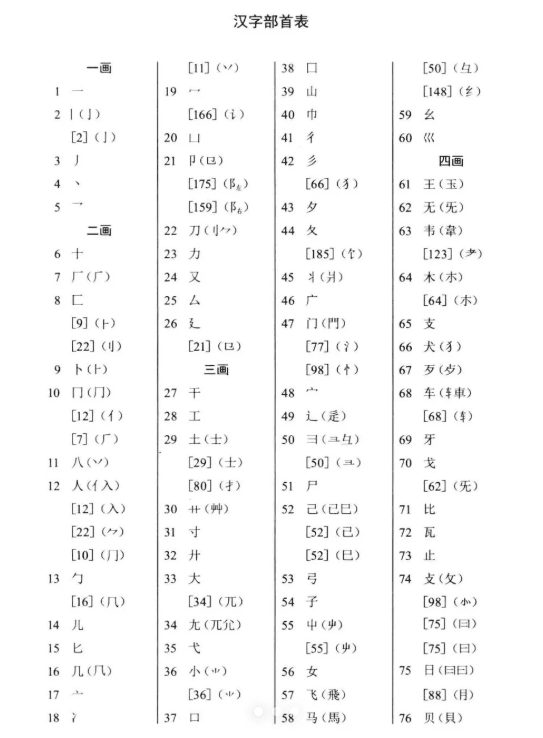
3. If you want to expand your knowledge and try to recognize more radicals, you can purchase a Chinese dictionary like (Xinhua Dictionary) and browse through its (Radicals) section, which is usually at the first couple of pages in the dictionary.
I promise you, the moment you stop seeing as [8 random strokes](https://migaku.com/blog/chinese/chinese-stroke-order) and start seeing “heart” + “white,” you’ve won.
This is a screenshot of the first page of the radical section in Xinhua Dictionary:
 ---
## If you are looking for a systematic start, here is a solution!
It's easy to feel overwhelmed when facing a new foreign language, not to mention that Chinese features a sharp learning curve from the very start! Learning strokes and radicals on your own can feel messy and confusing. But picking this knowledge up from a systematic teaching session, you will have a clearer idea of how to learn, what to learn, and to what extent you need to master it.
You can go for any beginner course for a systematic built, or try our course at Migaku, which teaches you Chinese pronunciation, and then 80% of the most common Chinese words and grammar patterns used in Chinese TV shows and movies.
1. This course teaches basic to intermediate Chinese
2. It features comprehensive lessons that introduce new Chinese words and grammar
3. It helps you study 1 new word at a time
---
## FAQs
A Chinese character is built from components (). These are the recurring, meaningful parts. Some are radicals that hint at meaning, like 氵 for water. Others are phonetic components that can suggest sound. Some are only for structural balance. They combine like LEGO bricks to form the full character.
There's no single exact count, as definitions vary and different dictionaries also arrange the components in their own way. However, a functional set for learners is around 200-300 key semantic and phonetic components. By mastering these, you can systematically analyze and remember thousands of characters. (Kangxi Dictionary) lists 214 traditional radicals, which is a common foundational framework.
The "five elements" refer to — a philosophical, not linguistic, system. Its core characters (Wood), (Fire), (Earth), (Metal), and (Water) are, however, fundamental semantic components in Chinese characters. They act as meaning radicals, appearing in hundreds of characters related to their respective element's qualities.
---
## So, what's the next step?
Understanding the Simplified Chinese components is a major step towards better vocabulary acquisition and handwriting. As the rule is simple, there is no need to spend more than 3 sessions of your time on it. Instead, keep the rule in mind and continue with your daily language studying plan. As you read and go through more and more media, you will get a firmer hold on the radical knowledge as well!
> If you consume media in Chinese, and you understand at least some of the messages and sentences within that media, you will make progress. _Period_.
Keep going!
---
## If you are looking for a systematic start, here is a solution!
It's easy to feel overwhelmed when facing a new foreign language, not to mention that Chinese features a sharp learning curve from the very start! Learning strokes and radicals on your own can feel messy and confusing. But picking this knowledge up from a systematic teaching session, you will have a clearer idea of how to learn, what to learn, and to what extent you need to master it.
You can go for any beginner course for a systematic built, or try our course at Migaku, which teaches you Chinese pronunciation, and then 80% of the most common Chinese words and grammar patterns used in Chinese TV shows and movies.
1. This course teaches basic to intermediate Chinese
2. It features comprehensive lessons that introduce new Chinese words and grammar
3. It helps you study 1 new word at a time
---
## FAQs
A Chinese character is built from components (). These are the recurring, meaningful parts. Some are radicals that hint at meaning, like 氵 for water. Others are phonetic components that can suggest sound. Some are only for structural balance. They combine like LEGO bricks to form the full character.
There's no single exact count, as definitions vary and different dictionaries also arrange the components in their own way. However, a functional set for learners is around 200-300 key semantic and phonetic components. By mastering these, you can systematically analyze and remember thousands of characters. (Kangxi Dictionary) lists 214 traditional radicals, which is a common foundational framework.
The "five elements" refer to — a philosophical, not linguistic, system. Its core characters (Wood), (Fire), (Earth), (Metal), and (Water) are, however, fundamental semantic components in Chinese characters. They act as meaning radicals, appearing in hundreds of characters related to their respective element's qualities.
---
## So, what's the next step?
Understanding the Simplified Chinese components is a major step towards better vocabulary acquisition and handwriting. As the rule is simple, there is no need to spend more than 3 sessions of your time on it. Instead, keep the rule in mind and continue with your daily language studying plan. As you read and go through more and more media, you will get a firmer hold on the radical knowledge as well!
> If you consume media in Chinese, and you understand at least some of the messages and sentences within that media, you will make progress. _Period_.
Keep going!