Days of the week in Chinese (+ how to say the days and months!)
Last updated: March 14, 2025

What day is it today?
(Checks notes...)
Ah! Today is the day you learn Chinese weekdays. Below you'll find a bunch of tables, vocabulary words, and example sentences related to the days of the week—plus audio recordings so you can check your pronunciation.
Anyway, let's get into it:
- [Grammar note] How time fits into sentences in Chinese and English
- 1. 礼拜 X vs 星期 X: The two main ways to say the days of the week in Chinese
- 2. 週 X: A more formal way to say the days of the week in Mandarin
- 3. X 月 Y 号: Combine the days and months of the year in Chinese to make dates
- Some bonus vocab related to dates in Chinese
- ... on the off chance you're trying to figure out how to get started learning Mandarin Chinese
[Grammar note] How time fits into sentences in Chinese and English
So, we need to take a quick detour.
The weekdays in Chinese are really easy to learn—you'll have them down in like three minutes. Tops.
What isn't quite so easy, unfortunately, is how to use them.
In English, time words can go pretty much anywhere in a sentence:
- In a moment, I'm going to tell you a secret.
- I originally planned to write this article on a Friday, but life got in the way.
- So now, here I am, in a cafe, with a much smaller glass of milk tea than I had anticipated, writing this article at noon on Saturday.
In contrast, Chinese isn't as flexible. You've got two main places where you can put time words, and they're both at the beginning of the sentence:
- Subject + Time + Verb + Object
我星期一去学校。
wǒ xīngqī yī qù xuéxiào.
On Monday, I go to school. - Time + Subject + Verb + Object
星期一我要尖叫。
xīngqī yī wǒ yaò jiānjiào.
On Monday, I'm going to shriek.
The structures are pretty much interchangeable, so don't overthink this too much. Just remember that when you're scheduling appointments or making plans with friends, you should place the date/time word before the main verb of the sentence.
1. 礼拜 X vs 星期 X: The two main ways to say the days of the week in Chinese
To remember all of the Chinese days of the week, you only need to remember three things:
- The week begins on Monday
- The weekdays are "weekday" + "number", as in weekday-one, weekday-two, and so forth
- Sunday breaks this pattern, becoming weekday-sun or weekday-day
So, if you know how to count in Chinese, you basically get the weekdays for free!
...The catch is that Chinese has two (actually three) words for "weekday":
- 星期 (xīngqī) is more formal
- 礼拜 (lǐbài) is more colloquial
- 周 (zhōu) is the most formal, and we'll talk about it in the next section
Nevertheless, you can basically consider 星期 and 礼拜 to be interchangeable. Chinese speakers use both. As such, while you'll hear both, you can just pick whichever one you like and use it all the time. I personally picked 礼拜 purely because I thought it was easier to pronounce than 星期.
English | † 礼拜 X | Pinyin | 星期 X | Pinyin |
|---|---|---|---|---|
Monday | 礼拜一 | lǐbàiyī | 星期一 | † xīngqīyī |
Tuesday | 礼拜二 | lǐbài'èr | 星期二 | xīngqī'èr |
Wednesday | 礼拜三 | lǐbàisān | 星期三 | xīngqīsān |
Thursday | 礼拜四 | lǐbàisì | 星期四 | xīngqīsì |
Friday | 礼拜五 | lǐbàiwǔ | 星期五 | xīngqīwǔ |
Saturday | 礼拜六 | lǐbàiliù | 星期六 | xīngqīliù |
Sunday | † 礼拜天 / 礼拜日 | lǐbàitiān/lǐbàirì | 星期天 / 星期日 | xīngqītiān/xīngqīrì |
- Note 1: The traditional version of 礼拜 is 禮拜.
- Note 2: In Taiwan, xīngqī is pronounced xīngqí. Compare: xīngqī vs xīngqí
- Note 3: Originally, in Chinese culture, months consisted of three 10-day weeks. Christian missionaries brought the 7-day calendar to China: 礼拜 literally means "attend a place of worship". One of 天's meanings is "heavens" so 礼拜天 is kind of like "The Lord's Day"; 日 means "sun", so 礼拜日 is more literally "Sunday". The words no longer have any religious connotation at all, and the only difference between them is that the ~天 variants are slightly more casual, while the 日 variants are slightly more formal.
Some example sentences featuring 礼拜 and 星期
Here are a few example sentences utilizing the vocabulary words we looked at above. In each set, the sentence is first written in simplified characters, then traditional ones.
- 礼拜五晚上我看了一部电影。
禮拜五晚上我看了一部電影。
lǐbài wǔ wǎnshàng wǒ kànle yí bù diànyǐng.
On Friday evening, I watched a movie. - 今天星期几? 今天星期二。
今天星期幾? 今天星期二。
jīntiān xīngqī jǐ? jīntiān xīngqī'èr.
What day is it today? Today is Tuesday. - 你星期六早上有空嗎?
你星期六早上有空嗎?
nǐ xīngqīliù zǎoshàng yǒu kòng ma?
Are you free on Saturday morning?* - 礼拜三好像也要下雨呢。
禮拜三好像也要下雨呢。
lǐbài sān hǎoxiàng yě yào xià yǔ ne.
It looks like it's going to rain again on Wednesday.
2. 週 X: A more formal way to say the days of the week in Mandarin
The third way you'll see weekdays expressed in Mandarin is via 週 (zhoū). The logic works exactly the same as it does with 礼拜 and 星期: just tack a number onto the end of 週, as shown below:
English | † 周 X | pinyin |
|---|---|---|
Monday | 周一 | zhōuyī |
Tuesday | 周二 | zhōu'èr |
Wednesday | 周三 | zhōusān |
Thursday | 周四 | zhōusì |
Friday | 周五 | zhōuwǔ |
Saturday | 周六 | zhōuliù |
Sunday | † 周日 | zhōurì |
- _† Note: The traditional version of 周 is 週.
- † Note: 周日 means Sunday. I was going to say that 周天 doesn't exist, but it apparently refers to a concept or certain type of exercise in Qigong. Anyway—if you see 周天, it (probably) doesn't mean Sunday!
This is the most formal variant of the three ways to refer to weekdays, and it's also the shortest, so you'll see it in newspapers, business emails, signs, and announcements... but it'll also show up in conversations, text messages, and informal places like that. It really just depends on the person, region, and situation!
Some example sentences featuring 週
- 由于除夕,我们的餐厅将于本周五休息一天。
由於除夕,我們的餐廳將於本週五休息一天。
yóuyú chúxì, wǒmen de cāntīng jiāng yú běn zhōu wǔ xiūxí yītiān.
Due to New Year's Eve, our restaurant will be closed this Friday. - 请在本周内回答。
請在本週內回答。
qǐng zài běn zhōu nèi huídá.
Please respond within this week. - 可以改为周二吗?
可以改為週二嗎?
kěyǐ gǎi wèi zhōu èr ma?
Could it be changed to Tuesday? - 营业时间: 週一 ~ 週五, 早上 8:00 ~ 晚上 5 点半
營業時間: 週一 ~ 週五, 早上 8:00 ~ 晚上 5 點半
yíngyè shíjiān: Zhōu yī ~ zhōurì 08:30-17:00
Business hours: Monday~Friday, 8:30–17:00
3. X 月 Y 号: Combine the days and months of the year in Chinese to make dates
The names of the months in Chinese are also just numbers... but, this time, the number comes first. You may see the months written out entirely in Chinese characters (一月) or with a number plus a character (1 月).
English | Chinese | Pinyin |
|---|---|---|
January | 一月 | yīyuè |
February | 二月 | èryuè |
March | 三月 | sānyuè |
April | 四月 | sìyuè |
May | 五月 | wǔyuè |
June | 六月 | liùyuè |
July | 七月 | qīyuè |
August | 八月 | bāyuè |
September | 九月 | jiǔyuè |
October | 十月 | shíyuè |
November | 十一月 | shíyīyuè |
December | 十二月 | shí'èryuè |
To write dates, just combine a month with #号:
- 一月一号
一月一號
yīyuè yī hào
January 1st
Alternatively, you may also see dates written out like this, especially in emails or when the dates of an event are being listed out on a poster or something like that:
- 12/18(三)16:00
12/18 (sān) 16:00
12/18 (Weds.) 16:00
Some bonus vocab related to dates in Chinese
Since you were Googling for how to say the weekdays in Mandarin Chinese, here's a collection of other words I suppose you might also be interested in:
English | Chinese | pinyin |
|---|---|---|
calendar | 日历 (日曆) | rìlì |
date (calendar date) | 日期 | rìqī |
schedule | 时间表 (時間表) | Shíjiān biǎo |
today | 今天 | jīntiān |
yesterday | 昨天 | zuótiān |
the day before yesterday | 前天 | qiántiān |
tomorrow | 明天 | míngtiān |
the day after tomorrow | 后天 (後天) | hòutiān |
this week | 这周 (這週) | zhèzhōu |
last week | 上周 (上週) | shàngzhōu |
next week | 下周 (下週) | xiàzhōu |
weekend | 周末 (週末) | zhōumò |
this month | 这个月 (這個月) | zhège yuè |
last month | 上个月 (上個月) | shàng ge yuè |
next month | 下个月 (下個月) | xià ge yuè |
last year | 去年 | qùnián |
this year | 今年 | jīnnián |
next year | 明年 | míngnián |
... on the off chance you're trying to figure out how to get started learning Mandarin Chinese
I'm not completely sure how to say this... but
If you're reading this because you want to learn Mandarin, know that you probably shouldn't go out of your way to learn the days of the week.
You see, words aren't equally useful. While native speakers know tens of thousands of words, you only actually need to know the ~1,500 most common ones to recognize ~80% of the words you encounter in sentences. Given the disproportionate value provided by these words, learning them should be your first priority as a new learner.
The Migaku Mandarin Academy teaches you these 1,500 words—and, surprise surprise, the days of the week are included.
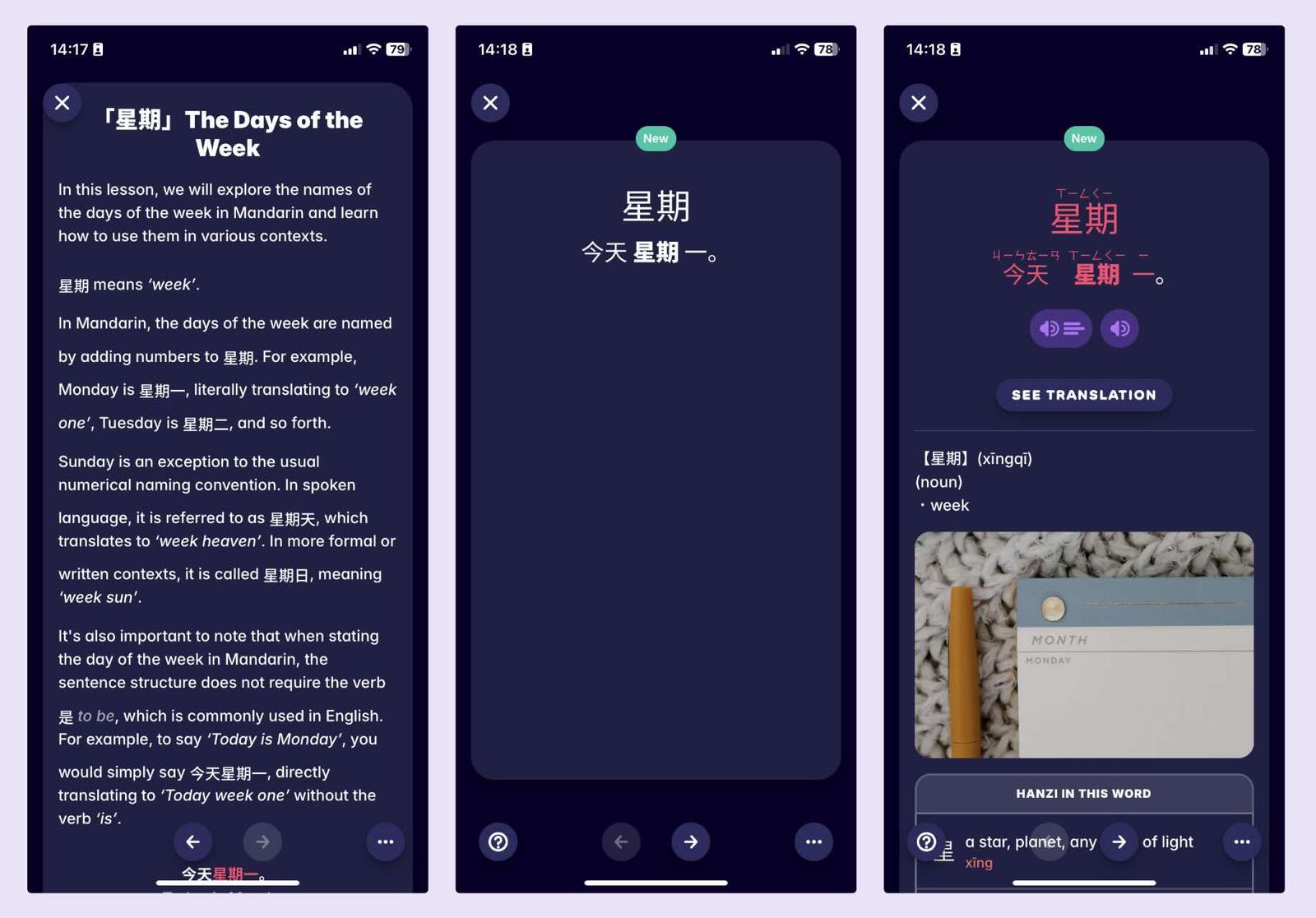
Our course is flashcard-based: each flashcard contains a vocabulary word, a sentence featuring that word, an image, and recordings of native speakers saying the word and the sentence.
What's special about our course is that each "next" flashcard contains only one word that you haven't learned yet, making the learning process super smooth.
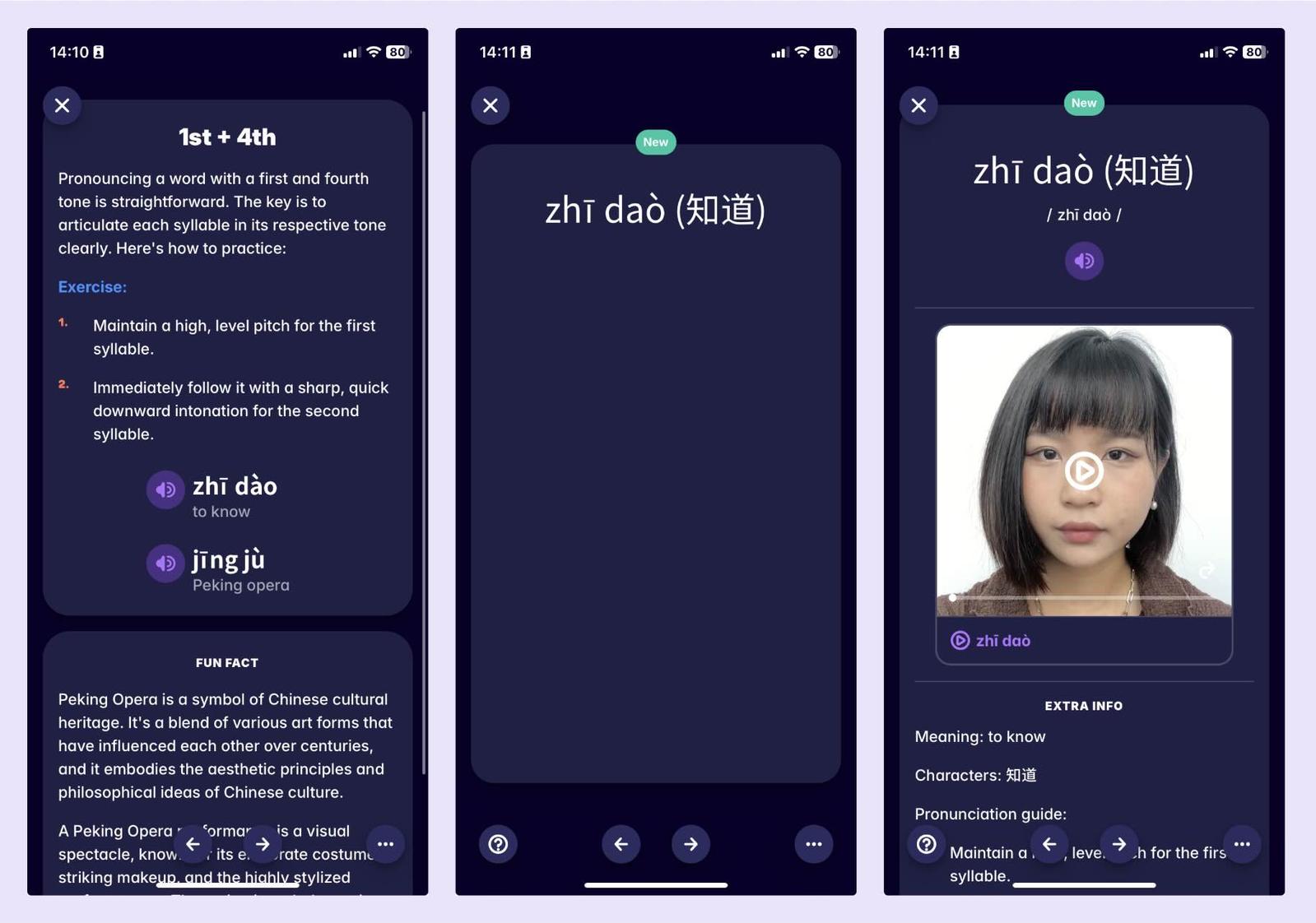
(Oh—if you're completely new to Chinese, our Migaku Chinese Fundamentals course teaches you how to read and correctly pronounce pinyin—including tones!)
Days in Chinese, weeks in Chinese, months in Chinese, years in Chinese
Nice 💪
But now you've got a bigger challenge: language learning is a marathon, not a sprint. Just sheer willpower won’t be enough—you've got to find ways to enjoy the process.
Remember this:
If you spend time interacting with Chinese media and you understand the messages within, you will make progress. Period.
So go ahead—spend days, weeks, months, and years enjoying Chinese content. The more fun you have with the language, the faster you'll progress. Enjoy!