# Chinese Duration Expressions: Syntax and Phrases to Express Duration in Mandarin
> Chinese duration expressions are crucial to understand how people talk about their daily life. This post helps you understand how people map duration.
**URL:** https://migaku.com/blog/chinese/chinese-duration-expressions
**Last Updated:** 2025-12-22
**Tags:** vocabulary, phrases
---
So, you want to talk about time when [learning Mandarin Chinese](https://migaku.com/learn-chinese).⌚ That's very smart of you to know that so many scenarios require Chinese duration expressions - how long you’ve been studying, or how many days your trip was... It’s the convenience of asking the restaurant how long you have to wait when you have a flight to catch. The good news? The logic is beautifully consistent. Basically, once you see the pattern, you can talk about any span of time. We’ll get you from confused to confident, so far as talking about time is concerned.
---
## The basic syntax of time expression for duration
The truth is, the most common way to express duration in Chinese feels very familiar to English speakers. In English, we put the time after the verb and the object: “I studied law for three hours.” In Chinese, the structure is basically the same, except that the object will need to be moved after the Chinese words for duration.
Remember that based on the tense of when this duration happens, we need to modify the verbs using particles like [了](https://migaku.com/blog/chinese/chinese-particle-le) (Past tense) accordingly.
> The structure is more or less this: Subject + Verb + Duration + Object
1. 。
*I watched TV for two hours.*
2. 。
*He has been working for five days.* ( signifies the past perfect tense.)
3. 。
*She will do an internship for two months.* ( marks the future tense here.)
The duration phrase itself (“two hours,” “five days”) slots directly in. All you need to consider is where to place the tense particles and the objects, for these are the differences from the English syntax.
---
## Where to add time and locations when using duration expressions in Chinese?
Now, what if I told you the structure can be more complicated? We not just want to tell the duration, but also when and where this action happens. As the locations and time join the syntax, we need a bit more adjustment based on the first section.
This pattern is highly similar to the basic [Chinese word order](https://migaku.com/blog/chinese/chinese-word-order). Just add the duration phrase at the end of the sentence!
> The pattern is: Subject + Time + Location + Verb + Duration
1. 。
*I have lived in Shanghai for three years.*
2. 。
*She waited twenty minutes at the cafe yesterday.*
See that “了” at the end of the first example? It often shows up here to indicate that the situation has continued up until now. The downside to this structure is that it feels a bit more “descriptive.” The upside? It’s incredibly natural to talk about life experiences and completed waits.
---
## What is the Chinese vocabulary for time units and duration?
We should address the measure word in the room. You know them for objects: (One book), (Three cats). Time words often need them too, but it’s way simpler. For days and above, you usually use for “day,” for most other units.
Here’s the practical cheat sheet I use:
| Categories | Chinese Examples | English Translations |
| - | - | - |
| Days | 三天 | Three days |
| Weeks | 两个星期/两周 | Two weeks |
| Months | 三个月 | Three months |
| Years | 两年 | Two years |
| Hours | 两个小时 | Two hours |
| Minutes | 五分钟 | Five minutes |
| Seconds | 三十秒 | Thirty seconds |
And a quick, honest warning against a common mistake: you cannot say “” for “one day”, or "" for "one year". It’s just or . Think of it as a special exception you memorize. You'll love how consistent it is once you get past that one.
---
## How to ask questions or express negations concerning duration time in Chinese?
Let’s get functional. How do you ask how long something took or lasted?
> You use (How long) or (How long, more casual).
1. ?
*How long have you been living in China?*
2. ?
*How long is this movie?*
> For negation — saying you didn’t do something for a period — you typically use the Verb + Duration structure with a .
1. 。
*I haven’t slept for three days.*
2. 。
*He hasn't gone to work for two days.*
The negation particle indicates the past tense. You can check [here](https://migaku.com/blog/chinese/chinese-negation) for more information on when to use .
---
## Let media teach you how to express the duration of time in real-life situations
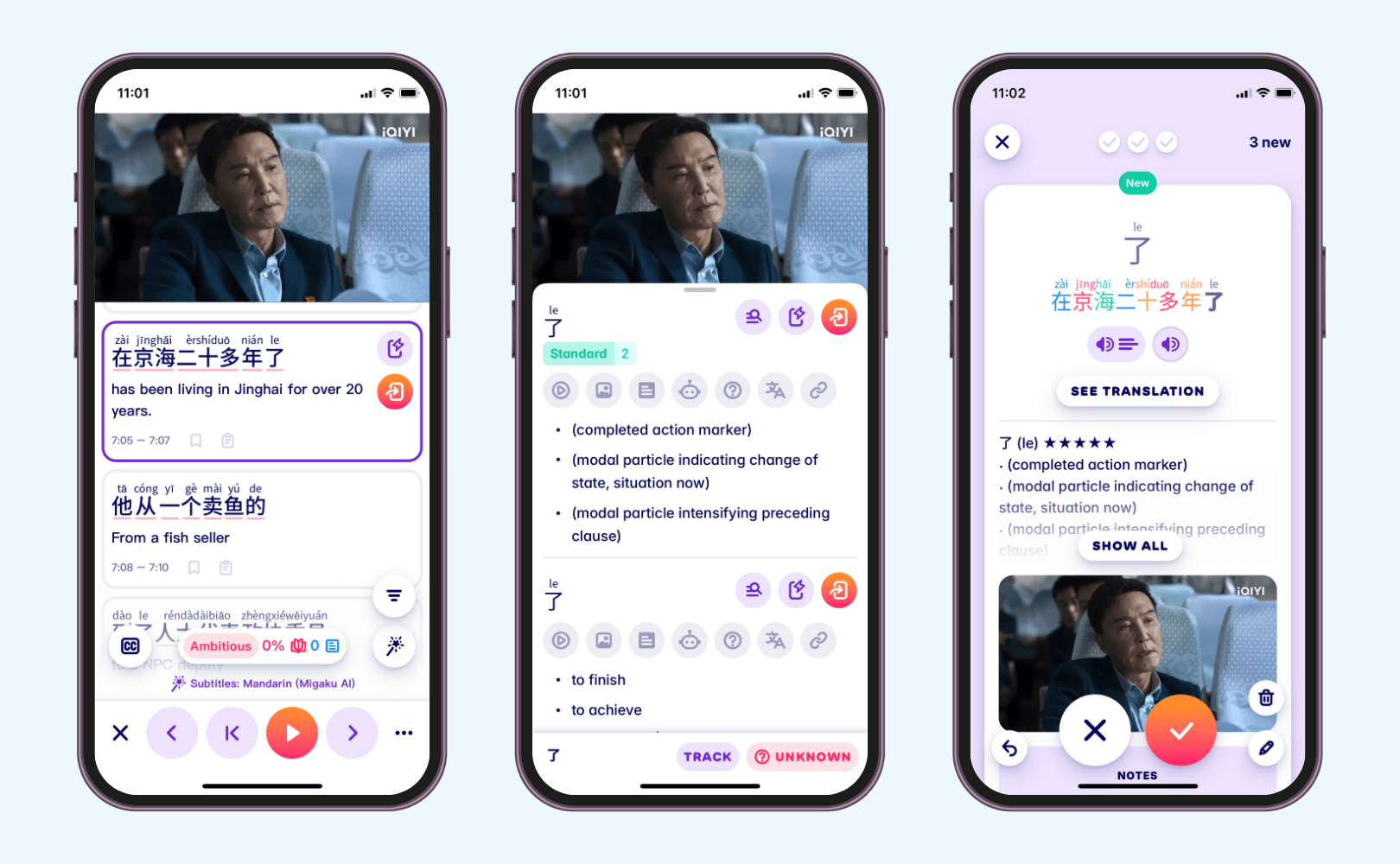
As time-related expressions are highly common in real life, you can learn a lot about Chinese grammar related to them from dramas and movies! The good news is, Migaku app can help generate Chinese subtitles even when the video does not feature any. For example, Migaku app can generate subtitles for this cut from *The Knockout* with the English translation. You can also click the words or sentences to add them to your flashcard collections and review them later.
1. Switch on YouTube and search for Chinese videos with the app.
2. Click "Watch with Migaku", and the magic wand at the lower right corner to generate Chinese subtitles.
3. Click on the new words or sentences in each subtitle and generate flashcards!
 ---
## FAQs
Yes, it's a direct loan translation from the Chinese phrase (Long time no see). It entered English in the early 20th century through interactions between English speakers and Chinese communities, initially as a kind of "Chinglish" phrase that was charming in its directness. Over decades of use, it became a fully naturalized, informal English greeting.
To express time duration, you need to acquire the vocabulary for days, hours, years, and others to signify how much time you spent on something. Then, follow the correct syntax like Subject + Time + Location + Verb + Duration to form a sentence.
---
## Understanding time and duration makes your life in China more convenient!
So there you have it. The truth is, talking about duration isn't about memorizing a thousand rules. It's about internalizing one core pattern — Subject + Time + Location + Verb + Duration + Object, and knowing how to measure your time words. Pay attention to the characters' lines in dramas and movies, and internalize these rules. You will see the progress.
> If you consume media in Chinese, and you understand at least some of the messages and sentences within that media, you will make progress. _Period_.
Now go try it.
---
## FAQs
Yes, it's a direct loan translation from the Chinese phrase (Long time no see). It entered English in the early 20th century through interactions between English speakers and Chinese communities, initially as a kind of "Chinglish" phrase that was charming in its directness. Over decades of use, it became a fully naturalized, informal English greeting.
To express time duration, you need to acquire the vocabulary for days, hours, years, and others to signify how much time you spent on something. Then, follow the correct syntax like Subject + Time + Location + Verb + Duration to form a sentence.
---
## Understanding time and duration makes your life in China more convenient!
So there you have it. The truth is, talking about duration isn't about memorizing a thousand rules. It's about internalizing one core pattern — Subject + Time + Location + Verb + Duration + Object, and knowing how to measure your time words. Pay attention to the characters' lines in dramas and movies, and internalize these rules. You will see the progress.
> If you consume media in Chinese, and you understand at least some of the messages and sentences within that media, you will make progress. _Period_.
Now go try it.