# Chinese Family Words: Understand How to Address Chinese Families and Its Inner Logic
> It's not easy to learn words for Chinese families. Here are the basics of the nuclear family, paternal, and maternal line for the family in Chinese.
**URL:** https://migaku.com/blog/chinese/chinese-family-words
**Last Updated:** 2025-12-03
**Tags:** vocabulary, culture, phrases
---
Most Chinese kids have been through this scenario:
Mom: (Quickly, say hi to your aunt.)
Kid: (Hi, auntie.)
You may wonder why the kid has to wait for mom's signal. That's because the kid may not know how to call this relative, for it is not as simple as calling her aunt! When you [learn Chinese](https://migaku.com/learn-chinese), you will realize that "aunt" could mean more than four different people. The world of Chinese family vocabulary is a precise and beautiful lexicon where every title maps a relationship. Learning these terms, and you are on your way to becoming a cultural insider!
---
## The cultural foundation of the vocabulary of Chinese families
Learning words for family members serves as both a linguistic cornerstone and a cultural decoder ring. These terms are among the most frequently used words in daily life, appearing in greetings, stories, and polite conversation, providing immediate practical utility.
More profoundly, this lexicon is the living embodiment of Confucian values like filial piety () and social hierarchy, teaching you that language in China is never separate from relationship and respect.
By starting with the Chinese family tree, you don't just memorize words like , (father's elder brother) and (mother's brother); you internalize the foundational Chinese worldview that defines an individual through their network of obligations and connections.
---
## Key terms for immediate family members in the Chinese family tree
### How to call your parents
Beginning with the most immediate relationships, the Chinese words for parents provide your first lesson in the language's blend of formality and intimacy. You will learn the standard terms (father) and (mother), which are used in formal or written contexts. However, in everyday speech, the affectionate, monosyllabic calls of (Dad) and (Mom) are universal, mirroring the close-knit nature of the family unit. When you are referring to my/your/his/her dad/mom, you can also simplify the expression as , such as (My dad)。
### How to call your siblings
Unlike English's single terms "brother" or "sister," in Chinese culture, it requires precision based on the gender, and whether this sibling is older or younger than you. You must distinguish between an older brother, , and a younger brother, , as well as an older sister, , and a younger sister, . The title itself, in the Chinese language, acknowledges the seniority and inherent responsibility of the elder sibling.
### How to call your children
Finally, the terms for children round out your nuclear family vocabulary in Mandarin Chinese. The word for son is , and for daughter, it is . These terms are straightforward but essential, often used with possessive pronouns like (My son) or in questions about family, such as (How many daughters do you have?). Based on their seniority, you need to refer to the eldest as (Eldest son/ daughter), the second (or others) using numbers, such as (Second eldest daughter/ Third eldest son), and the youngest one as (Youngest daughter/ son).
Here is a table for the nuclear family terms!
| Parents and Step-Parents | Siblings | Children and Step-Children |
| - | - | - |
| 爸爸
*Dad* | 哥哥
*Elder brother* | 儿子
*Son* |
| 妈妈
*Mom* | 姐姐
*Elder sister* | 女儿
*Daughter* |
| 后爸
*Step-dad* | 妹妹
*Younger sister* | 养子
*Step-son* |
| 后妈
*Step-mom* | 弟弟
*Younger brother* | 养女
*Step-daughter* |
---
## Chinese family vocabulary for extended families: grandparents and kinship
### How to call your grandparents as fitting the Chinese culture
The family words for grandparents in Chinese state a distinction between paternal and maternal lineages. For your father's parents, the intimate and foundational terms are for paternal grandfather and for paternal grandmother. In contrast, this system uses the prefix , meaning "outside," to clearly designate relatives from your mother's side. Your mother's parents are referred to as , outside grandfather, and , outside grandmother. This isn't a judgment of closeness but a linguistic reflection of traditional Chinese patrilineal family structure, where the father's line is the "inner" core.
### How to address family members of kinship
As to the extended family members, Chinese kinship terms meticulously categorize relatives based on four key filters:
1. whether they are on your father's side
2. or mother's side,
3. their generation relative to you,
4. and their age relative to your parent within that generation. This creates a specific title for nearly every conceivable relation.
For instance, your father's older brother is , while his younger brother is . Your mother's older brother is , while her younger brother is . Or you can call both of them as . Your father's sister is , and you can call them (father's older sister) or (father's younger sister). Your mother's sister is , and you can call them (mother's older sister) or (mother's younger sister).
The complexity and beauty of this system are perhaps best illustrated in the terms for cousins, which differentiate between paternal and maternal lines as well as gender. The most critical distinction is between (Paternal lines) and (Maternal lines). Cousins from your father's brothers (your paternal uncles) are your (Paternal line cousins)—they share your surname and are traditionally considered part of your inner clan. All other cousins—whether from your father's sister or your mother's siblings—are your (Maternal line cousins), a category historically viewed as "external" relations. Thus, you would address a specific cousin as (father's brother's son, older than you) or (mother's sister's daughter, younger than you).
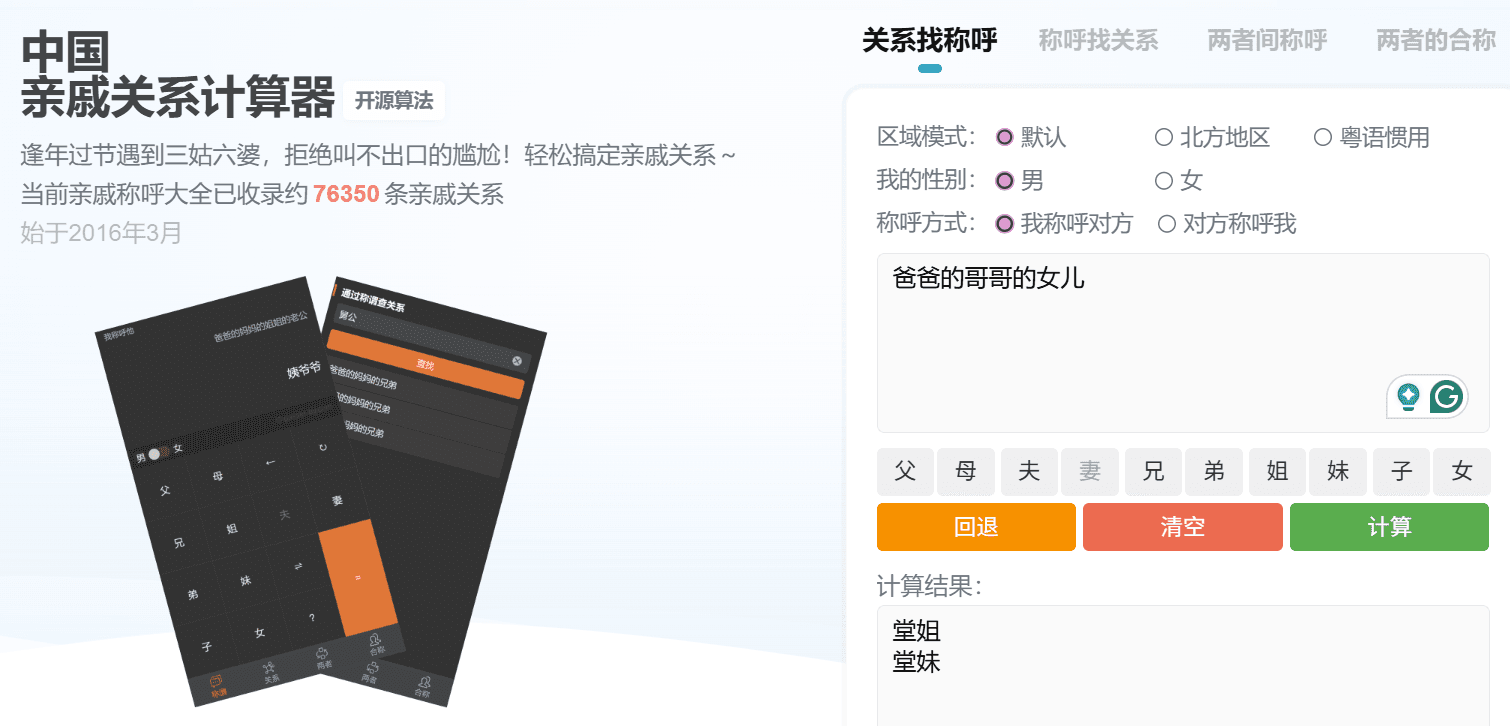
And yes, this is all very confusing, not to mention that different regions in mainland China have different customs in addressing family members in Chinese as well. So, you can try [this relative relationship calculator](https://passer-by.com/relationship/) out! There are many versions of calculators like this. You just need to input your relationship with this relative, and the calculator will tell you what the standard term for this relative is!
 ---
## Memorize the terms for family members in Chinese in real-life scenarios!
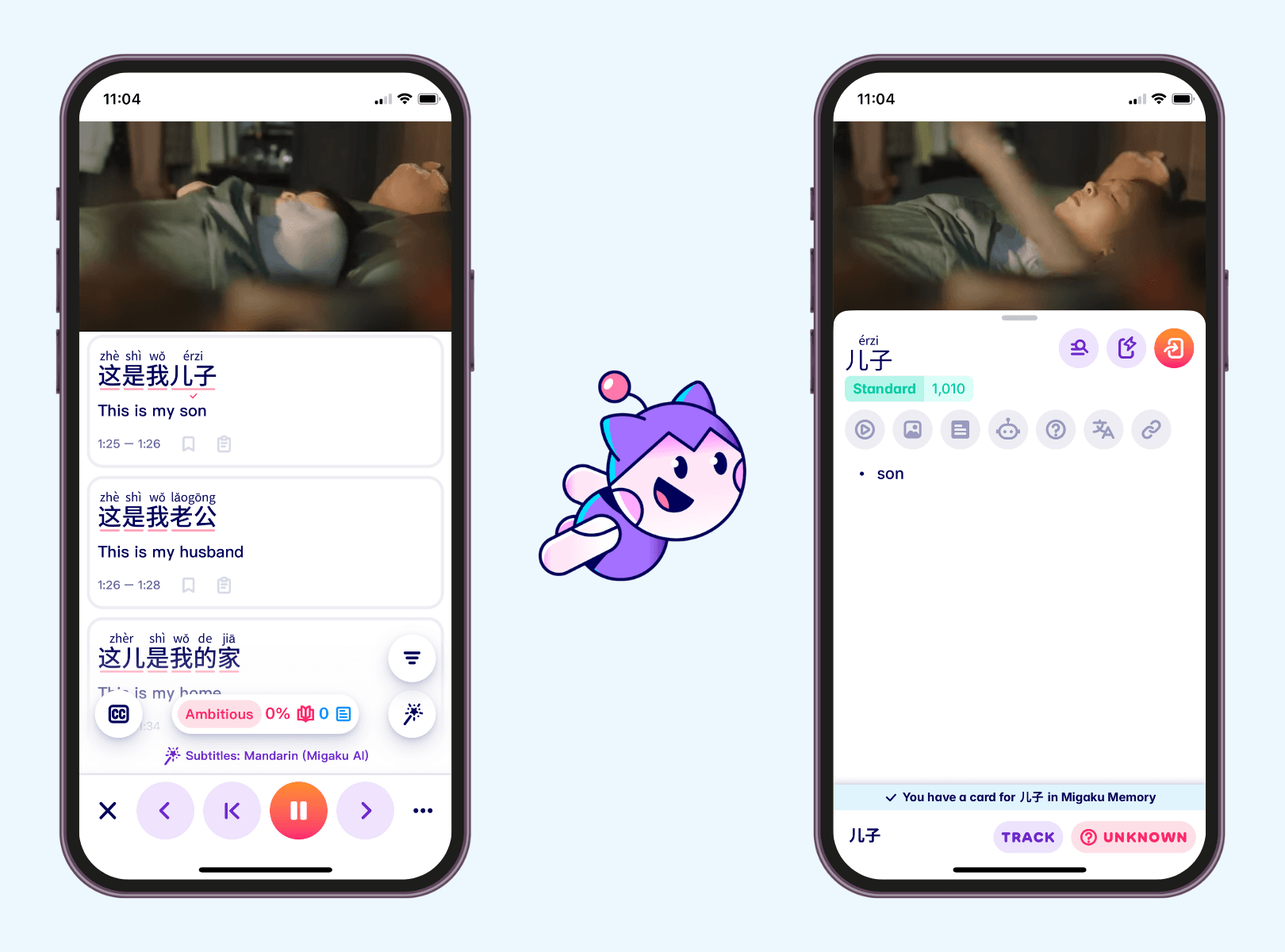
Equip yourself with the vocabulary of Chinese family members via Chinese drama! Family struggles are at the heart of many Chinese dramas in modern settings. Migaku app can help you understand the relationships by generating subtitles and creating flashcards for sentences!
1. Switch on YouTube and search for Chinese videos with the app
2. Click "Watch with Migaku", and the magic wand at the lower left corner to generate Chinese subtitles
3. Click on the new words or sentences in each subtitle and generate flashcards!
---
## Memorize the terms for family members in Chinese in real-life scenarios!
Equip yourself with the vocabulary of Chinese family members via Chinese drama! Family struggles are at the heart of many Chinese dramas in modern settings. Migaku app can help you understand the relationships by generating subtitles and creating flashcards for sentences!
1. Switch on YouTube and search for Chinese videos with the app
2. Click "Watch with Migaku", and the magic wand at the lower left corner to generate Chinese subtitles
3. Click on the new words or sentences in each subtitle and generate flashcards!
 ---
## FAQs
Mother-in-Law (Husband's Mother): This is the most common specific meaning. A wife refers to her husband's mother as . It is a key term in the family vocabulary for in-laws. General Term for an Elderly Woman: More broadly, can be used as a polite and slightly affectionate term for an elderly woman, similar to "granny" or "old lady."
is the collective Chinese noun for "sisters." It is a compound word combining (Older sister) and (Younger sister). Therefore, it inclusively refers to a group of female siblings regardless of birth order. It is also an Internet slang to refer to females in general, like "girls" or "sis".
---
## Why not draw a tree of members or relatives in Chinese?
Drawing family trees is an efficient practice for Chinese learners to master the Chinese family words. If you don't want to draw your own family trees, you can try drawing trees for characters in novels, drama, movies, or other media. Put theory into practice, and that's how you learn!
> If you consume media in Chinese, and you understand at least some of the messages and sentences within that media, you will make progress. _Period_.
Start drawing your (Relatives, literally meaning seven aunts from dad's side and eight aunts from mom's side) relationships!
---
## FAQs
Mother-in-Law (Husband's Mother): This is the most common specific meaning. A wife refers to her husband's mother as . It is a key term in the family vocabulary for in-laws. General Term for an Elderly Woman: More broadly, can be used as a polite and slightly affectionate term for an elderly woman, similar to "granny" or "old lady."
is the collective Chinese noun for "sisters." It is a compound word combining (Older sister) and (Younger sister). Therefore, it inclusively refers to a group of female siblings regardless of birth order. It is also an Internet slang to refer to females in general, like "girls" or "sis".
---
## Why not draw a tree of members or relatives in Chinese?
Drawing family trees is an efficient practice for Chinese learners to master the Chinese family words. If you don't want to draw your own family trees, you can try drawing trees for characters in novels, drama, movies, or other media. Put theory into practice, and that's how you learn!
> If you consume media in Chinese, and you understand at least some of the messages and sentences within that media, you will make progress. _Period_.
Start drawing your (Relatives, literally meaning seven aunts from dad's side and eight aunts from mom's side) relationships!