# Chinese Learning Resources: Online Resources for Beginners and Advanced Learners
> Explore Chinese learning resources beyond HSK and Duolingo. These apps and websites feature content for your reading, listening, and speaking practice.
**URL:** https://migaku.com/blog/chinese/chinese-learning-resources
**Last Updated:** 2025-12-08
**Tags:** resources, discussion
---
Duolingo is not the only option!🦉 The journey to fluency isn't about finding the one, but adapting many into resources that you can make use of. It is overwhelming to find the perfect [Chinese learning](https://migaku.com/learn-chinese) app, so maybe it's time to cast your eye on other apps that are not targeting language learning, but still function greatly as your Chinese learning helper! With the combination of structured guides and engaging real-world content, you can build comprehension from the ground up and soar into natural fluency. Let’s unlock the best tools for reading, listening, speaking, and fitting practice into your busy life.
---
## Structured reading resources for Mandarin beginners and advanced learners
Reading is the most important input for Chinese learners, and a proper reading resource that matches your language level can optimize your input efficiency.
For beginners, before you can run with novels, you need to walk with textbooks. The value of systematic learning should never be underestimated. Textbooks that stay up to date with the current modern language usage are the best option for building up the basics. If you do not already have a textbook in mind, you can try the most widely used [HSK Standard Course textbooks](https://www.digmandarin.com/forum/thread/hsk-standard-course-pdf-textbook). They provide a carefully graded ladder of grammar and vocabulary, and feature six levels for learners of different proficiency levels.
Another option for reading is to go through Mandarin learning websites, and you can pair your textbook with readings from websites. The upside of reading from a website is that these websites usually have more beginner-level texts. Learners can benefit from a variety of different texts using high-frequency words as well. One example is [Mandarin Bean](https://mandarinbean.com/all-lessons/?jsf=epro-loop-builder&tax=category:3). This website specializes in HSK-based reading exercises, offering a vast library of leveled texts with instant translation and grammar breakdowns. It is convenient for beginners, but it also has its disadvantages. The texts are short and not very engaging if you are looking for something more cultural, analytical, or in-depth.
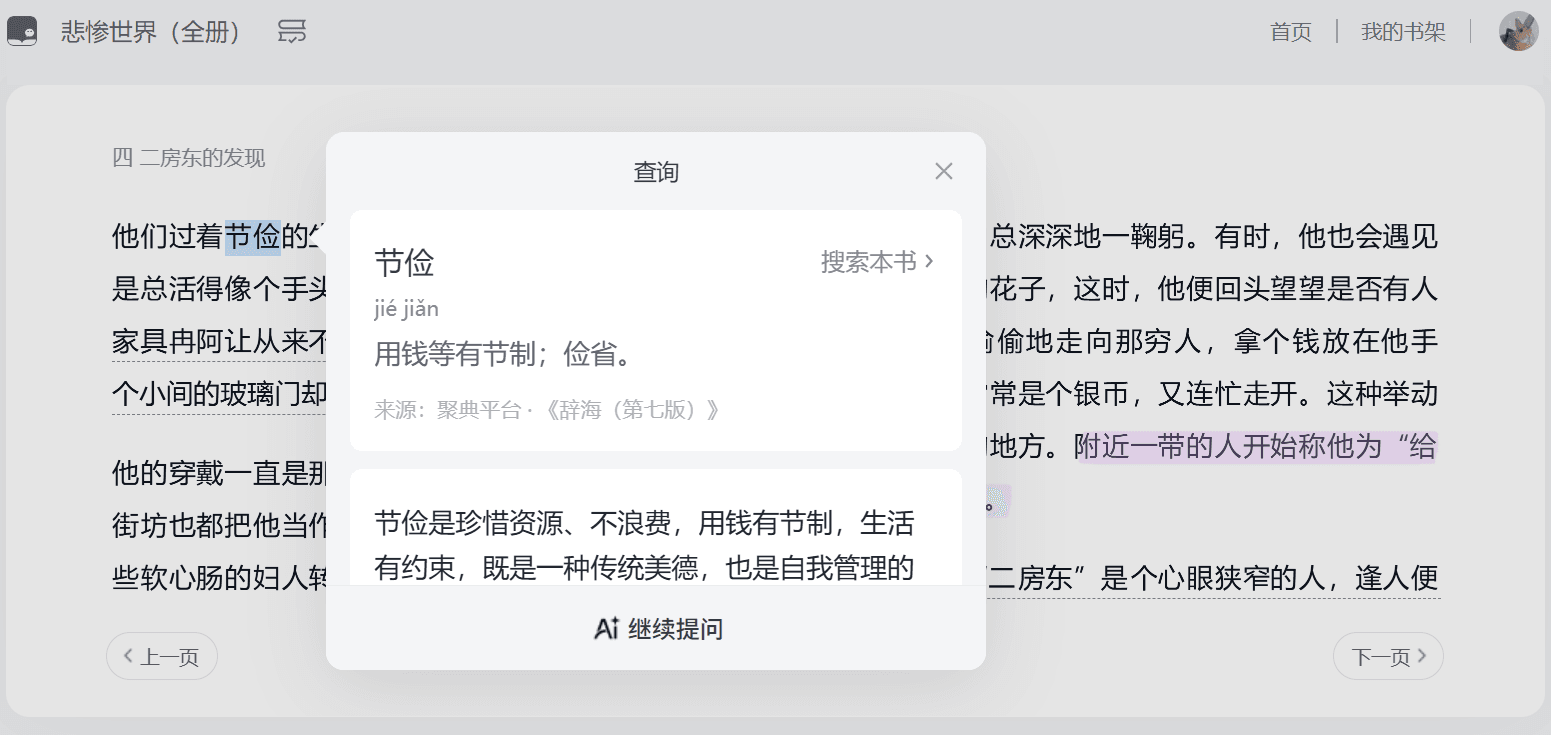
When you’re ready to graduate from textbook dialogues, bridge the gap with (WeRead). This massive Chinese e-book app is a treasure trove of native material. You can start with simplified classics, modern web novels, or Chinese translations of Western classics. Especially for the Chinese translations, this type of material is about the story you might have already been familiar with, and the language style of translation is generally standard Chinese, helping you avoid being confused by some authors' highly personalized language style.
This is a screenshot of the Chinese translation of *Les Misérables* from WeRead. Readers can highlight the text and search for its Chinese definitions, which is a rather immersive learning experience.
 ---
## Listening resources to begin and graduate your Chinese learning with
Conversation comprehension begins with the ear. Start with the audio accompaniments to your textbooks. Textbook audio has no background noise and adopts a slower speed and clearer pronunciation, which is designed for beginners who are not fully familiar with words and grammar yet. It does not matter which textbook you use, and [you can use HSK as well](https://www.digmandarin.com/forum/thread/hsk-standard-course-pdf-textbook). Listen actively: pause and repeat sentences, mimic the tones, and transcribe what you hear if you want to practice handwriting as well. This sharpens your ability to distinguish sounds like “qī” and “chī,” building the critical auditory foundation.
Additionally, you can try using a language app like Duolingo to train your ear when collecting vocabulary. The key is to go through several Chinese learning apps on your app store and pick one that gives you audio when feeding you new words. Word-level listening practice is the foundation for understanding any other listening materials.
Once your ear is primed, immerse it in the living language through Chinese drama and film. The ultimate goal is to watch without Chinese subtitles, but you can try to go through this process:
1. Watch with Chinese and your native language subtitles
2. Watch with Chinese subtitles
3. Watch without any subtitles
Platforms like Netflix, YouTube, iQIYI, or Bilibili offer a wealth of content. Your first pass can be watching them with leisure with two language subtitles. Then, pick and re-watch short clips. Listen for the phrases you’ve studied, notice how questions rise in intonation, and how emotions color speech. It would be even better if you could find a tool that can help you pause and look up new words in the subtitles.
When picking materials, you can go through:
1. Netflix for Chinese dramas and movies,
2. YouTube for classic Chinese dramas and movies that have been released for a long while, like ([*The Legend of Zhen Huan*](https://www.youtube.com/watch?v=QOaXm_9S9_0&list=PLbyBdEO7i3Lb4W9nMbMvSjFpAwVX12ZNa))
3. [Bilibili](https://www.bilibili.com/) for Chinese streamings, commentaries, and influencers' videos.
---
## Utilize your reading and listening resources for speaking when learning Mandarin
Speaking fluently requires moving knowledge from your head to your mouth. The most effective techniques are repeating after and shadowing. These two techniques are related and can be practiced together.
1. Revisit a short, clear audio clip from a drama, podcast, or even your textbook.
2. Play a sentence, pause, and immediately imitate it aloud — not just the words, but the exact tone, rhythm, and emotion.
3. After repeating after each sentence throughout the whole clip, try shadowing it, meaning to play it with a slower speed or original speed and speak together while the audio is playing.
For a more structured approach, you can use the same resources from reading and listening practice for your speaking improvements. For example, WeRead has an audio feature that can read out the book you are currently reading, even when it is not an audiobook. Or, you can also manually pause YouTube or Netflix videos to practice speaking.
---
## Social media can help you with micro-learning
Consistency trumps cramming. Integrate Chinese into the fabric of your day through microlearning on social media, and you can go through new knowledge every day just like browsing any other interesting content.
1. Follow dedicated Chinese learning accounts on Instagram, TikTok, or RedNote. Take RedNote as an example. Many accounts have Chinese texts and language learning related content, but they are not professional or commercial accounts. So, instead of searching the account names, try searching (Chinese learning) in RedNote directly, and click on several content that you are interested in. Then, check if that account has similar posts.
2. Teach the app algorithm to feed you more Chinese learning content. Some apps like RedNote have a more aggressive algorithm. If you click on 2 - 5 posts of Chinese learning on your feed page, it will keep pushing you similar content in the following days. Whenever Chinese content is fed to you, like it or check it to tell the algorithm that you are still interested!
3. Take this a step further by curating your own immersion feed. Follow authentic Chinese influencers in your hobbies—be it cooking, tech, fitness, or travel. Seeing captions about (Baking) or (Fitness) in a real-world context anchors the vocabulary far more deeply than any list. This constant, low-effort exposure keeps the language active in your mind, ensuring you’re building progress every single day, not just during “study time.”
---
## Who doesn't want to have a tool for subtitle and flashcard generation?
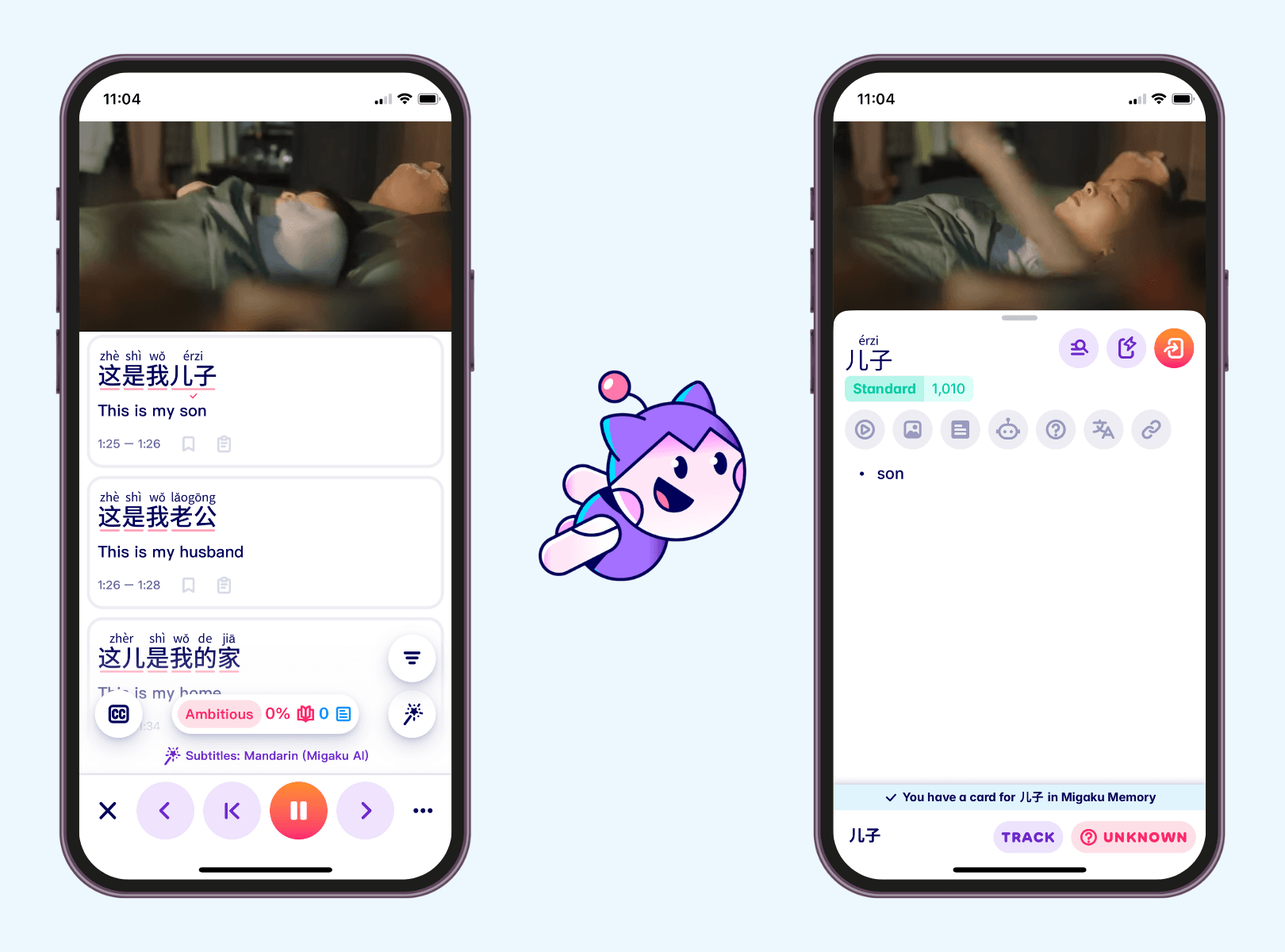
Be it for reading, listening, or speaking, Migaku app can help you make full use of media resources and generate Chinese subtitles even when the video does not feature any. This tool can greatly expand your pool for any kind of practice. For example, Migaku app can generate subtitles for this cut from *Nothing but Thirty* with the English translation. You can also click the words or sentences to add them to your flashcard collections and review them later. It is your best assistant for engaging with the media content.
1. Switch on YouTube and search for Chinese videos with the app
2. Click "Watch with Migaku", and the magic wand at the lower right corner to generate Chinese subtitles
3. Click on the new words or sentences in each subtitle and generate flashcards!
---
## Listening resources to begin and graduate your Chinese learning with
Conversation comprehension begins with the ear. Start with the audio accompaniments to your textbooks. Textbook audio has no background noise and adopts a slower speed and clearer pronunciation, which is designed for beginners who are not fully familiar with words and grammar yet. It does not matter which textbook you use, and [you can use HSK as well](https://www.digmandarin.com/forum/thread/hsk-standard-course-pdf-textbook). Listen actively: pause and repeat sentences, mimic the tones, and transcribe what you hear if you want to practice handwriting as well. This sharpens your ability to distinguish sounds like “qī” and “chī,” building the critical auditory foundation.
Additionally, you can try using a language app like Duolingo to train your ear when collecting vocabulary. The key is to go through several Chinese learning apps on your app store and pick one that gives you audio when feeding you new words. Word-level listening practice is the foundation for understanding any other listening materials.
Once your ear is primed, immerse it in the living language through Chinese drama and film. The ultimate goal is to watch without Chinese subtitles, but you can try to go through this process:
1. Watch with Chinese and your native language subtitles
2. Watch with Chinese subtitles
3. Watch without any subtitles
Platforms like Netflix, YouTube, iQIYI, or Bilibili offer a wealth of content. Your first pass can be watching them with leisure with two language subtitles. Then, pick and re-watch short clips. Listen for the phrases you’ve studied, notice how questions rise in intonation, and how emotions color speech. It would be even better if you could find a tool that can help you pause and look up new words in the subtitles.
When picking materials, you can go through:
1. Netflix for Chinese dramas and movies,
2. YouTube for classic Chinese dramas and movies that have been released for a long while, like ([*The Legend of Zhen Huan*](https://www.youtube.com/watch?v=QOaXm_9S9_0&list=PLbyBdEO7i3Lb4W9nMbMvSjFpAwVX12ZNa))
3. [Bilibili](https://www.bilibili.com/) for Chinese streamings, commentaries, and influencers' videos.
---
## Utilize your reading and listening resources for speaking when learning Mandarin
Speaking fluently requires moving knowledge from your head to your mouth. The most effective techniques are repeating after and shadowing. These two techniques are related and can be practiced together.
1. Revisit a short, clear audio clip from a drama, podcast, or even your textbook.
2. Play a sentence, pause, and immediately imitate it aloud — not just the words, but the exact tone, rhythm, and emotion.
3. After repeating after each sentence throughout the whole clip, try shadowing it, meaning to play it with a slower speed or original speed and speak together while the audio is playing.
For a more structured approach, you can use the same resources from reading and listening practice for your speaking improvements. For example, WeRead has an audio feature that can read out the book you are currently reading, even when it is not an audiobook. Or, you can also manually pause YouTube or Netflix videos to practice speaking.
---
## Social media can help you with micro-learning
Consistency trumps cramming. Integrate Chinese into the fabric of your day through microlearning on social media, and you can go through new knowledge every day just like browsing any other interesting content.
1. Follow dedicated Chinese learning accounts on Instagram, TikTok, or RedNote. Take RedNote as an example. Many accounts have Chinese texts and language learning related content, but they are not professional or commercial accounts. So, instead of searching the account names, try searching (Chinese learning) in RedNote directly, and click on several content that you are interested in. Then, check if that account has similar posts.
2. Teach the app algorithm to feed you more Chinese learning content. Some apps like RedNote have a more aggressive algorithm. If you click on 2 - 5 posts of Chinese learning on your feed page, it will keep pushing you similar content in the following days. Whenever Chinese content is fed to you, like it or check it to tell the algorithm that you are still interested!
3. Take this a step further by curating your own immersion feed. Follow authentic Chinese influencers in your hobbies—be it cooking, tech, fitness, or travel. Seeing captions about (Baking) or (Fitness) in a real-world context anchors the vocabulary far more deeply than any list. This constant, low-effort exposure keeps the language active in your mind, ensuring you’re building progress every single day, not just during “study time.”
---
## Who doesn't want to have a tool for subtitle and flashcard generation?
Be it for reading, listening, or speaking, Migaku app can help you make full use of media resources and generate Chinese subtitles even when the video does not feature any. This tool can greatly expand your pool for any kind of practice. For example, Migaku app can generate subtitles for this cut from *Nothing but Thirty* with the English translation. You can also click the words or sentences to add them to your flashcard collections and review them later. It is your best assistant for engaging with the media content.
1. Switch on YouTube and search for Chinese videos with the app
2. Click "Watch with Migaku", and the magic wand at the lower right corner to generate Chinese subtitles
3. Click on the new words or sentences in each subtitle and generate flashcards!
 ---
## FAQs
There is no single "best" way, as it depends on your goals. However, the most effective approach combines structured study (for grammar/characters, reading/listening/speaking) with active immersion (using media & conversation). Consistent, daily practice — no matter how many minutes you designate for language learning on the day — creates the repetition that is needed for Chinese learning.
Duolingo is a convenient tool for building a consistent habit and learning foundational vocabulary and basic sentences. However, it is insufficient alone. It lacks deeper grammar explanations, and for intermediate learning, learners need to leverage other apps and resources for more complex training.
---
## Explore your resources, and maximize their use for learning Mandarin Chinese language!
Ultimately, it's not about how many resources you have, but how well you utilize them! A single media resource, like WeRead, can be adapted for reading, listening, and shadowing practice. Migaku app plus YouTube is another combination that learners can explore to integrate these features into daily practice!
> If you consume media in Chinese, and you understand at least some of the messages and sentences within that media, you will make progress. _Period_.
Teaching one to fish is better than giving a fish. !
---
## FAQs
There is no single "best" way, as it depends on your goals. However, the most effective approach combines structured study (for grammar/characters, reading/listening/speaking) with active immersion (using media & conversation). Consistent, daily practice — no matter how many minutes you designate for language learning on the day — creates the repetition that is needed for Chinese learning.
Duolingo is a convenient tool for building a consistent habit and learning foundational vocabulary and basic sentences. However, it is insufficient alone. It lacks deeper grammar explanations, and for intermediate learning, learners need to leverage other apps and resources for more complex training.
---
## Explore your resources, and maximize their use for learning Mandarin Chinese language!
Ultimately, it's not about how many resources you have, but how well you utilize them! A single media resource, like WeRead, can be adapted for reading, listening, and shadowing practice. Migaku app plus YouTube is another combination that learners can explore to integrate these features into daily practice!
> If you consume media in Chinese, and you understand at least some of the messages and sentences within that media, you will make progress. _Period_.
Teaching one to fish is better than giving a fish. !