# Chinese Listening Practice: Four Methods Suitable for Beginners and Advanced Learners
> These four Chinese listening practices are suitable for learners of all levels. Hone your Mandarin listening skills with hard work and a splash of fun!
**URL:** https://migaku.com/blog/chinese/chinese-listening-practice
**Last Updated:** 2025-12-04
**Tags:** resources, discussion
---
Elusive and fast, that's most [Chinese learners](https://migaku.com/learn-chinese)' first impression when native speakers are talking. And with a touch of accents, listening to Chinese is turning into "Mission Impossible" completely... 🥲 Characters give you the map, but listening comprehension is a long and winding journey. It’s a separate skill that requires its own dedicated training. The good news? With a targeted, step-by-step approach, you can systematically tune your ear. This guide outlines a four-stage practice regimen to transform rapid sounds into clear meaning.
---
## Practice 1: build a solid vocabulary collection as a beginner
Before tackling sentences, you must first become intimately familiar with the basic building blocks for listening skills: syllables and tones. This foundational stage is about developing accurate phonemic awareness, because you will be going nowhere without a solid vocabulary collection for Mandarin listening practice.
1. Begin by rigorously pairing every new vocabulary word you learn with its standard audio pronunciation. The pinyin of each Mandarin Chinese word must be marked accurately. You can collect them with the help of flashcards, which is the key feature of some language apps.
2. Actively listen and repeat, because sometimes, beginners cannot pronounce naturally solely by looking at pinyin. In this case, you need to listen to the audio and check the pinyin at the same time.
3. Try minimal pair drills. You can group words into minimal pairs, such as words that differ only by tone (e.g., vs. ) or by a similar sound (e.g., vs. ). This fine-tunes your auditory discrimination.
---
## Practice 2: listen to contextual dialogues that are at the beginner level
Once individual sounds become clearer, the next step is to hear them strung together in meaningful, predictable contexts. This stage focuses on comprehensible input—listening material where you already know most of the words, and the scenario provides clear clues. Some textbooks feature sample dialogues that can happen in restaurants, train stations, and other day-to-day scenarios.
1. Focus on themed, scripted dialogues from textbooks or language learning platforms. Scenarios like "Ordering Food," "Asking for Directions," or "Making a Plan" are perfect.
2. Read the dialogue with pinyin to understand it. Then, listen to the audio without reading, trying to answer simple questions: Where are they? What does Person A want? What time did they agree on? This trains you to extract meaning from the stream of sound.
3. As to the resources for this Chinese listening practice, you can go for the dialogues from your coursebook (like the HSK standard course), or YouTube videos like (Ordering in Chinese).
For example, listen to this sample video to learn Chinese dialogues at restaurants.
---
## Practice 3: Mandarin media immersion for intermediate and advanced learners
To understand real-world Chinese, you must move beyond clear, slow, textbook audio and expose yourself to the natural rhythm, intonation, and pace of the language. This stage is about immersion and exposure. The goal is not full comprehension, but to "get the feel" of the language—how sentences rise and fall, how speakers express emotion, and how words blend together in casual speech.
This practice is more of a long-term approach for intermediate learners who are genuinely interested in Chinese culture and wish to learn Chinese beyond short-term travellers' language level.
1. Watch through a large number of videos, be it reality shows, dramas, movies, or documentaries. Opt for long videos over short videos, because long videos offer you a better immersion experience with their twists and turns of the plot. You can watch with Chinese and your native language subtitles.
2. Listen to Chinese songs. Understanding songs is more difficult than understanding videos, as there are no tones for characters in songs. Find songs you like on Spotify or YouTube, look up the lyrics (), and sing along. This is more about convenience and repetition, because we usually listen to songs while doing something else, and tend to listen to them repeatedly.
---
## Practice 4: intensive Chinese listening practice with subtitles
This final, active practice stage is where you develop high-resolution listening comprehension. The goal is to close the gap between what you think you hear and what is actually being said, while expanding your ability to understand more complex and unstructured speech.
1. Choose a video you think you will enjoy.
2. Use a platform that allows you to toggle Chinese subtitles on and off, such as Netflix or YouTube.
3. Follow this intensive process: First, watch with subtitles, focusing on the gist. Second, watch without Chinese subtitles, pausing at every line you didn't fully catch. Listen again, look at the characters, and analyze why you missed it—was it a new word, a tonal change, or fast linking of speech?
4. If this practice is way too advanced for you, try to watch videos with Chinese subtitles on. Instead of solely relying on listening, practicing listening with visual assistance (Chinese subtitles) can serve the purpose as well.
As a side note, almost all the Chinese TV channels and movies at the theater feature subtitles. Generally speaking, the only scenario where you need to listen to Chinese without any assistance is when you are talking to people directly.
---
## Unlock a fluent Chinese listening practice experience with Migaku app
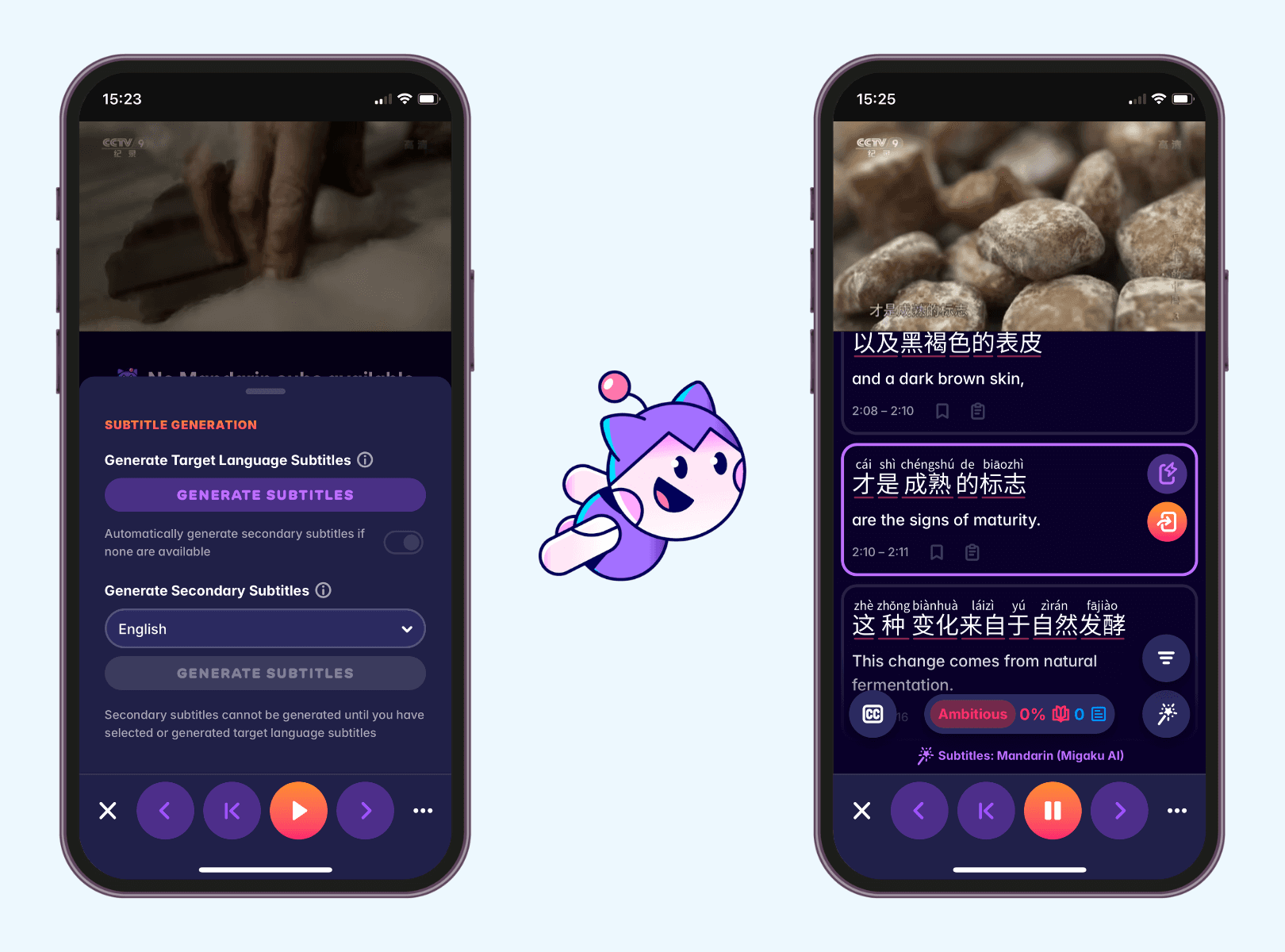
Migaku app can generate Chinese subtitles even when the video does not feature any. This tool can greatly expand your pool for listening practice. For example, Migaku app can generate subtitles for this cut from *A Bite of China* with the English translation. You can also click the words or sentences to add them to your flashcard collections and review them later. It is your best assistant for intensive Chinese listening practice.
1. Switch on YouTube and search for Chinese videos with the app
2. Click "Watch with Migaku", and the magic wand at the lower right corner to generate Chinese subtitles
3. Click on the new words or sentences in each subtitle and generate flashcards!
 ---
## FAQs
Follow a strategic four-stage process. First, master vocabulary sounds and tones. Second, practice with simple, contextual dialogues. Third, immerse yourself in native content like songs and videos to absorb rhythm. Finally, use intensive listening with Chinese subtitles to bridge gaps.
Listening is essential but insufficient alone. It's the primary way to acquire natural pronunciation, tones, rhythm, and intuitive grammar. However, to read, write, and deepen comprehension of vocabulary and characters, you must combine it with active study. Listen, read, and speak. This is the general rule for any language learning!
---
## How about challenging your listening skills by listening to speakers with accents?
If you feel so confident about your Chinese listening skills, why not spice up your practice with the accent challenge? China is a country with many provinces, and people from different areas speak under the influence of their local dialects. Sometimes, the same thing will have different names across the country. That's how some videos can help you adapt to this situation.
> If you consume media in Chinese, and you understand at least some of the messages and sentences within that media, you will make progress. _Period_.
Listen to this one: (I want to eat the morning glory so much!)
---
## FAQs
Follow a strategic four-stage process. First, master vocabulary sounds and tones. Second, practice with simple, contextual dialogues. Third, immerse yourself in native content like songs and videos to absorb rhythm. Finally, use intensive listening with Chinese subtitles to bridge gaps.
Listening is essential but insufficient alone. It's the primary way to acquire natural pronunciation, tones, rhythm, and intuitive grammar. However, to read, write, and deepen comprehension of vocabulary and characters, you must combine it with active study. Listen, read, and speak. This is the general rule for any language learning!
---
## How about challenging your listening skills by listening to speakers with accents?
If you feel so confident about your Chinese listening skills, why not spice up your practice with the accent challenge? China is a country with many provinces, and people from different areas speak under the influence of their local dialects. Sometimes, the same thing will have different names across the country. That's how some videos can help you adapt to this situation.
> If you consume media in Chinese, and you understand at least some of the messages and sentences within that media, you will make progress. _Period_.
Listen to this one: (I want to eat the morning glory so much!)