# Chinese Modal Verbs: Use 会, 能, 可以 This Way to Talk in Mandarin Chinese
> Check here for the grammar of 会, 能, 可以, and advice on how to learn Chinese modal verbs. Complete guide including negations and sentence examples.
**URL:** https://migaku.com/blog/chinese/chinese-modal-verbs
**Last Updated:** 2025-12-18
**Tags:** grammar, verbs
---
Simple translation from the English "can" does not work here.❌ The truth is, [Chinese](https://migaku.com/learn-chinese) doesn’t just ask if you can do something — it cares deeply about why. Is it a learned skill? A permission granted? A physical ability in this exact moment? To deal with these nuances, there are three different verbs: , , and . Understanding their split is your key to sounding precise and appropriate, not just correct.
---
## 会 (huì): The modal verb in Chinese for learned skill & inherent probability
Let’s start with , the most misunderstood of the trio. We often translate it as “can,” but that’s misleading. is not about ability in the moment; it’s about knowledge and skill acquired through learning or practice. It’s the verb for what you know how to do.
1. 。
*She knows how to speak Chinese.*
2. 。
*I know how to swim.*
The implication is clear: there was a time before you didn’t know, and now you do. It’s a stable, internal capability. Think of it as your resumé verb. If you use here (), you’re shifting the meaning to a situational ability, like “She is able to speak Chinese (right now, because her throat isn’t sore).”
But has a second, equally important job: expressing future likelihood. This isn’t a random extension; it’s about predicting based on inherent nature or learned patterns.
1. 。
*It will rain tomorrow.*
2. 。
*He will definitely come.*
> So, bridges two core ideas: **know-how** (a learned internal state) and **future certainty** (a predicted external state). Both are about projecting a stable quality forward in time.
---
## 能 (néng) vs. 可以 (kě yǐ): Chinese modal verbs for permissions and conditions
Now we get to the pair that causes the most headaches: and . They both often translate to “can” or “may,” and in many simple permission contexts, they’re interchangeable.
The word is the verb of social permission or broadly acceptable options. It’s about being allowed or something being feasible.
1.
*Teacher, may I go to the bathroom?* (Asking for permission.)
2.
*You may park here.* (It is permitted/allowed.)
3.
*You can try this method.* (You can only use when it is about recommending something.)
The character , however, is fundamentally about capability or circumstance. It asks: Do the external or personal conditions enable this?
1. 。
*I’m sick, so I can’t go.* (My health condition prevents it.)
2.
*This room can house three people.* (Its physical capacity allows it.)
3.
*The phone is dead, so it can’t take pictures.* (The external circumstance - no power - disables the function.)
However, nowadays, people more and more use the two verbs interchangeably when it comes to considering the conditions.
> The strict rule is: Use when referring to **permission** and **recommendation**, and use them interchangeably for **external or personal conditions**.
---
## The negations of the modal verbs in Chinese
Of course, there’s a significant gray area where and overlap, as mentioned in the previous section.
The true clarifying power, however, comes with negation. This is where the meanings diverge, and misunderstanding happens fast.
1. often implies an external, circumstantial obstruction.
。
*I am unable to tell you.* (Because of rules, a secret, an order.)
2. is a direct prohibition or denial of permission.
。
*You are not allowed to tell him.*
Similarly, compare and when refusing.
1. 。
*I don’t drink.* (A statement of personal practice.)
2. 。
*I can’t drink.* (Stating that the conditions are not allowed.)
---
## A simple guideline on how to choose modal verbs in Mandarin Chinese
So how do you move from memorizing rules to intuitively choosing the right word? You adopt a new mindset. Before you say “can,” pause and ask a quick internal audit:
1. Is this about know-how or prediction? → Use .
(I can play piano. / It will probably be cold.)
2. Is this about external permission or recommendations? → Use .
(May I leave? / You can use this app.)
3. Is this about physical/mental capacity or circumstantial possibility? → Use or .
(I can lift 50kg. / I can’t be exposed to the sunlight.)
---
## Grammar books can never replace real-world training
According to the rules above, should I say for "I can't come"? Wait, that sounds weird, and people usually say . Even the best grammar book cannot exhaust the real-life cases in language learning.
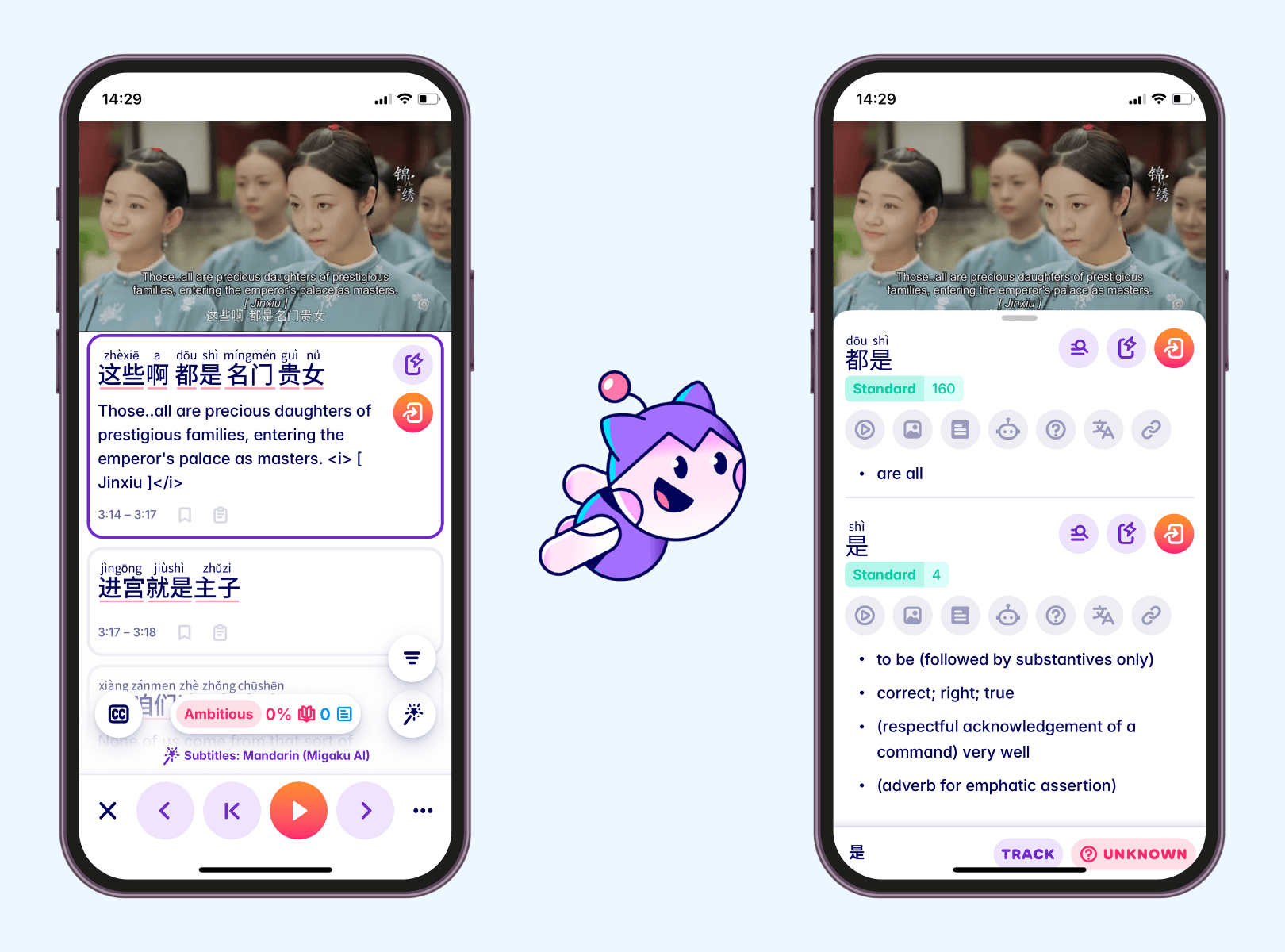
The good news is, Migaku app can help you make full use of media resources to learn Chinese and generate Chinese subtitles even when the video does not feature any. For example, Migaku app can generate subtitles for this cut from Story of Yanxi Palace with the English translation. You can also click the words or sentences to add them to your flashcard collections and review them later. It can assist you with collecting sentences related to the modal verbs.
1. Switch on YouTube and search for Chinese videos with the app
2. Click "Watch with Migaku", and the magic wand at the lower right corner to generate Chinese subtitles
3. Click on the new words or sentences in each subtitle and generate flashcards!
 ---
## FAQs
Yes, absolutely—and they're essential. Chinese modal verbs like , , and don't just translate "can" or "will." They express a distinct type of ability: for learned skill or prediction, for circumstantial capability, for permission and recommendation. Mastering them means understanding not just grammar, but the Chinese logic of possibility and probability.
The core Chinese modal verbs are: : For learned skill or future prediction. : For capability or circumstantial possibility. : For permission or recommendation. : For strong intention or necessity. : For advice or moral obligation. : For simple possibility.
Use grammar books to get the core rules — understand the why behind vs. vs. . Then, immediately switch to media (shows, podcasts, conversations). Listen actively: every time you hear a modal verb, pause. Ask your book's rule: Why did they use here and not ? This bridges theory to the nuanced, living language. Books map the territory; media teach you how to walk it.
---
## Mastering modal verbs in Chinese is more important than you might think...
Modal verbs not just express meanings; they allow listeners to tell your attitudes about things too. Imagine telling your boss that (I can draft this material, but...) In this case, the modal verb together with "but" conveys the tone that you are not really willing to do something... And, the media is the best place where you can pick up thousands of cases like this!
> If you consume media in Chinese, and you understand at least some of the messages and sentences within that media, you will make progress. _Period_.
Regardless of knowing how, first say if you're able to!
---
## FAQs
Yes, absolutely—and they're essential. Chinese modal verbs like , , and don't just translate "can" or "will." They express a distinct type of ability: for learned skill or prediction, for circumstantial capability, for permission and recommendation. Mastering them means understanding not just grammar, but the Chinese logic of possibility and probability.
The core Chinese modal verbs are: : For learned skill or future prediction. : For capability or circumstantial possibility. : For permission or recommendation. : For strong intention or necessity. : For advice or moral obligation. : For simple possibility.
Use grammar books to get the core rules — understand the why behind vs. vs. . Then, immediately switch to media (shows, podcasts, conversations). Listen actively: every time you hear a modal verb, pause. Ask your book's rule: Why did they use here and not ? This bridges theory to the nuanced, living language. Books map the territory; media teach you how to walk it.
---
## Mastering modal verbs in Chinese is more important than you might think...
Modal verbs not just express meanings; they allow listeners to tell your attitudes about things too. Imagine telling your boss that (I can draft this material, but...) In this case, the modal verb together with "but" conveys the tone that you are not really willing to do something... And, the media is the best place where you can pick up thousands of cases like this!
> If you consume media in Chinese, and you understand at least some of the messages and sentences within that media, you will make progress. _Period_.
Regardless of knowing how, first say if you're able to!