# Chinese Prepositions: Master Common Chinese Prepositions and How to Use Prepositions in Sentences
> Improve your fluency with the word order of Chinese prepositions. Learn the words to describe position, direction, and movement in Mandarin.
**URL:** https://migaku.com/blog/chinese/chinese-prepositions-location-words-guide
**Last Updated:** 2026-03-01
**Tags:** fundamentals, vocabulary, grammar
---
If you've been [learning Mandarin](https://migaku.com/learn-chinese) for a while, you've probably noticed that Chinese handles prepositions differently than English. The whole system feels backwards at first because Chinese prepositions work closely with location words to describe where things are, where you're going, and how objects relate to each other in space. Here's the thing: mastering these isn't about memorizing lists. You need to understand how prepositions and location words combine to form natural sentence patterns that Chinese speakers use every day.
---
## Why Chinese prepositions differ from English
> 💡 Chinese vs. English Prepositions 💡
The fundamental difference between Chinese and English prepositions comes down to **[word order](https://migaku.com/blog/chinese/chinese-word-order)** and how each language structures information.
**English tends to put prepositional phrases after verbs, while Chinese places them before verbs.** This reflects a broader pattern in Chinese grammar where context and setting come before action.
Chinese also combines prepositions with location words more systematically than English. In English, you might say "on the table" or "in the room" using just a preposition and noun. Chinese typically adds a location word after the noun: (on table-top) and (in room-inside).
This system actually gives you more precision. When you say , you're specifying the surface of the table. If you said , you'd mean underneath the table. The location word makes the spatial relationship crystal clear.
---
## Common Chinese prepositions you'll use constantly
### 在 (zài): Location and existence
This is probably the most important preposition you'll learn. 在 indicates where something is located or where an action takes place. You'll use it dozens of times every day.
> The basic pattern is: Subject + 在 + Location + Verb
Examples:
- 。
*I work at home.*
- 。
*The book is on the table.*
- 。
*He studies at the library.*
When 在 appears with location words (which we'll cover in detail below), it creates precise descriptions of position. The combination of 在 plus a noun plus a location word gives you the exact spatial relationship.
### 从 (cóng): Starting point and origin
从 indicates where something starts, originates, or comes from. It's similar to "from" in English, but Chinese uses it more consistently.
> Pattern:
> - Subject + 从 + Starting Point + Verb
> - Subject + 从 + Starting Point + Verb + 到 + Ending Point
> - Subject + 从 + Starting Point + 到 + Ending Point + 很 + Adjective
Examples:
- 。
*I come from America.*
- 。
*He works from morning to evening.*
- 。
*From here to there is very far.*
从 often pairs with to show a complete range or journey from one point to another. This combination appears constantly when describing time periods, distances, or processes.
### 到 (dào): destination and arrival
到 marks the endpoint or destination of movement. Think of it as "to" or "until" depending on context.
Examples:
- 。
*I go to school.*
- 。
*Work until 5 o'clock.*
- 。
*He arrived in Beijing.*
The pattern creates a complete range: means "from Monday to Friday."
### 对 (duì): Direction toward and attitude
对 indicates direction toward someone or something, often in an abstract sense. It's commonly used to express attitudes, opinions, or actions directed at someone.
Examples:
- 。
*Say to me.*
- 。
*Have interest in Chinese.*
- 。
*Treat him well.*
对 appears frequently in phrases expressing feelings or attitudes toward things. You'll see it paired with verbs like (to speak), (to be interested), and (to be important).
### 离 (lí): Distance from
离 describes the distance between two points or how far something is from something else.
Examples:
-
*The school is close to home.*
- ?
*How far is it from Beijing?*
- 。
*My home is not far from the subway station.*
---
## Basic location words that combine with prepositions in Mandarin language
Location words () are the secret sauce that makes Chinese spatial descriptions work. These words specify exact positions relative to a reference point. You'll combine them with prepositions like to create precise location phrases.
The core location words are:
| Chinese | English |
| - | - |
| | on, above, up |
| | under, below, down |
| | front, before |
| | back, behind |
| | left |
| | right |
| | inside |
| | outside |
These single-character words form the foundation, but you'll usually see them with suffixes that make them into complete location phrases.
### Suffixes that complete location words: 边, 面, and 旁
Chinese adds suffixes to basic location words to create fuller expressions. The three most common are , , and .
边 means "side" and creates casual location words:
| Chinese | English |
| - | - |
| | on top, above |
| | below, underneath |
| | in front |
| | behind |
| | left side |
| | right side |
| | outside |
面 also means "side" but sounds slightly more formal:
| Chinese | English |
| - | - |
| | on top |
| | below |
| | in front |
| | behind |
| | inside |
| | outside |
旁 specifically means "beside" or "next to":
- = beside, next to
In everyday speech, 边 and 面 are often interchangeable. Some regions prefer one over the other, but both work fine in most situations.
---
## How to build location phrases with prepositions
The standard pattern for describing location in Chinese follows this structure:
> 在 + Reference Object + Location Word
Examples:
-
*On the table.*
-
*In the room.*
-
*In front of the school.*
-
*Next to the bank.*
When you put this into a complete sentence, remember the **preposition phrase comes before the verb**:
- 。
*The cat sleeps on the sofa.*
- 。
*The book is on the bookshelf.*
- 。
*The supermarket is next to the subway station.*
---
## Time prepositions and how they work in Mandarin Chinese
Chinese uses some of the same prepositions for time as it does for space. This makes sense when you think about time as a dimension you move through.
**在 works for specific times**:
-
*On Monday.*
-
*At 3 o'clock.*
-
*In 2026.*
**从 and 到 create time ranges**:
-
*From morning to evening.*
-
*From 2020 to 2026.*
Time phrases in Chinese also **come before the verb**, just like location phrases:
- 。
*I study in the evening.*
- 。
*He worked from yesterday to today.*
---
## Prepositions with direction and movement
When describing movement and direction, Chinese combines prepositions with directional verbs to create precise meanings.
> Common directional combinations:
> - 往: toward (indicates direction)
> - 向: toward, facing
Examples:
-
*Walk forward.*
-
*Turn left.*
-
*Drive north.*
---
## Object prepositions and how they function
Some Chinese prepositions relate to how verbs affect objects or how actions target specific things. These include , which we covered earlier, plus others like:
**: to give, for**
-
*Call me.* (Literally: to me make phone call)
-
*Buy a gift for him.*
**: with, and**
-
*Go with friends.*
-
*Speak with him.*
These prepositions introduce the recipient or companion of an action. Like other prepositional phrases in Chinese, they come before the main verb in the sentence.
---
## Practical tips for mastering prepositions in Chinese
1. Start by focusing on the big three: , , and . These cover most spatial and temporal relationships you'll need in daily conversation. Practice them with the basic location words () until the combinations feel automatic.
2. Pay attention to word order. Train yourself to think "at location do action" instead of "do action at location." This mental shift takes time but makes Chinese sentence structure click into place.
3. Create example sentences for each preposition using places and objects from your daily life. Instead of memorizing abstract examples, use real locations you know: your home, workplace, favorite cafe, local subway station. This makes the patterns stick better.
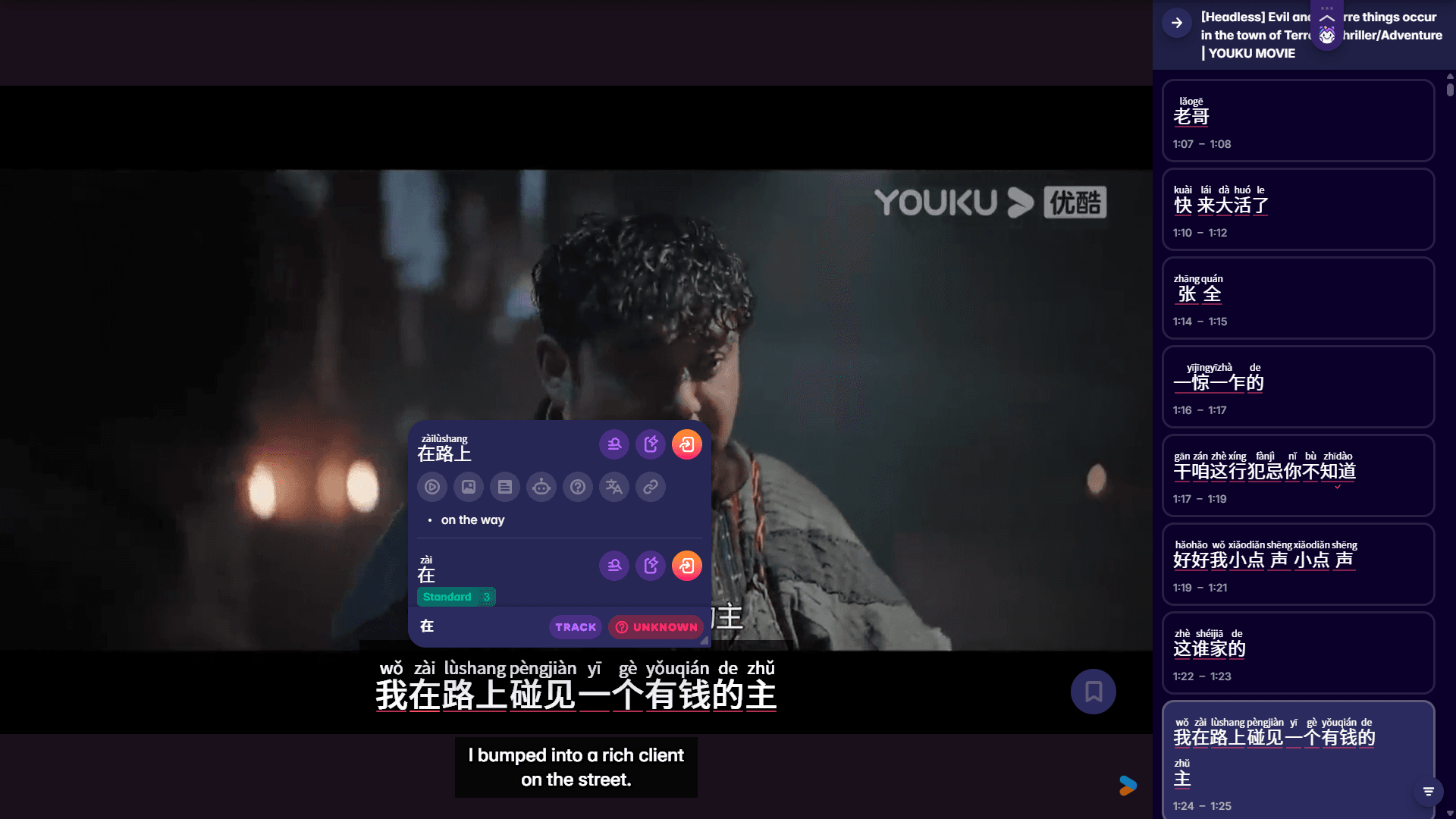
4. Listen for prepositions in native content. You'll hear 在 constantly in Chinese media. Notice how speakers combine it with different location words and verbs. The repetition in natural context helps you internalize the patterns way faster than drilling grammar rules.
5. Practice describing your surroundings. Look around the room and describe where objects are using 在 plus location words. "The laptop is on the desk" becomes . "The bag is under the chair" becomes . This active practice builds the neural pathways you need.
If you want to practice these prepositions with real Chinese content, Migaku's browser extension and app let you look up words and grammar patterns instantly while watching shows or reading articles. Makes learning from context way more practical. There's a 10-day free trial if you want to check it out.
 ---
## FAQs
Yes, Chinese absolutely uses prepositions, but they function differently in comparison with the English ones. In Mandarin, prepositions come before their objects (just like English), but the preposition phrase usually appears before the main verb in the sentence. This order trips up English speakers constantly. Chinese prepositions also tend to be more specific about spatial relationships than English. Where English might use "at" for multiple situations, Chinese distinguishes between being at a location, moving toward something, or coming from somewhere with different prepositions.
---
## Using prepositions in Chinese correctly makes you sound way more natural!
I've heard English speakers translating English sentences into Chinese ones following the English word order all the time. Honestly, Chinese speakers can still understand you if you say (Literally "I came from USA.") It seems like a small change to make, to adjust the word order to , but the sentence sounds instantly native and natural! It's also true that it is not just about picking up grammar rules, but also about changing your mindset and thinking like a native Chinese speaker. The only way to achieve this is through immersion. The more media content you consume, the more natural your Chinese becomes.
> If you consume media in Chinese, and you understand at least some of the messages and sentences within that media, you will make progress. _Period_.
The best language teacher is the media. 👩🏫
---
## FAQs
Yes, Chinese absolutely uses prepositions, but they function differently in comparison with the English ones. In Mandarin, prepositions come before their objects (just like English), but the preposition phrase usually appears before the main verb in the sentence. This order trips up English speakers constantly. Chinese prepositions also tend to be more specific about spatial relationships than English. Where English might use "at" for multiple situations, Chinese distinguishes between being at a location, moving toward something, or coming from somewhere with different prepositions.
---
## Using prepositions in Chinese correctly makes you sound way more natural!
I've heard English speakers translating English sentences into Chinese ones following the English word order all the time. Honestly, Chinese speakers can still understand you if you say (Literally "I came from USA.") It seems like a small change to make, to adjust the word order to , but the sentence sounds instantly native and natural! It's also true that it is not just about picking up grammar rules, but also about changing your mindset and thinking like a native Chinese speaker. The only way to achieve this is through immersion. The more media content you consume, the more natural your Chinese becomes.
> If you consume media in Chinese, and you understand at least some of the messages and sentences within that media, you will make progress. _Period_.
The best language teacher is the media. 👩🏫