# Chinese Slang Words: Popular Chinese Internet Vocab for 2026
> With a budget of a banana, you can only hire a monkey (not a human). Chinese slang words and expressions are ever evolving. Unlock the culture behind them!
**URL:** https://migaku.com/blog/chinese/chinese-slang-guide
**Last Updated:** 2026-01-29
**Tags:** vocabulary, culture, phrases
---
Mastering casual slang words is what transforms you from a careful speaker into someone who can banter, joke, and truly connect like a native. As shown in the picture, you can joke with your friends that your salary right now is only a "banana"🍌, in which case you can only deliver the job quality of a monkey!🐒
Basically, [learning Chinese ](https://migaku.com/learn-chinese)internet slang is your fastest ticket to sounding cool. So, what are we waiting for? Let's explore the slang that can make you sound cool!
---
## The core toolkit: Must-know Chinese internet slang words you can use today
Let’s start with the workhorses — phrases with serious staying power that are safe and effective in most casual settings. These are your foundation for sounding like a native speaker.
First, you absolutely need (Reliable/Solid). It’s the ultimate compliment for a person, a plan, or even information. It implies trustworthiness and stability. You’ll hear it constantly when people are making plans or vouching for someone.
- 。
*He does things very reliably, handing it to him is no problem.*
- ?
*Is this news you heard reliable?*
- 。
*We need to find a reliable renovation company.*
For anything awesome, effective, supportive, or just plain cool, use (Awesome/Cool). It’s wildly versatile and injects a lot of positive energy. A friend who helps you move is . A powerful computer is .
- !
*You can always help at the critical moment, too awesome!*
- 。
*The new phone’s performance is really awesome, playing games doesn’t lag at all.*
- 。
*This restaurant’s beef noodles are too awesome. There’s so much meat, and I can barely finish it.*
And when you’re left speechless with disbelief, frustration, or sheer absurdity, there’s (Speechless). It’s a one-word emotional shutdown, perfect for texting.
- 。
*I am completely speechless about him. No matter how many times I told him, he still forgets.*
- 。
*Seeing this price, I am directly speechless.*
---
## The daily grind: Chinese slang words for the tiring work environment
Every culture needs vocabulary to collectively sigh about work.😮💨 Chinese internet slang has created some brilliantly relatable — and often darkly humorous — terms for the modern workplace reality. These slang phrases are less about complaining to your boss and more about bonding with coworkers over the shared struggle. Learning these will help you understand the daily reality of many Chinese people.
The classic modern identity is (Laborer/Office drone). It’s a self-deprecating, almost proud label for anyone who works for a salary, acknowledging the grind without romanticizing it. You’ll see it in memes and morning greetings online.
- 。
*Good morning, office drones! Today is another day of hard struggle.*
- 。
*Laborer, laborer spirit, laborers are the best people.* (This is a common, ironic online mantra.)
- 。
*The weekend is over, the office drone goes online again tomorrow.*
A related and very common Chinese workplace slang term is (Touch fish). It literally means to slack off or pretend to work while actually doing something else, like browsing your phone. It’s used to describe the art of looking busy.
- 。
*He was touching fish all afternoon, didn’t work at all.*
- 。
*Touching fish at work is the best time to scroll through short videos.*
- 。
*Be careful not to get caught touching fish by the boss.*
And for that soul-crushing, zero-sum competition where everyone works harder and longer just to stay in the same place, you have (Involution). It describes the pointless, exhausting inflation of effort in academia, workplaces, and even parenting.
- 。
*This industry has too much involution. Everyone is desperately working overtime, but salaries haven’t risen.*
- 。
*Educational involution puts huge pressure on both children and parents.*
[A simple video demonstrating the meanings of 摸鱼 and 内卷.](https://www.bilibili.com/video/BV1Vr4y1z7R6/?spm_id_from=333.337.search-card.all.click&vd_source=8f65c1c1b7018c90142faaa43d5e6e60)
 ---
## Modern anxieties: Popular Chinese slang for living stress
Beyond the office, life itself serves up a unique platter of pressures. This popular Chinese internet slang articulates the anxieties of social expectation, economic insecurity, and the desire to just opt out. What if I told you these words and phrases could help you understand entire social discussions among Chinese youth?
When you choose to consciously reject that exhausting race and embrace doing the bare minimum to get by, you’re (Lie flat). It’s a philosophy of passive resistance to societal pressures to overachieve. It refers to young people or people who reject the constant hustle.
- 。
---
## Modern anxieties: Popular Chinese slang for living stress
Beyond the office, life itself serves up a unique platter of pressures. This popular Chinese internet slang articulates the anxieties of social expectation, economic insecurity, and the desire to just opt out. What if I told you these words and phrases could help you understand entire social discussions among Chinese youth?
When you choose to consciously reject that exhausting race and embrace doing the bare minimum to get by, you’re (Lie flat). It’s a philosophy of passive resistance to societal pressures to overachieve. It refers to young people or people who reject the constant hustle.
- 。
*This weekend I decided to lie flat, not scheduling any activities, just binge-watching shows at home.*
- 。
*Facing high housing prices, some young people have chosen to lie flat.*
- 。
*Lying flat occasionally is not laziness, but for better rest and thinking.*
And for that specific, gnawing anxiety of having no financial breathing room — when your budget is stretched paper-thin—you feel (Skint). It’s a polite, common way to say you’re temporarily broke or on a tight budget.
- 。
*Recently my money is tight, I won’t join the dinner gathering next month.*
- 。
*When my money is not tight, let’s travel again.*
---
## Digital lingo: Numbers, laughs, and gaming slang
A huge part of Chinese internet slang revolves around numbers, abbreviations, and gaming slang. This is the secret code of Chinese netizens that you need to crack to understand online chat.
### Number slang phrases: 520, 666, 233
Let’s start with Chinese number slang. Because numbers sound like words, they’re used as abbreviation. The most famous is 520 (wǔ èr líng), which sounds like wǒ ài nǐ (I love you). 520 is used everywhere online on Valentine's Day.
- 。
*He sent me a 520 red envelope (of money).*
Then there’s 666 (liù liù liù). The number 6 (liù) in ancient Chinese sounds like a word for “smooth” or skilled. So 666 is used to describe something incredibly slick, awesome, or praiseworthy — the Chinese equivalent of “Wow, amazing!”
- !
*Your move is so awesome!*
- !
*This streamer’s winning streak is too awesome!*
For laughter, forget “lol”. In contemporary Chinese forums, you’ll see 233.
- 。
*This joke is too funny, lolll.*
- 。
*The comment section is all lolll.*
### Other slang in the online language of gaming
The world of online gaming is also a slang factory. A terrible teammate is a (Pit). When you perform exceptionally well, you carry.
- 。
*Don’t team up with him, he sucks at the game.*
- ?
*Can you carry this round?*
And when someone’s skill seems impossibly good, the accusation is (Open hack/cheating).
- ?
*He reacts so fast? Must be cheating, right?*
---
## Consumer culture: Slang for purchases & recommendations
Online shopping and influencer culture have spawned their own vivid ecosystem of slang words. This is the language of desire, satisfaction, and disappointment in the digital marketplace.
When a review plants a seed of intense desire in your heart for a product, it (Plants grass) for you. You’ve been influenced.
- 。
*After watching that review video, I was completely in for this brand’s coffee machine.*
- !
*Stop recommanding to me, my shopping cart is already full!*
Finally giving in and buying that thing is (Pull grass). It’s the satisfying conclusion.
- 。
*I saved three months’ salary, finally bought this luxury bag I wanted a long time ago.*
The unpleasant opposite is when a purchase is a total disappointment — a waste of money. That’s to (Step on a mine). It warns others away.
- 。
*Don’t buy this skincare product. I stepped on a mine for you. It's completely useless.*
---
## How to learn Chinese slang and sound like a native speaker
Here’s something I’ve learned from my own cringe-worthy moments: you can’t just memorize slang and force it. Here’s how to learn Chinese slang effectively.
1. First, become a sponge. [Immerse](https://migaku.com/blog/chinese/chinese-immersion-learning) yourself where slang lives. Follow influencers on Chinese internet platforms. Read the comments—that’s the raw online language.
2. Second, start safe. Use positive common words like 666 first. Save edgy terms like (Angelic b*tch) until you’re sure of the context.
3. Third, do a vibe check. Ask a Chinese friend: “?” (Does using this word now feel a bit weird?). This is key to learning Mandarin naturally.
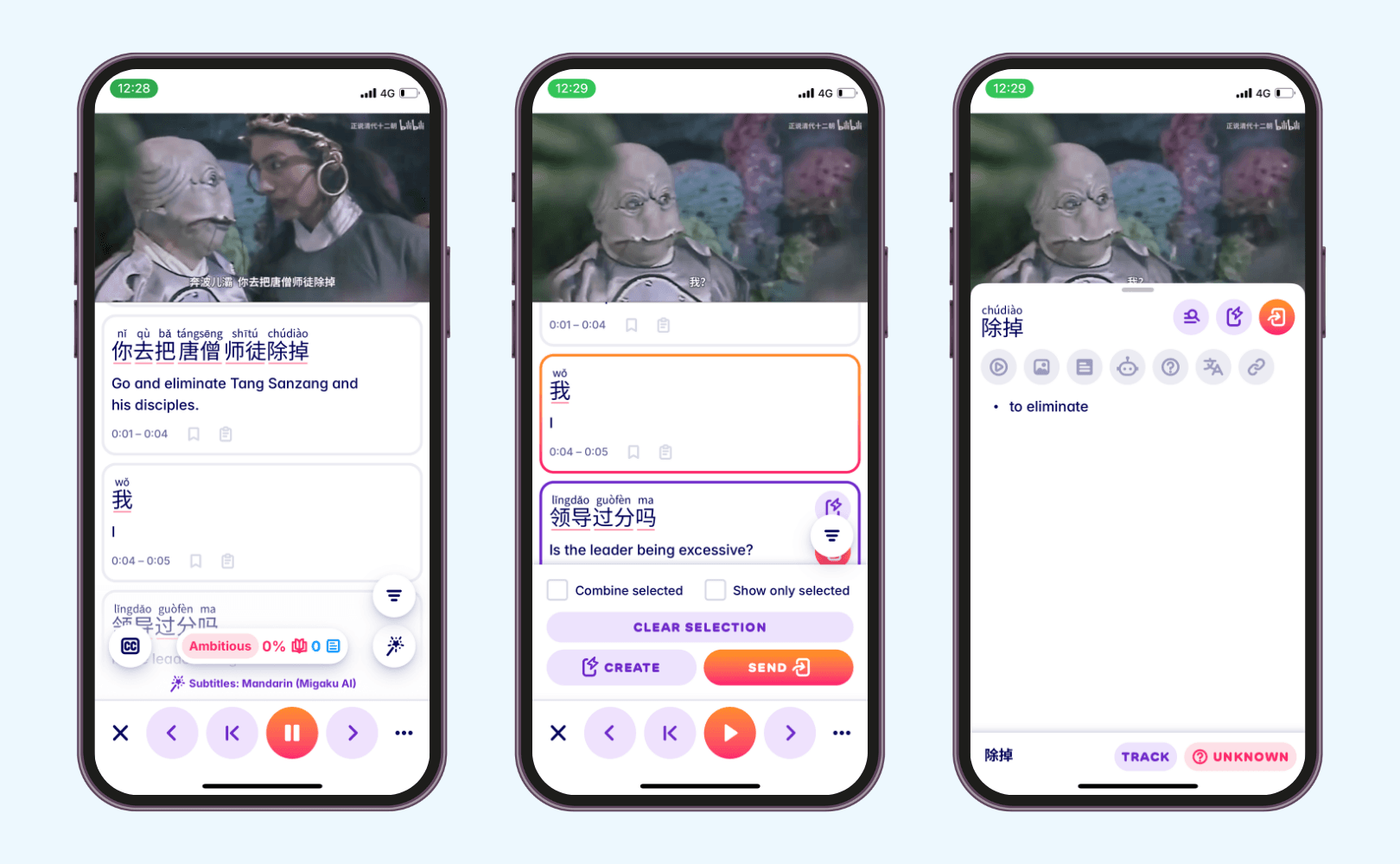
4. If you want to use these slang and other Chinese phrases in context, Migaku's browser extension and app let you look up words and save examples while watching Chinese shows or reading articles. Makes learning from real content way more practical. There's a 10-day free trial if you want to check it out.
 ---
## FAQs
In Chinese slang, 250 (èr bǎi wǔ) is a common insult meaning "idiot" or "half-wit." It implies someone is stupid, acting foolishly, or is not all there mentally.
In Chinese internet slang, 2333 is the digital representation of laughter, similar to "hahaha" or "LOL."
In Chinese internet slang, 666666 is a string of high praise. It comes from the word for six (liù), which sounds like the word for "slick" or "skilled."
---
## 真香警告: Start using common Chinese slang already?
The final bridge from knowing Chinese slang words to using them is built by listening. Watch Chinese reality TV and gaming streams. Pay attention to the natural banter — the teasing, the quick comebacks. When you start to predict the slang term coming next, you’re ready. That’s when you start to think — and joke — like a native.
> If you consume media in Chinese, and you understand at least some of the messages and sentences within that media, you will make progress. _Period_.
If only I had known slang was so useful earlier! !
---
## FAQs
In Chinese slang, 250 (èr bǎi wǔ) is a common insult meaning "idiot" or "half-wit." It implies someone is stupid, acting foolishly, or is not all there mentally.
In Chinese internet slang, 2333 is the digital representation of laughter, similar to "hahaha" or "LOL."
In Chinese internet slang, 666666 is a string of high praise. It comes from the word for six (liù), which sounds like the word for "slick" or "skilled."
---
## 真香警告: Start using common Chinese slang already?
The final bridge from knowing Chinese slang words to using them is built by listening. Watch Chinese reality TV and gaming streams. Pay attention to the natural banter — the teasing, the quick comebacks. When you start to predict the slang term coming next, you’re ready. That’s when you start to think — and joke — like a native.
> If you consume media in Chinese, and you understand at least some of the messages and sentences within that media, you will make progress. _Period_.
If only I had known slang was so useful earlier! !