# Chinese Travel Phrases: Essential Phrases for Greetings, Transportation, and Ordering
> Chinese travel phrases are helpful for travelers who haven't mastered the language yet! These Mandarin Chinese phrases can be applied to many situations.
**URL:** https://migaku.com/blog/chinese/chinese-travel-phrases
**Last Updated:** 2025-11-30
**Tags:** vocabulary, culture, phrases
---
Traveling to a foreign country is stressful sometimes... It entails inconveniency and embarrassment, but you can help yourself by learning a handful of essential travel phrases in [Chinese](https://migaku.com/learn-chinese). They transform you from a bewildered tourist into an engaged traveler. Mastering these keys doesn't just help you order food or find a bathroom; it helps you navigate most of the scenarios with minimum embarrassing moments! This isn't about fluency; it's about empowerment. Let's unpack the vocabulary for boosting your travel experience!
---
## Must-know basic greetings in Mandarin Chinese
Before you pack your bags, pack these five linguistic essentials. Consider them your pre-trip survival kit, more crucial than a power adapter. Starting any request with (Please) softens your approach, while a sincere (Thanks) acknowledges helps and builds goodwill. These simple courtesies signal that you are a respectful guest, not just a passing tourist, and will be met with immediate warmth and patience from locals.
Here are the essential [greetings](https://migaku.com/blog/chinese/how-are-you-in-chinese) to show respect:
| Chinese Greetings | English Translations |
| - | - |
| 请 | Please |
| 谢谢 | Thank you |
| 对不起 | Sorry |
| 你好 | Hello|
| 再见 | Goodbye |
| 打扰了 / 不好意思 | Excuse me... |
Now, pair these greetings with your first practical phrase: meaning “Do you speak English?” Asking this politely, after a greeting, is far more effective than assuming. Remember, for “yes” and for “no” are your basic affirmatives, but be prepared for the common, subtle head nod or shake in response. With these pillars, you have a stable foundation to build upon.
---
## Chinese travel phrases for handling directions and transportation
### Chinese phrases for finding your way
When you need to orient yourself or find a crucial destination, one phrase is your indispensable anchor: (Where is…?) Simply slot your destination into the blank—whether it’s (Toilet), (Exit), or your hotel’s name. This simple construction is universally understood.
To successfully follow the response, you’ll need three directional keywords: (Left), (Right), and the essential (Go straight). Pairing your question with these words will help you decipher the pointing and gestures that are sure to follow.
### Phrases to use for transportation
For taxis and ride-hailing apps like DiDi, clarity is key. In most cases, if you are using an online taxi app, you just need to type in the destination, and there is no need to communicate with the driver. The app will deduct the money directly from your bank account.
However, if there's a need, use the clear and polite request: …… (Please take me to…) followed by your address or hotel name. If you are not using an app, it’s wise to gently remind the driver, (Please use the meter.) When you want to drop off, you can say, (Drop me off here.)
For public transit, your goal is to confirm you’re on the right vehicle. Hold up your ticket or point to the bus number and ask, (Is this the bus/train to…?) When purchasing a ticket, the straightforward phrase (One ticket to…) will get you exactly what you need.
Some other common destination words for travelling are:
| Chinese Destination Words | English Translations |
| - | - |
| 厕所 | Toilet|
| 饭店 | Restaurant |
| 酒店 | Hotel|
| 便利店 | Convenience store |
| 警察局 | Police station |
| 医院 | Hospital |
| 加油站 | Gas station |
| 地铁站 | Subway station |
| 公交站 | Bus station |
| 火车站 | Train station |
| 机场 | Airport |
---
## The essential phrases to order food when traveling to China
Stepping into a Chinese restaurant or walking through a vibrant night market is a highlight of any trip, and a few key phrases will turn the menu from a puzzle into a portal for discovery. This involves securing your seat, asking for guidance, stating your preferences clearly, and handling the transaction smoothly.
Here is the table to help you navigate the scenarios at restaurants!
| Scenarios | Chinese Expressions |
| - | - |
| Getting seated | 请给我们两人桌。
*A table for 2 please.*
你们还有位吗?
*Are there any empty tables now?*
我们要等多久?
*How long do we need to wait?* |
| Asking for menu | 有菜单吗?
*Where's the menu?*
有酒水单吗?
*Is there a drinking menu?*
我们还要考虑一下。
*Give us more time to think about (what to order).* |
| Ordering and allergies | 请给我一个这个。
*I'll have one of this.*
有素食菜谱吗?
*Is there a vegetarian menu?*
我不吃海鲜/辣。
*I don't eat seafood/ spicy food.* |
| Paying bills | 结账。
*Hand me the bill please. *
支付宝/微信/刷卡。
*(I'll pay using) Alipay/ WeChatpay / bank cards.*
打包。
*Take away.* |
---
## Learn Chinese travelling words via dramas and movies!
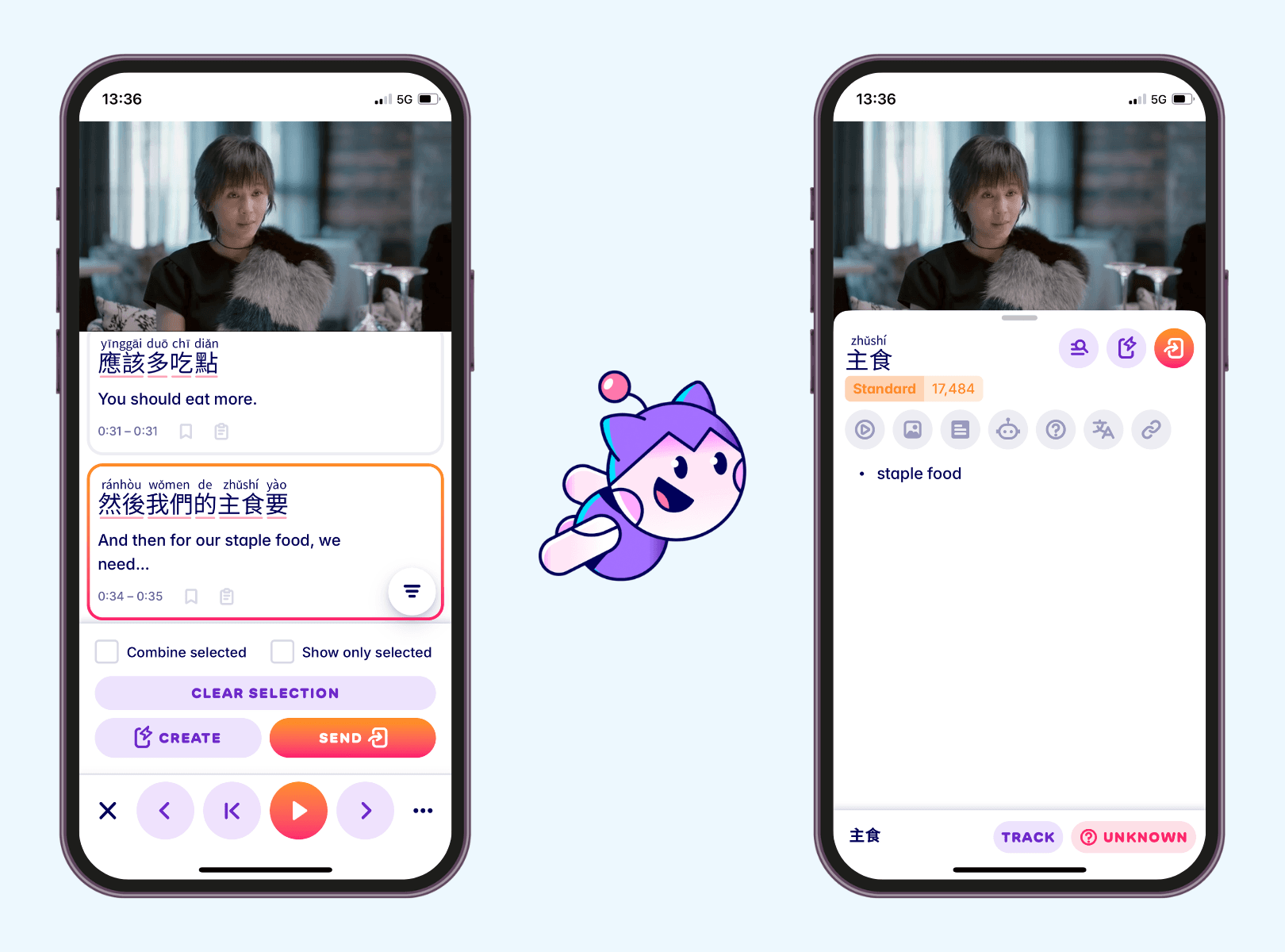
Equip yourself with phrases for travelers via Chinese dramas and movies! For example, this cut from Ode to Joy can help you get a rough idea of how to order food at a Chinese restaurant! Migaku app can help you understand the conversation by generating subtitles and creating flashcards for sentences!
1. Switch on YouTube and search for Chinese videos with the app
2. Click "Watch with Migaku", and the magic wand at the lower left corner to generate Chinese subtitles
3. Click on the new words or sentences in each subtitle and generate flashcards!
 ---
## FAQs
The most celebrated Chinese proverb on travel is , meaning “Read ten thousand books, travel ten thousand miles.” It encapsulates the idea that true wisdom and knowledge are earned through direct experience of the world as much as through scholarly study. Another profound saying is , meaning “A journey of a thousand miles begins with a single step.” It emphasizes the importance of initiative, perseverance, and the courage to begin.
There is no direct comment on travelling from Confucius. A saying from him that has something to do with traveling is , meaning "Is it not a joy to have friends visit from afar?" It conveys the joy of having friends visiting and coming from a faraway place.
---
## Practice the pronunciation of commonly used travel terms!
[Pronunciation](https://migaku.com/blog/chinese/chinese-pronunciation) determines whether the locals can understand you correctly or not. Especially in Chinese language learning, the change of tones can lead to the alteration of meanings. Before embarking on the journey to China, why not practice the pronunciation with the help of videos and audios?
> If you consume media in Chinese, and you understand at least some of the messages and sentences within that media, you will make progress. _Period_.
Every day counts!
---
## FAQs
The most celebrated Chinese proverb on travel is , meaning “Read ten thousand books, travel ten thousand miles.” It encapsulates the idea that true wisdom and knowledge are earned through direct experience of the world as much as through scholarly study. Another profound saying is , meaning “A journey of a thousand miles begins with a single step.” It emphasizes the importance of initiative, perseverance, and the courage to begin.
There is no direct comment on travelling from Confucius. A saying from him that has something to do with traveling is , meaning "Is it not a joy to have friends visit from afar?" It conveys the joy of having friends visiting and coming from a faraway place.
---
## Practice the pronunciation of commonly used travel terms!
[Pronunciation](https://migaku.com/blog/chinese/chinese-pronunciation) determines whether the locals can understand you correctly or not. Especially in Chinese language learning, the change of tones can lead to the alteration of meanings. Before embarking on the journey to China, why not practice the pronunciation with the help of videos and audios?
> If you consume media in Chinese, and you understand at least some of the messages and sentences within that media, you will make progress. _Period_.
Every day counts!