# Chinese Verbs: A Guide to the Grammar of Common Chinese Verbs
> Chinese verbs do not feature different grammatical conjugations, then how to indicate tense and express nuanced meanings? Read the guide here for answers!
**URL:** https://migaku.com/blog/chinese/chinese-verbs
**Last Updated:** 2025-11-28
**Tags:** vocabulary, grammar, verbs
---
Great news if you are going to [learn Chinese](https://migaku.com/learn-chinese) verbs! Compared to English grammar, Chinese verbs are rather "minimalist"—no conjugation, no tense changes, and no irregular forms to memorize. However, in order to convey messages without the verb change, you need to learn some specific words that hold the key to expressing time, mood, and subtle nuances. Don't be nervous. It's definitely easier than memorizing a whole chart of English verb forms!
---
## No conjugation: Chinese verbs do not change forms
For learners weary of memorizing endless verb tables, there is no verb in Chinese requiring the change of forms. A single verb form is used universally, regardless of who is performing the action or when it occurs. There are no suffixes to change for "I," "you," or "he," and no complex rules for past, present, or future tense. The verb (to eat), for instance, remains perfectly unchanged whether you say "I eat," "she eats," or "they ate."
This foundational rule means that from your very first lesson, you can correctly use any verb you learn with any subject. The [sentence structure](https://migaku.com/blog/chinese/chinese-word-order) "Subject + Verb" is instantly powerful and universally applicable. You can confidently state (I study), (you study), and (he studies) without a second thought. On the other hand, to let these phrases make sense, you still need to add other words to make your meaning unambiguous.
---
## How to express past, present, and future: 在 (zài), 会 (huì), and other indicators
In Chinese grammar, the verb itself never changes to show tense. Instead, time is indicated through a powerful combination of context, specific time words, and grammatical particles. You simply tell people when something happened, and the verb remains constant.
### The past
To talk about the past, the most important tool is the particle . Placed directly after the verb, it indicates that an action is completed. For instance, (I watched a movie yesterday). Notice how the time word (yesterday) clarifies the specific past time, while emphasizes the completion of the action "watch."
There are more past time indicators such as:
| Chinese | English | Chinese | English |
| - | - | - | - |
| 昨天 | Yesterday | XXX天前 | XXX days ago |
| 前天 | The day before yesterday | XXX年前 | XXX years ago |
| 去年 | Last year | XXX小时前 | XXX hours ago |
| 前年 | Two years ago | 昨天晚上/早上/中午/上午/下午 | Last night/morning/noon/morning/afternoon|
### The present
For the present, often no marker is needed if the time is clear or habitual, unless it is the present progressive tense.
For normal present tense, the sentences use time words like (every day) to express a routine present action. For example:
*I drink tea every day.*
For the present progressive tense, you need to add before the verb to indicate that the action is still ongoing. For example:
*I'm thinking when to go home.*
### The future
Expressing the future is typically achieved by using the modal verb , which means "will" or "am going to." It is placed before the main verb. Yet, the sentence can still convey the future tense without , as long as there is a word indicating a future timeline. For example:
*Tomorrow I will go to the bookstore.*
Other indicating words of future time are:
| Chinese | English | Chinese | English |
| - | - | - | - |
| 明天 | Tomorrow | XXX天后 | XXX days later |
| 后天 | The day after tomorrow | XXX年后 | XXX years later |
| 明年 | Next year | XXX小时后 | XXX hours later |
| 后年 | Two years later | 明天晚上/早上/中午/上午/下午 | Tomorrow night/morning/noon/morning/afternoon |
---
## How to learn Chinese modal verbs: 能 (néng), 可以 (kě yǐ), 要 (yào), 应该 (yīng gāi), 必须 (bì xū)
Mandarin Chinese language uses a powerful set of helper words called modal verbs to express a wide range of meanings like ability, permission, obligation, and desire. These modals are the key to moving beyond simple statements of fact ("I eat") to expressing your capabilities, needs, and intentions ("I can eat," "I should eat," "I want to eat"). The modal verb is always placed directly before the main action verb in a simple "Subject + Modal + Main Verb" structure.
The specific meaning changes entirely based on which modal verb you choose. Here are the most essential ones you need to know:
1. : Both mean "can," expressing either ability or permission. For example:
*I can speak Chinese.*
*You can come in.*
2. : This versatile word means "to want to" or "to need to," indicating a strong desire or intention. Example:
*I want to drink water.*
3. : This translates to "should," used for giving advice or stating what is advisable. Example:
*You should rest.*
4. : A strong word for "must" or "have to," expressing necessity or obligation. Example:
*I must study.*
---
## Learn the most common Chinese verbs in sentences with Migaku
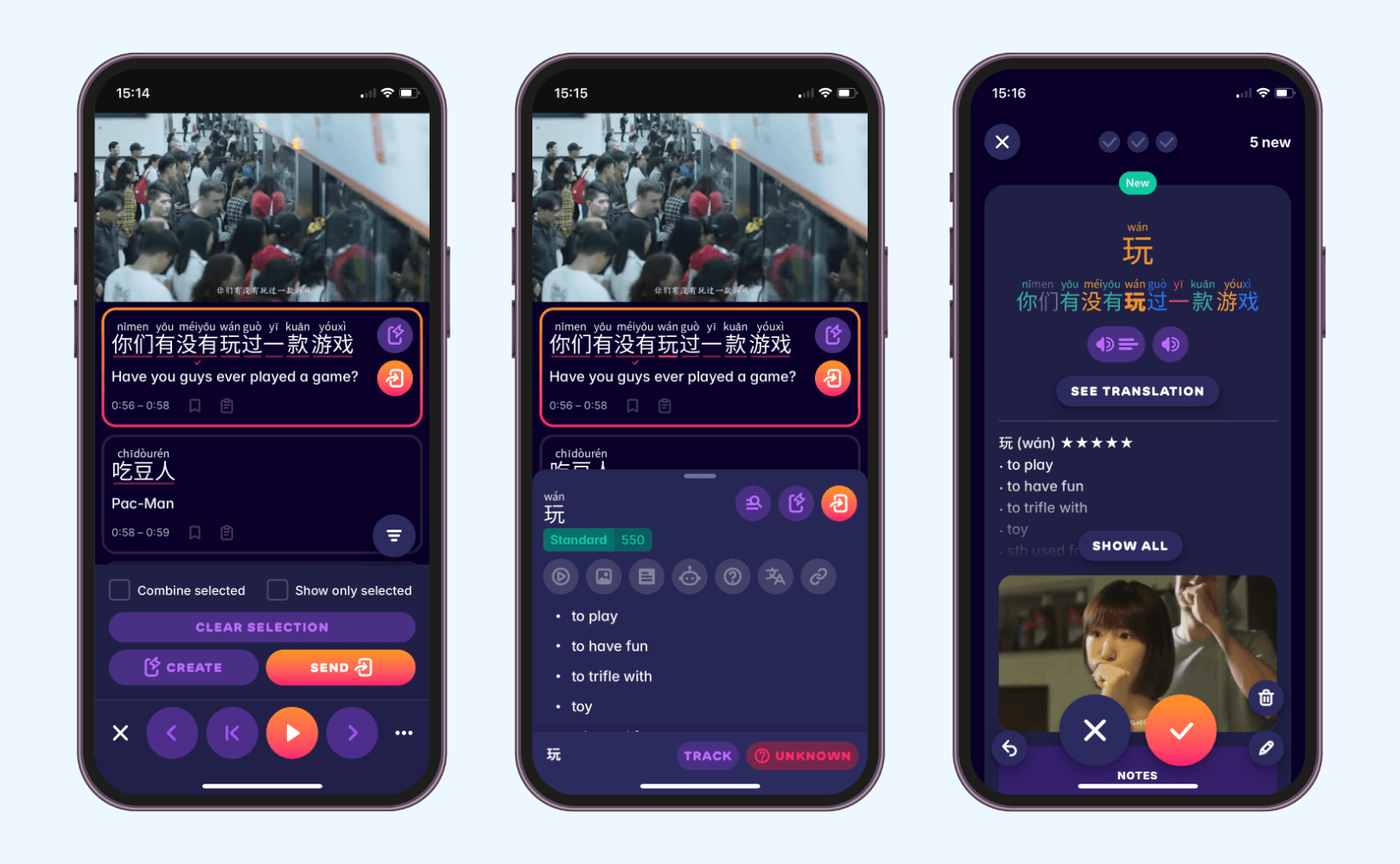
It is not easy to gather and memorize the essential Chinese verbs, and it is even more difficult to remember to review each and every one of them according to the forgetting curve! That's when Migaku app can step in to assist if you want to learn common verbs in Chinese and expand your Chinese vocabulary! When using Migaku app, you can:
1. Switch on YouTube and search for Chinese videos with the app
2. Tap "Watch with Migaku", and the magic wand at the lower left corner to generate Chinese subtitles
3. Tap on the new words in each subtitle and generate flashcards!
 ---
## FAQs
In Chinese, a verb () is a word that expresses an action, an occurrence, or a state of being, like (to like). Crucially, they are invariable and do not change form for tense, person, or number.
Chinese verbs are remarkably simple. They never change form for tense or subject. Instead, time is shown with context, time words (yesterday, tomorrow), and particles like for completed actions. Modal verbs (can, should, will) are placed before the main verb to express ability, necessity, or desire.
Chinese verb repetition, known as verb reduplication, is a key grammatical feature. It primarily makes an action feel more casual, temporary, or tentative, softening the tone. For example, means "to have a look," which is less formal and more relaxed than just (to look). It's also used in questions to sound more polite, like (to ask a quick question).
---
## Time to collect the essential Chinese verbs!
As a crucial part of the vocabulary system in Chinese, it takes day-to-day effort to build up your verb phrase reservoir. And one day, you will understand that when the hero says: "", the verb cannot be taken as "think", but "miss".
> If you consume media in Chinese, and you understand at least some of the messages and sentences within that media, you will make progress. _Period_.
10 words a day keeps laziness away!
---
## FAQs
In Chinese, a verb () is a word that expresses an action, an occurrence, or a state of being, like (to like). Crucially, they are invariable and do not change form for tense, person, or number.
Chinese verbs are remarkably simple. They never change form for tense or subject. Instead, time is shown with context, time words (yesterday, tomorrow), and particles like for completed actions. Modal verbs (can, should, will) are placed before the main verb to express ability, necessity, or desire.
Chinese verb repetition, known as verb reduplication, is a key grammatical feature. It primarily makes an action feel more casual, temporary, or tentative, softening the tone. For example, means "to have a look," which is less formal and more relaxed than just (to look). It's also used in questions to sound more polite, like (to ask a quick question).
---
## Time to collect the essential Chinese verbs!
As a crucial part of the vocabulary system in Chinese, it takes day-to-day effort to build up your verb phrase reservoir. And one day, you will understand that when the hero says: "", the verb cannot be taken as "think", but "miss".
> If you consume media in Chinese, and you understand at least some of the messages and sentences within that media, you will make progress. _Period_.
10 words a day keeps laziness away!