# Duolingo Chinese Review: Strategies of Learning Chinese on Duolingo and Pairing It With Other Resources
> Duolingo Chinese review is here! Let me explain why Duolingo is great for beginners, and how you can pair it with other resources in the long run!
**URL:** https://migaku.com/blog/chinese/duolingo-chinese-review
**Last Updated:** 2025-12-11
**Tags:** resources, discussion
---
You are starting to [learn Chinese](https://migaku.com/learn-chinese) and are ready to commit yourself to Duolingo.💍 Unfortunately, language learning is not that simple! Duolingo excels at making a daunting language feel approachable, but it has clear ceilings. Basically, it’s a vibrant, gamified playground for Chinese — perfect for getting your feet wet, but you wouldn’t want to swim across the ocean with just its floaties. Let's see where it shines and where you'll need a life raft.
---
## Duolingo Chinese has a gentle launchpad of pinyin and hanzi
Here's something I've learned from starting several languages: that initial "alphabet shock" can make you quit before you even start. This is where Duolingo's integration of pinyin and hanzi is its single biggest asset for a Mandarin beginner. For learning the Chinese language, you need to know both how the character looks and is pronounced because it is a logogram language.
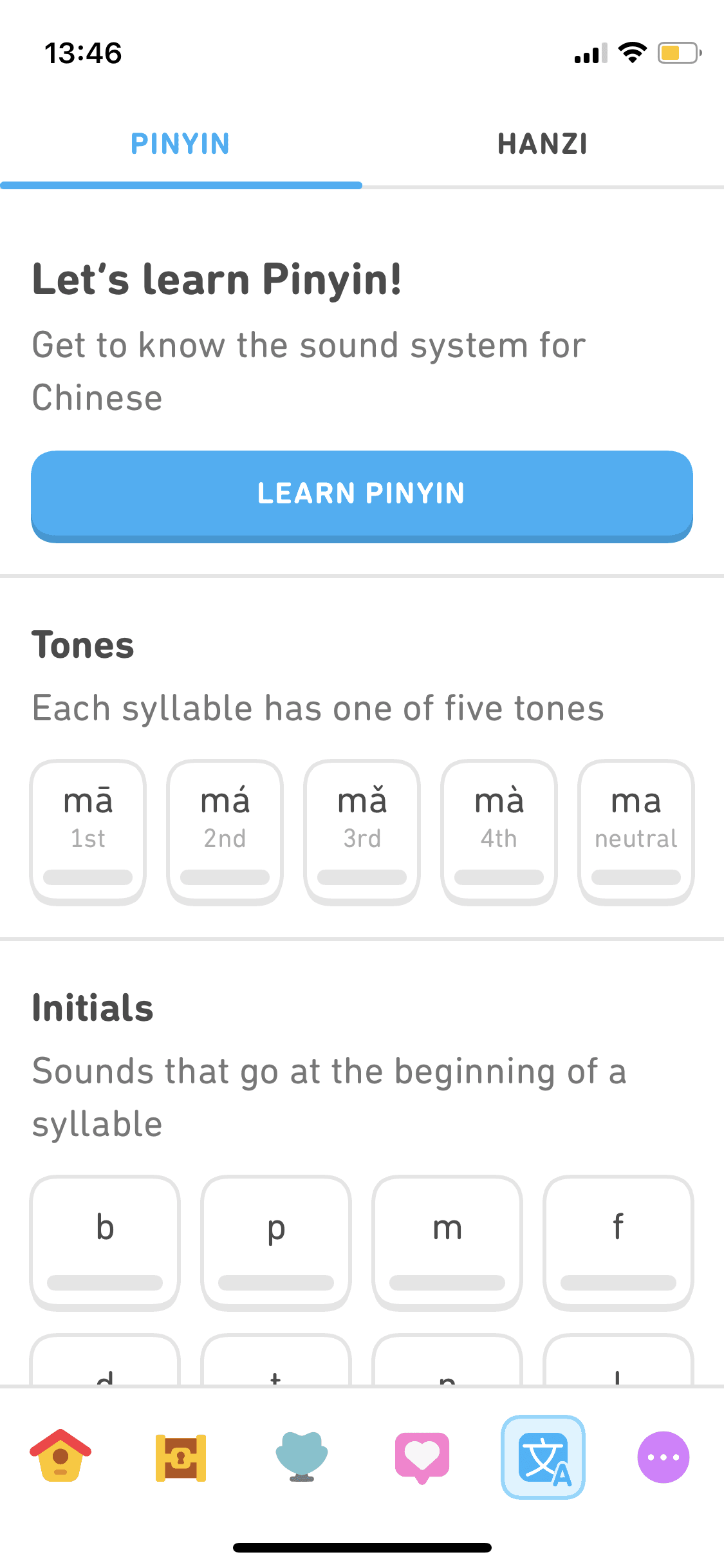
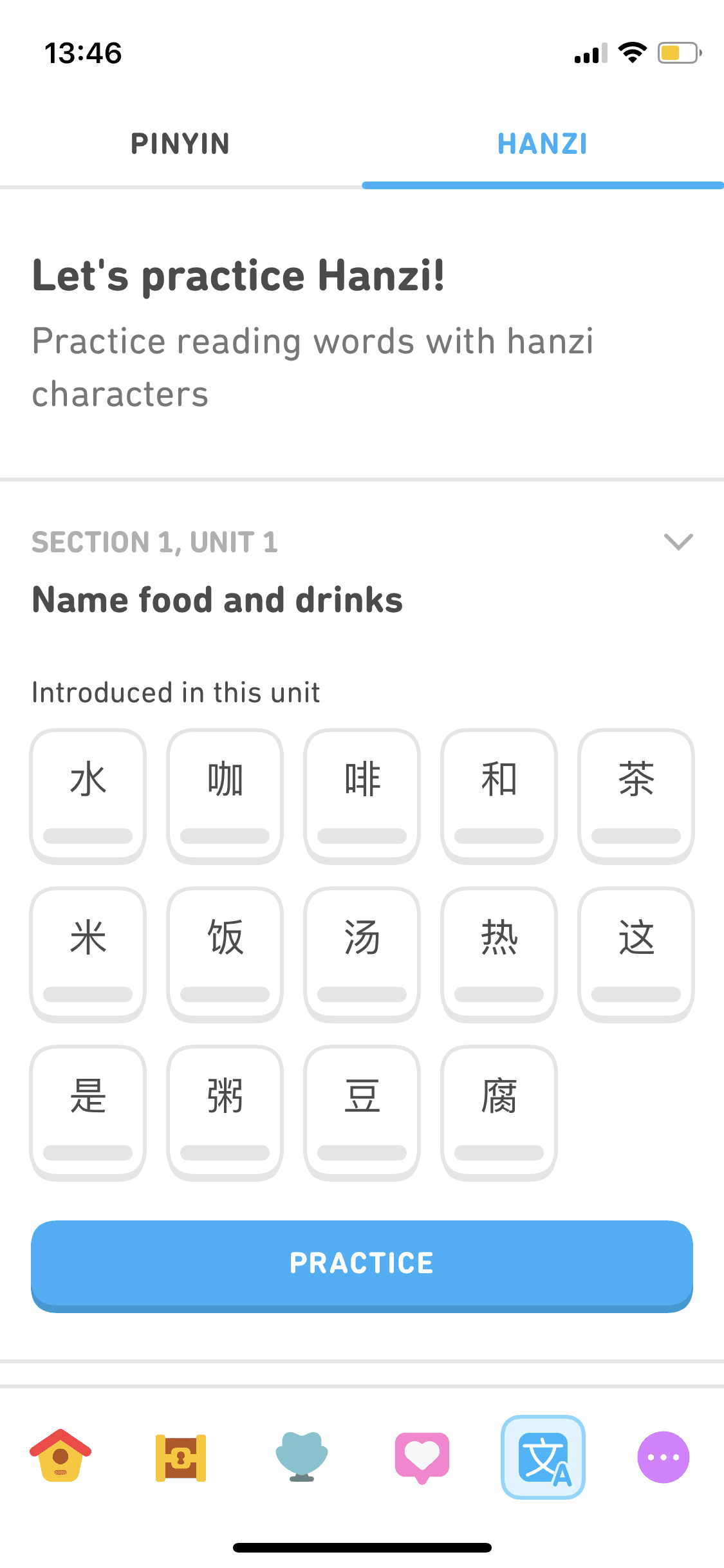
Duolingo features an independent section that lets you start speaking and understanding pinyin and hanzi anytime during your study. Because this section is apart from its learning trajectory, you can switch back to reinforce your memory about pinyin and learn new high-frequency Chinese characters anytime you want.
Duolingo is a convenient tool to refer to the pinyin chart:
 Duolingo is convenient for picking up high-frequency hanzi, as well:
 ---
## Using Duolingo Chinese to grasp words and simple sentences is nice
If you're someone who needs a structured, visual system for building a word bank, you'll love this part. Duolingo is fundamentally excellent for absorbing vocabulary and rigid sentence patterns through sheer, addictive repetition. Its strength is turning memorization into a matching game.
For example, you'll drill nouns like (Apple), verbs like (To eat), and formulaic sentences like (I want to eat an apple) until they're second nature.
How does Duolingo make this work?
1. Every unit it formulates about 10 to 20 short phrases and sentences using the new words you just learned, and keeps repeating them.
2. The curriculum is built around practical, thematic units (Food, Family, Travel). This means you learn related words together, which helps with association.
3. The "strength" meters and review sessions also use a spaced repetition system (SRS) to bring back old vocabulary just as you're about to forget it.
For building a foundation of several hundred high-frequency words and understanding basic Chinese sentence order (Subject + Verb + Object), it’s a powerful, engaging tool. It turns the early grind into a game you want to keep playing.
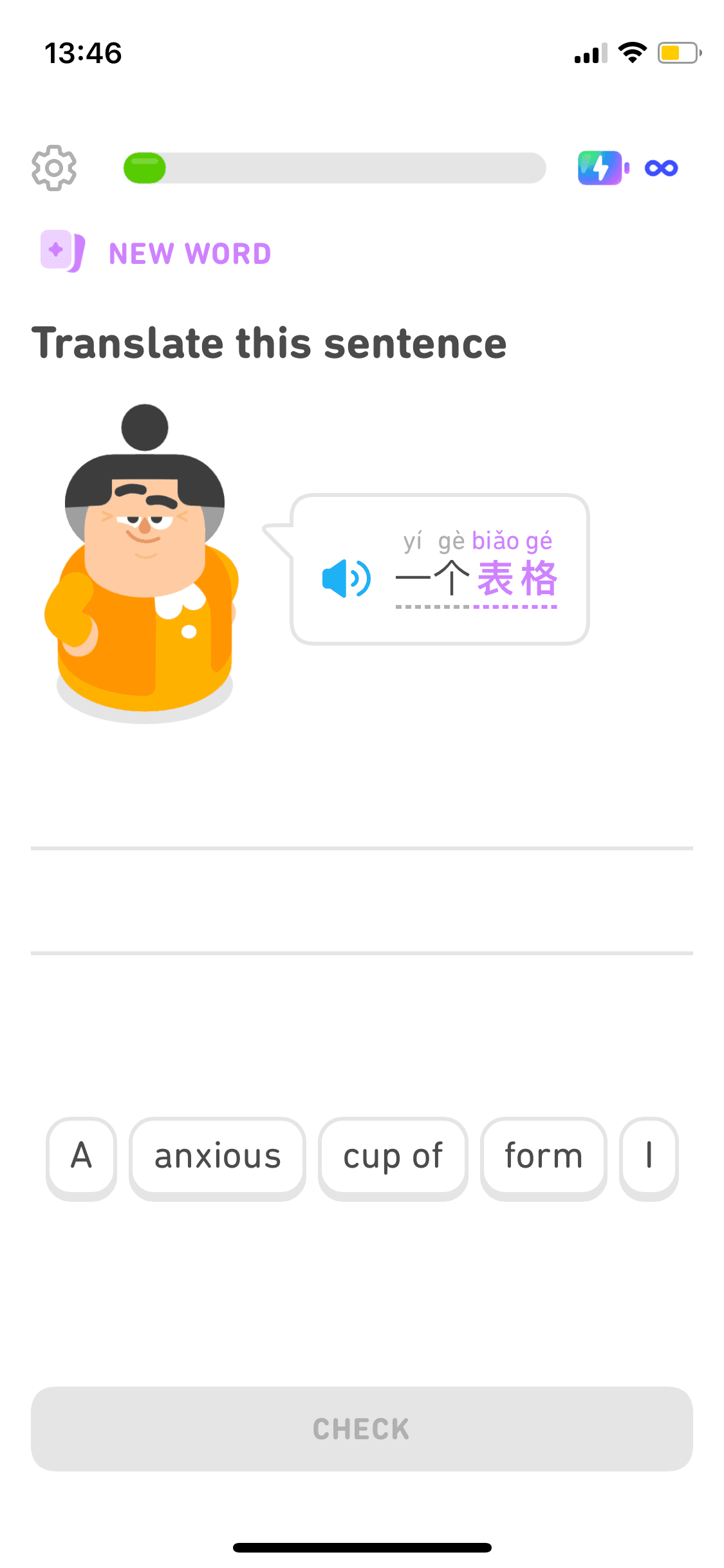
Here is a demonstration of how the Duolingo app trains your Mandarin Chinese:
---
## Using Duolingo Chinese to grasp words and simple sentences is nice
If you're someone who needs a structured, visual system for building a word bank, you'll love this part. Duolingo is fundamentally excellent for absorbing vocabulary and rigid sentence patterns through sheer, addictive repetition. Its strength is turning memorization into a matching game.
For example, you'll drill nouns like (Apple), verbs like (To eat), and formulaic sentences like (I want to eat an apple) until they're second nature.
How does Duolingo make this work?
1. Every unit it formulates about 10 to 20 short phrases and sentences using the new words you just learned, and keeps repeating them.
2. The curriculum is built around practical, thematic units (Food, Family, Travel). This means you learn related words together, which helps with association.
3. The "strength" meters and review sessions also use a spaced repetition system (SRS) to bring back old vocabulary just as you're about to forget it.
For building a foundation of several hundred high-frequency words and understanding basic Chinese sentence order (Subject + Verb + Object), it’s a powerful, engaging tool. It turns the early grind into a game you want to keep playing.
Here is a demonstration of how the Duolingo app trains your Mandarin Chinese:
 ---
## Is Duolingo good for learning Mandarin grammar?
Alright, let's talk about grammar. Duolingo's approach is pure pattern recognition. It rarely gives you an explicit rule. Instead, it shows you 20 examples of how to use the particle for possession, and you're supposed to intuit the rule. For simple structures, this works surprisingly well. You'll pick up how to form questions with or negate verbs with just by doing it over and over.
In a way, this method is great for learners who hate textbook grammar charts. It feels natural and low-pressure. However, the downside is a lack of systematic clarity. Chinese has crucial grammatical concepts that aren't intuitive, like the different uses of for completed actions or change of state, or the subtle differences between and for ongoing actions. Duolingo introduces these, but without clear explanations, you're left with a fuzzy, often incomplete understanding. You learn that a sentence is correct, but not always why, which can limit your ability to create your own sentences confidently.
Also, due to this shortage, Duolingo cannot bring your Chinese learning to the next level, meaning around the HSK 6-9 level of understanding and expressing complex ideas. If you are a language learner aiming for career or academic excellence, Duolingo cannot help you learn to read these kinds of complex analytical texts.
---
## How to make use of Duolingo together with other resources?
So, what's the best practice? Basically, treat Duolingo as your motivational drill sergeant and practice partner, not your sole teacher. Its true power is unlocked when you pair it with structured resources that fill its gaps.
Here’s a simple, effective combo plan:
1. Core structure: Use an [HSK Standard Course Textbook](https://migaku.com/blog/chinese/hsk-test) as your main guide. It provides the systematic grammar explanations, dialogues, and cultural context that Duolingo lacks. Follow its order.
2. Daily drill & game: Use Duolingo daily to reinforce the vocabulary and sentences. Let it handle the flashcard repetition.
3. Tone and ear training: Add a dedicated resource like Migaku to assist you in media consumption. You can also watch Chinese videos on YouTube or Netflix with their own subtitles, but Migaku can help you generate subtitles and translations based on the video soundtrack.
4. (Optional) You can also purchase a Chinese grammar book for systematic understanding, and always refer back to this grammar book during your study.
---
## Compared to Duolingo Chinese, what is the Migaku Chinese review?
I'm afraid the comparison simply doesn't exist... Because if you try both apps, you will realize that their main features are a great combination for your Chinese learning. Duolingo can help you drill your vocabulary, while Migaku can assist you with consuming Chinese media.
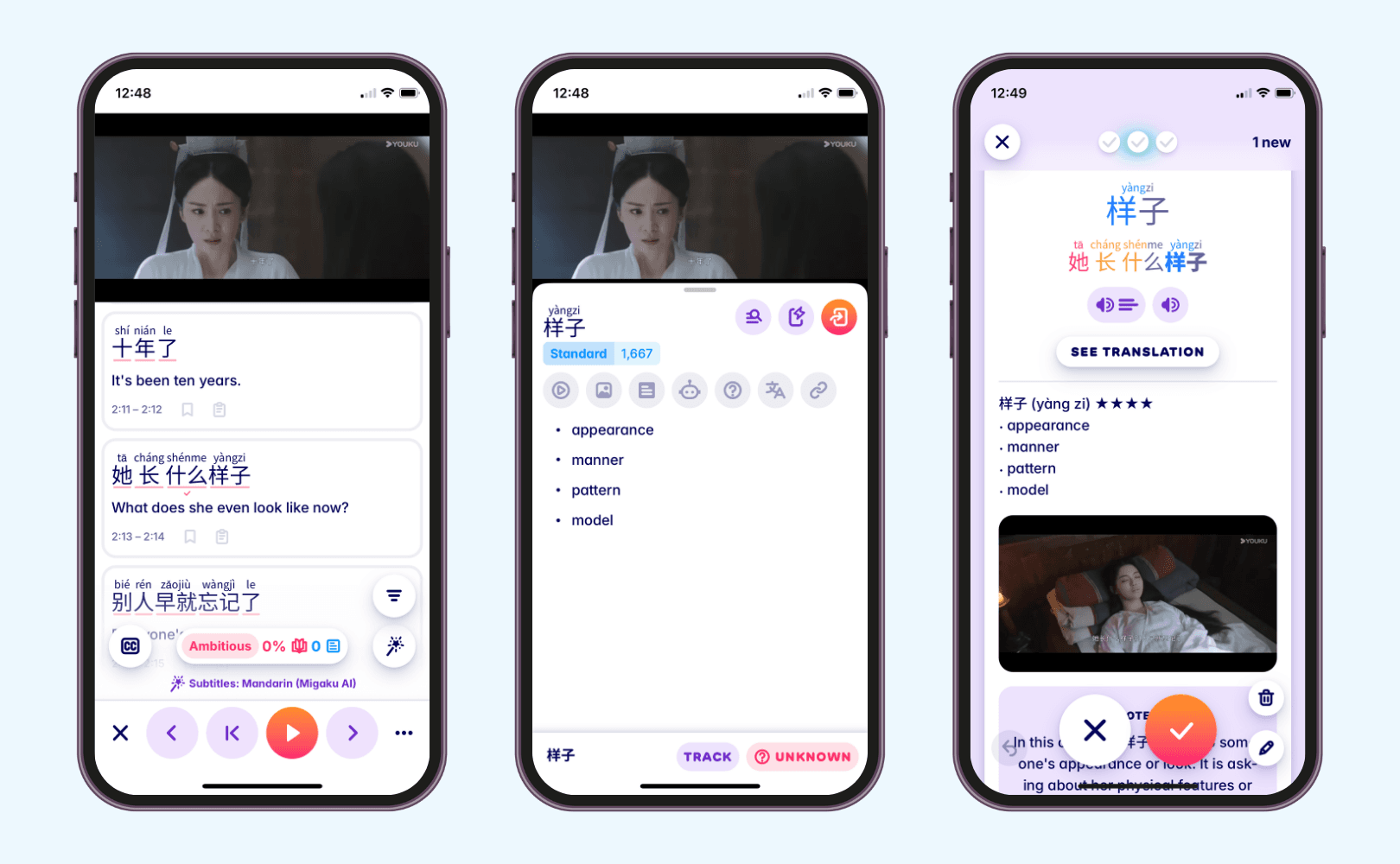
For example, Migaku app can generate subtitles for the cut from *The Double* with pinyin and English translation, even when the original videos do not feature any subtitles. You can click and add sentences and words to your flashcards as well.
1. Switch on YouTube and search for Chinese videos with the app
2. Click "Watch with Migaku", and the magic wand at the lower right corner to generate Chinese subtitles
3. Click on the new words or sentences in each subtitle and generate flashcards!
---
## Is Duolingo good for learning Mandarin grammar?
Alright, let's talk about grammar. Duolingo's approach is pure pattern recognition. It rarely gives you an explicit rule. Instead, it shows you 20 examples of how to use the particle for possession, and you're supposed to intuit the rule. For simple structures, this works surprisingly well. You'll pick up how to form questions with or negate verbs with just by doing it over and over.
In a way, this method is great for learners who hate textbook grammar charts. It feels natural and low-pressure. However, the downside is a lack of systematic clarity. Chinese has crucial grammatical concepts that aren't intuitive, like the different uses of for completed actions or change of state, or the subtle differences between and for ongoing actions. Duolingo introduces these, but without clear explanations, you're left with a fuzzy, often incomplete understanding. You learn that a sentence is correct, but not always why, which can limit your ability to create your own sentences confidently.
Also, due to this shortage, Duolingo cannot bring your Chinese learning to the next level, meaning around the HSK 6-9 level of understanding and expressing complex ideas. If you are a language learner aiming for career or academic excellence, Duolingo cannot help you learn to read these kinds of complex analytical texts.
---
## How to make use of Duolingo together with other resources?
So, what's the best practice? Basically, treat Duolingo as your motivational drill sergeant and practice partner, not your sole teacher. Its true power is unlocked when you pair it with structured resources that fill its gaps.
Here’s a simple, effective combo plan:
1. Core structure: Use an [HSK Standard Course Textbook](https://migaku.com/blog/chinese/hsk-test) as your main guide. It provides the systematic grammar explanations, dialogues, and cultural context that Duolingo lacks. Follow its order.
2. Daily drill & game: Use Duolingo daily to reinforce the vocabulary and sentences. Let it handle the flashcard repetition.
3. Tone and ear training: Add a dedicated resource like Migaku to assist you in media consumption. You can also watch Chinese videos on YouTube or Netflix with their own subtitles, but Migaku can help you generate subtitles and translations based on the video soundtrack.
4. (Optional) You can also purchase a Chinese grammar book for systematic understanding, and always refer back to this grammar book during your study.
---
## Compared to Duolingo Chinese, what is the Migaku Chinese review?
I'm afraid the comparison simply doesn't exist... Because if you try both apps, you will realize that their main features are a great combination for your Chinese learning. Duolingo can help you drill your vocabulary, while Migaku can assist you with consuming Chinese media.
For example, Migaku app can generate subtitles for the cut from *The Double* with pinyin and English translation, even when the original videos do not feature any subtitles. You can click and add sentences and words to your flashcards as well.
1. Switch on YouTube and search for Chinese videos with the app
2. Click "Watch with Migaku", and the magic wand at the lower right corner to generate Chinese subtitles
3. Click on the new words or sentences in each subtitle and generate flashcards!
 ---
## FAQs
Yes — but only as a starting point, not the finish line. It's worth it to build a daily habit, learn basic vocabulary, and demystify characters. You'll love the game-like structure. But for more complex grammar and communications, especially for academic or formal settings, you must quickly pair it with textbooks, media, and real conversation practice.
Absolutely not. Duolingo’s structure tops out at an intermediate level. The C2 (HSK 6) stage requires sophisticated cultural understanding, nuanced expression, and professional fluency — things no gamified app can provide. You’ll need years of immersive study, academic resources, and real-world engagement far beyond any app.
Its main disadvantages are a lack of depth and a systematic study plan. You will not master real conversations or understand complex grammar. It is a tool for introduction, not for achieving fluency.
---
## Committing to one app is a no-brainer, but structuring a plan is hard...
The final verdict: Duolingo Chinese is a brilliant gateway app and a powerful supplementary tool. It will build your initial vocabulary, reinforce simple grammar through practice, and — most importantly — make a habit of daily practice. But to truly understand the language and speak it, you must build a bridge from Duolingo's playground to the real world of comprehensive and authentic content. That's where the media comes in:
> If you consume media in Chinese, and you understand at least some of the messages and sentences within that media, you will make progress. _Period_.
Eventually, you will be able to fly without the little green owl!🦉
---
## FAQs
Yes — but only as a starting point, not the finish line. It's worth it to build a daily habit, learn basic vocabulary, and demystify characters. You'll love the game-like structure. But for more complex grammar and communications, especially for academic or formal settings, you must quickly pair it with textbooks, media, and real conversation practice.
Absolutely not. Duolingo’s structure tops out at an intermediate level. The C2 (HSK 6) stage requires sophisticated cultural understanding, nuanced expression, and professional fluency — things no gamified app can provide. You’ll need years of immersive study, academic resources, and real-world engagement far beyond any app.
Its main disadvantages are a lack of depth and a systematic study plan. You will not master real conversations or understand complex grammar. It is a tool for introduction, not for achieving fluency.
---
## Committing to one app is a no-brainer, but structuring a plan is hard...
The final verdict: Duolingo Chinese is a brilliant gateway app and a powerful supplementary tool. It will build your initial vocabulary, reinforce simple grammar through practice, and — most importantly — make a habit of daily practice. But to truly understand the language and speak it, you must build a bridge from Duolingo's playground to the real world of comprehensive and authentic content. That's where the media comes in:
> If you consume media in Chinese, and you understand at least some of the messages and sentences within that media, you will make progress. _Period_.
Eventually, you will be able to fly without the little green owl!🦉