# How to Learn Chinese Characters: Three Strategies to Memorize and Understand Chinese Characters
> How to learn Chinese characters for reading and writing Chinese? Here are three strategies for your journey of learning Chinese: basics, context, and media
**URL:** https://migaku.com/blog/chinese/how-to-learn-chinese-characters
**Last Updated:** 2025-11-27
**Tags:** fundamentals, vocabulary
---
Tackling Chinese characters can feel daunting — like trying to recognize each duck in a big group! They all look so similar to one another!🦆 [The secret of learning Chinese characters](https://migaku.com/learn-chinese) lies in understanding their basic logics and embracing smart strategies. This post can help you build your character knowledge efficiently and confidently, with the help of three strategies!
---
## We can't talk about Chinese characters without knowing their structures...
First, stop viewing characters as random drawings and start seeing them as systematic constructions.
### Learning Chinese radicals
The most important components are [radicals](https://migaku.com/blog/chinese/chinese-radicals)—semantic clues that often reveal a character's core meaning. For instance, the water radical (氵) appears in (river), (lake), and (flow), immediately connecting them to liquids and the movements of liquids.
### Learning to read phonetic components
Many characters contain phonetic components that offer hints to their pronunciation. These phono-semantic compounds make up the majority of Chinese characters. For example, in the word (father), the character combines the male radical (父) with the component , which provides a clue about the pronunciation.
### Read and write Chinese characters with strokes
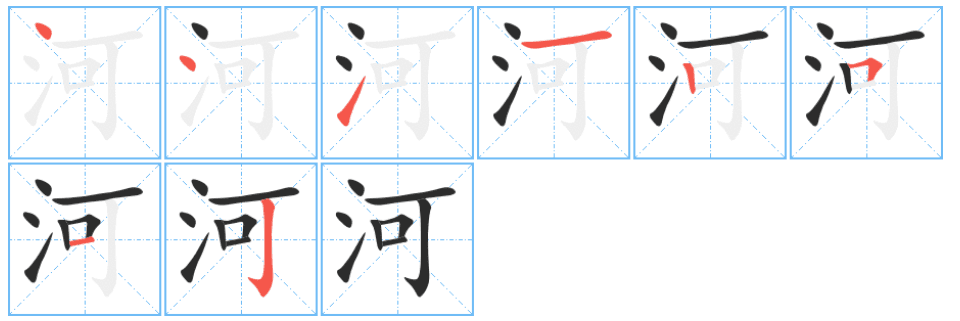
Finally, understanding [strokes](https://migaku.com/blog/chinese/chinese-stroke-order) and their proper order is the essential mechanics of writing and searching dictionaries. Stroke order—governed by logical rules like "top to bottom" and "left to right"—isn't just about penmanship. It ensures characters are written legibly, even at speed. More practically, it's crucial to use digital handwriting input and search for new characters in dictionaries without knowing their pinyin.
---
## Strategy 1: try to learn radicals and stroke order first
To learn Chinese characters as a beginner, we must start by acquiring the knowledge and insights about radicals and stroke order. The reason for prioritizing this strategy is that, in most cases, when a beginner encounters new Chinese words, the pinyin of these words is not given, be it that you are reading a Chinese text or watching a drama with subtitles on.
As a solution, when you know about radicals and stroke order, you will have clues on how to look them up in a dictionary:
1. Count the strokes of the character's radical, and go to the page number after that radical.
2. Count the strokes of the character's other components, and go to the page number after that component.
3. Now, you have located the page explaining all the information about that character! This is how you can learn new characters.
All in all, this strategy provides beginners with the essential skills for grasping new words in Mandarin when they read Chinese.
 ---
## Strategy 2: understand Chinese characters as meaningful groups in their contexts
Resist the temptation to study characters as isolated units. True mastery comes from encountering and using them within their natural habitat: words, phrases, and sentences. Learning in context provides crucial semantic glue, revealing how a character's meaning shifts and combines with others to form actual vocabulary. And in real life, you are more likely to learn to read and write Chinese in words, phrases, sentences, or even articles, rather than an isolated character.
There are many ways to review characters in groups. You can learn to write Chinese phrases, read paragraphs containing semantically similar words, or listen to audio about different scenarios.
Consider the fundamental character , in the Chinese language. On its own, its core meanings include "life," "birth," and "to give birth." However, this abstract knowledge becomes practical and memorable only when you see it in action. For example, it combines with (day) to form (birthday). With (sickness), it creates (to fall ill, or literally, to generate sickness). In the word (student), it means "person who is learning to live" or "one who is born to learn."
Moreover, an effective way to learn these common characters is to read and write them in a meaningful sentence. You can compose a sentence like:
>
---
## Strategy 2: understand Chinese characters as meaningful groups in their contexts
Resist the temptation to study characters as isolated units. True mastery comes from encountering and using them within their natural habitat: words, phrases, and sentences. Learning in context provides crucial semantic glue, revealing how a character's meaning shifts and combines with others to form actual vocabulary. And in real life, you are more likely to learn to read and write Chinese in words, phrases, sentences, or even articles, rather than an isolated character.
There are many ways to review characters in groups. You can learn to write Chinese phrases, read paragraphs containing semantically similar words, or listen to audio about different scenarios.
Consider the fundamental character , in the Chinese language. On its own, its core meanings include "life," "birth," and "to give birth." However, this abstract knowledge becomes practical and memorable only when you see it in action. For example, it combines with (day) to form (birthday). With (sickness), it creates (to fall ill, or literally, to generate sickness). In the word (student), it means "person who is learning to live" or "one who is born to learn."
Moreover, an effective way to learn these common characters is to read and write them in a meaningful sentence. You can compose a sentence like:
>
My student fell ill on his/her birthday.
Now you understand how to practice writing Chinese characters and memorizing them as meaningful groups!
---
## Strategy 3: learn to read and write Mandarin with media and spaced repetition
The most powerful reinforcement for learning characters comes from seeing them in action through authentic media. Immersing yourself in Chinese TV shows, movies, music, podcasts, and web articles provides crucial, real-world context that textbooks cannot match. This "deliberate immersion"—where you actively listen for familiar words and scan subtitles for characters you recognize—transforms abstract symbols into living language. Character learning is all the more effective and practical when media place the characters into context for Chinese learners.
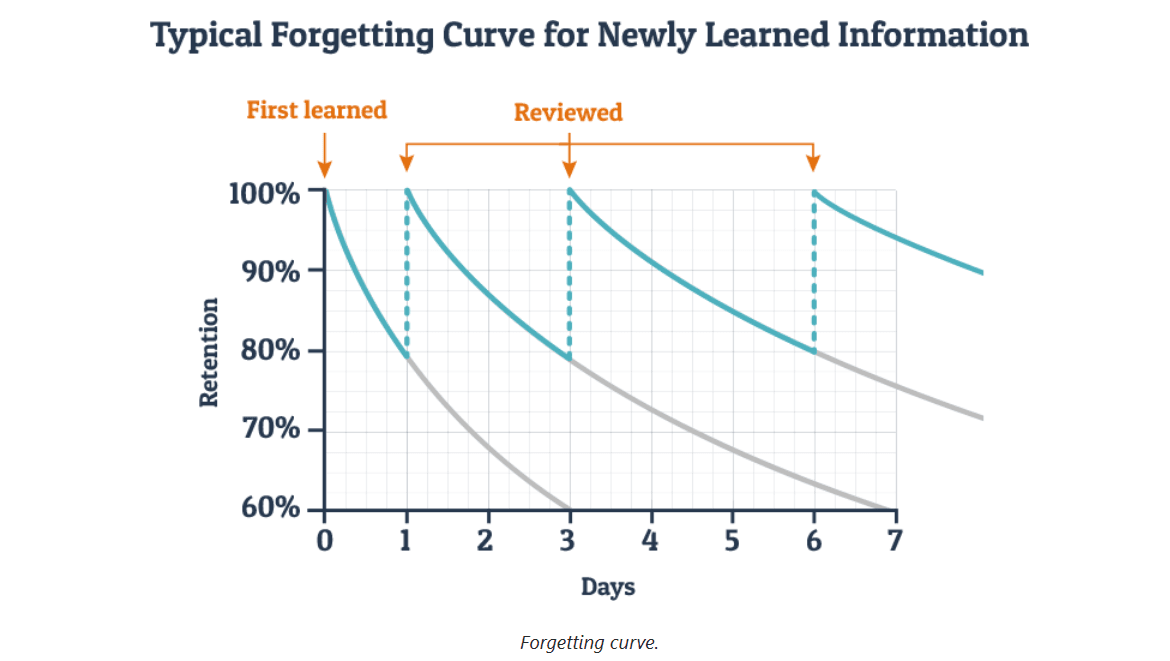
To systematically lock these media-driven discoveries into your long-term memory, you must pair this immersion with spaced repetition. It is a learning technique to review the information right before you are likely to forget it. When you encounter a new character in a show or article, you can add it to a flashcard, and then set up a schedule to review them based on the forgetting curve.
 ---
## Your best assistant in combining media and flashcards to learn Chinese characters
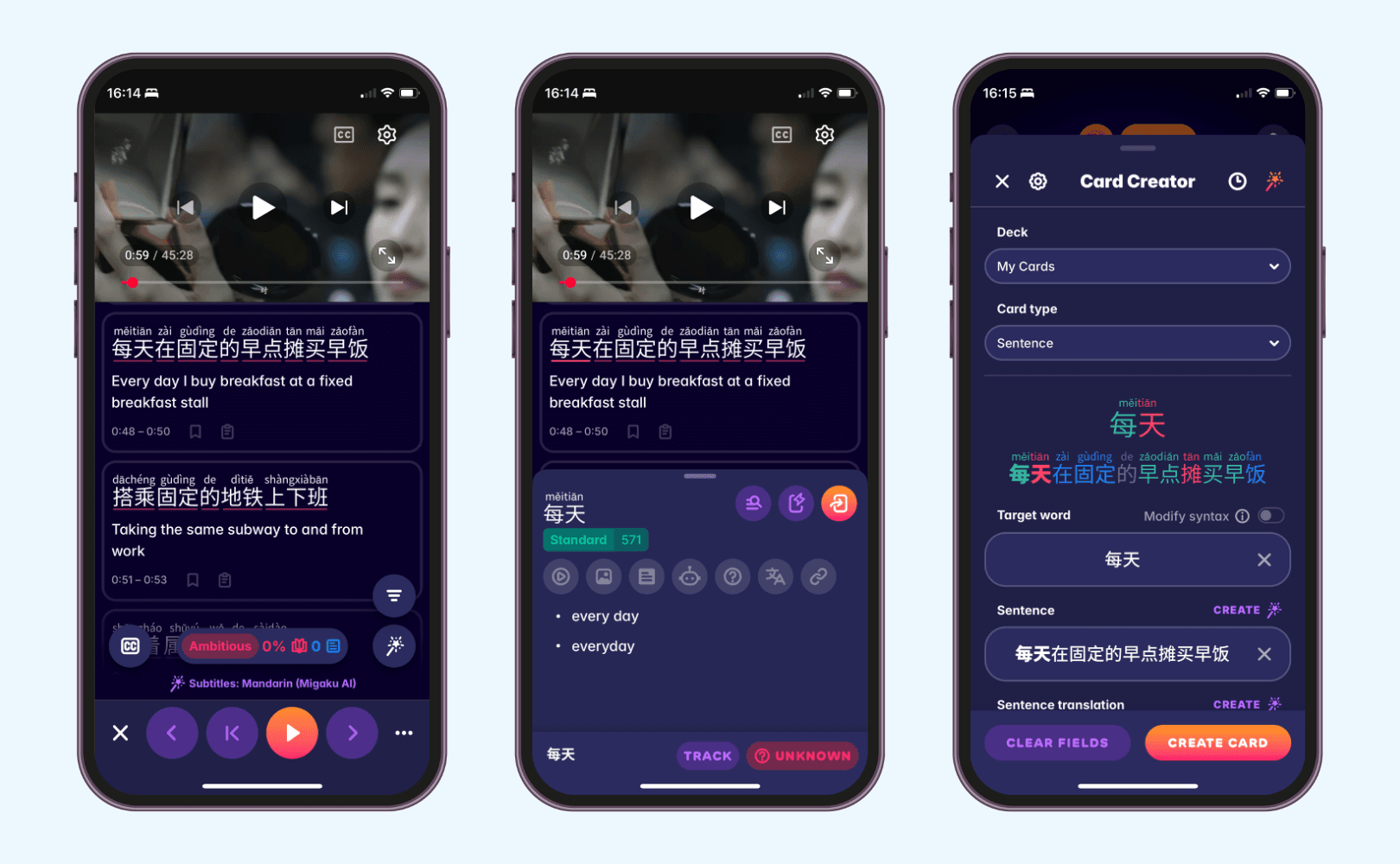
It is not easy to create handwriting flashcards, and it is even more difficult to remember to review each and every one of them according to the forgetting curve! That's when Migaku app can step in to assist if you want to learn Chinese characters with the boost from technology! When using Migaku app, you can:
1. Switch on YouTube and search for Chinese videos with the app
2. Click "Watch with Migaku", and the magic wand at the lower left corner to generate Chinese subtitles
3. Click on the new words in each subtitle and generate flashcards!
---
## Your best assistant in combining media and flashcards to learn Chinese characters
It is not easy to create handwriting flashcards, and it is even more difficult to remember to review each and every one of them according to the forgetting curve! That's when Migaku app can step in to assist if you want to learn Chinese characters with the boost from technology! When using Migaku app, you can:
1. Switch on YouTube and search for Chinese videos with the app
2. Click "Watch with Migaku", and the magic wand at the lower left corner to generate Chinese subtitles
3. Click on the new words in each subtitle and generate flashcards!
 ---
## FAQs
To memorize Chinese characters easily, deconstruct them into radicals and components to understand their logic. Furthermore, leverage media like dramas and podcasts to see characters in context. Use Migaku flashcards to systematically review characters you encounter, turning passive recognition into active recall through engaging, real-world exposure.
Chinese characters are systematic, not simple. While their number seems daunting, many words and phrases are simply different combinations of characters, so the longer you study, the easier it gets later. By learning radicals and patterns—and using media immersion—you can build understanding efficiently.
The sad news is unlikely. 3 months is only enough to learn the basic rules of pinyin, Chinese characters, and how to write characters. To become proficient in reading, writing, and speaking, it will take years of effort!
---
## Take your first step of learning the Chinese language smartly
This is the start of your journey to memorize thousands of symbols with a deep understanding. Your approach matters! Take your time to sip in every character in the media you consume, and make it count.
The fundamental rule for language learning is always the same:
> If you consume media in Chinese, and you understand at least some of the messages and sentences within that media, you will make progress. _Period_.
Celebrate every "Aha" moment!
---
## FAQs
To memorize Chinese characters easily, deconstruct them into radicals and components to understand their logic. Furthermore, leverage media like dramas and podcasts to see characters in context. Use Migaku flashcards to systematically review characters you encounter, turning passive recognition into active recall through engaging, real-world exposure.
Chinese characters are systematic, not simple. While their number seems daunting, many words and phrases are simply different combinations of characters, so the longer you study, the easier it gets later. By learning radicals and patterns—and using media immersion—you can build understanding efficiently.
The sad news is unlikely. 3 months is only enough to learn the basic rules of pinyin, Chinese characters, and how to write characters. To become proficient in reading, writing, and speaking, it will take years of effort!
---
## Take your first step of learning the Chinese language smartly
This is the start of your journey to memorize thousands of symbols with a deep understanding. Your approach matters! Take your time to sip in every character in the media you consume, and make it count.
The fundamental rule for language learning is always the same:
> If you consume media in Chinese, and you understand at least some of the messages and sentences within that media, you will make progress. _Period_.
Celebrate every "Aha" moment!