# How to Write in Chinese: Learn to Write Chinese Characters with Basics on Strokes and Stroke Order
> How to write Chinese characters, strokes, and how to follow the Chinese stroke order? Seek answers here to prep for your character writing journey!
**URL:** https://migaku.com/blog/chinese/how-to-write-in-chinese
**Last Updated:** 2025-12-08
**Tags:** culture, discussion
---
Chinese handwriting is essential in [Chinese learning](https://migaku.com/learn-chinese), as the saying goes - (The handwriting mirrors the person). Knowing some basics about Chinese characters and strokes when you are learning Chinese can help you weather this journey better! Each Chinese character is a miniature world of meaning and history. There are essential logics on how each character is combined and how the strokes should be written. With the right approach and a good amount of practice, you can write smoothly like a native Chinese, too!
---
## Decoding Chinese character core principles: Chinese strokes and stroke order
Before you can write a word, you must learn [the very composition from which characters are made](https://migaku.com/blog/chinese/chinese-stroke-order): the strokes. Interestingly, in Chinese, each stroke is associated with a specific name, direction, and energy. Mastery begins with the seven basic strokes:
1. The decisive horizontal: 一
2. The strong vertical: 丨
3. The sharp dot: 丶
4. The graceful hook: 亅
5. The left-falling stroke: 丿
6. The right-falling stroke: 乀
7. The rising stroke: ㇀
All characters are a combination of these seven basic strokes. The strokes should be written from left to right and top to bottom. Thus, picking up on the knowledge of how to write these strokes can give Chinese learners a basic idea of how to write in Chinese.
Once you are comfortable with individual strokes, you must learn the sequence that assembles them: stroke order. Far from being an arbitrary rule, stroke order follows a set of logical rules that is very similar to the rules of writing individual strokes. The primary rules are: write
1. from top to bottom,
2. from left to right,
3. horizontal strokes before vertical ones that cross them,
4. outer frames before inner contents,
5. and center strokes before wings.
Adhering to this order is not just for tradition's sake; it is the key to writing characters that are correctly proportioned and balanced on the page. It ensures that characters written quickly or cursively remain legible, as the natural flow from one stroke to the next is preserved. Ultimately, correct stroke order also ensures that you are not missing any strokes when writing this character.
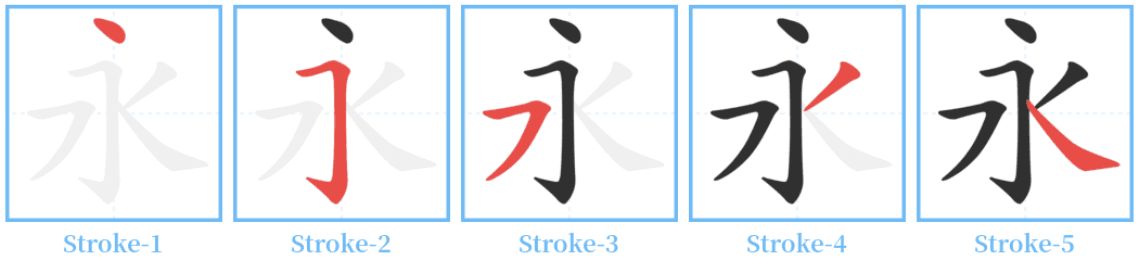
Most Chinese kids follow the strokes of to memorize the basic strokes:
 ---
## Beyond the strokes: radicals, components, and how to combine them
If strokes are the bricks, then [radicals](https://migaku.com/blog/chinese/chinese-radicals) are the prefabricated walls and frames. Of the tens of thousands of characters, most are composed of a combination of a radical (which often indicates a general category of meaning) and a phonetic component (which offers a clue to pronunciation). There are 214 traditional Kangxi radicals, and learning the most common 50-100 will give you a powerful lens through which to view the language. For example:
1. The radical (Water) or its simplified form 氵 appears in characters like (River), (Lake), (Flow), and (Sweat).
2. The radical (Heart) or its form 忄 appears in (To feel), (To fear), (Emotion), and (To think).
By recognizing the radical, you immediately gain an intuitive, if sometimes abstract, hint about the character's theme. This allows you to categorize and mentally file characters in related groups, making recall easier.
Additionally, some characters have phonetic components next to the radicals. By grasping the knowledge of radicals and phonetic components, you stop seeing a complex character as a monolithic, daunting image and begin to see it as an assembly of familiar parts, like: "That's the 'speech' radical (讠) next to the component for 'exchange' (), so it must be (To speak)." This analytical approach is the cornerstone of efficient literacy.
Consequently, as a Chinese learner, now you have a clearer clue on how to memorize the strokes and compositions of each character, as they become more logical and meaningful.
---
## How to practice Chinese handwriting: the way to write with paper and digital tool
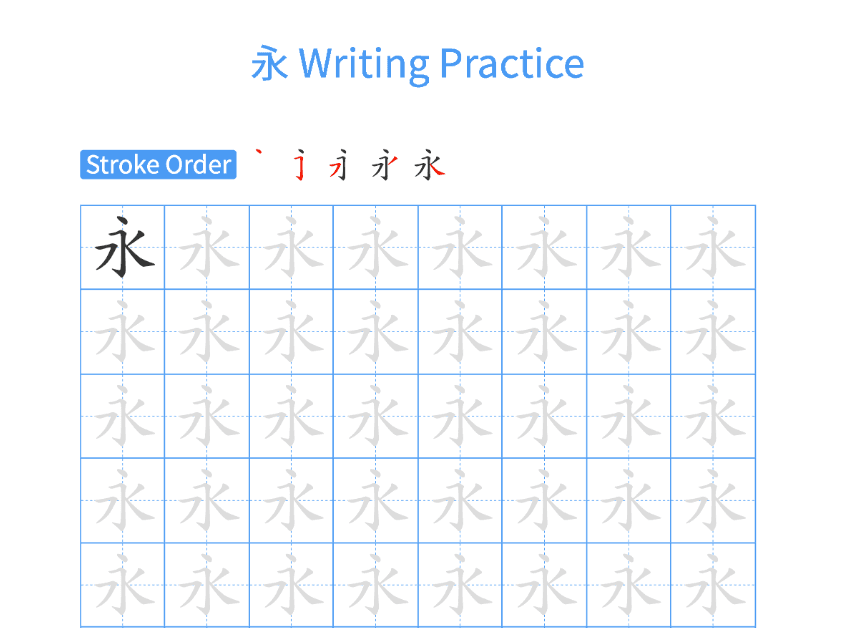
The modern students have a suite of practical tools at their disposal. The journey often begins with gridded practice paper ( or ). These sheets, with their central crosshairs, are indispensable for beginners. They provide a visual scaffold, teaching crucial spatial awareness—how to center a character and balance its components within an imaginary square. Starting with a pencil here allows for error and refinement, focusing purely on form and proportion. Some practice sheets also feature , a shadowy sample character to exemplify how to position each part of this character in the grid.
This is an example of the worksheet with . You can also purchase or download the sheets for basic Chinese characters online.
---
## Beyond the strokes: radicals, components, and how to combine them
If strokes are the bricks, then [radicals](https://migaku.com/blog/chinese/chinese-radicals) are the prefabricated walls and frames. Of the tens of thousands of characters, most are composed of a combination of a radical (which often indicates a general category of meaning) and a phonetic component (which offers a clue to pronunciation). There are 214 traditional Kangxi radicals, and learning the most common 50-100 will give you a powerful lens through which to view the language. For example:
1. The radical (Water) or its simplified form 氵 appears in characters like (River), (Lake), (Flow), and (Sweat).
2. The radical (Heart) or its form 忄 appears in (To feel), (To fear), (Emotion), and (To think).
By recognizing the radical, you immediately gain an intuitive, if sometimes abstract, hint about the character's theme. This allows you to categorize and mentally file characters in related groups, making recall easier.
Additionally, some characters have phonetic components next to the radicals. By grasping the knowledge of radicals and phonetic components, you stop seeing a complex character as a monolithic, daunting image and begin to see it as an assembly of familiar parts, like: "That's the 'speech' radical (讠) next to the component for 'exchange' (), so it must be (To speak)." This analytical approach is the cornerstone of efficient literacy.
Consequently, as a Chinese learner, now you have a clearer clue on how to memorize the strokes and compositions of each character, as they become more logical and meaningful.
---
## How to practice Chinese handwriting: the way to write with paper and digital tool
The modern students have a suite of practical tools at their disposal. The journey often begins with gridded practice paper ( or ). These sheets, with their central crosshairs, are indispensable for beginners. They provide a visual scaffold, teaching crucial spatial awareness—how to center a character and balance its components within an imaginary square. Starting with a pencil here allows for error and refinement, focusing purely on form and proportion. Some practice sheets also feature , a shadowy sample character to exemplify how to position each part of this character in the grid.
This is an example of the worksheet with . You can also purchase or download the sheets for basic Chinese characters online.
 On the other hand, most of the Chinese typing tools on mobile phones feature both pinyin and strokes. Sometimes, as a beginner, when you are unsure about the pinyin of a specific character, you can use the stroke input to help you type. This input method is quite commonly used among the middle-aged and elderly group in mainland China, as visually identifying the English alphabet is difficult for them. You can search up how to switch to with your typing tool.
---
## Practice to write Chinese characters with groups of words from a similar context
The final, most critical element is how you practice. Effective practice is contextual and meaningful. As you are practicing Chinese handwriting, you are also familiarizing yourself with the meaning and the look of each new word. You can combine handwriting with vocabulary building via this method: The moment you learn a new character, immediately use it to write a word.
Don't just write (Ice). Practice writing words that are connected with (Ice), such as (Iced Americano), (Iced soybean drink), (Ice cubes), (Ice packs), and so on. These are all very commonly used words if you are travelling to China. The ability to recognize them will make your travel experience much easier.
---
## Collect vocabulary for writing Chinese practice with this app!
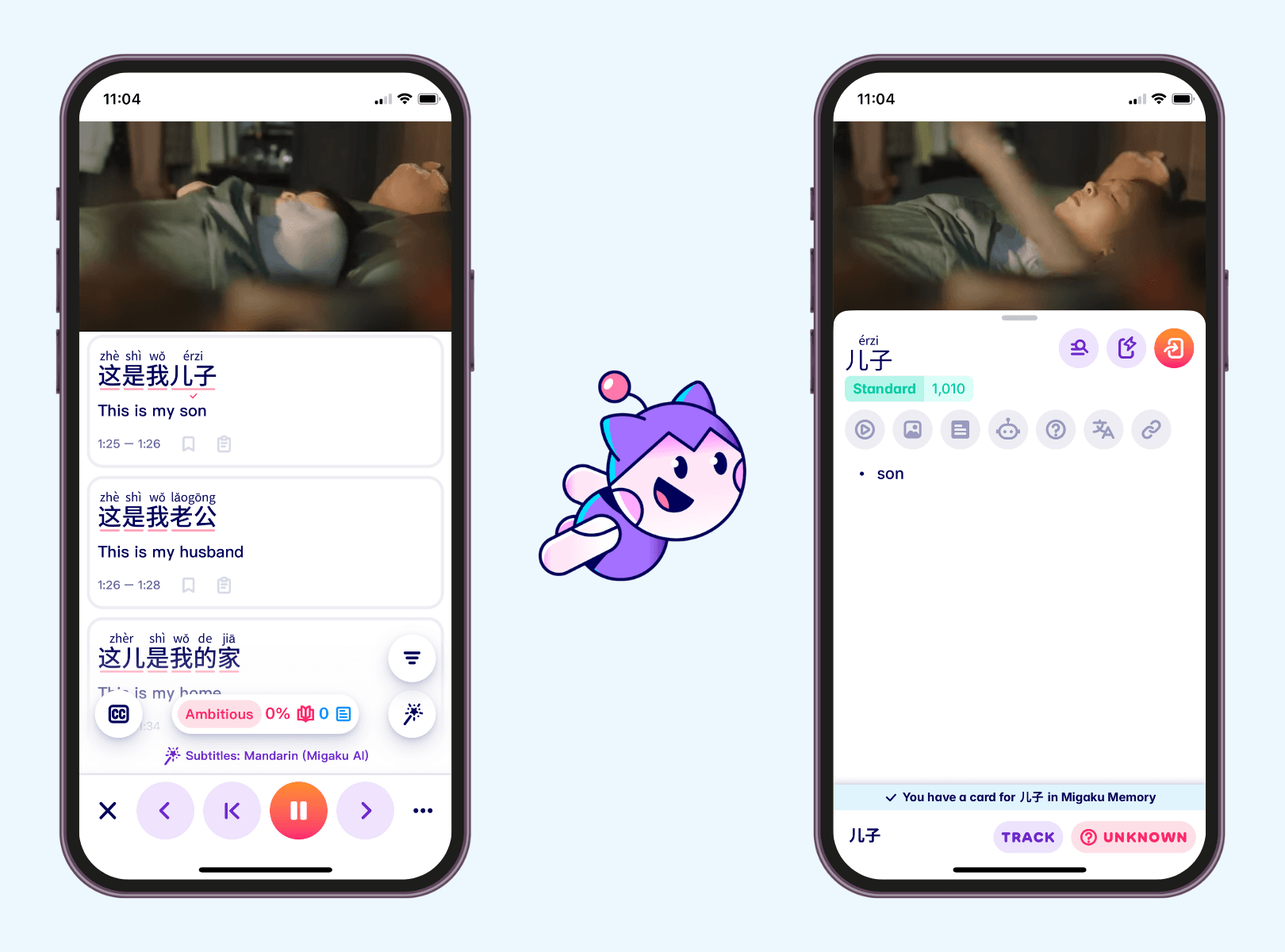
How do I know which character I should practice today? Migaku app can help you with generating Chinese subtitles even when the video does not feature any and adding new words to flashcards. By clicking the words or sentences to add them to your flashcard collections, you can review them later or input them into a worksheet-generating website to create writing practice for yourself. It is your best assistant for intensive Chinese handwriting practice.
1. Switch on YouTube and search for Chinese videos with the app
2. Click "Watch with Migaku", and the magic wand at the lower right corner to generate Chinese subtitles
3. Click on the new words or sentences in each subtitle and generate flashcards!
On the other hand, most of the Chinese typing tools on mobile phones feature both pinyin and strokes. Sometimes, as a beginner, when you are unsure about the pinyin of a specific character, you can use the stroke input to help you type. This input method is quite commonly used among the middle-aged and elderly group in mainland China, as visually identifying the English alphabet is difficult for them. You can search up how to switch to with your typing tool.
---
## Practice to write Chinese characters with groups of words from a similar context
The final, most critical element is how you practice. Effective practice is contextual and meaningful. As you are practicing Chinese handwriting, you are also familiarizing yourself with the meaning and the look of each new word. You can combine handwriting with vocabulary building via this method: The moment you learn a new character, immediately use it to write a word.
Don't just write (Ice). Practice writing words that are connected with (Ice), such as (Iced Americano), (Iced soybean drink), (Ice cubes), (Ice packs), and so on. These are all very commonly used words if you are travelling to China. The ability to recognize them will make your travel experience much easier.
---
## Collect vocabulary for writing Chinese practice with this app!
How do I know which character I should practice today? Migaku app can help you with generating Chinese subtitles even when the video does not feature any and adding new words to flashcards. By clicking the words or sentences to add them to your flashcard collections, you can review them later or input them into a worksheet-generating website to create writing practice for yourself. It is your best assistant for intensive Chinese handwriting practice.
1. Switch on YouTube and search for Chinese videos with the app
2. Click "Watch with Migaku", and the magic wand at the lower right corner to generate Chinese subtitles
3. Click on the new words or sentences in each subtitle and generate flashcards!
 ---
## FAQs
No, it is not inherently easy, but its difficulty is often misunderstood. The initial hurdle—memorizing characters—is significant. However, the language's logical structure (through radicals and consistent stroke order) provides a clear path. Practicing consistently can help you build muscle memory in the flow of writing the basic strokes.
---
## Start with one page of the worksheet today!
Your first characters will be imperfect, but when you reach the end of the first writing sheet, you will make progress. Find joy in the small, daily victories, like the moment you recognize a character from the drama subtitles, or the moment you start to enjoy Chinese calligraphy! Use all kinds of media to generate practice input:
> If you consume media in Chinese, and you understand at least some of the messages and sentences within that media, you will make progress. _Period_.
Impress your Chinese friends with your perfect handwriting!
---
## FAQs
No, it is not inherently easy, but its difficulty is often misunderstood. The initial hurdle—memorizing characters—is significant. However, the language's logical structure (through radicals and consistent stroke order) provides a clear path. Practicing consistently can help you build muscle memory in the flow of writing the basic strokes.
---
## Start with one page of the worksheet today!
Your first characters will be imperfect, but when you reach the end of the first writing sheet, you will make progress. Find joy in the small, daily victories, like the moment you recognize a character from the drama subtitles, or the moment you start to enjoy Chinese calligraphy! Use all kinds of media to generate practice input:
> If you consume media in Chinese, and you understand at least some of the messages and sentences within that media, you will make progress. _Period_.
Impress your Chinese friends with your perfect handwriting!