# Nice to Meet You in Chinese: Formal and Casual Phrases for Different Occasions
> Knowing "nice to meet you" in Chinese gives you great opportunities to leave a good first impression. Explore how to greet a peer or a senior here!
**URL:** https://migaku.com/blog/chinese/nice-to-meet-you-in-chinese
**Last Updated:** 2025-12-24
**Tags:** vocabulary, culture, phrases
---
You’ve just been introduced to someone new in Mandarin, and your brain scrambles for the right phrase. What to say after the first "hello"? How to start the conversation naturally?🧐 The thing is, with the simple "nice to meet you" in English, there are a multitude of expressions when [learning Chinese](https://migaku.com/learn-chinese) for different occasions. Let's break down how to make a genuinely good first impression.
---
## The formal standard way to say "nice to meet you" in Chinese: 幸会 vs. 很高兴认识你
### 幸会 (xìng huì)
The textbook phrase you absolutely must know is:
。
*It is my fortune to meet you.*
This is the timeless, classic, go-to phrase for formal introductions. It’s concise, deeply respectful, and carries a humble tone, suggesting you feel fortunate for the meeting. You’ll hear it in business settings, at formal events, or when being introduced to someone of clear seniority or status.
The upside is its impeccable appropriateness; the downside is that it can feel a bit austere or distant in very casual, friendly situations.
### 很高兴认识你 (hěn gāoxìng rènshi nǐ)
Its more elaborate and even more common sibling is:
。
*I am very happy to know you.*
This is the direct translation that feels more natural to English speakers and is highly useful. It’s polite, warm, and works in a huge range of scenarios, from a business lunch to being introduced to a friend’s parent.
You can adjust its formality slightly: uses the formal “you” (), which is perfect for showing respect to elders or superiors.
Think of as a respectful bow and as a warm, firm handshake. Together, they form the essential foundation for any introduction.
---
## The casual phrases for friends and peers in the Chinese language
Alright, let’s loosen the tie. In casual, everyday life — meeting a friend of a friend, a new classmate, or someone at a party — the formal phrases can feel a bit over-the-top. Here’s where modern, spoken Mandarin shines with phrases that are friendly and relaxed.
1. 。
*Hello hello.* (When introduced, people will often simply greet the person again with a double , accompanied by a smile or a nod. It’s an implicit “nice to meet you” through repeated greeting, and it’s wonderfully low-pressure.)
2. 。
*I have long admired your great name.* (Now, this one has nuance. Used sincerely, it’s for when you’re meeting someone truly renowned or an expert whose work you know. But among peers, especially in younger crowds or business networking, it’s often used with a playful, slightly self-aware tone — a way to humorously inflate someone’s status and break the ice. The key is delivery: with a grin, it means “I’ve heard great things.”)
3. 。
*He mentions you a lot.* (You can replace the pronoun with the name of a friend or a peer. It means that you have heard about this person before this meeting. It's a good way to start the conversation!)
---
## The respectful expressions for seniors and superiors
This is where cultural intelligence becomes crucial. In Chinese etiquette, showing respect isn’t just polite — it’s foundational. When meeting someone older, a teacher, a boss, or anyone in a position of authority, your language needs to elevate them and humble you. The standard is a good start, but you can layer in deeper respect.
1. 。
*Long admiration, long admiration.* (This is a shortened, conversational version of . It directly expresses that you’ve heard of them and hold them in high esteem.)
2. 。
*Please give me much advice and guidance.* (It’s perfect for meeting a master in your field, a senior colleague, or your new boss’s boss. It acknowledges their experience and your desire to learn.)
You might also combine phrases for maximum effect:
。
*It is my fortune to meet you, I have long admired your name, and I ask for your guidance in the future.*
This is the full ceremonial greeting — respectful, humble, and deeply formal. While a mouthful, understanding its components helps you grasp the hierarchy and humility embedded in the culture.
---
## How to greet beyond the first meeting?
Here’s a pro tip that most learners miss: what do you say the second time you meet someone? Repeating “nice to meet you” would be strange. This is where you graduate from introduction to connection.
1. 。
*We meet again.* (This is the standard, cheerful phrase for acknowledging a repeat meeting.)
2. 。
*Long time no see.* (The absolute staple for meeting someone you haven’t seen in a while.)
3. 。
*I hope nothing has changed for the worse since we parted.*
(This is a classical, four-character idiom that’s a more literary and profound version of “long time no see.”)
---
## Try out Migaku to collect Chinese native speakers' "nice to meet you"
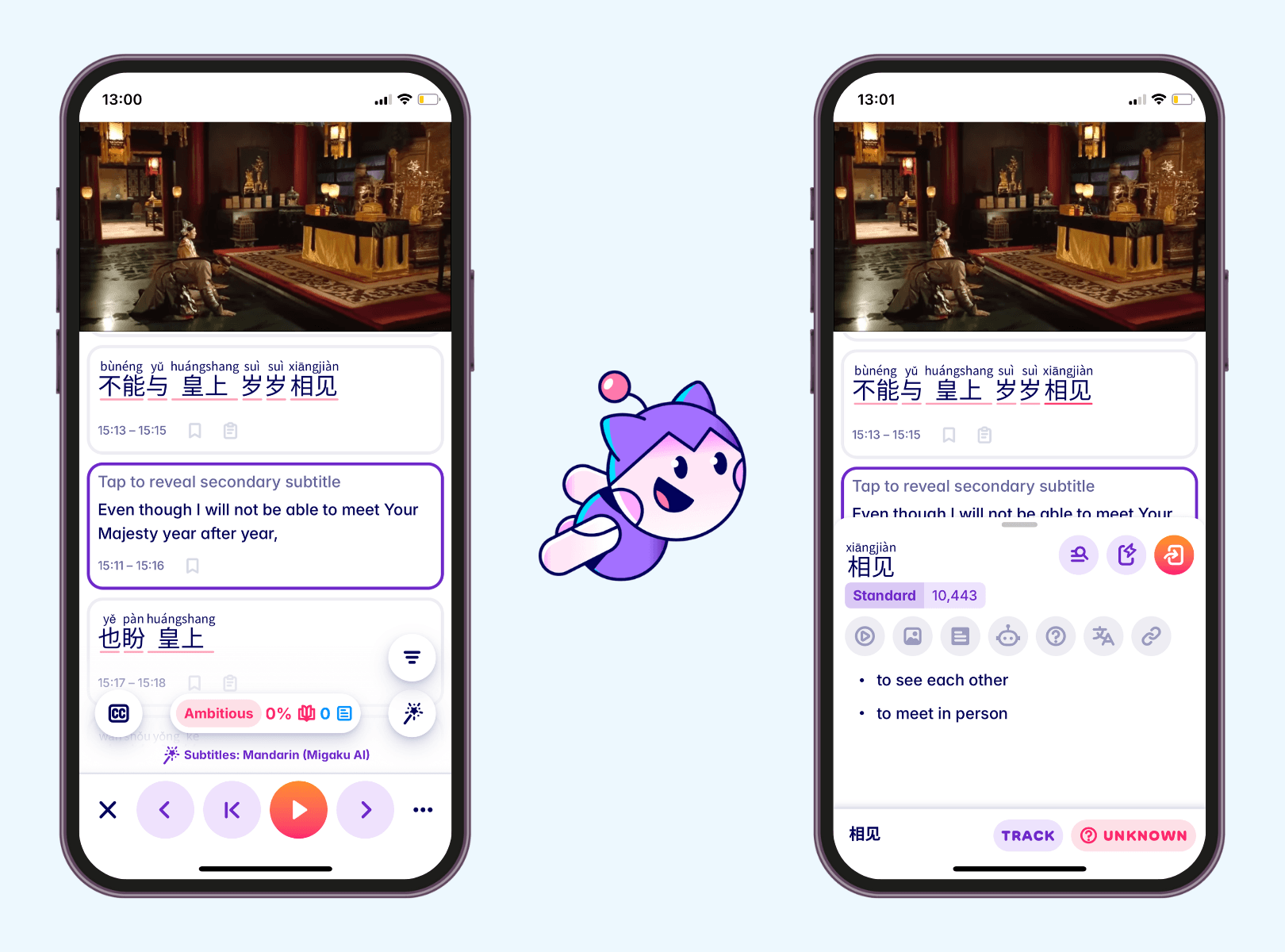
There are how modern people say "nice to meet you", and how ancient cultures expressed the same meaning but in a different way! If you enjoy Chinese dramas in ancient settings like I do, Migaku can help you explore the greetings in (Costume drama) as well.
Migaku app can help generate Chinese subtitles even when the video does not feature any. For example, Migaku app can generate subtitles for this cut from *Empresses in the Palace* with the English translation. You can also click the words or sentences to add them to your flashcard collections and review them later. This is how you can click and save the words for greetings if you encounter any!
1. Switch on YouTube and search for Chinese videos with the app.
2. Click "Watch with Migaku", and the magic wand at the lower right corner to generate Chinese subtitles.
3. Click on the new words or sentences in each subtitle and generate flashcards!
 ---
## FAQs
Yes, absolutely. Chinese people do say phrases equivalent to "nice to meet you," but the choice depends heavily on formality and context. The most common and versatile one is (I am very happy to know you). In formal situations, (It is my fortune to meet you) is the classic, respectful standard.
Hen gao xing ren shi ni is the pinyin for the Chinese phrase . It translates to "I am very happy to know you" or "Very pleased to meet you." This is the most common and versatile way to express "nice to meet you" in Mandarin, suitable for a wide range of social and formal introductions.
A proper greeting depends on context. The universal, safe choice is (Hello). For elders or superiors, use the respectful (Hello). In very informal settings with friends, a simple (Hi) works. You can also explore [here](https://migaku.com/blog/chinese/how-are-you-in-chinese) to know the Chinese "how are you".
---
## This is how you can leave great first impressions!
So, the truth is, “nice to meet you” in Chinese is a gateway. It begins with a humble or a warm , can be deepened with respectful bows like , and matures into the reconnection of . Listen to and watch videos on how people greet each other. More or less, that’s how you learn to not just speak the words, but perform the social harmony they’re meant to create.
> If you consume media in Chinese, and you understand at least some of the messages and sentences within that media, you will make progress. _Period_.
You only have one opportunity to make a first impression!
---
## FAQs
Yes, absolutely. Chinese people do say phrases equivalent to "nice to meet you," but the choice depends heavily on formality and context. The most common and versatile one is (I am very happy to know you). In formal situations, (It is my fortune to meet you) is the classic, respectful standard.
Hen gao xing ren shi ni is the pinyin for the Chinese phrase . It translates to "I am very happy to know you" or "Very pleased to meet you." This is the most common and versatile way to express "nice to meet you" in Mandarin, suitable for a wide range of social and formal introductions.
A proper greeting depends on context. The universal, safe choice is (Hello). For elders or superiors, use the respectful (Hello). In very informal settings with friends, a simple (Hi) works. You can also explore [here](https://migaku.com/blog/chinese/how-are-you-in-chinese) to know the Chinese "how are you".
---
## This is how you can leave great first impressions!
So, the truth is, “nice to meet you” in Chinese is a gateway. It begins with a humble or a warm , can be deepened with respectful bows like , and matures into the reconnection of . Listen to and watch videos on how people greet each other. More or less, that’s how you learn to not just speak the words, but perform the social harmony they’re meant to create.
> If you consume media in Chinese, and you understand at least some of the messages and sentences within that media, you will make progress. _Period_.
You only have one opportunity to make a first impression!