# Future Tense Conjugation in Spanish: Complete Guide
> Learn how to conjugate the Spanish future tense with clear rules, charts, and examples. Covers regular verbs, irregular stems, and ir + a + infinitive.
**URL:** https://migaku.com/blog/spanish/future-tense-conjugation-spanish
**Last Updated:** 2026-04-29
**Tags:** fundamentals, grammar
---
So you want to [learn Spanish](https://migaku.com/learn-spanish) future tense to talk about what you're going to do tomorrow, next week, or five years from now? Good news: the future tense is actually one of the easier verb conjugations to learn. Unlike past tenses that can get pretty messy with all their irregular forms, the Spanish future tense follows a pattern that works for almost every verb you'll encounter. I'm going to walk you through everything you need to know about conjugating the future tense in Spanish. We'll cover the regular patterns, the handful of irregular verbs you need to memorize, and when you'd use this tense versus other ways of talking about the future.
----
## Understanding the Spanish future tense
The future tense in Spanish, called **futuro simple** (simple future), tells you **what will happen or what someone will do**.
What makes this tense super learner-friendly is that you don't change the verb stem for regular verbs. You take the full infinitive form of any verb (hablar, comer, vivir) and just stick the ending on. Compare that to the present tense where you're chopping off those -ar, -er, and -ir endings and replacing them with different forms for each subject. The future tense keeps the whole infinitive intact.
This means whether you're working with -ar verbs, -er verbs, or -ir verbs, you use the exact same set of endings. That's one set of endings to memorize instead of three.
----
## Regular future tense conjugation
Let's get into the conjugation pattern. Here are the endings you'll add to any infinitive:
**Future Tense Endings:**
- Yo: -é
- Tú: -ás
- Él/Ella/Usted: -á
- Nosotros/Nosotras: -emos
- Vosotros/Vosotras: -éis
- Ellos/Ellas/Ustedes: -án
Notice those accent marks? They're important for pronunciation and you'll see them on every form except the nosotros form.
### Conjugating -ar verbs in the future
Let's use **hablar** (to speak) as our example:
- Yo hablaré (I will speak)
- Tú hablarás (you will speak)
- Él/Ella/Usted hablará (he/she/you formal will speak)
- Nosotros/Nosotras hablaremos (we will speak)
- Vosotros/Vosotras hablaréis (you all will speak)
- Ellos/Ellas/Ustedes hablarán (they/you all will speak)
You literally just took "hablar" and added those endings. That's it.
### Conjugating -er verbs in the future
Now let's try **comer** (to eat):
- Yo comeré (I will eat)
- Tú comerás (you will eat)
- Él/Ella/Usted comerá (he/she/you formal will eat)
- Nosotros/Nosotras comeremos (we will eat)
- Vosotros/Vosotras comeréis (you all will eat)
- Ellos/Ellas/Ustedes comerán (they/you all will eat)
Same exact endings, different infinitive. The pattern holds.
### Conjugating -ir verbs in the future
And finally, **vivir** (to live):
- Yo viviré (I will live)
- Tú vivirás (you will live)
- Él/Ella/Usted vivirá (he/she/you formal will live)
- Nosotros/Nosotras viviremos (we will live)
- Vosotros/Vosotros viviréis (you all will live)
- Ellos/Ellas/Ustedes vivirán (they/you all will live)
You're probably noticing a pattern here. The verb type doesn't matter for future tense conjugation. This consistency makes the future tense way easier to master than other tenses in Spanish [grammar](https://migaku.com/blog/spanish/spanish-grammar-guide).
----
## Irregular verbs in the future tense
Okay, so I mentioned this tense is pretty easy, and it is. But there are about a dozen irregular verbs you need to know. The good news? They use the same endings as regular verbs. The only difference is that their stem changes before you add those endings.
Here are the main irregular future stems:
**Verbs that drop the 'e' or 'i' from the infinitive:**
| Verb | English | Future Stem | Yo | Tú | Él/Ella/Usted | Nosotros | Vosotros | Ellos/Ellas/Ustedes |
| - | - | - | - | - | - | - | - | - |
| Haber | To have | habr- | habré | habrás | habrá | habremos | habréis | habrán |
| Poder | To be able to | podr- | podré | podrás | podrá | podremos | podréis | podrán |
| Querer | To want | querr- | querré | querrás | querrá | querremos | querréis | querrán |
| Saber | To know | sabr- | sabré | sabrás | sabrá | sabremos | sabréis | sabrán |
**Verbs that replace the vowel with 'd':**
| Verb | English | Future Stem | Yo | Tú | Él/Ella/Usted | Nosotros | Vosotros | Ellos/Ellas/Ustedes |
| - | - | - | - | - | - | - | - | - |
| Poner | To put | pondr- | pondré | pondrás | pondrá | pondremos | pondréis | pondrán |
| Salir | To leave | saldr- | saldré | saldrás | saldrá | saldremos | saldréis | saldrán |
| Tener | To have | tendr- | tendré | tendrás | tendrá | tendremos | tendréis | tendrán |
| Venir | To come | vendr- | vendré | vendrás | vendrá | vendremos | vendréis | vendrán |
**Verbs with unique stems:**
| Verb | English | Future Stem | Yo | Tú | Él/Ella/Usted | Nosotros | Vosotros | Ellos/Ellas/Ustedes |
| - | - | - | - | - | - | - | - | - |
| Decir | To say | dir- | diré | dirás | dirá | diremos | diréis | dirán |
| Hacer | To do / To make | har- | haré | harás | hará | haremos | haréis | harán |
These irregular stems might seem random at first, but if you practice them for a few days, they'll stick. Most Spanish learners find these easier to memorize than the irregular preterite forms, which have way more variations.
----
## The informal future: Ir + a + infinitive
Here's where things get interesting. Spanish actually has two main ways to talk about future actions. We've covered the simple future tense, but there's also what's called the **informal future** or **near future**.
> 💡This construction uses the verb **ir** (to go) conjugated in the present tense, followed by the preposition **a**, followed by the infinitive of your main verb. The formula: **ir (conjugated) + a + infinitive**
Let's conjugate ir in the present tense first:
- Yo voy (I go)
- Tú vas (you go)
- Él/Ella/Usted va (he/she/you formal go)
- Nosotros/Nosotras vamos (we go)
- Vosotros/Vosotras vais (you all go)
- Ellos/Ellas/Ustedes van (they/you all go)
Now add "a" and any infinitive:
- Voy a estudiar.
*I am going to study.*
- Vas a comer.
*You are going to eat.*
- Va a llegar tarde.
*He/She is going to arrive late.*
- Vamos a viajar.
*We are going to travel.*
- Vais a trabajar.
*You all are going to work.*
- Van a comprar una casa.
*They are going to buy a house.*
This construction is super common in everyday Spanish conversation, probably more common than the simple future tense in many regions. It feels more immediate and certain, kind of like saying "I'm going to..." in English versus "I will..."
----
## When to use the future tense
So when do you use the future tense versus the informal future with ir? Good question. Both can express future actions, but there are some subtle differences.
### Predictions and assumptions
Use the future tense for predictions about what will happen:
- El partido será emocionante.
*The game will be exciting.*
- Llegaremos antes del mediodía.
*We will arrive before noon.*
- Tu hermana tendrá éxito.
*Your sister will be successful.*
### Expressing probability in the present
This is a cool use that surprises a lot of learners. You can use the future tense to express probability or speculation about what's happening right now:
- ¿Dónde está María? Estará en casa.
*Where is María? She's probably at home.*
- ¿Qué hora es? Serán las tres.
*What time is it? It must be around three o'clock.*
- Tendrán hambre después del viaje.
*They're probably hungry after the trip.*
This usage adds a layer of uncertainty or educated guessing to your statement.
### Formal intentions and promises
The simple future tense sounds more formal and definitive:
- Te llamaré mañana.
*I will call you tomorrow.*
- No olvidaré tu cumpleaños.
*I won't forget your birthday.*
- Pagaremos la cuenta.
*We will pay the bill.*
### Near future with ir + a + infinitive
The informal future works better for:
**Immediate plans:**
- Voy a salir en cinco minutos.
*I'm going to leave in five minutes.*
- Vamos a cenar ahora.
*We're going to eat dinner now.*
**Definite intentions:**
- Voy a aprender español este año.
*I'm going to learn Spanish this year.*
- Van a mudarse a México.
*They're going to move to Mexico.*
In Latin American Spanish especially, you'll hear the ir + a construction way more often in casual conversation. The simple future tense can sometimes sound a bit formal or literary.
----
## Regional differences: Vosotros vs. Ustedes
Quick grammar note about regional variations. In Spain, people use the vosotros/vosotras forms for informal plural "you." So you'd say "hablaréis" (you all will speak) when talking to friends.
In Latin America, this form basically doesn't exist in everyday speech. Instead, people use ustedes for both formal and informal plural "you," which means you'd say "hablarán" whether you're talking to your friends or to your boss's parents.
This affects how you conjugate, but the good news is that if you're learning Latin American Spanish, you can basically skip learning the vosotros forms entirely. That's one less conjugation to memorize for every tense.
----
## The four types of future tense
You might've heard that Spanish has four types of future tense. Here's the breakdown:
- **Simple Future (Futuro Simple):** What we've been focusing on. Hablaré, comeré, viviré.
- **Informal Future (Ir + A + Infinitive):** Voy a hablar, vas a comer, van a vivir.
- **Future Perfect (Futuro Perfecto):** Uses haber in the future tense plus a past participle. Habré hablado (I will have spoken). This expresses actions that will be completed by a certain point in the future.
- **Future Progressive (Futuro Continuo):** Less common, but uses estar in the future tense plus a present participle. Estaré hablando (I will be speaking). Shows ongoing action in the future.
For most everyday conversations, you'll mainly use the simple future and the informal future with ir. The future perfect and future progressive are less common but useful for specific situations.
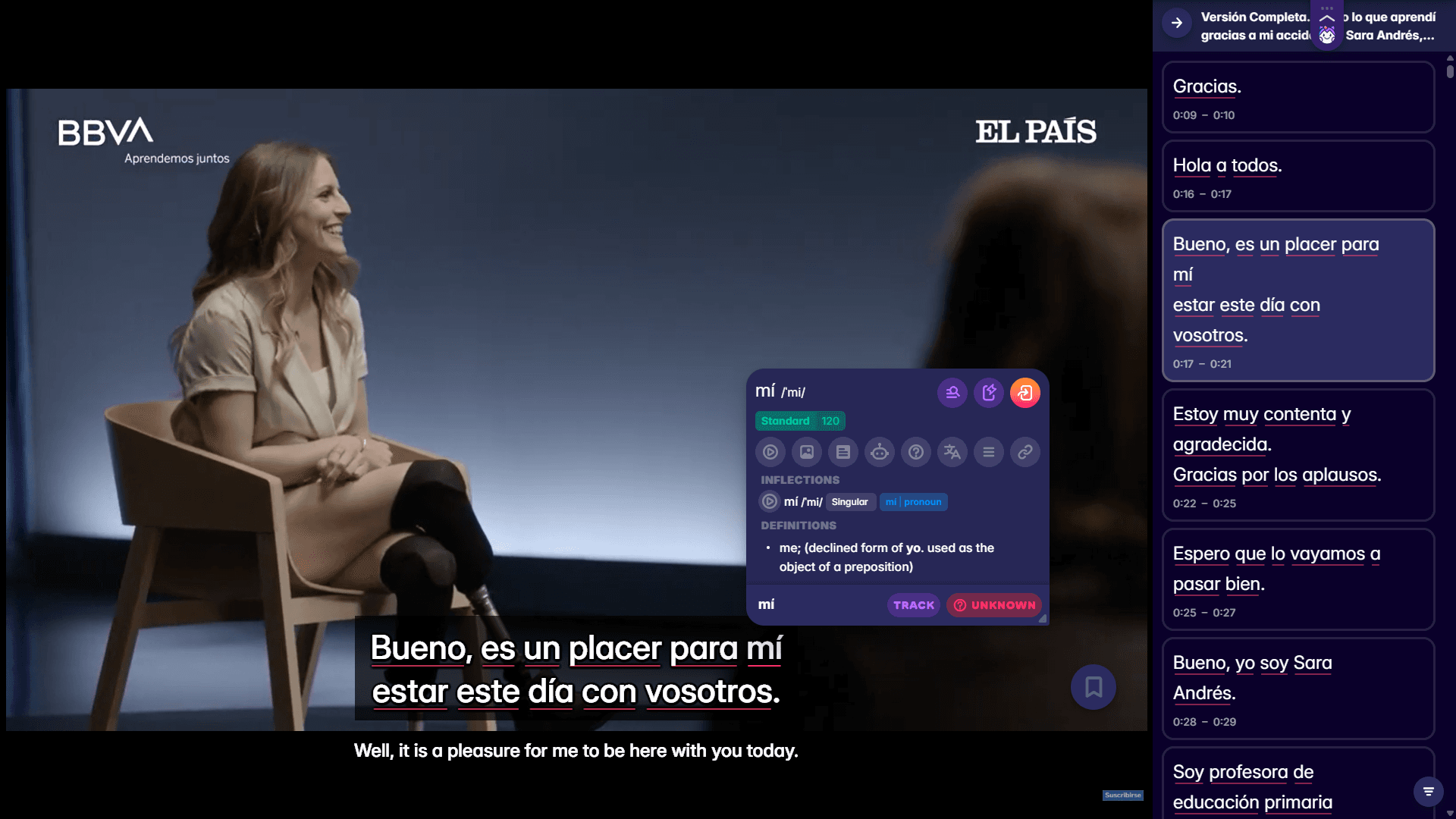
Anyway, if you want to practice these conjugations with real Spanish content, Migaku's browser extension and app let you look up verb forms instantly while watching shows or reading articles. You can see these future tense verbs in actual context, which beats memorizing conjugation charts any day. There's a 10-day free trial if you want to check it out.
 ----
## The best way to master future tense conjugation
Practice with verbs you actually use. Start with common verbs like hablar, comer, ir, hacer, tener, and poder. Pay attention to how native speakers use the future tense when you're watching Spanish shows or listening to podcasts. You'll notice that the informal future with ir pops up constantly in dialogue, while the simple future tense appears more in narration or formal contexts.
> If you consume media in Spanish, and you understand at least some of the messages and sentences within that media, you will make progress. _Period_.
Media teach real language. Textbooks teach rules.
----
## The best way to master future tense conjugation
Practice with verbs you actually use. Start with common verbs like hablar, comer, ir, hacer, tener, and poder. Pay attention to how native speakers use the future tense when you're watching Spanish shows or listening to podcasts. You'll notice that the informal future with ir pops up constantly in dialogue, while the simple future tense appears more in narration or formal contexts.
> If you consume media in Spanish, and you understand at least some of the messages and sentences within that media, you will make progress. _Period_.
Media teach real language. Textbooks teach rules.