Complete Ir Conjugation Chart: All Spanish Tenses Explained
Last updated: April 15, 2026

Here's the thing about learning Spanish verbs: most of them follow predictable patterns. Then you meet ir (to go), and it basically throws all those rules out the window. The verb ir is one of the most irregular verbs in Spanish, which means you can't just apply standard conjugation rules and hope for the best. This guide breaks down the complete ir conjugation chart across all the major tenses you need to know. I'll show you the patterns, give you real examples, and help you understand when to use each form.
Present tense conjugation of ir
Let's start with the present tense, where you'll probably use ir most often when you're learning Spanish. Here's the complete conjugation chart:
Pronoun | Conjugation | English |
|---|---|---|
yo | voy | I go |
tú | vas | you go (informal) |
él/ella/usted | va | he/she goes, you go (formal) |
nosotros/nosotras | vamos | we go |
vosotros/vosotras | vais | you all go (informal, Spain) |
ellos/ellas/ustedes | van | they go, you all go |
Notice how none of these forms look anything like the infinitive ir? That's what makes this verb so irregular. You can't predict these conjugations from the base form.
The form vamos gets used a lot in casual speech, often as "let's go!" You'll hear it constantly in Spanish-speaking countries. "¡Vamos a la playa!" (Let's go to the beach!) or just "¡Vamos!" (Let's go!).
Here are some practical examples:
- Yo voy al supermercado cada domingo.
I go to the supermarket every Sunday. - ¿Vas a la fiesta esta noche?
Are you going to the party tonight? - Ellos van a la escuela en autobús.
They go to school by bus.
Using ir + a + infinitive for future actions
One of the coolest things about the verb ir is how you can use it to talk about the future without even touching the actual future tense. The construction "ir + a + infinitive" works like "going to" in English.
Here's how it works:
- Voy a estudiar mañana.
I'm going to study tomorrow. - Vamos a comer pizza.
We're going to eat pizza. - Ella va a viajar a México.
She's going to travel to Mexico.
This construction is super common in everyday conversation, way more common than the formal future tense for many situations. Spanish speakers use it constantly to express near-future plans and intentions.
Preterite tense conjugation in Spanish
The preterite tense is where ir really shows its irregular side. Actually, it shares these exact same forms with the verb ser (to be). Yep, "fui" means both "I went" AND "I was" depending on context. Wild, right?
Pronoun | Conjugation | English |
|---|---|---|
yo | fui | I went |
tú | fuiste | you went |
él/ella/usted | fue | he/she/you went |
nosotros/nosotras | fuimos | we went |
vosotros/vosotras | fuisteis | you all went |
ellos/ellas/ustedes | fueron | they/you all went |
The forms fui and fueron appear all the time when talking about past trips, visits, or movements. The preterite tense indicates completed actions in the past, so you'd use these forms when describing where you went yesterday, last week, or at any specific point in the past.
Examples that show the preterite in action:
- Fui a Madrid el año pasado.
I went to Madrid last year. - ¿Fuiste al concierto?
Did you go to the concert? - Fueron a la playa durante las vacaciones.
They went to the beach during vacation.
Remember, context tells you whether someone means "went" or "was." Usually, it's pretty clear from the sentence structure and surrounding words.
Imperfect tense conjugation
The imperfect tense describes ongoing or habitual actions in the past. When you talk about where you used to go regularly or where you were going when something else happened, you'll need these forms.
Pronoun | Conjugation | English |
|---|---|---|
yo | iba | I was going/used to go |
tú | ibas | you were going/used to go |
él/ella/usted | iba | he/she/you was/were going |
nosotros/nosotras | íbamos | we were going/used to go |
vosotros/vosotras | ibais | you all were going/used to go |
ellos/ellas/ustedes | iban | they/you all were going/used to go |
Good news: the imperfect forms of ir actually look somewhat related to the infinitive, unlike the present or preterite. These are more predictable.
Check out these examples:
- Cuando era niño, iba a la piscina todos los veranos.
When I was a kid, I used to go to the pool every summer. - Íbamos al cine cada viernes.
We used to go to the movies every Friday. - Ella iba a la universidad cuando la conocí.
She was going to university when I met her.
The difference between preterite and imperfect with ir matters a lot. "Fui al parque" means you went to the park (completed action). "Iba al parque" means you were going/used to go to the park (ongoing or habitual).
Future tense in Spanish conjugation
Here's some relief: the future tense of ir follows regular patterns. You take the infinitive and add standard future endings. No weird stem changes or completely different forms.
Pronoun | Conjugation | English |
|---|---|---|
yo | iré | I will go |
tú | irás | you will go |
él/ella/usted | irá | he/she/you will go |
nosotros/nosotras | iremos | we will go |
vosotros/vosotras | iréis | you all will go |
ellos/ellas/ustedes | irán | they/you all will go |
The future tense sounds more formal than the "ir + a + infinitive" construction I mentioned earlier. You'll see it more in writing or formal speech.
Examples:
- Iré a España el próximo mes.
I will go to Spain next month. - ¿Irás a la reunión mañana?
Will you go to the meeting tomorrow? - Iremos juntos.
We will go together.
Conditional tense
The conditional tense expresses what would happen under certain conditions. Like the future, it follows regular patterns with ir.
Pronoun | Conjugation | English |
|---|---|---|
yo | iría | I would go |
tú | irías | you would go |
él/ella/usted | iría | he/she/you would go |
nosotros/nosotras | iríamos | we would go |
vosotros/vosotras | iríais | you all would go |
ellos/ellas/ustedes | irían | they/you all would go |
Use the conditional when talking about hypothetical situations:
- Yo iría contigo, pero tengo que trabajar.
I would go with you, but I have to work. - ¿Irías a vivir a otro país?
Would you go live in another country? - Ellos irían si tuvieran dinero.
They would go if they had money.
Present subjunctive form
The subjunctive mood expresses doubt, wishes, emotions, or uncertainty. The verb ir has irregular subjunctive forms you need to memorize.
Pronoun | Conjugation | English |
|---|---|---|
yo | vaya | (that) I go |
tú | vayas | (that) you go |
él/ella/usted | vaya | (that) he/she/you go |
nosotros/nosotras | vayamos | (that) we go |
vosotros/vosotras | vayáis | (that) you all go |
ellos/ellas/ustedes | vayan | (that) they/you all go |
The subjunctive appears after certain triggers like "espero que" (I hope that), "es importante que" (it's important that), or "quiero que" (I want that).
Examples:
- Espero que vayas a la fiesta.
I hope you go to the party. - Es necesario que vayamos temprano.
It's necessary that we go early. - Quieren que yo vaya con ellos.
They want me to go with them.
Imperfect subjunctive
The imperfect subjunctive has two acceptable forms in Spanish. Both are correct, though one is more common in Spain and the other in Latin America.
Pronoun | Conjugation (-ra) | Conjugation (-se) |
|---|---|---|
yo | fuera | fuese |
tú | fueras | fueses |
él/ella/usted | fuera | fuese |
nosotros/nosotras | fuéramos | fuésemos |
vosotros/vosotras | fuerais | fueseis |
ellos/ellas/ustedes | fueran | fuesen |
Notice these forms look similar to the preterite third-person plural "fueron." That's your memory hook.
You'd use these after past-tense triggers:
- Me pidió que fuera a su casa.
He asked me to go to his house. - Dudaba que ellos fueran a tiempo.
I doubted they would go on time.
Tips for mastering Spanish verb ir conjugations quickly
Learning this irregular verb takes some focused effort. Here are strategies that actually work:
- Practice with frequency. The verb ir appears so often in Spanish that you'll naturally reinforce it through exposure. Read Spanish texts, watch shows, and pay attention every time you see or hear a form of ir.
- Group similar tenses together. Notice how the future and conditional both use the infinitive as their stem? Learn them as a pair. The present and present subjunctive share similar irregularity patterns too.
- Use memory hooks. The preterite forms match ser exactly. The imperfect forms (iba, ibas) actually look like they come from "ir." The present tense is completely unique.
- Create example sentences. Don't just memorize the conjugation chart as isolated words. Build full sentences using each form. Your brain remembers context better than lists.
- Focus on high-frequency forms first. You'll use "voy," "vas," "va," and "vamos" way more than "vosotros" forms (unless you're in Spain). Prioritize what you'll actually say.
- A worksheet with fill-in-the-blank exercises can help drill these forms. Write out the conjugation chart by hand multiple times. Sounds old-school, but the physical act of writing helps cement the patterns.
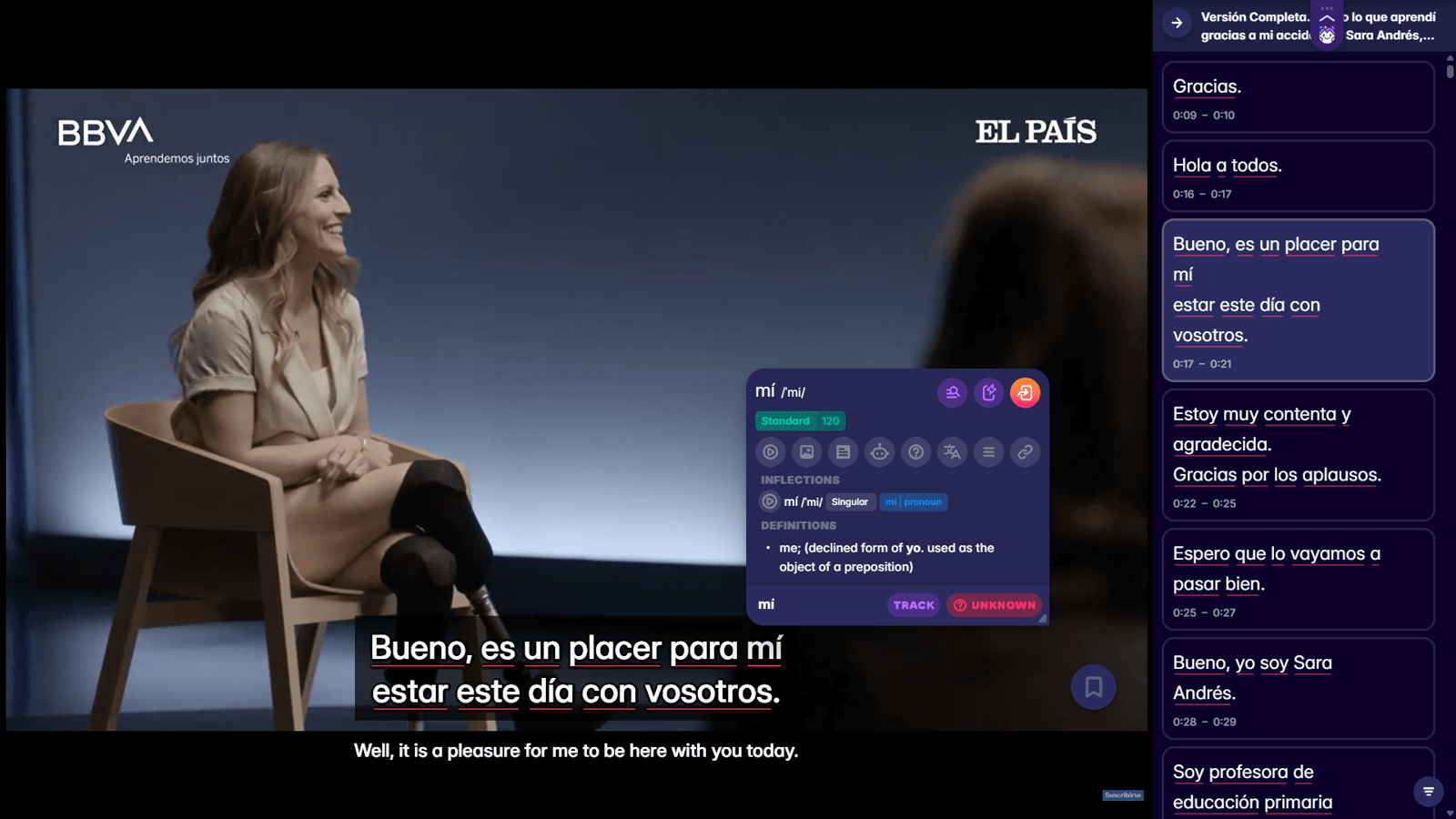
Anyway, if you're serious about learning Spanish through actual content you enjoy, Migaku's browser extension and app let you look up any verb conjugation instantly while watching Spanish shows or reading articles. Makes learning these forms way more natural than drilling flashcards. There's a 10-day free trial if you want to check it out.
Keep this conjugation chart handy as a reference
The complete ir conjugation chart covers a lot of ground. You've got present, preterite, imperfect, future, conditional, and subjunctive forms to work with. Each tense serves a specific purpose in Spanish communication. The key to mastering this Spanish verb is consistent practice over time. Your brain needs repeated exposure to real Spanish content and active use to move these conjugations from short-term to long-term memory.
If you consume media in Spanish, and you understand at least some of the messages and sentences within that media, you will make progress. Period.
Learning feels slow at first. That's normal.☕☀️