# Spanish Body Parts: Essential Vocabulary Guide for Learners
> Your feet are sore from walking, but you've got no idea how to tell it to your Spanish friend... Unlock the body part phrases with English translations.
**URL:** https://migaku.com/blog/spanish/spanish-body-parts-vocabulary-guide
**Last Updated:** 2026-02-02
**Tags:** fundamentals, vocabulary, phrases, grammar
---
Learning body parts [in Spanish](https://migaku.com/learn-spanish) is one of those topics that seems super basic until you actually need to describe where something hurts at a doctor's office in Madrid or explain to your hairstylist exactly what you want trimmed. Most Spanish body part vocabulary follows pretty predictable patterns with gender and article usage, and once you nail down the core terms, you'll be able to talk about the human body with confidence. 👀
Let's jump into the essential vocabulary you need.
---
## Why body parts in Spanish matter for learners
Here's the thing. Body part vocabulary shows up constantly in real conversations. You're not just learning random words for a test. You'll use these terms when you're sick, at the gym, describing someone's appearance, reading news articles about health, or even just talking about your day.
I've noticed that a lot of Spanish learners skip over this vocabulary category because it seems too simple or boring. Then they end up in situations where they can't explain that their ankle hurts or that they bit their tongue. Pretty frustrating, right?
The other reason this vocabulary matters? Spanish uses body parts in tons of idiomatic expressions. "Meter la pata " (To put your foot in it) means to mess up. "Costar un ojo de la cara " (To cost an eye from the face) means something's super expensive. You can't understand these phrases without knowing the basic body part terms first.
---
## The head and face: Essential Spanish vocabulary
Let's start from the top.
The head in Spanish is "la cabeza ". Notice it's feminine, so you'd say "mi cabeza " (My head) or "la cabeza me duele " (My head hurts).
For the face, you've got "la cara ". Here are the main facial features you need to know:
| Spanish | English |
| - | - |
| el ojo | Eye |
| la nariz | Nose |
| la boca | Mouth |
| la oreja | Ear (Outer part) |
| el oído | Ear (Inner ear/Hearing) |
| los dientes | Teeth |
| la lengua | Tongue |
| los labios | Lips |
| la mejilla | Cheek |
| la frente | Forehead |
| la barbilla / el mentón | Chin |
| las cejas | Eyebrows |
| las pestañas | Eyelashes |
One thing that trips people up: Spanish distinguishes between "la oreja" (The external ear you can see) and "el oído" (The internal ear and your sense of hearing). So if your ear hurts on the outside, that's "me duele la oreja ". If you have an inner ear infection, that's "me duele el oído ".
Also notice the gender switching. El ojo is masculine, but la nariz is feminine. There's no real pattern here, you just have to memorize which article goes with each word.
---
## Upper body parts you'll actually use
Moving down from the head, here's what you need for the torso and upper body:
| Spanish | English |
| - | - |
| el cuello | Neck |
| el hombro | Shoulder |
| el pecho | Chest |
| la espalda | Back |
| el brazo | Arm |
| el codo | Elbow |
| la muñeca | Wrist |
| la mano | Hand |
| el dedo | Finger |
| el pulgar | Thumb |
| el estómago | Stomach |
| la barriga / el vientre | Belly |
| la cintura | Waist |
Quick note on "la mano". Even though it ends in -o, which usually signals a masculine noun, it's actually feminine. You say "la mano", not "el mano". This is one of those exceptions that catches everyone at first.
For the fingers, you can get specific if you want:
| Spanish | English |
| - | - |
| el dedo índice | Index finger |
| el dedo medio / el dedo corazón | Middle finger |
| el dedo anular | Ring finger |
| el dedo meñique | Pinky finger |
But honestly, most of the time, people just say "el dedo" and point to which one they mean.
---
## Lower body, legs and feet in Spanish with English translation
The lower half of the body has its own set of terms:
| Spanish | English |
| - | - |
| la pierna | Leg |
| el muslo | Thigh |
| la rodilla | Knee |
| la pantorrilla | Calf |
| el tobillo | Ankle |
| el pie | Foot |
| el dedo del pie | Toe |
| el talón | Heel |
| las nalgas / el trasero | Buttocks |
| la cadera | Hip |
For toes, Spanish doesn't have separate common names like English does (Big toe, pinky toe, etc.). You usually just say "el dedo gordo del pie " (The fat toe of the foot) for the big toe and "el dedo pequeño del pie " (The small toe of the foot) for the pinky toe.
The medical term for buttocks in Spanish is "las nalgas" or "los glúteos" (Glutes). In casual conversation, people say "el trasero ", "el culo ", or various regional slang terms. "Las nalgas" sounds more clinical and professional, which is what a doctor would use.
---
## Internal organs and human body systems
You might not use these every day, but they're good to know for medical situations:
| Spanish | English |
| - | - |
| el corazón | Heart |
| los pulmones | Lungs |
| el hígado | Liver |
| los riñones | Kidneys |
| el cerebro | Brain |
| el estómago | Stomach (Organ) |
| los intestinos | Intestines |
| la sangre | Blood |
| el hueso | Bone |
| el músculo | Muscle |
| la piel | Skin |
Notice that many internal organs are masculine (el corazón, el hígado, el cerebro), but there are exceptions like la sangre and la piel.
---
## Plural forms and article usage when talking about body in Spanish
Spanish body parts follow standard plural rules, but the article usage is worth paying attention to. When you're talking about body parts that come in pairs, you use the plural article:
- los ojos (The eyes)
- las orejas (The ears)
- los brazos (The arms)
- las piernas (The legs)
- los pies (The feet)
Here's something interesting though. In English, you'd say "my hands hurt". In Spanish, you often use the definite article instead of the possessive: "me duelen las manos" (Literally "to me hurt the hands"). The "me" already shows possession, so you don't need to say "mis manos".
This pattern shows up all the time:
- Me duele la cabeza
*My head hurts*
- Me lavé las manos
*I washed my hands*
- Se rompió el brazo
*He broke his arm*
---
## Regional variations and slang
Spanish varies a lot across different countries, and body part vocabulary is no exception. For example, "la oreja " is standard for ear, but in some regions people say "la orejera ".
For breasts, the standard term is "el pecho " or "los senos ", but there are tons of slang variations. "Las tetas " is common informal slang across most Spanish-speaking countries. "Los pechos " works in more polite contexts. Regional slang includes "las chichis " (Mexico), "las tetas " (Spain and Latin America, pretty universal), and "los senos " (More formal/medical). If you're in a medical context, stick with "los senos" or "las mamas " (Mammary glands).
The word for buttocks also varies. "El trasero " is safe and widely understood. "El culo " is more vulgar but extremely common. "Las nalgas " sounds clinical. In Argentina, you'll hear "la cola ". In Mexico, "las pompis " or "el trasero ".
---
## How to memorize Spanish body parts effectively
Are you studying Spanish and want to know the Spanish names of different parts of the body? The memorization part can feel overwhelming when you're looking at a list of 50+ terms. Here's what actually works.
1. First, learn body parts in logical groups rather than alphabetically. Start with the face, then move to arms and hands, then legs and feet. Your brain connects related vocabulary better than random word lists.
2. Second, use the vocabulary physically. Touch your nose while saying "la nariz". Point to your elbow while saying "el codo". This physical association helps the words stick way better than just reading a list.
3. Third, describe yourself or other people using the vocabulary. Look in a mirror and say "Tengo dos ojos, una nariz, y una boca". Sounds silly, but it works.
4. Fourth, learn common phrases that use body parts, not just isolated words. "Me duele el estómago" (my stomach hurts), "tengo dolor de cabeza" (I have a headache), "me torcí el tobillo" (I twisted my ankle). You'll remember "el tobillo" way better when it's connected to a real situation.
5. Also, [use spaced repetition](https://migaku.com/blog/japanese/duocards-vs-anki). Review the vocabulary after one day, then three days, then a week. This is way more effective than cramming everything in one session.
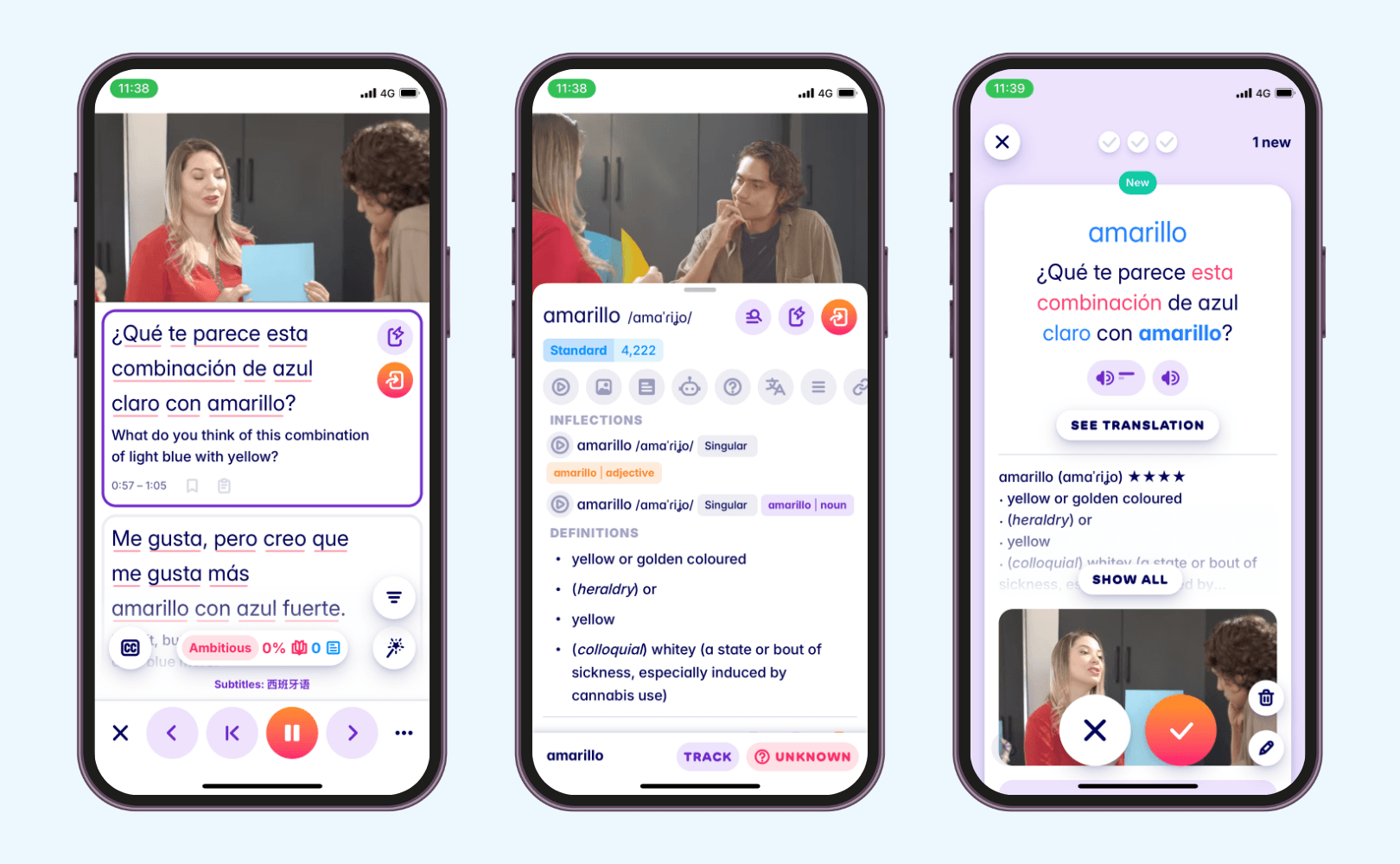
Anyway, if you want to learn body part vocabulary (and everything else) through actual Spanish content, Migaku's browser extension and app let you look up words instantly while watching shows or reading articles. Way more interesting than drilling flashcards. There's a 10-day free trial if you want to check it out 🫡
 ---
## Learn common phrases and talk about body parts in context
The best way to actually learn this vocabulary? See it used in real content. Reading health articles in Spanish, watching cooking shows where chefs talk about chicken parts, or following fitness content in Spanish all expose you to body part vocabulary naturally.
> If you consume media in Spanish, and you understand at least some of the messages and sentences within that media, you will make progress. _Period_.
Joining Flamenco dancing classes with a Spanish teacher helps too!
---
## Learn common phrases and talk about body parts in context
The best way to actually learn this vocabulary? See it used in real content. Reading health articles in Spanish, watching cooking shows where chefs talk about chicken parts, or following fitness content in Spanish all expose you to body part vocabulary naturally.
> If you consume media in Spanish, and you understand at least some of the messages and sentences within that media, you will make progress. _Period_.
Joining Flamenco dancing classes with a Spanish teacher helps too!