# Spanish Gerund: Master the Spanish Progressive Tenses Fast
> Learn how to form and use the Spanish gerund (gerundio) in progressive tenses. Clear rules and examples for better Spanish grammar.
**URL:** https://migaku.com/blog/spanish/spanish-gerund-progressive-tenses
**Last Updated:** 2026-04-06
**Tags:** fundamentals, grammar, verbs
---
If you've been [learning Spanish for a while](https://migaku.com/learn-spanish), you've probably noticed that expressing ongoing actions works differently than in English. The Spanish gerund, or gerundio, is your key to talking about things happening right now, actions that were in progress yesterday, or even things that will be ongoing in the future. Getting comfortable with this verb form opens up a whole new level of fluency, and honestly, it's way simpler than you might think once you see the patterns.
----
## What exactly is the Spanish gerund
> 💡 Definition 💡
The gerund in Spanish is a verb form that **expresses ongoing or continuous action**. You'll recognize it immediately because it's the equivalent of English verbs ending in -ing, like "walking," "eating," or "sleeping." In Spanish, these forms end in **-ando** or **-iendo**.
Here's the thing: while English uses the -ing form for multiple purposes (gerunds, present participles, and more), Spanish keeps it pretty focused. The gerundio mainly shows up in progressive tenses to indicate that an action is or was in progress.
When you see "estoy comiendo" (I am eating), that "comiendo" part is your gerund. It combines with the verb estar to create what we call the progressive tense.
The [grammar](https://migaku.com/blog/spanish/spanish-grammar-guide) behind this is actually pretty straightforward. You take the verb stem and add the appropriate ending based on whether you're working with an -ar, -er, or -ir verb.
----
## How to form the gerund in Spanish with examples
Let's get into the actual formation rules, because once you nail these down, you can create gerunds from pretty much any Spanish verb.
### Regular -ar verbs
For any verb ending in -ar, you **drop that ending and add -ando**.
- hablar (to speak) becomes hablando (speaking)
- caminar (to walk) becomes caminando (walking)
- estudiar (to study) becomes estudiando (studying)
- trabajar (to work) becomes trabajando (working)
Pretty simple, right? This pattern covers the majority of Spanish verbs since -ar verbs make up the largest group.
### Regular -er and -ir verbs
For verbs ending in -er or -ir, you **drop the infinitive ending and add -iendo**.
- comer (to eat) becomes comiendo (eating)
- beber (to drink) becomes bebiendo (drinking)
- vivir (to live) becomes viviendo (living)
- escribir (to write) becomes escribiendo (writing)
These two verb categories share the same gerund ending, which makes your life easier when memorizing the patterns.
### The -yendo exception
When an -er or -ir verb has a stem that ends in a vowel, **the i in -iendo changes to y**. This prevents having three vowels in a row, which would sound awkward to native Spanish speakers.
- leer (to read) becomes leyendo (reading)
- caer (to fall) becomes cayendo (falling)
- oír (to hear) becomes oyendo (hearing)
- construir (to build) becomes construyendo (building)
This -yendo form is super common, so you'll see it all the time in everyday Spanish.
### Stem-changing verbs and irregular gerunds
Some verbs change their stem when forming the gerund, particularly -ir verbs that have stem changes in the present tense.
**Verbs that change e to i:**
- decir (to say) becomes diciendo (saying)
- pedir (to ask for) becomes pidiendo (asking for)
- servir (to serve) becomes sirviendo (serving)
- repetir (to repeat) becomes repitiendo (repeating)
**Verbs that change o to u:**
- dormir (to sleep) becomes durmiendo (sleeping)
- morir (to die) becomes muriendo (dying)
**The verb "ir" (to go) has an irregular gerund**: yendo (going).
**Power (to be able to) becomes pudiendo**, which you'll use less frequently but should still recognize.
----
## Using the present progressive tense with estar
The most common way you'll use the Spanish gerund is with the verb estar to form progressive tenses. The present progressive describes actions happening right now, at this very moment.
> 💡The formula is simple: **conjugate estar in the present tense, then add your gerund**.
- Estoy estudiando español.
*I am studying Spanish.*
- Estás comiendo demasiado rápido.
*You are eating too fast.*
- Ella está trabajando desde casa.
*She is working from home.*
- Estamos viendo una película.
*We are watching a movie.*
- Están hablando por teléfono.
*They are talking on the phone.*
Unlike English, where we sometimes use the present progressive to talk about future plans ("I'm meeting her tomorrow"), Spanish keeps the progressive focused on the immediate present. If something is happening right now, use the progressive. If it's a habitual action or a future plan, use the simple present or future tense instead.
----
## Past progressive and imperfect progressive
You can also talk about actions that were in progress at some point in the past.
> 💡For this, you **conjugate estar in either the preterite or [imperfect tense](https://migaku.com/blog/spanish/imperfect-tense-in-spanish)**.
### With the imperfect
The imperfect progressive emphasizes that an action was ongoing in the past, often setting the scene for another event.
- Estaba leyendo cuando llamaste.
*I was reading when you called.*
- Estábamos cocinando toda la tarde.
*We were cooking all afternoon.*
- ¿Qué estabas haciendo a las ocho?
*What were you doing at eight?*
This form is super useful for storytelling and describing background actions.
### With the preterite
The preterite progressive is less common but shows a completed continuous action in the past.
- Estuve esperando dos horas.
*I was waiting for two hours.*
- Estuvieron bailando toda la noche.
*They were dancing all night.*
Most Spanish speakers prefer the imperfect for past progressive constructions, but you'll occasionally hear the preterite version for emphasis.
----
## Future and conditional progressive in Spanish grammar
Yes, you can even talk about actions that will be or would be in progress using the gerund.
### Future progressive
> 💡**Conjugate estar in the future tense:**
- Mañana a esta hora estaré volando a Madrid.
*Tomorrow at this time I will be flying to Madrid.*
- Estaremos trabajando en el proyecto la próxima semana.
*We will be working on the project next week.*
### Conditional progressive
> 💡**Conjugate estar in the conditional:**
- Con más tiempo, estaría estudiando medicina.
*With more time, I would be studying medicine.*
- Estarían durmiendo si no hicieras tanto ruido.
*They would be sleeping if you weren't making so much noise.*
These forms add nuance to your Spanish and help you express more complex time relationships.
----
## Other uses of the gerund beyond progressive tenses
While the gerund mainly appears in progressive constructions, it has a few other uses worth knowing.
### Describing how an action is done
The gerund can explain the manner or means by which something happens.
- Aprendí español viendo series.
*I learned Spanish by watching series.*
- Salió corriendo de la casa.
*He left running from the house.*
- Pasamos el tiempo charlando.
*We spent the time chatting.*
### With verbs of perception
Verbs like "ver" (to see) and "oír" (to hear) often pair with gerunds.
- La vi bailando en la fiesta.
*I saw her dancing at the party.*
- Los oímos cantando en la calle.
*We heard them singing in the street.*
### Expressing simultaneous actions
The gerund can show that two actions happen at the same time.
- Caminaba silbando una canción.
*He walked while whistling a song.*
- Trabajo escuchando música.
*I work while listening to music.*
----
## When NOT to use the gerund in Spanish
This is where a lot of English speakers trip up. In English, we use the -ing form as a noun all the time: "Swimming is fun," "I love reading." Spanish doesn't work this way.
In Spanish, you use the infinitive where English uses a gerund as a noun.
❌Wrong: Nadando es divertido.
✅Right: Nadar es divertido. (Swimming is fun.)
❌Wrong: Me encanta leyendo.
✅Right: Me encanta leer. (I love reading.)
The infinitive form serves as the noun in Spanish, while the gerund stays focused on expressing continuous action. This takes some getting used to if you're coming from English, but it becomes natural with practice.
Also, **avoid using the gerund after prepositions**. Again, use the infinitive instead.
- ✅Después de comer (After eating), ❌not "después de comiendo"
- ✅Antes de salir (Before leaving), ❌not "antes de saliendo"
----
## Regional variations and real-world usage
Spanish usage varies across different countries and regions.
- In some parts of Latin America, you'll hear progressive forms used more frequently than in Spain. Mexican Spanish speakers, for instance, tend to use the present progressive quite a bit in casual conversation.
- In Argentina and Uruguay, you might hear the gerund used with the verb **"andar"** instead of estar to express ongoing actions: "Ando buscando trabajo" (I'm looking for work). This construction adds a sense of movement or casualness to the action.
- The progressive with **"seguir"** (to continue) or "continuar" is common everywhere: "Sigo estudiando" (I'm still studying/I continue studying).
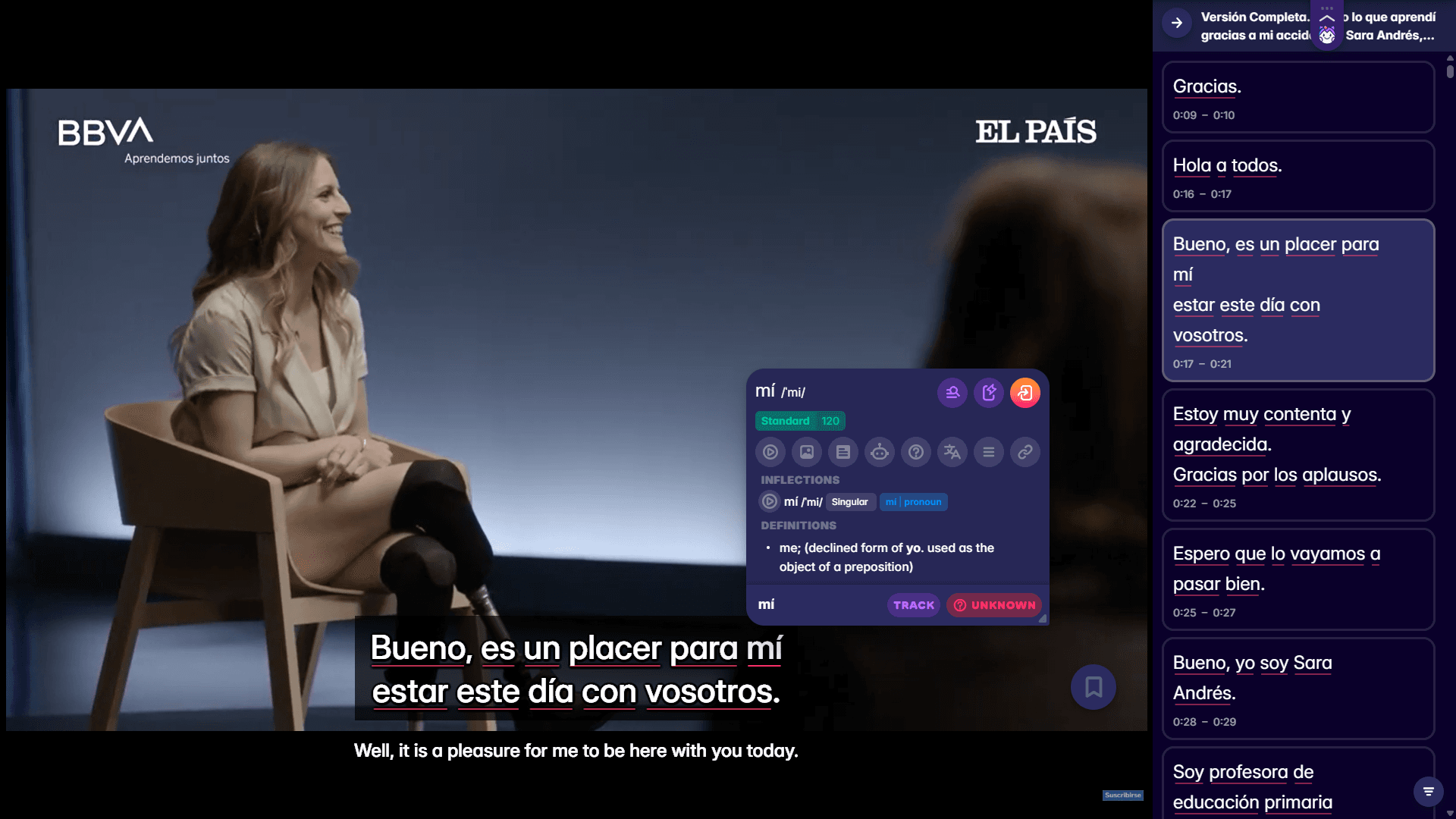
If you're serious about picking up these grammar patterns naturally, Migaku's browser extension and app let you look up any verb form instantly while [watching Spanish shows](https://migaku.com/blog/spanish/best-spanish-shows-guide) or reading articles. You can save sentences with gerunds directly to your flashcards and review them in context. There's a 10-day free trial if you want to see how much faster you pick up verb forms when you're learning from real content.
 ----
## Practice makes progress
The Spanish gerund becomes second nature once you start using it regularly. The formation rules are consistent, the exceptions are manageable, and the usage patterns make logical sense once you understand that Spanish treats ongoing actions differently than English does.
Watch Spanish shows and listen to how native speakers actually use these forms in context. You'll start noticing the patterns everywhere.
> If you consume media in Spanish, and you understand at least some of the messages and sentences within that media, you will make progress. *Period*.
Every grammar point learned brings you closer to fluency.🫡
----
## Practice makes progress
The Spanish gerund becomes second nature once you start using it regularly. The formation rules are consistent, the exceptions are manageable, and the usage patterns make logical sense once you understand that Spanish treats ongoing actions differently than English does.
Watch Spanish shows and listen to how native speakers actually use these forms in context. You'll start noticing the patterns everywhere.
> If you consume media in Spanish, and you understand at least some of the messages and sentences within that media, you will make progress. *Period*.
Every grammar point learned brings you closer to fluency.🫡