Spanish Possessive Adjectives: How to Use Mi, Tu, Su, Nuestro
Last updated: March 25, 2026

Learning Spanish possessive adjectives can feel confusing at first, especially when you're trying to figure out whether to use mi, tu, or su in a sentence. Here's the thing though: once you understand how these words work and how they agree with the nouns they modify, everything clicks into place. Spanish possessive adjectives follow specific rules about gender and number that English doesn't really have, so you'll need to wrap your head around some new concepts. This guide breaks down exactly how to use mi, tu, su, nuestro, and all their forms with plenty of examples to make it stick.
- What are possessive adjectives in Spanish
- The complete chart of Spanish possessive adjectives
- Understanding singular and plural forms
- Gender agreement with masculine and feminine nouns
- How to use possessive adjectives in sentences
- The tricky case of su and sus
- Spanish possessive adjectives chart for long-form adjectives
- Possessive pronouns versus possessive adjectives
- Common mistakes to avoid
- Regional differences with vuestro
- Tips on how to learn and use possessive adjectives in Spanish
What are possessive adjectives in Spanish
A possessive adjective is a word that shows ownership or relationship between the possessor and what they possess. In Spanish, these words appear directly before the noun they modify, just like in English when you say "my book" or "your car." The key difference is that Spanish possessive adjectives must match the gender and number of the thing being possessed, not the person who possesses it.
When you say "mi libro" (my book), the word mi doesn't change based on whether you're male or female. It stays the same because it's a singular noun. But when you talk about multiple books, you'd say "mis libros" because the noun is now plural. This agreement system is what trips up most English speakers when they start to learn Spanish.
The Spanish language has two main types of possessive adjectives: short-form (unstressed) and long-form (stressed). The short-form versions are what you'll use 95% of the time in everyday conversation. These include mi, tu, su, nuestro, vuestro, and their variations.
The complete chart of Spanish possessive adjectives
Here's a breakdown of all the short-form possessive adjectives you need to know:
English | Spanish (Singular) | Spanish (Plural) |
|---|---|---|
My | mi | mis |
Your (informal) | tu | tus |
His / Her / Your (formal) / Their | su | sus |
Our | nuestro / nuestra | nuestros / nuestras |
Your (informal plural, Spain) | vuestro / vuestra | vuestros / vuestras |
The possessive adjective forms change based on what you're describing, which is pretty different from English. You don't think about whether the book is masculine or feminine in English, but in Spanish, that matters for some possessive adjectives.
Understanding singular and plural forms
Most Spanish possessive adjectives have both singular and plural versions. When the noun you're describing is singular, you use the singular form. When it's plural, you switch to the plural form.
- With mi, the singular form describes one item: "mi casa" (my house). The plural form mis describes multiple items: "mis casas" (my houses).
- Same pattern applies to tu and tus: "tu amigo" (your friend) versus "tus amigos" (your friends).
- The word su works the same way for singular and plural agreement: "su coche" (his/her/your/their car) becomes "sus coches" (his/her/your/their cars). This is where things get interesting because su can mean so many different things depending on context.
For nuestro and vuestro, you've got four different forms to work with because these possessive adjectives also change for gender. I'll explain that in the next section, but the singular versus plural distinction still applies to all forms.
Gender agreement with masculine and feminine nouns
Here's where Spanish possessive adjectives get more complex than English.
💡While mi, tu, and su stay the same regardless of whether the noun is masculine or feminine, nuestro and vuestro actually change their endings.
If you're talking about "our book" and libro is masculine, you say "nuestro libro." But if you're talking about "our house" and casa is feminine, you say "nuestra casa." The possessive adjective matches the gender of the thing being possessed. This pattern continues in plural forms too. "Nuestros libros" (our books, masculine) versus "nuestras casas" (our houses, feminine).
Same deal with vuestro: "vuestro perro" (your dog, masculine) and "vuestra gata" (your cat, feminine).
The masculine and feminine agreement only applies to nuestro and vuestro. You don't change mi to ma or tu to ta based on gender. That would make things way too complicated, and Spanish already has enough complexity with gender agreement in other areas.
How to use possessive adjectives in sentences
💡Possessive adjectives in Spanish always go directly before the noun they modify. You can't separate them with other words like you sometimes can in English.
"Mi hermano vive en Madrid" (My brother lives in Madrid). The possessive adjective mi sits right before hermano with no articles or other words in between. You wouldn't say "mi el hermano" or "el mi hermano" because Spanish doesn't use articles with possessive adjectives in this short form.
Here are more examples showing natural usage:
- Tu madre cocina muy bien.
Your mother cooks very well. - Sus hijos estudian en la universidad.
His/Her/Your/Their children study at the university. - Nuestras amigas llegan mañana.
Our friends arrive tomorrow. - Mis padres trabajan juntos.
My parents work together.
Notice how the possessive adjective changes to match the noun in number, and in the case of nuestras, it also matches in gender because amigas is feminine plural.
The tricky case of su and sus
The word su causes more confusion than any other possessive adjective because it can mean "his," "her," "your" (formal), "its," or "their." The pronoun it refers to depends entirely on context.
"Su casa es grande" could mean:
- His house is big
- Her house is big
- Your house is big (formal)
- Their house is big
In conversation, context usually makes it clear. If you've been talking about María, then "su casa" obviously means "her house." But in writing or when clarity matters, Spanish speakers often use a prepositional phrase instead: "la casa de él" (his house), "la casa de ella" (her house), "la casa de usted" (your house), or "la casa de ellos" (their house).
The same ambiguity applies to sus in plural: "sus libros" could refer to his books, her books, your books, or their books. When you need to be specific, swap it out for the clearer prepositional construction.
Spanish possessive adjectives chart for long-form adjectives
💡Spanish also has stressed or long-form possessive adjectives that come after the noun instead of before it. These forms add emphasis or appear in specific grammatical constructions.
The long-form possessives are:
English | Masculine Singular | Feminine Singular | Masculine Plural | Feminine Plural |
|---|---|---|---|---|
Mine | mío | mía | míos | mías |
Yours (informal) | tuyo | tuya | tuyos | tuyas |
His / Hers / Yours (formal) / Theirs | suyo | suya | suyos | suyas |
Ours | nuestro | nuestra | nuestros | nuestras |
Yours (plural, Spain) | vuestro | vuestra | vuestros | vuestras |
You use these after the noun for emphasis: "un amigo mío" (a friend of mine) instead of "mi amigo" (my friend). The long-form version emphasizes the possessive relationship or sounds more formal.
These long-form possessives also appear after the verb ser: "Este libro es mío" (This book is mine). You can't use the short form here. You'd never say "Este libro es mi."
Possessive pronouns versus possessive adjectives
A possessive pronoun replaces the noun entirely, while a possessive adjective modifies a noun. This distinction matters when you're constructing sentences.
"Mi coche es rojo" (My car is red) uses the possessive adjective mi before the noun coche. But "El mío es rojo" (Mine is red) uses the possessive pronoun mío to replace "mi coche" entirely.
The possessive pronoun forms in Spanish are:
English | Masculine Singular | Feminine Singular | Masculine Plural | Feminine Plural |
|---|---|---|---|---|
Mine | el mío | la mía | los míos | las mías |
Yours (informal) | el tuyo | la tuya | los tuyos | las tuyas |
His / Hers / Yours (formal) / Theirs | el suyo | la suya | los suyos | las suyas |
Ours | el nuestro | la nuestra | los nuestros | las nuestras |
Yours (plural, Spain) | el vuestro | la vuestra | los vuestros | las vuestras |
Notice that possessive pronouns include the definite article (el, la, los, las) and must match the gender and number of the noun they're replacing. "Tu casa es grande, pero la mía es pequeña" (Your house is big, but mine is small). The possessive pronoun la mía is feminine singular because it replaces casa, which is feminine singular.
Common mistakes to avoid
- Beginners often try to use articles with short-form possessive adjectives. You don't say "la mi casa" or "el tu carro." Just drop the article: "mi casa," "tu carro." The possessive adjective replaces the article.
- Another frequent mistake is forgetting to make the possessive adjective plural when the noun is plural. "My friends" is "mis amigos," not "mi amigos." The plural marker on mis matches the plural noun.
- Gender agreement trips people up with nuestro and vuestro. Remember that these change based on the noun's gender, not the speaker's gender. A woman talking about "our car" still says "nuestro coche" if coche is masculine in Spanish.
- Overusing su when you need clarity causes confusion too. If you're writing and it's not obvious from context whose possession you're describing, use the prepositional phrase construction instead: "el libro de María" rather than "su libro."
Regional differences with vuestro
In Latin America, vuestro and its forms basically don't exist in everyday speech. Latin American Spanish uses ustedes for both formal and informal plural "you," which means the possessive becomes su/sus for all plural "your" situations.
In Spain, vuestro/vuestra/vuestros/vuestras are for informal plural situations. Spanish speakers in Madrid would say "vuestro coche" when talking to a group of friends about "your car." But in Mexico City, that same sentence would be "su coche."
This regional variation doesn't affect mi, tu, or nuestro. Those work the same across all Spanish-speaking regions. If you're learning Spanish primarily for Latin America, you can basically ignore vuestro forms and focus on the others.
Tips on how to learn and use possessive adjectives in Spanish
- The easiest possessive adjectives to remember are mi/mis and tu/tus because they only change for plural. Just ask yourself: am I talking about one thing or multiple things? That determines whether you add the s.
- For nuestro and vuestro, think about both the number and gender of what you're describing. Create a mental checklist: Is it one or many? Is the noun masculine or feminine? Then pick the right form.
- With su and sus, start by checking if the noun is singular or plural. Then, if context doesn't make ownership clear, consider switching to a prepositional phrase for clarity.
- Practice by describing things around you. Look at your desk and say "mi computadora, mis libros, mi taza." Then describe someone else's stuff: "su teléfono, sus papeles." The more you use these in real contexts, the faster they'll become automatic.
Anyway, if you want to practice Spanish possessive adjectives in real contexts, Migaku's browser extension and app let you read articles and watch videos with instant word lookups. You can see how native content uses mi, tu, and su naturally in thousands of sentences. There's a 10-day free trial if you want to check it out.
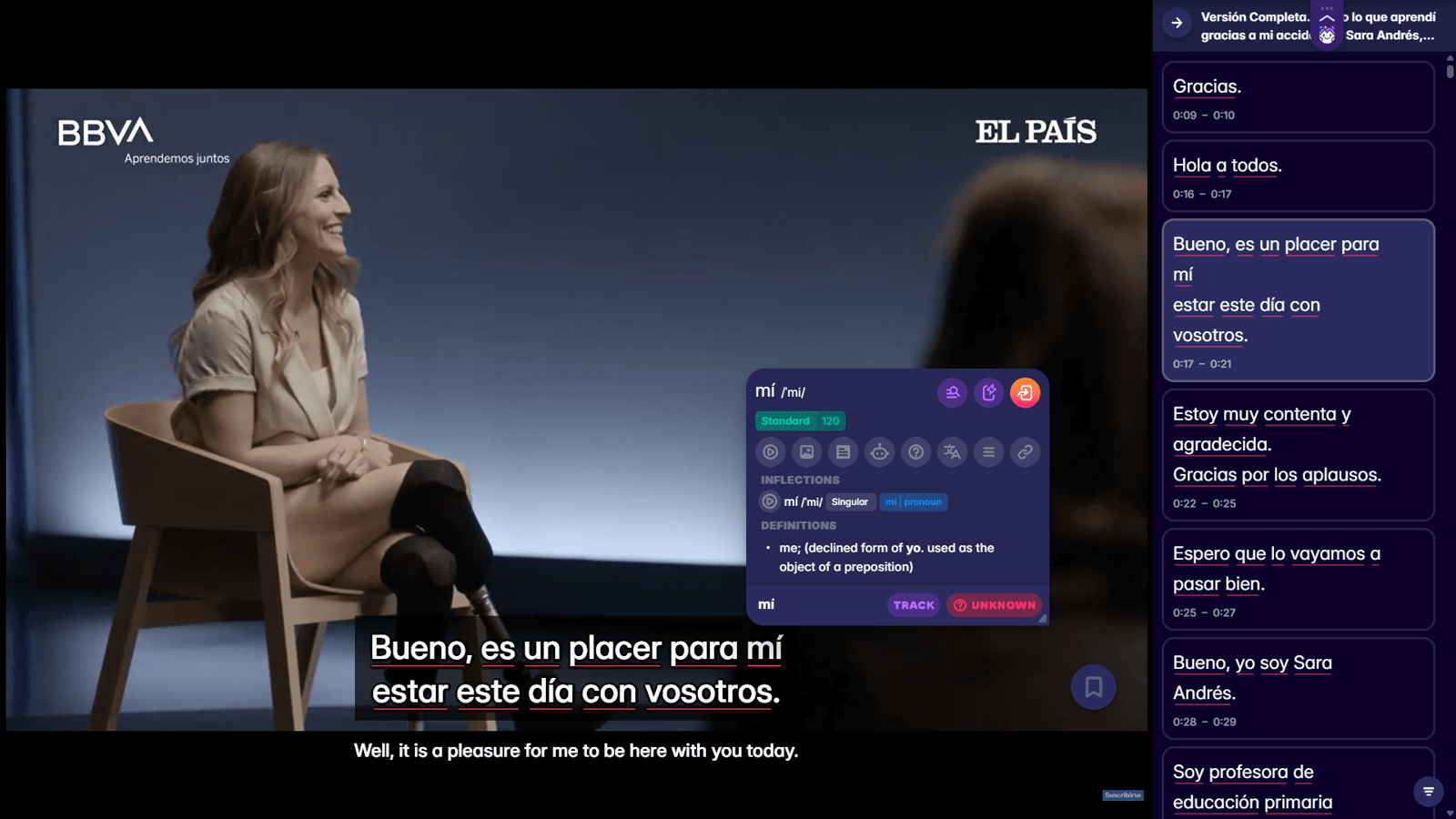
Knowing how to use Spanish possessive adjectives can improve your fluency
You use possessive adjectives in almost every conversation. Talking about your day involves mentioning "mi trabajo" (my work), "mi jefe" (my boss), "mis compañeros" (my coworkers). Making plans means discussing "tu horario" (your schedule) or "nuestro restaurante favorito" (our favorite restaurant). The system is trickier than the English one, but getting these right can improve your listening comprehension when you are consuming Spanish media. As you see more and more of how native speakers use them, you will know how to say them properly.
If you consume media in Spanish, and you understand at least some of the messages and sentences within that media, you will make progress. Period.
Learn the system once, practice it consistently, and you'll have it down.