# Spanish Present Tense: How to Conjugate Regular Verbs and Irregular Ones
> Understand Spanish present tense conjugation for -ar, -er, and -ir verbs. This guide includes regular verbs, stem changes, irregular verbs, etc.
**URL:** https://migaku.com/blog/spanish/spanish-present-tense
**Last Updated:** 2026-02-01
**Tags:** fundamentals, vocabulary, pronunciation, conjugation, grammar
---
The Spanish present tense is one of the first verb forms you'll learn when [studying Spanish](https://migaku.com/learn-spanish), and honestly, it's pretty essential. You'll use it constantly in conversations, whether you're talking about what you do every day, stating facts, or even describing what's happening right now.💡 The good news? Once you understand the [conjugation](https://migaku.com/blog/spanish/spanish-grammar-guide) patterns for regular verbs and memorize a handful of irregular ones, you'll be able to express tons of ideas. Let's break down exactly how to conjugate and use the present tense in Spanish.
---
## What is the present tense in Spanish
The present tense in Spanish (called "el presente de indicativo ") works similarly to the English present tense, but it actually covers more ground.
> You use it to talk about actions happening right now, habitual actions, general truths, and even future events in some contexts.
For example, "hablo español " can mean:
1. "I speak Spanish" (Habitual),
2. "I am speaking Spanish" (Right now),
3. or even "I will speak Spanish" (In certain future contexts, like "mañana hablo con mi profesor").
Spanish speakers rely on context to figure out which meaning you intend.
The present tense is part of a larger system of tenses in Spanish. There are around 14 different verb tenses when you count all the moods (Indicative, subjunctive, and imperative), but the present tense is definitely the foundation. You'll use it more than any other tense when learning Spanish.
---
## When to use the Spanish present tense
The present tense in Spanish handles several different situations. You use verbs in the present tense to describe:
1. **Actions happening right now**: "Como una manzana " (I'm eating an apple).
2. **Habitual or repeated actions**: "Trabajo todos los días " (I work every day).
3. **General truths or facts**: "El sol sale por el este " (The sun rises in the east).
4. **Future events (when context makes it clear)**: "Mañana voy a Madrid " (Tomorrow I'm going to Madrid).
5. **How long something has been happening (with "desde" or "hace")**: "Vivo aquí desde 2020 " (I've been living here since 2020).
This versatility makes the present tense super practical. You can express a ton without needing to learn more complex tenses right away.
---
## How Spanish verb conjugation works
Spanish verbs change their form based on who's doing the action. This is called conjugation. Every verb has an infinitive form that ends in one of three patterns: -ar, -er, or -ir. Think of verbs like "hablar " (To speak), "comer " (To eat), and "vivir " (To live).
> To conjugate a verb in the present tense, you remove the infinitive ending and add specific endings based on the subject. The subject pronouns in Spanish are:
- yo (I)
- tú (You, informal singular)
- él /ella /usted (He/She/You formal)
- nosotros /nosotras (We)
- vosotros /vosotras (You, informal plural, used mainly in Spain)
- ellos /ellas /ustedes (They/You formal plural)
The conjugation endings change depending on whether you're working with an -ar, -er, or -ir verb. Let's look at each type.
---
## Regular -ar verb conjugation
Regular verbs follow predictable patterns, which makes them easier to learn.
> For -ar verbs, you take the stem (The infinitive minus the -ar ending) and add these endings:
- yo: -o
- tú: -as
- él/ella/usted: -a
- nosotros/nosotras: -amos
- vosotros/vosotras: -áis
- ellos/ellas/ustedes: -an
Let's use "hablar" (To speak) as an example:
- yo hablo (I speak)
- tú hablas (You speak)
- él/ella/usted habla (He/She speaks, you speak)
- nosotros/nosotras hablamos (We speak)
- vosotros/vosotras habláis (You all speak)
- ellos/ellas/ustedes hablan (They speak, you all speak)
Other common regular -ar verbs include "trabajar " (To work), "estudiar " (To study), "caminar " (To walk), and "comprar " (To buy). Once you know the pattern, you can conjugate hundreds of Spanish verbs.
---
## Regular -er verb conjugation
> For -er verbs, the process is the same, but the endings are different. Take the stem and add:
- yo: -o
- tú: -es
- él/ella/usted: -e
- nosotros/nosotras: -emos
- vosotros/vosotras: -éis
- ellos/ellas/ustedes: -en
Using "comer" (To eat):
- yo como (I eat)
- tú comes (You eat)
- él/ella/usted come (He/She eats, you eat)
- nosotros/nosotras comemos (We eat)
- vosotros/vosotras coméis (You all eat)
- ellos/ellas/ustedes comen (They eat, you all eat)
Common regular -er verbs include "beber " (To drink), "leer " (To read), "correr " (To run), and "vender " (To sell).
---
## Regular -ir verb conjugation
> The -ir verbs are pretty similar to -er verbs. The only differences are in the nosotros and vosotros forms.
Here are the endings:
- yo: -o
- tú: -es
- él/ella/usted: -e
- nosotros/nosotras: -imos
- vosotros/vosotras: -ís
- ellos/ellas/ustedes: -en
Using "vivir" (To live):
- yo vivo (I live)
- tú vives (You live)
- él/ella/usted vive (He/She lives, you live)
- nosotros/nosotras vivimos (We live)
- vosotros/vosotras vivís (You all live)
- ellos/ellas/ustedes viven (They live, you all live)
Other regular -ir verbs include "escribir " (To write), "abrir " (To open), and "recibir " (To receive).
---
## Stem-changing verbs in the present tense grammar
Here's where things get a bit trickier. Some verbs in the present tense change their stem vowel when conjugated.
> These are called stem-changing verbs, and they follow patterns like e>ie, o>ue, and e>i.
The stem change happens in all forms except nosotros and vosotros.
**The verb "pensar" (To think) changes from e to ie**:
- yo pienso
- tú piensas
- él/ella/usted piensa
- nosotros/nosotros pensamos (No change)
- vosotros/vosotras pensáis (No change)
- ellos/ellas/ustedes piensan
Common e>ie verbs include "querer " (To want), "empezar " (To begin), "entender " (To understand), and "preferir " (To prefer).
**For o>ue stem changes, look at "poder" (To be able to)**:
- yo puedo
- tú puedes
- él/ella/usted puede
- nosotros/nosotras podemos (No change)
- vosotros/vosotras podéis (No change)
- ellos/ellas/ustedes pueden
Other o>ue verbs include "dormir " (To sleep), "volver " (To return), "encontrar " (To find), and "costar " (To cost).
**The e>i pattern appears in verbs like "pedir" (To ask for)**:
- yo pido
- tú pides
- él/ella/usted pide
- nosotros/nosotras pedimos (No change)
- vosotros/vosotras pedís (No change)
- ellos/ellas/ustedes piden
Similar verbs include "servir " (To serve), "repetir " (To repeat), and "seguir " (To follow).
---
## Irregular verbs you need to know
Some Spanish verbs are just plain irregular. They don't follow the normal patterns, so you have to memorize them. The most important irregular verbs in the present tense are the ones you'll use constantly in conversation.
**"Ser" (To be, permanent states)**:
- yo soy
- tú eres
- él/ella/usted es
- nosotros/nosotras somos
- vosotros/vosotras sois
- ellos/ellas/ustedes son
**"Estar" (To be, temporary states and locations)**:
- yo estoy
- tú estás
- él/ella/usted está
- nosotros/nosotras estamos
- vosotros/vosotras estáis
- ellos/ellas/ustedes están
**"Tener" (To have)**:
- yo tengo
- tú tienes
- él/ella/usted tiene
- nosotros/nosotras tenemos
- vosotros/vosotras tenéis
- ellos/ellas/ustedes tienen
**"Ir" (To go)**:
- yo voy
- tú vas
- él/ella/usted va
- nosotros/nosotras vamos
- vosotros/vosotras vais
- ellos/ellas/ustedes van
Other crucial irregular verbs include "hacer " (To do/make), "decir " (To say), "venir " (To come), "salir " (To leave), "poner " (To put), and "traer " (To bring). These verbs appear in everyday Spanish constantly, so getting comfortable with their conjugations will make a huge difference in your fluency.
---
## Present progressive tense
While the simple present tense can describe actions happening right now, Spanish also has a present progressive tense (Similar to English "I am eating").
> You form it using the verb "estar" plus a present participle (The -ando/-iendo form).
To make the present participle:
- -ar verbs: replace -ar with -ando (hablar becomes hablando)
- -er verbs: replace -er with -iendo (comer becomes comiendo)
- -ir verbs: replace -ir with -iendo (vivir becomes viviendo)
Examples:
- Estoy estudiando español.
*I am studying Spanish.*
- Están comiendo pizza.
*They are eating pizza.*
- Estamos viendo una película.
*We are watching a movie.*
Some verbs have irregular present participles, like "leer" (leyendo), "dormir" (durmiendo), and "pedir" (pidiendo). The present progressive emphasizes that something is happening at this exact moment, while the simple present tense is more general.
---
## The 20 most used verbs in Spanish
If you're wondering which verbs to prioritize, here are the 20 most commonly used Spanish verbs that you'll encounter in the present tense:
1. ser (To be)
2. estar (To be)
3. tener (To have)
4. hacer (To do/make)
5. ir (To go)
6. poder (To be able to)
7. decir (To say)
8. dar (To give)
9. ver (To see)
10. saber (To know)
11. querer (To want)
12. llegar (To arrive)
13. pasar (To pass/happen)
14. deber (To owe/should)
15. poner (To put)
16. parecer (To seem)
17. quedar (To stay/remain)
18. creer (To believe)
19. hablar (To speak)
20. llevar (To carry/wear)
Focus on these first. They'll cover a massive portion of what you need to say in Spanish.
---
## Practical examples and usage
Let's look at how these conjugations work in real sentences:
- Todos los días desayuno a las siete.
*Every day I eat breakfast at seven.* (This uses the simple present for a habitual action.)
- Mi hermana vive en Barcelona y trabaja en un hospital.
*My sister lives in Barcelona and works in a hospital.* (Two regular verbs describing ongoing situations.)
- ¿Quieres café?
*Do you want coffee?* (A stem-changing verb in a question.)
- No puedo ir a la fiesta porque tengo que estudiar.
*I can't go to the party because I have to study.* (Two irregular verbs expressing ability and obligation.)
- Estamos aprendiendo mucho en esta clase.
*We are learning a lot in this class.* (Present progressive for an action in progress.)
The more you practice these patterns, the more natural they'll feel. Reading Spanish content and listening to native speakers will help you internalize when to use each form.
---
## Common mistakes to avoid
When you're starting out with Spanish grammar, a few mistakes pop up constantly. Watch out for these:
1. Forgetting stem changes: Remember that verbs like "querer" and "poder" change their stem in most forms.
2. Mixing up ser and estar: Both mean "to be," but "ser" is for permanent characteristics and "estar" is for temporary states and locations.
3. Using the wrong ending: Make sure you're using -ar endings for -ar verbs, -er endings for -er verbs, and so on.
4. Dropping the subject pronoun when it's needed for clarity: Spanish often drops subject pronouns, but sometimes you need them to clarify who you're talking about.
5. Overgeneralizing regular patterns to irregular verbs: Verbs like "ir" and "ser" just have to be memorized.
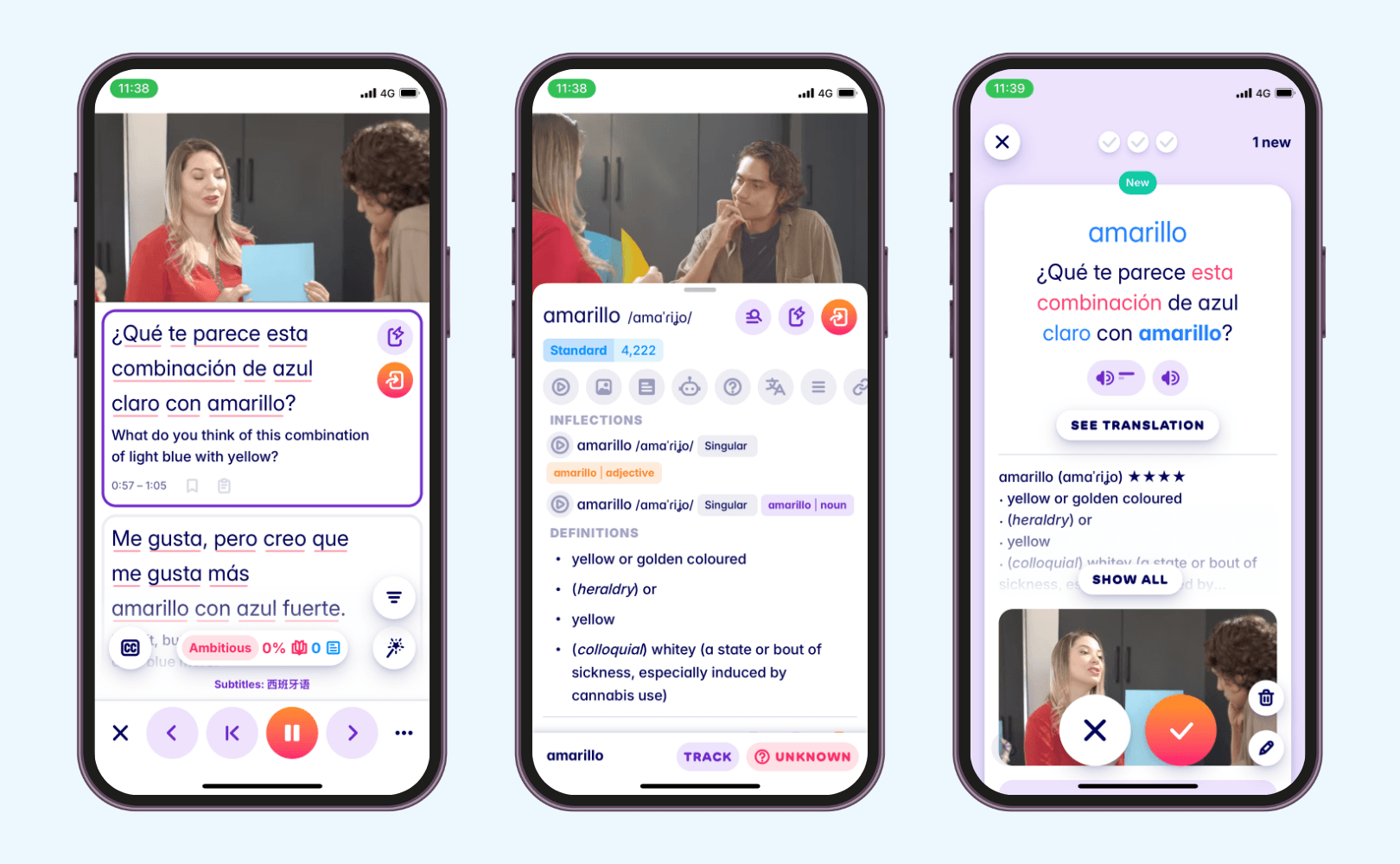
Anyway, if you want to practice Spanish with real content, Migaku's browser extension and app let you look up words and save vocabulary while watching Spanish shows or reading articles. Makes learning from native material way more practical. There's a 10-day free trial if you want to check it out.
 ---
## Are you prepared for the next step?
Your next steps should include practicing these conjugations in context. Don't just memorize charts. Use the verbs in sentences, write about your daily routine, describe what you see around you, and try to think in Spanish when you can. The conjugation patterns will stick much better when you're actually using them and seeing them in context and media.
> If you consume media in Spanish, and you understand at least some of the messages and sentences within that media, you will make progress. _Period_.
Conjugation is difficult to learn. Take your time!
---
## Are you prepared for the next step?
Your next steps should include practicing these conjugations in context. Don't just memorize charts. Use the verbs in sentences, write about your daily routine, describe what you see around you, and try to think in Spanish when you can. The conjugation patterns will stick much better when you're actually using them and seeing them in context and media.
> If you consume media in Spanish, and you understand at least some of the messages and sentences within that media, you will make progress. _Period_.
Conjugation is difficult to learn. Take your time!