# Spanish Reflexive Verbs: How to Use Reflexive Verbs in Spanish Naturally
> Tired of mixing up me, te, and se? Learn how Spanish reflexive verbs work with clear examples, conjugation rules, and common verbs you'll use daily.
**URL:** https://migaku.com/blog/spanish/spanish-reflexive-verbs
**Last Updated:** 2026-02-10
**Tags:** fundamentals, grammar, verbs
---
If you're [learning Spanish](https://migaku.com/learn-spanish), you've probably noticed verbs like "levantarse" or "llamarse" with that weird "se" stuck on the end. These are reflexive verbs, and they're everywhere in everyday Spanish conversation. They seem complicated at first, but the rules are actually pretty straightforward. Let's break down everything you need to know about Spanish reflexive verbs so you can start using them naturally.
---
## What are reflexive verbs in Spanish
> A reflexive verb is a verb where the subject performs an action on **themselves**.
The person doing the action is also receiving it. In English, we sometimes use words like "myself," "yourself," or "himself" to show this, but in Spanish, every reflexive verb comes with a special pronoun that matches the subject.
Here's a simple example: "lavarse" means "to wash oneself." When you say "Me lavo," you're saying "I wash myself." The "me" is the reflexive pronoun that shows you're doing the action to yourself.
The thing that makes Spanish different from English is that you'll use reflexive verbs way more often. Actions that sound totally normal in English without any "self" language often require reflexive verbs in Spanish. When you wake up, get dressed, or sit down, Spanish treats these as reflexive actions.
---
## Understanding reflexive pronouns in Spanish
> 🙋♀️Every reflexive verb needs a reflexive pronoun.
These [pronouns](https://migaku.com/blog/spanish/spanish-pronouns) change based on who's doing the action, and they always go right before the conjugated verb (Or attached to infinitives and gerunds, but we'll get to that).
Here are the Spanish reflexive pronouns:
- me (Myself)
- te (Yourself, informal)
- se (Himself, herself, yourself formal, themselves)
- nos (Ourselves)
- os (Yourselves, used in Spain)
Notice that "se" does a lot of work. It covers he, she, you (Formal), and they. Context usually makes it clear which one you mean.
When you conjugate a reflexive verb, you match the pronoun to the subject. Let's look at "lavarse" (To wash oneself) in present tense:
- Yo me lavo (I wash myself)
- Tu te lavas (You wash yourself)
- El/Ella se lava (He/She washes himself/herself)
- Nosotros nos lavamos (We wash ourselves)
- Vosotros os lavais (You all wash yourselves)
- Ellos/Ellas se lavan (They wash themselves)
The verb conjugates normally (lavo, lavas, lava), but you add the matching pronoun before it. That's the basic pattern for every reflexive verb in Spanish.
---
## How to conjugate a reflexive verb in Spanish language
Conjugating reflexive verbs follows the same rules as regular verbs, plus the reflexive pronoun. If the verb has stem changes, those still apply. If it's irregular, it stays irregular. The reflexive part just adds the pronoun.
Let's take "vestirse" (To get dressed), which has an e to i stem change:
- Yo me visto
- Tu te vistes
- El/Ella se viste
- Nosotros nos vestimos
- Vosotros os vestis
- Ellos/Ellas se visten
The stem change happens in the same places it would for any e to i verb. The reflexive pronoun doesn't change that.
For "acostarse" (To go to bed), which has an o to ue stem change:
- Yo me acuesto
- Tu te acuestas
- El/Ella se acuesta
- Nosotros nos acostamos
- Vosotros os acostais
- Ellos/Ellas se acuestan
When you're using the infinitive form, the pronoun attaches to the end: "Voy a ducharme" (I'm going to shower). When you're using the gerund form, same thing: "Estoy duchándome" (I'm showering). You can also put the pronoun before the helping verb: "Me voy a duchar" or "Me estoy duchando." Both ways work fine.
---
## Different types of Spanish reflexive verbs
Not all reflexive verbs work the same way. Spanish has a few different categories, and understanding them helps you know when to use "se" and when not to.
1. **True reflexive verbs** are the straightforward ones where you literally do something to yourself. "Cortarse" (To cut oneself), "mirarse" (To look at oneself), "lastimarse" (To hurt oneself). The action loops back to the person doing it.
2. **Reciprocal reflexive verbs** describe actions people do to each other. "Nosotros nos abrazamos" means "We hug each other." "Ellos se besan" means "They kiss each other." The plural reflexive pronouns (nos, os, se) can show mutual action between people.
3. Then you've got **idiomatic reflexive verbs**, which are reflexive just because that's how Spanish works. "Irse" (To leave) is reflexive, but you're not really "leaving yourself." "Quedarse" (To stay) is the same. These verbs just exist in reflexive form, and you have to memorize them.
Some verbs change meaning completely when you make them reflexive. "Dormir" means "to sleep," but "dormirse" means "to fall asleep." "Ir" means "to go," but "irse" means "to leave" or "go away." "Poner" means "to put," but "ponerse" can mean "to put on" (Clothing) or "to become" (An emotion or state).
---
## How to know if it's reflexive or not
This trips people up. How do you know when to use the reflexive form?
The basic test: ask yourself if the subject is doing the action to themselves. If yes, use the reflexive.
"Lavo el carro" (I wash the car) versus "Me lavo" (I wash myself). In the first sentence, the car is the object. In the second, you are both subject and object.
For [daily routine verbs](https://migaku.com/blog/spanish/spanish-grammar-guide), Spanish almost always uses reflexive forms. Getting up, going to bed, getting ready, sitting down - these default to reflexive in Spanish even when English doesn't emphasize the "self" part.
Some verbs you just have to learn as reflexive. "Llamarse" for your name is always reflexive. You say "Me llamo Maria" (I call myself Maria), not "Llamo Maria." There's no logic trick here, that's just how Spanish handles names.
When you see a verb with "se" attached in the dictionary (like "levantarse"), that tells you it's reflexive. You'll conjugate it with the reflexive pronouns.
---
## Using reflexive verbs in commands
Commands with reflexive verbs work a bit differently.
> - For positive commands, you attach the pronoun to the end of the verb.
> - For negative commands, you put it before the verb.
1. Positive informal command: "Levantate" (Get up!). The pronoun sticks to the verb.
2. Negative informal command: "No te levantes" (Don't get up!). The pronoun goes before.
3. Positive formal command: "Sientese" (Sit down, formal). Again, attached.
4. Negative formal command: "No se siente" (Don't sit down, formal). Before the verb.
5. With plural commands, same pattern. "Levantense" (Get up, you all) versus "No se levanten" (Don't get up, you all).
You'll notice accent marks pop up when you attach pronouns to commands. That's to keep the stress on the right syllable. "Levantate" needs the accent on the "a" so you don't stress the "ta" instead.
---
## Common reflexive verbs you'll use constantly
Some reflexive verbs pop up in daily conversation all the time. If you're talking about your routine, you'll probably use at least five or six of these before lunch.
Here are the most common reflexive verbs:
| Spanish | English |
| - | - |
| levantarse | To get up |
| acostarse | To go to bed |
| despertarse | To wake up |
| ducharse | To shower |
| bañarse | To bathe |
| vestirse | To get dressed |
| llamarse | To be called/named |
| sentarse | To sit down |
| quedarse | To stay |
| irse | To leave/go away |
Let's see these in action. If you're describing your morning, you might say: "Me despierto a las siete, me levanto, me ducho, y me visto." (I wake up at seven, I get up, I shower, and I get dressed.)
Notice how natural these feel in Spanish even though we don't always say "myself" in English for these actions. You wouldn't say "I wake myself up" in English, but in Spanish, "despertarse" is reflexive.
---
## How to use reflexive verbs in sentences
Let's look at how these work in actual sentences you'd use.
| Spanish | English | Explanation |
| - | - | - |
| Mi hermano se despierta temprano pero no se levanta hasta las ocho. | My brother wakes up early but doesn't get up until eight. | Two reflexive verbs showing different parts of his morning routine. |
| Nos vemos mañana, ¿verdad? | We'll see each other tomorrow, right? | Reciprocal use of "verse." |
| Me pongo nervioso antes de los exámenes. | I get nervous before exams. | "Ponerse" with an adjective to show becoming a state. |
| Se llama Pedro y se queja de todo. | His name is Pedro and he complains about everything. | Two different reflexive verbs, one for naming and one for complaining. |
| ¡Acuéstate ahora! | Go to bed now! | Command form with the pronoun attached. |
These examples show how reflexive verbs fit into normal Spanish grammar. Once you get comfortable with the pronouns and [conjugation](https://migaku.com/blog/spanish/haber-conjugation) patterns, they become automatic.
---
## Practice makes progress
The best way to get good with reflexive verbs is to use them.
1. Describe your daily routine in Spanish, even if you're just talking to yourself. "Me despierto, me levanto, me ducho..." Walk through your day using as many reflexive verbs as you can.
2. Pay attention when you're reading Spanish or watching shows. You'll see reflexive verbs constantly. Notice which verbs are reflexive and how native speakers use them in context.
3. Start with the super common ones for daily activities. Once those feel natural, branch out to emotion verbs and idiomatic reflexive verbs. You'll build up your reflexive verb [vocabulary](https://migaku.com/blog/japanese/the-problem-with-textbooks) over time.
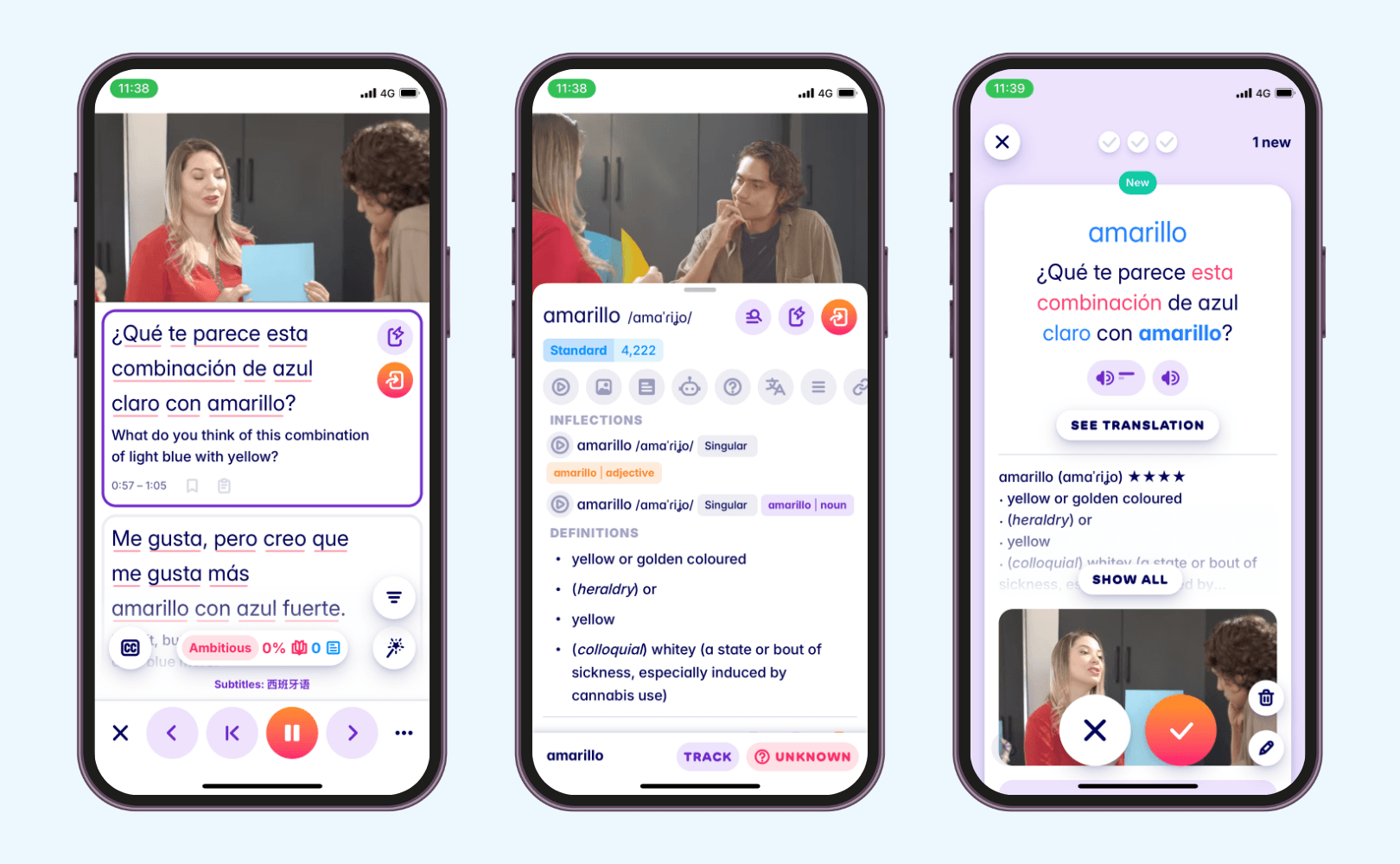
If you want to actually practice these reflexive verbs with real Spanish content, Migaku's browser extension and app let you look up words and grammar instantly while watching shows or reading articles. You'll see reflexive verbs in context and can save examples that actually matter to you. There's a 10-day free trial if you want to check it out.
 ---
## You can't skip the reflexive Spanish verbs...
They're fundamental to everyday Spanish. You can't talk about your morning routine, your feelings, or tons of common actions without them. The good news is the pattern stays consistent. Pronoun plus conjugated verb. Match the pronoun to the subject. Follow the same conjugation rules as non-reflexive verbs. Once you've got that down, you can apply it to any reflexive verb you learn, and let immersion take that fluency to the next level.
> If you consume media in Spanish, and you understand at least some of the messages and sentences within that media, you will make progress. _Period_.
For a goal worth achieving, there's no shortcut.
---
## You can't skip the reflexive Spanish verbs...
They're fundamental to everyday Spanish. You can't talk about your morning routine, your feelings, or tons of common actions without them. The good news is the pattern stays consistent. Pronoun plus conjugated verb. Match the pronoun to the subject. Follow the same conjugation rules as non-reflexive verbs. Once you've got that down, you can apply it to any reflexive verb you learn, and let immersion take that fluency to the next level.
> If you consume media in Spanish, and you understand at least some of the messages and sentences within that media, you will make progress. _Period_.
For a goal worth achieving, there's no shortcut.