# Spanish Transport Vocabulary: Get Around With Ease
> Learn essential Spanish transport vocabulary for buses, trains, planes, and getting around. Includes practical phrases for tickets and directions.
**URL:** https://migaku.com/blog/spanish/spanish-transport-vocabulary
**Last Updated:** 2026-03-28
**Tags:** vocabulary, phrases
---
If you're planning to travel through [Spanish-speaking](https://migaku.com/learn-spanish) countries or just want to navigate everyday conversations about getting around, you need solid transportation vocabulary. Whether you're catching a bus in Madrid, booking a train ticket in Mexico City, or asking for directions to the nearest metro station, knowing the right words makes everything smoother. This guide covers all the essential Spanish transport vocabulary you'll actually use, from basic vehicle names to practical phrases for buying tickets and asking where you're supposed to go.
----
## Basic modes of transportation in Spanish
Let's start with the fundamental vehicles and transport methods you'll encounter. These are the bread-and-butter words you need to know.
The most common way to say "car" in Spanish is "el coche," but heads up, this varies by region:
| Spanish | English |
| - | - |
| el carro / el auto | Car (Latin America) |
| el taxi | Taxi |
| el cab | Taxi (in some areas influenced by English) |
For public transport:
| Spanish | English |
| - | - |
| el autobús / el bus | Bus |
| el tren | Train |
| el metro | Subway / Metro |
| el barco | Boat (larger vessels) |
| el bote | Boat (smaller ones) |
| el buque | Ship |
Here are some other vehicles worth knowing:
| Spanish | English |
| - | - |
| el camión | Truck (in Mexico, "camión" often means bus) |
| la furgoneta / la camioneta | Van |
| el helicóptero | Helicopter |
| el tranvía | Tram / Streetcar |
| el ferry / el transbordador | Ferry |
| el avión | Plane |
| el aeropuerto | Airport |
| la bicicleta / la bici | Bicycle |
| la motocicleta / la moto | Motorcycle |
----
## Essential travel verbs and phrases
Vocabulary lists are cool, but you need to actually use these words in sentences. Here are the key verbs and phrases that'll help you get around.
- The verb "to travel" is **"viajar." **
- "To go" is **"ir," ** which you'll use constantly. "I'm going to the airport" is "Voy al aeropuerto."
- "To take" (as in take a bus) is **"tomar" ** or **"coger" ** in Spain. Be careful with "coger" in Latin America though, it has a vulgar meaning in many countries. Stick with "tomar" to be safe. "I'm taking the bus" is "Tomo el autobús."
- "To arrive" is **"llegar" ** and "to leave/depart" is **"salir." ** "The train arrives at 3pm" is "El tren llega a las tres de la tarde."
Here are some super practical phrases for getting around:
- ¿Dónde está la parada de autobús?
*Where is the bus stop?*
- ¿Cuánto cuesta el billete?
*How much does the ticket cost?*
- ¿A qué hora sale el tren?
*What time does the train leave?*
- ¿Este autobús va a...?
*Does this bus go to...?*
- Necesito un billete para Madrid.
*I need a ticket to Madrid.*
- ¿Dónde compro los billetes?
*Where do I buy tickets?*
- ¿Qué andén?
*Which platform?*
- ¿Está ocupado este asiento?
*Is this seat taken?*
- Perdón, me bajo aquí.
*Excuse me, I get off here.*
----
## Specific vocabulary for different transport types
Each mode of transport has its own specific vocabulary. Let's break it down.
### Train travel terms
When traveling by train, you'll encounter different types of trains.
| Spanish | English |
| - | - |
| el AVE (Alta Velocidad Española) | High-speed train in Spain |
| el tren regional | Regional train |
| el cercanías | Commuter train |
| el revisor / el conductor | Conductor |
| el ferrocarril | Railroad / Railway |
| primera clase | First class |
| segunda clase | Second class |
### Bus-specific language
| Spanish | English |
| - | - |
| el conductor / el chofer | Bus driver |
| el autocar | Long-distance bus (used in Spain) |
| el autobús escolar | School bus |
| el autobús turístico | Tour bus |
### Plane and airport vocabulary
| Spanish | English |
| - | - |
| la puerta de embarque | Boarding gate |
| el equipaje | Luggage |
| la tarjeta de embarque | Boarding pass |
| el registro / la facturación | Check-in |
| el control de seguridad | Security |
| la aduana | Customs |
| el vuelo | Flight |
| un vuelo directo | Direct flight |
| un vuelo con escala | Connecting flight |
| el piloto | Pilot |
| el auxiliar de vuelo / la azafata / el azafato | Flight attendant |
----
## Spanish vocabulary for directions and navigation
Getting around means asking for and understanding directions. Here's what you need.
| Spanish | English |
| - | - |
| derecha | Right |
| izquierda | Left |
| todo recto / derecho | Straight ahead |
| cerca | Near |
| lejos | Far |
| al lado de | Next to |
| delante de | In front of |
| detrás de | Behind |
Some helpful direction phrases:
- ¿Cómo llego a...?
*How do I get to...?*
- ¿Está lejos?
*Is it far?*
- Gira a la derecha.
*Turn right.*
- Sigue recto.
*Go straight.*
- Está a dos cuadras / dos manzanas.
*It's two blocks away.*
- ¿Me lo puede mostrar en el mapa?
*Can you show me on the map?*
----
## Regional differences worth knowing
Spanish varies quite a bit depending on where you are. Transportation vocabulary is no exception.
In Spain, people say "coger el autobús" (to catch the bus), but in Latin America, you'd say "tomar el autobús" because "coger" has a sexual connotation in many Latin American countries.
"El coche" is the standard word for car in Spain, but in Mexico and much of Latin America, "el carro" is more common. Argentina often uses "el auto."
In Mexico, "el camión" means bus, which can confuse Spanish learners since in Spain it means truck. Mexicans use "el camión de carga" for truck.
"El billete" (ticket) is used in Spain, while most of Latin America uses "el boleto."
----
## Tips for learning and remembering vocabulary related to transportation
Here's the thing about vocabulary: lists are useful for reference, but you won't really learn these words until you use them in context.
1. The best approach is immersion. [Watch Spanish shows or movies](https://migaku.com/blog/spanish/best-spanish-shows-guide) that involve travel scenes. Travel vlogs on YouTube in Spanish are goldmine for this vocabulary because creators are constantly talking about getting around, buying tickets, and navigating new places.
2. When you encounter these words in real content, save them. [Create flashcards with full sentences](https://migaku.com/blog/spanish/best-spanish-anki-decks), not just isolated words. Seeing "el billete" in the sentence "Compré el billete en línea" (I bought the ticket online) gives you context that helps the word stick.
3. Practice the phrases out loud. Seriously, just saying "¿Dónde está la estación de tren?" a few times helps your mouth get comfortable with the sounds. You'll feel way less awkward when you need to ask this in real life.
4. Group vocabulary by scenario. Instead of trying to memorize random transport words, learn them in clusters: all the words you need for buying a train ticket, all the words for asking directions, all the words for talking about delays and problems.
5. Pay attention to grammar patterns too. Notice that modes of transport use "en" when you're talking about traveling by them: "Viajo en tren" (I travel by train), "Voy en autobús" (I'm going by bus). But you use "a" when talking about going to a place: "Voy a la estación" (I'm going to the station).
----
## Common mistakes to avoid
1. A lot of Spanish learners mix up "la estación" (station) with "la parada" (stop). Buses have stops (paradas), trains and metros have stations (estaciones). Using the wrong one sounds a bit off.
2. Don't forget that "el metro" can mean both the subway system and a meter (measurement). Context usually makes it clear, but it trips people up sometimes.
3. Remember that "el avión" needs the article. You can't just say "voy en avión" without thinking about it, you need to say it correctly as a phrase meaning "I'm going by plane."
4. Another common mistake is forgetting that Spanish uses "tener" (to have) for age and certain states, but "ser" or "estar" for other descriptions. This matters when describing transport: "El tren está retrasado" (The train is delayed) uses "estar" because it's a temporary condition.
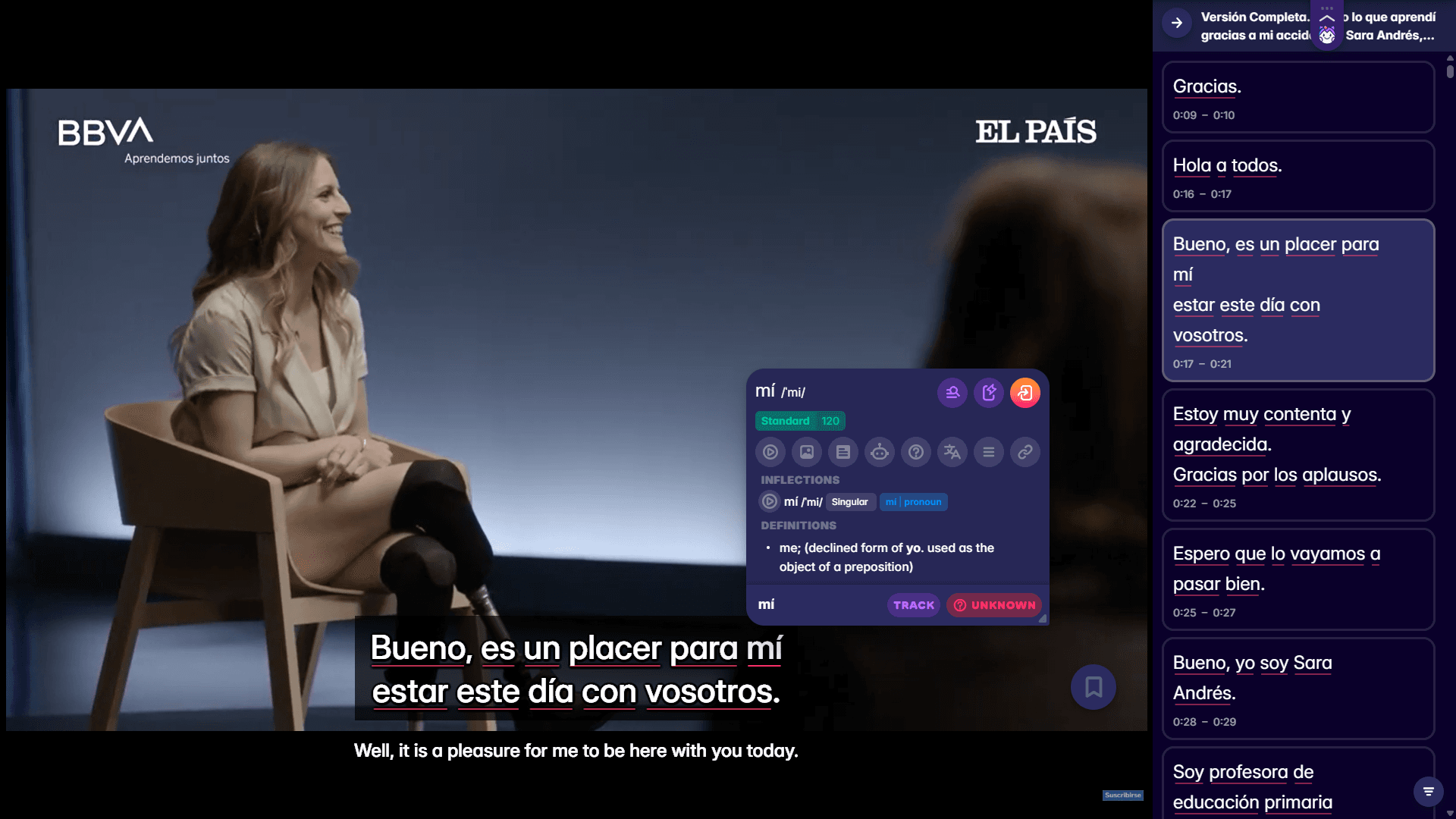
If you want to pick up this vocabulary naturally from real Spanish content, Migaku's browser extension and app let you look up any word instantly while watching shows or reading articles. Makes [learning from immersion](https://migaku.com/blog/spanish/get-started-in-spanish) way more practical. There's a 10-day free trial if you want to check it out.
 ----
## Your Spanish transportation vocabulary is ready for the road
You've got the words, the phrases, and the context to navigate transportation in Spanish-speaking countries. From asking where the bus stop is to buying train tickets and understanding arrival times, this vocabulary covers the real situations you'll face when traveling or living in a Spanish-speaking environment. The key now is using these words in actual context, not just memorizing lists. Watch Spanish travel content, listen to how native speakers ask for directions, and practice the phrases until they feel natural.
> If you consume media in Spanish, and you understand at least some of the messages and sentences within that media, you will make progress. Period.
Knowledge is of no value unless you put it into practice!
----
## Your Spanish transportation vocabulary is ready for the road
You've got the words, the phrases, and the context to navigate transportation in Spanish-speaking countries. From asking where the bus stop is to buying train tickets and understanding arrival times, this vocabulary covers the real situations you'll face when traveling or living in a Spanish-speaking environment. The key now is using these words in actual context, not just memorizing lists. Watch Spanish travel content, listen to how native speakers ask for directions, and practice the phrases until they feel natural.
> If you consume media in Spanish, and you understand at least some of the messages and sentences within that media, you will make progress. Period.
Knowledge is of no value unless you put it into practice!