Spanish Verb Conjugation Chart: Complete Guide
Last updated: April 14, 2026

When you start learning Spanish, verb conjugations hit you pretty fast. You need to memorize different endings for different subjects, different tenses, and somehow keep track of which verbs follow the rules and which ones do their own thing. Here's the thing: once you understand the patterns, Spanish verb conjugation actually becomes way more manageable than it looks at first. I'm going to walk you through complete conjugation charts for regular Spanish verbs, show you the patterns that matter most, and give you the reference tables you actually need. No fluff, just the practical stuff.
- How Spanish verb conjugation works
- Regular -ar verb conjugations
- Regular -er verb conjugations
- Regular -ir verb conjugations
- How to conjugate Spanish verbs step by step
- Not all Spanish verb conjugations follow the same rules
- Beyond the basics: Other verb tenses you’ll need
- Using conjugation charts as reference tools
- Tips for learning Spanish verb conjugations
How Spanish verb conjugation works
Spanish verbs change their form based on who's doing the action and when it happens. Every verb in Spanish has an infinitive form that ends in either -ar, -er, or -ir. Think hablar (to speak), comer (to eat), or vivir (to live).
When you conjugate a verb, you remove that ending and add new endings based on the subject pronoun and tense. The stem of the verb stays the same for regular verbs, which makes them predictable once you know the patterns.
Spanish has six subject pronouns you need to know:
- yo (I)
- tú (you, informal)
- él/ella/usted (he/she/you formal)
- nosotros/nosotras (we)
- vosotros/vosotras (you all, informal, used mainly in Spain)
- ellos/ellas/ustedes (they/you all formal)
Each of these gets its own verb ending for every tense. Yeah, it's a lot of combinations, but the good news is that regular verbs follow consistent patterns.
Regular -ar verb conjugations
About 80% of Spanish verbs end in -ar, so this is the biggest group you'll work with. Let's use hablar (to speak) as our example verb.
Present tense chart for -ar verbs
The present tense describes what's happening now or what happens regularly. Here's how you conjugate hablar:
Subject Pronoun | Ending | Conjugation |
|---|---|---|
yo | -o | hablo |
tú | -as | hablas |
él/ella/usted | -a | habla |
nosotros/nosotras | -amos | hablamos |
vosotros/vosotras | -áis | habláis |
ellos/ellas/ustedes | -an | hablan |
You drop the -ar from hablar and add these endings. The pattern stays the same for all regular -ar verbs. So if you want to conjugate trabajar (to work), you get: trabajo, trabajas, trabaja, trabajamos, trabajáis, trabajan.
Preterite tense chart for -ar verbs
The preterite tense talks about completed actions in the past. The endings change completely from present tense:
Subject Pronoun | Ending | Conjugation |
|---|---|---|
yo | -é | hablé |
tú | -aste | hablaste |
él/ella/usted | -ó | habló |
nosotros/nosotras | -amos | hablamos |
vosotros/vosotras | -asteis | hablasteis |
ellos/ellas/ustedes | -aron | hablaron |
Notice that nosotros looks identical in present and preterite (hablamos). Context usually makes it clear which tense you mean.
Future tense chart for -ar verbs
Future tense is actually easier because you keep the whole infinitive and just add endings:
Subject Pronoun | Ending | Conjugation |
|---|---|---|
yo | -é | hablaré |
tú | -ás | hablarás |
él/ella/usted | -á | hablará |
nosotros/nosotras | -emos | hablaremos |
vosotros/vosotras | -éis | hablaréis |
ellos/ellas/ustedes | -án | hablarán |
The future tense works the same way for all three verb types, which is pretty convenient.
Regular -er verb conjugations
The -er verbs are the second group. Let's use comer (to eat) as our model verb.
Present tense chart for -er verbs
Subject Pronoun | Ending | Conjugation |
|---|---|---|
yo | -o | como |
tú | -es | comes |
él/ella/usted | -e | come |
nosotros/nosotras | -emos | comemos |
vosotros/vosotras | -éis | coméis |
ellos/ellas/ustedes | -en | comen |
The -er endings are similar to -ar verbs but with e instead of a in most forms. Other common -er verbs include beber (to drink), leer (to read), and aprender (to learn).
Preterite tense chart for -er verbs
Subject Pronoun | Ending | Conjugation |
|---|---|---|
yo | -í | comí |
tú | -iste | comiste |
él/ella/usted | -ió | comió |
nosotros/nosotras | -imos | comimos |
vosotros/vosotras | -isteis | comisteis |
ellos/ellas/ustedes | -ieron | comieron |
The preterite endings for -er verbs are identical to -ir verbs, which cuts down on what you need to memorize.
Future tense chart for -er verbs
Subject Pronoun | Ending | Conjugation |
|---|---|---|
yo | -é | comeré |
tú | -ás | comerás |
él/ella/usted | -á | comerá |
nosotros/nosotras | -emos | comeremos |
vosotros/vosotras | -éis | comeréis |
ellos/ellas/ustedes | -án | comerán |
Same endings as -ar verbs in the future, just attached to the -er infinitive.
Regular -ir verb conjugations
The -ir verbs are the smallest group but still super common. We'll use vivir (to live) as our example.
Present tense chart for -ir verbs
Subject Pronoun | Ending | Conjugation |
|---|---|---|
yo | -o | vivo |
tú | -es | vives |
él/ella/usted | -e | vive |
nosotros/nosotras | -imos | vivimos |
vosotros/vosotras | -ís | vivís |
ellos/ellas/ustedes | -en | viven |
The -ir present tense looks almost identical to -er verbs except for the nosotros and vosotros forms. Other common -ir verbs include escribir (to write), abrir (to open), and decidir (to decide).
Preterite tense chart for -ir verbs
Subject Pronoun | Ending | Conjugation |
|---|---|---|
yo | -í | viví |
tú | -iste | viviste |
él/ella/usted | -ió | vivió |
nosotros/nosotras | -imos | vivimos |
vosotros/vosotras | -isteis | vivisteis |
ellos/ellas/ustedes | -ieron | vivieron |
Exactly the same as -er verbs in preterite. Notice vivimos is identical in present and preterite, just like with -ar verbs.
Future tense chart for -ir verbs
Subject Pronoun | Ending | Conjugation |
|---|---|---|
yo | -é | viviré |
tú | -ás | vivirás |
él/ella/usted | -á | vivirá |
nosotros/nosotras | -emos | viviremos |
vosotros/vosotras | -éis | viviréis |
ellos/ellas/ustedes | -án | vivirán |
Same future pattern again. Pretty straightforward.
How to conjugate Spanish verbs step by step
When you see a Spanish verb and need to conjugate it, follow this process:
- Step 1: Identify the infinitive ending. Is it -ar, -er, or -ir?
- Step 2: Determine which tense you need based on context. Present for current actions, preterite for completed past actions, future for what will happen.
- Step 3: Figure out the subject. Who's doing the action?
- Step 4: Remove the infinitive ending from the verb.
- Step 5: Add the appropriate ending from the chart based on verb type, tense, and subject.
Let's practice with aprender (to learn). Say you want to say "we learned" in the past.
The verb ends in -er, you need preterite tense, and the subject is nosotros. Remove -er to get the stem aprend, then add the preterite -er ending for nosotros, which is -imos. You get aprendimos.
Not all Spanish verb conjugations follow the same rules
Regular verbs follow the patterns I showed you above, but Spanish has plenty of irregular verbs that change in unexpected ways. Some of the most common verbs in Spanish are irregular, which is annoying but typical for any language.
- Verbs like ser (to be), estar (to be), ir (to go), tener (to have), and hacer (to make/do) all have irregular conjugations that you need to memorize separately.
- The verb ir is particularly irregular in the preterite tense, where it becomes fui, fuiste, fue, fuimos, fuisteis, fueron. That looks nothing like a regular verb pattern.
- Some verbs are mostly regular but have stem changes in certain forms. For example, pensar (to think) changes the e to ie in present tense for most forms: pienso, piensas, piensa, but then goes back to regular for nosotros: pensamos.
- Other verbs have spelling changes to maintain pronunciation. Verbs ending in -car, -gar, and -zar change spelling in the preterite yo form. Buscar (to look for) becomes busqué instead of "buscé" to keep the hard k sound.
Beyond the basics: Other verb tenses you’ll need
The present, preterite, and future tenses cover a lot of ground, but Spanish actually has way more verb tenses. Here's a quick overview:
- Imperfect tense describes ongoing or habitual actions in the past. The verb ending patterns are different from preterite, and you use it for things like "I used to play" or "I was playing."
- Conditional tense expresses what would happen. It uses endings similar to the imperfect but attached to the infinitive like the future tense.
- Present perfect combines the verb haber with a past participle to talk about recent past actions. "I have eaten" would be he comido.
- Subjunctive mood gets its own set of conjugations and expresses doubt, desire, emotion, or uncertainty. It's one of the trickier aspects of learning Spanish.
Each of these tenses has its own conjugation chart with specific endings. The good news is that once you master the three main tenses with regular verbs, the patterns for other tenses become easier to pick up.
Using conjugation charts as reference tools
Having a good conjugation chart on hand helps when you're reading or writing Spanish and need to double check a form. You can find Spanish verb conjugation chart PDF free download options online, though quality varies.
A printable Spanish verb conjugation chart works great as a desk reference. Keep one near your study space so you can glance at it quickly without switching between apps or browser tabs.
Most conjugation charts focus on regular verbs in the main tenses because that covers the majority of what you'll encounter. Some include notes about common irregulars or spelling changes, which is helpful.
When you're looking at a conjugation chart with English translations, make sure the English meanings are clear. Some charts just show the conjugated forms without context, which makes it harder to understand when you'd use each tense.
Tips for learning Spanish verb conjugations
Memorizing all these charts feels overwhelming at first. Here's what actually helps:
- Focus on the most common verbs first. You'll use hablar, comer, vivir, ser, estar, ir, tener, and hacer constantly. Get those down solid before worrying about less common verbs.
- Practice with real sentences, not just charts. Conjugating verbs in isolation is boring and doesn't stick. Use them in sentences that mean something to you.
- Learn verb tenses one at a time. Master present tense before moving to preterite. Get comfortable with preterite before tackling imperfect. Trying to learn everything at once leads to confusion.
- Notice patterns across verb types. The future tense uses the same endings for all verbs. The preterite uses the same endings for -er and -ir verbs. Finding these patterns reduces what you need to memorize.
- Accept that irregular verbs require separate memorization. There's no shortcut for verbs like ser or ir. You just have to drill them until they're automatic.
Anyway, if you want to learn Spanish verb conjugations through actual content instead of just drilling charts, Migaku's browser extension and app let you look up any verb form instantly while watching Spanish shows or reading articles. You can save examples to review later and build your understanding through context. There's a 10-day free trial if you want to check it out.
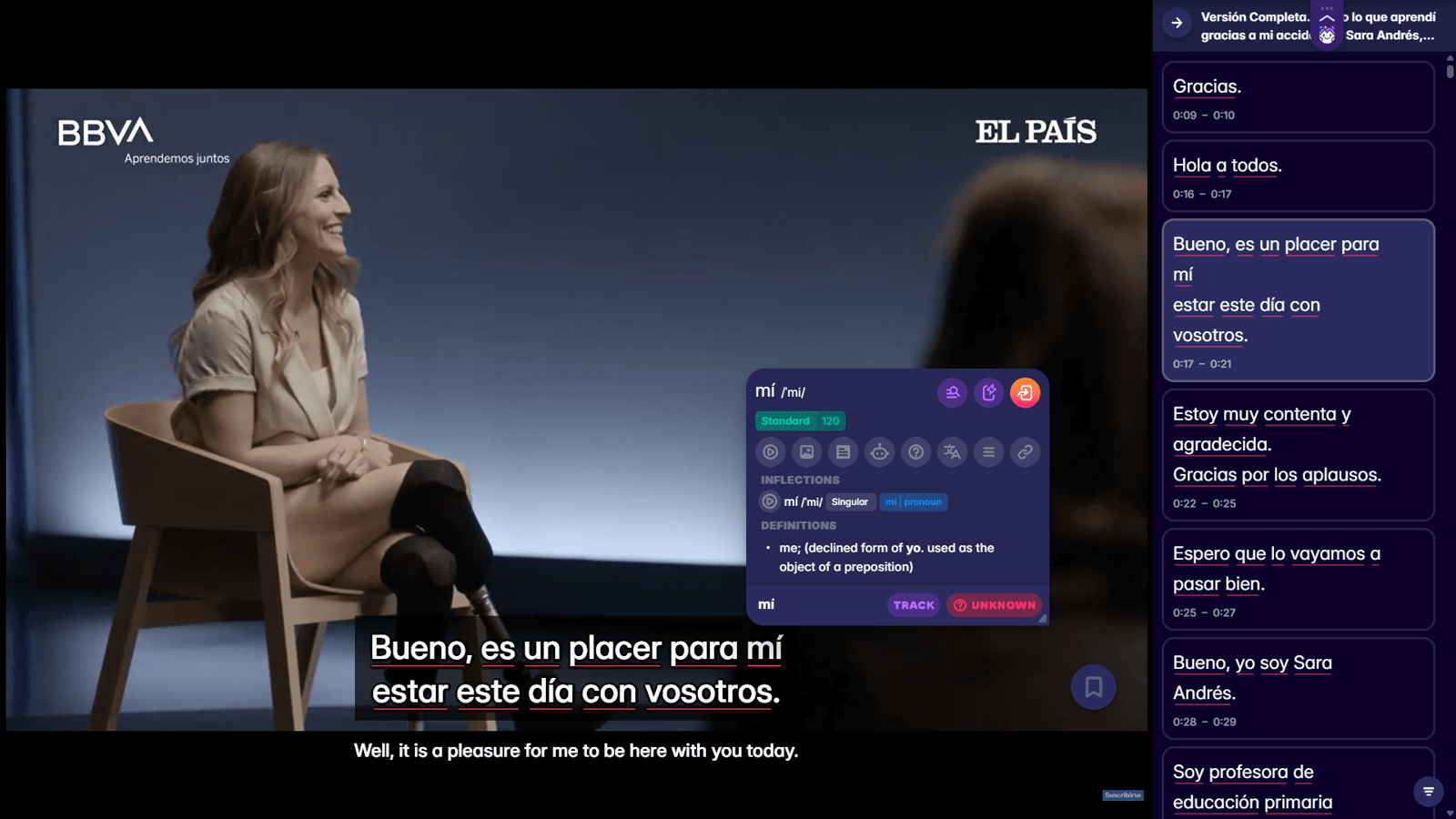
Making verb conjugations stick through immersion
Charts and tables give you the rules, but actually using verbs in context makes them stick in your memory. When you encounter conjugated verbs while reading articles, watching shows, or listening to podcasts in Spanish, you start recognizing patterns automatically.
If you consume media in Spanish, and you understand at least some of the messages and sentences within that media, you will make progress. Period.
See it in context. Repeat it. Keep it.💪