# Chinese Classifiers Guide: Chinese Measure Words Explained Simply
> Basic Chinese measure words: 个, 本, 只. Advanced level: 你的猫变成了一滩 (Your cat is sprawling on the floor.) Let's level up your understanding of measure words!
**URL:** https://migaku.com/blog/chinese/chinese-classifiers-guide-measure-words
**Last Updated:** 2026-02-15
**Tags:** fundamentals, vocabulary, phrases, grammar
---
[Learning Chinese](https://migaku.com/learn-chinese) can feel like a puzzle sometimes, and one of the trickier pieces is definitely measure words. If you've ever tried to say "three cats" in Mandarin and wondered why you can't just say "", you've bumped into classifiers.🐈 These little words sit between numbers and nouns, and yeah, they're pretty much mandatory in Chinese. This guide will break down everything you need to know about Chinese measure words, from the super common ones you'll use daily to the weird specific ones that'll make you sound like a native speaker.
----
## What are measure words in Chinese
Alright, so here's the deal. In English, we sometimes use measure words like "a loaf of bread" or "two cups of coffee", but in Chinese, you need a measure word basically every single time you count something or point at something specific.
> 🗒️The [grammar](https://migaku.com/blog/chinese/chinese-grammar-guide) rule is simple: **number + measure word + noun**. Always.
So instead of saying "one book", you say "one book" (). Instead of "that dog", you say "that dog" (). The measure word changes depending on what you're counting, which is where things get interesting.
Chinese measure words are also called **classifiers** because they classify nouns into different categories. Think of them as sorting words into groups based on their characteristics like shape, size, or function. The Chinese language uses these to organize how we talk about objects, people, and even abstract concepts.
### Why Chinese speakers use classifiers
You might wonder why the Chinese language bothers with this whole system. Linguistically, classifiers appear in lots of Asian languages including Japanese, Korean, Thai, and Vietnamese. They're not unique to Mandarin.
1. One theory is that classifiers help **clarify meaning in a tonal language** where lots of words sound similar. The measure word gives you extra information about what type of thing you're talking about.
2. They also **make the grammar more specific**. When you say , the classifier tells you something about the fish's shape, that it's long and thin. It adds semantic information beyond just the number.
For learners, yeah, they're an extra thing to memorize. But they also make you think about objects in new ways. You start noticing shapes and categories you didn't pay attention to before. Pretty cool from a linguistic perspective.
----
## The universal measure word in Chinese language: 个
Let me start with the best news you'll hear about Chinese classifiers. There's one measure word that works for a huge chunk of nouns: . This thing is your best friend when you're starting to [learn Chinese](https://migaku.com/blog/chinese/best-chinese-learning-apps) and can't remember the specific measure word for something.
个 is the most common measure word in Mandarin by far. You can use it for people (), fruits (), countries (), and tons of other stuff. Honestly, if you forget which classifier to use, just throw in 个 and most native speakers will understand you perfectly fine.
Can you use 个 as the general measure word and be understood by native Chinese speakers? Absolutely. Will you sound like a beginner? Maybe. But you'll be understood, and that's what matters when you're learning.
That said, using the correct specific measure word makes you sound way more natural. It's like the difference between saying "I have two pieces of furniture" versus "I have two chairs." Both work, but one is more precise.
----
## How shape and size determine how to use measure words
One of the coolest things about Chinese measure words is how they reveal the way Chinese speakers categorize the world. The classifier often tells you something about the noun's physical characteristics.
- Long and thin objects use . This applies to rivers (), roads (), snakes (), fish (), and even pants because, well, they have two long thin parts.
- Flat objects use . Paper, tables, beds, maps, all flat things.
- Small round objects often use . Think grains, seeds, teeth, hearts. "One heart" is .
- Stick-shaped objects use . Sticks, pencils, needles, hair strands, cigarettes. "One cigarette" is .
- Machines and appliances use . Computers, air conditioners, televisions. "One computer" is .
----
## Common Chinese measure words you'll use
Let me give you the measure words that show up constantly in everyday conversation. These are the ones worth memorizing first because you'll use them all the time.
### 本 (běn) for books and publications
Use 本 for anything bound like a book. Magazines, notebooks, dictionaries, novels, all use 本. So "two books" is .
### 只 (zhī) for animals
Most animals use 只 as their classifier. Dogs, cats, birds, chickens, you name it. "Three cats" becomes . There are exceptions (like fish sometimes use 条), but 只 covers most animals you'll talk about.
### 辆 (liàng) for vehicles
Cars, bikes, buses, basically anything with wheels uses 辆. "One car" is . Pretty straightforward.
### 件 (jiàn) for clothing and matters
This one does double duty. Use it for clothes like shirts, jackets, and pants (), but also for abstract things like tasks or matters ().
### 张 (zhāng) for flat things
Paper, tables, beds, tickets, photos, anything flat and thin uses 张. "A piece of paper" is . The logic here is about the shape of the object.
### 条 (tiáo) for long, thin objects
Rivers, snakes, fish, roads, pants (Yeah, pants use 条 too), anything long and flexible. "One road" is .
### 把 (bǎ) for things with handles
Chairs, knives, umbrellas, basically anything you grab with a handle. "One chair" is .
### 杯 (bēi) for cups and glasses
This one's easy because it literally means cup. "A cup of coffee" is .
### 瓶 (píng) for bottles
Same deal as 杯. Use it for anything in a bottle. "One bottle of water" is .
----
## Chinese classifiers for people
Talking about people gets its own special set of measure words, and choosing the right one actually carries some social meaning.
- 个 works fine for people in casual conversation. just means "one person" and nobody will judge you for using it.
- 位 is the polite, respectful version. Use this for guests, customers, teachers, or anyone you want to show respect toward. "Three guests" would be . You'll hear this in restaurants and formal settings constantly.
- 名 shows up in more formal or written contexts, often for counting members of a group. "Five students" could be , though works too.
----
## Common measure words for abstract concepts
Not everything you count is physical. Chinese uses measure words for abstract nouns too.
- 种 means "kind" or "type". "Three kinds of fruit" is .
- 次 is for occurrences or times. "Once" is , "twice" is .
- 些 means "some" and works as a vague quantifier when you don't want to specify an exact number. means "some" or "a few".
- 点 means "a little bit" and works for uncountable stuff. is "a little water".
----
## Tips for learning measure words effectively
Here's my honest take on memorizing these things. Lists are helpful for reference, but you won't really internalize measure words until you see them used in context repeatedly.
1. When you learn a new noun in Chinese, learn its measure word at the same time. Don't just memorize " means dog", memorize " means one dog". Pair them together from the start.
2. Common measure words like probably cover 70% of what you'll need in daily conversation. Focus on those first before worrying about obscure ones.
3. Read and listen to actual Mandarin content. When you encounter a noun with its measure word in a sentence, you'll remember it way better than from a list. Your brain likes context.
4. Make mistakes and get corrected. Seriously, using the wrong classifier won't make you incomprehensible. Native speakers will know what you mean, and over time you'll naturally pick up the right ones.
5. If you're preparing for [the HSK exams](https://migaku.com/blog/chinese/hsk-vocabulary-lists), you'll need to know specific lists of measure words for each level. HSK 1 and 2 cover the basics like . Higher levels add more specialized ones. A good dictionary will usually tell you which classifier goes with each noun.
----
## Common mistakes to avoid to learn Chinese measure words
1. Using for everything is fine when you're starting out, but try to branch out as you improve. Native speakers notice when you use the correct specific measure word.
2. Don't forget the measure word entirely. Saying without any classifier sounds super weird because it sounds like a nickname or a special noun. The measure word isn't optional.
3. Watch out for nouns that can take different classifiers depending on context. (Fish) usually uses when you're talking about live fish swimming around, but might use (Plate) if you're talking about cooked fish as a dish.
4. Some learners stress about getting every single classifier perfect. Don't let it paralyze you. Communication matters more than perfection. Use what you know, and refine it over time.
----
## Resources for mastering must-know measure words
1. Good [textbooks](https://migaku.com/blog/chinese/best-chinese-textbooks) usually include measure word charts organized by category. The Integrated Chinese series and HSK Standard Course books have solid reference sections.
2. Online dictionaries like Pleco show you the correct measure word for each noun entry. Super helpful when you're looking up new [vocabulary](https://migaku.com/blog/chinese/chinese-food-vocabulary).
3. Flashcard apps work great for drilling measure words. You can make cards with the noun on one side and the full phrase with measure word on the other.
4. Watching Chinese shows and reading content helps you see measure words in their natural habitat. You'll notice patterns way faster than memorizing lists.
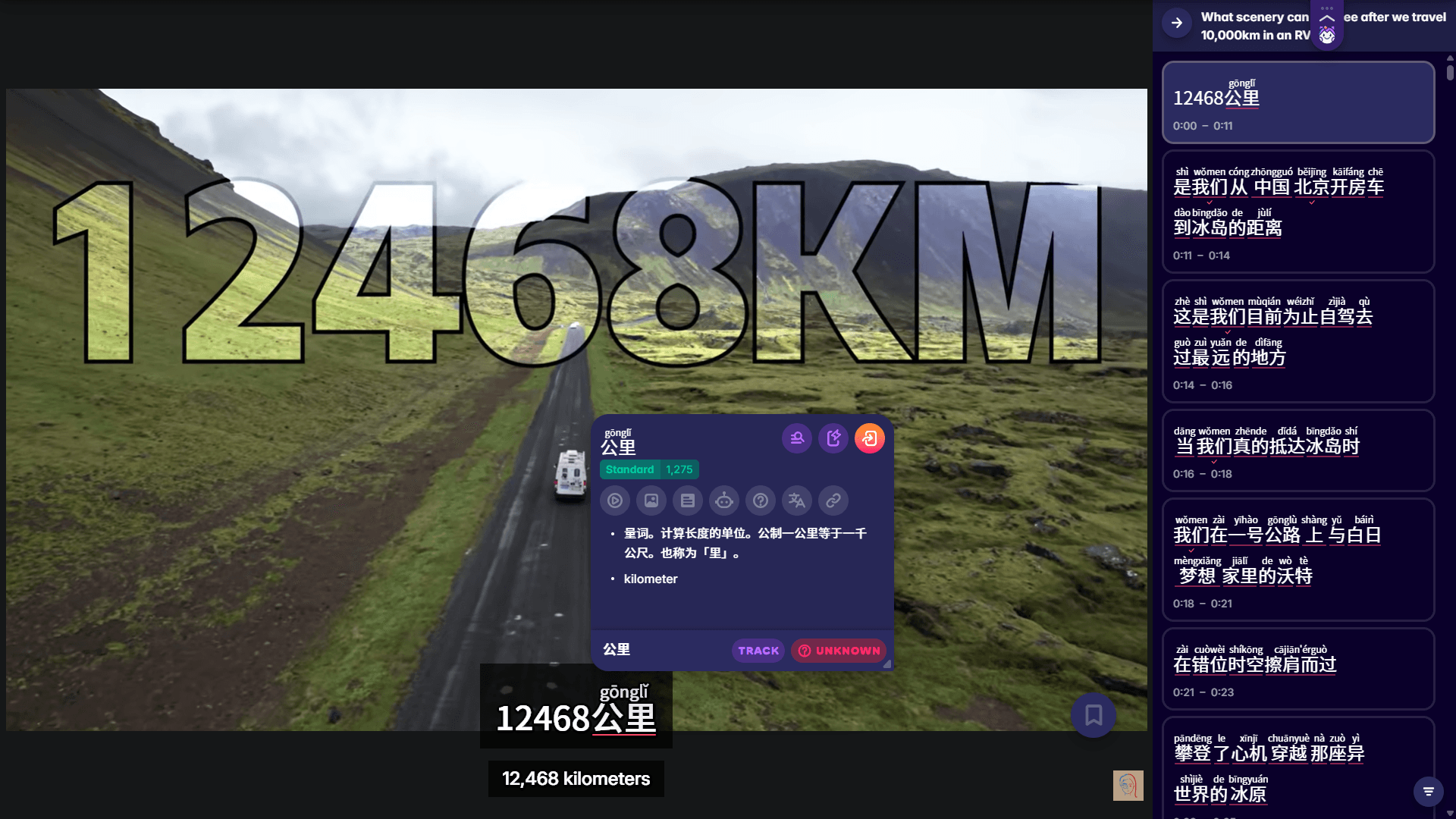
If you want to speed up your learning with real Chinese content, Migaku's browser extension and app let you look up words and their measure words instantly while watching shows or reading articles. Makes immersion way more practical. There's a 10-day free trial if you want to check it out.
 ----
## Measure words, finally, is that they can be flexible!
Remember that we mentioned shapes are important in understanding measure words? That's when things get really interesting. We all know cats change shapes (by that, I mean they have flexible bodies...) You can vividly describe that with Chinese measure words by saying: (When a cat is stretching), (When a fat cat is lying on the floor like a pool of water), (When a cat is curling up)... The more you read, listen, and practice, the more natural these classifiers will feel, and the more you know how to "play with" the language!
> If you consume media in Chinese, and you understand at least some of the messages and sentences within that media, you will make progress. _Period_.
Internalize the rules, and have fun with how the language works!
----
## Measure words, finally, is that they can be flexible!
Remember that we mentioned shapes are important in understanding measure words? That's when things get really interesting. We all know cats change shapes (by that, I mean they have flexible bodies...) You can vividly describe that with Chinese measure words by saying: (When a cat is stretching), (When a fat cat is lying on the floor like a pool of water), (When a cat is curling up)... The more you read, listen, and practice, the more natural these classifiers will feel, and the more you know how to "play with" the language!
> If you consume media in Chinese, and you understand at least some of the messages and sentences within that media, you will make progress. _Period_.
Internalize the rules, and have fun with how the language works!