# Chinese Conversation Practice: Four Intensive Practices to Help You Master Chinese Speaking
> Chinese conversation practice is a crucial link to transform passive learning into active output. Try these four methods in order to speak like a native!
**URL:** https://migaku.com/blog/chinese/chinese-conversation-practice
**Last Updated:** 2025-12-05
**Tags:** resources, culture, pronunciation
---
Ready to hear many (What?) when you just start to talk with Chinese natives...
Conversation is a test of your memory on your vocabulary, pronunciation, and grammar knowledge. On top of that, it's also a dynamic dance of listening, thinking, and responding in real-time. The fear of stumbling can keep a [Chinese beginner](https://migaku.com/learn-chinese) silent, but the path forward is built through deliberate, vocal action. This guide outlines four practical methods — from the safety of your home to the reality of immersion — that will help you stumble less gradually, to say the least...🫡
---
## Method 1: read your Chinese textbook conversations out loud
Every journey needs a reliable starting point. For conversation practice, this begins with your textbook or language app, whichever has sample dialogues or conversations. The first advice is that you shouldn't just read the dialogue silently. Read them out loud, with intention.
1. Find a conversation that covers a practical scenario, like introducing yourself, ordering food, or making plans.
2. First, listen carefully to the accompanying audio, noting the pronunciation, tones, and rhythm. If there is no audio, mark down the pinyin of every new word.
3. Then, mimic the speaker's cadence if there is an audio.
4. Finally, read the entire conversation aloud by yourself, playing both roles.
This practice is crucial for several reasons. It trains your mouth to form unfamiliar sounds correctly. It internalizes common sentence structures and useful phrases so they become readily available in your memory. Textbooks usually start with very basic conversations. As you might have noticed, even for the same scenario, there may be a simple conversation and a complex one. If you are not satisfied with the simple versions anymore, you can go to YouTube and browse through several videos based on the same scenarios to practice speaking Chinese.
---
## Method 2: repeat after and shadow Chinese conversations from the media
Compared to textbook conversation, practicing using media like dramas, movies, and reality shows is one more step towards real-life scenarios. When people talk, their speech is subject to the influence of their current health, mood, situations, etc. Subsequently, the conversation may not be as clear as it can be from the textbook.
This is where shadowing becomes your most powerful tool, which is the process of listening to native speakers and repeating what they say in real-time, with minimal delay.
1. Choose engaging content like a slice-of-life drama scene, a movie clip, or even a relaxed podcast interview. The key is to find material with natural, conversational dialogue.
2. Use Chinese subtitles to connect the sounds you hear with the words you see.
3. Watch a short segment (2-3 minutes) first to understand the context. Then, play it again and try to speak simultaneously or closely after the characters. Aim to be their echo—copy their speed, their emotional inflection, their pauses, and even their casual expressions.
This forces you to process natural speed and reproduce it immediately, breaking the slow, analytical habit of translation. You'll start to pick up some common interjections and how words blend together in everyday talk. Your listening skills will be sharpened too, as you understand what the speakers are trying to say more and more despite the environmental noise, their accents, and overlapping speeches.
---
## Method 3: start a conversation in real-life scenarios in China
There is no substitute for the ultimate classroom: real life. Traveling to China or another Mandarin-speaking region and using the language for daily needs is the most effective accelerator for your conversational skills.
1. Create missions for yourself in safe, transactional environments. Walk into a convenience store and buy a bottle of water, asking for it specifically. Start asking the staff like this:
*Do you guys have any water?*
*Yeah, it's over there at the fridge. Go get it yourself.*
2. Go to a local [restaurant](https://migaku.com/blog/chinese/chinese-restaurant-phrases) and order from a menu without pictures, asking the server for a recommendation. You can add more requests like:
*Can I have this dish without the chilli?*
3. Visit a park and ask for simple directions.
*Excuse me, where is the toilet?*
The goal here is successful communication, not perfection. You will make mistakes, forget words, and encounter unfamiliar accents. It's okay to use a translation app as a last resort as well!
Moreover, this process teaches you to use body language and understand varied pronunciations. The triumphant feeling of getting your meal, finding your way, or sharing a smile after a simple exchange provides unparalleled motivation.
---
## Method 4: practice mock speeches on specific topics
Wait, this is how we practice for the English speaking exam of IELTS! Even when it's not for English learning, making mock speeches is still a highly practical way to practice conversation in a safe environment. This method focuses on building your ability to produce extended, structured speech independently.
1. Choose a simple, familiar topic—your hobby, your family, your favorite movie, or your plans for the weekend.
2. Set a timer for one or two minutes and talk about it aloud in Chinese, without stopping.
3. Record yourself on your phone. Don't worry about errors; focus on keeping the flow. Afterwards, listen back. Where did you hesitate? What word did you need but couldn't find? What grammar felt shaky?
4. If you have any friends, not necessarily Chinese friends, make a mock speech in front of your friends. People tend to get more nervous when there are other people present!
Use this analysis to improve. Look up the missing vocabulary, correct the grammar point, and then give the speech again. It forces you to connect your known vocabulary into original sentences, strengthening your ability to think in Chinese. It prepares you to contribute meaningfully in conversations, moving beyond one-line responses to expressing actual opinions and stories. After all, in-depth conversations are the only way we can make true friends and enjoy meaningful events together!
---
## Improve your Chinese speaking with this little helper!
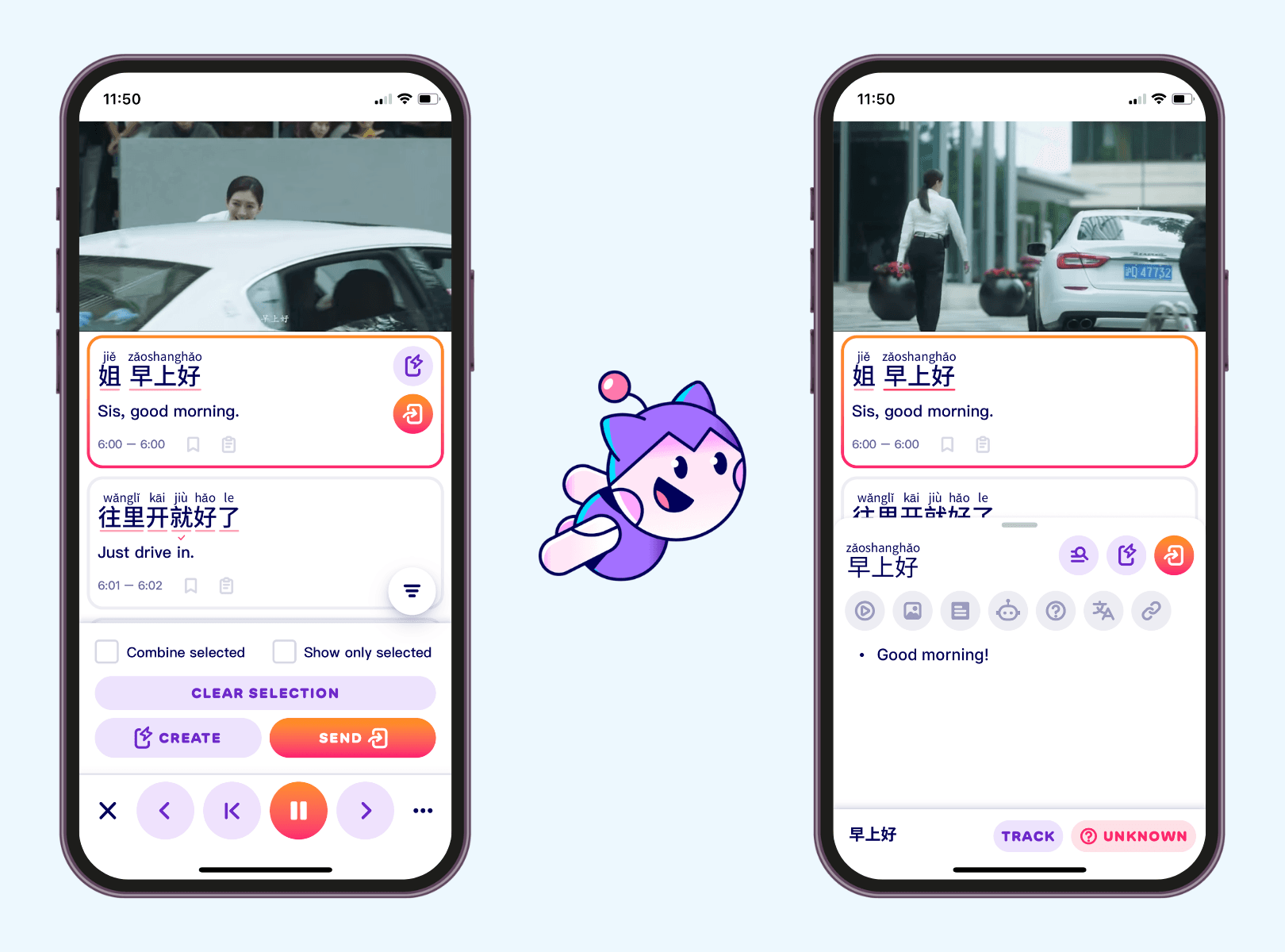
Remember the repeat-after and shadowing practice? Migaku app can help you with this practice and generate Chinese subtitles even when the video does not feature any. This tool can greatly expand your pool for speaking practice. For example, Migaku app can generate subtitles for this cut from *Nothing but Thirty* with the English translation. You can also click the words or sentences to add them to your flashcard collections and review them later. It is your best assistant for intensive Chinese shadowing practice.
1. Switch on YouTube and search for Chinese videos with the app
2. Click "Watch with Migaku", and the magic wand at the lower right corner to generate Chinese subtitles
3. Click on the new words or sentences in each subtitle and generate flashcards!
 ---
## FAQs
Start with greetings: (Hello).
---
## FAQs
Start with greetings: (Hello).
Learn to reply hello by repeating (Hello/Hi/Hello).
Use key phrases: (Excuse me/May I ask...), (Sorry), (My name is...), (Goodbye).
Speak slowly, listen carefully, and don't worry about mistakes. Practice these simple exchanges often.
"Conversational" Chinese is generally considered intermediate level (HSK 3-4). This means you can handle everyday topics like shopping, dining, transportation, work, and family in simple, direct exchanges. You understand common sentences, can ask and answer basic questions, and describe experiences or plans, though speech may be slow and grammar imperfect. True conversation requires active listening and the ability to manage unscripted dialogue, not just reciting phrases.
At Home: Read textbook dialogues aloud. Make mock speeches on interesting topics.
Online: Shadow dramas or movies with Chinese subtitles.
In Daily Life: Visit a local Chinese restaurant or market and place an order. Speak with Chinese-speaking friends or community members.
In China: Immerse yourself by speaking in shops, on transport, and with locals.
---
## Go through more and more media for the eureka moment when speaking Chinese
As you watch more and more videos and witness the conversations between many native Chinese, you will go through the experience of how your brain stores the information and exchanges, waiting for the moments of using them in real life. So, when you try to say something, suddenly you might hear a voice, a voice from a character in the drama you just finished watching, and yes, that's the expression you're looking for!
> If you consume media in Chinese, and you understand at least some of the messages and sentences within that media, you will make progress. _Period_.
You cannot make proper output without solid input!