# Chinese Particles: How to Use Basic Particles Like 吗, 了, 吧, and More
> Chinese particles are signifiers of the meanings, tones, and attitudes of a sentence in Mandarin. Learn these basic particles for accurate expressions!
**URL:** https://migaku.com/blog/chinese/chinese-particles
**Last Updated:** 2025-12-19
**Tags:** fundamentals, grammar
---
As [a Chinese learner](https://migaku.com/learn-chinese), you have happily escaped the [verb conjugation](https://migaku.com/blog/chinese/chinese-verbs)! Yet, to express your meanings clearly, you must master particles.😶 While English relies on conjugation and change of word order to convey the intention, tense, etc., Chinese heavily relies on particles to tell the nuances. The truth is, they’re the emotional and contextual glue of the language. Basically, if tones give your words melody, particles give them the right meanings and feelings. Let's dive into the big ones — you'll love how much personality they add to your Chinese.
---
## How to form a question sentence with the Chinese particle: 吗 (ma)
You can’t escape - That's the cost of having no word order change from statements to questions. It’s the most straightforward way to turn a statement into a yes-no question, and it’s ridiculously easy to use. You just tack it onto the end of a declarative sentence.
In other words:
1. 。 (You are a student) becomes ? (Are you a student?)
2. 。 (You have eaten) becomes ?(Have you eaten already?)
Simple, right? But we should address the elephant in the room: relying only on will make your questions sound a bit like a police interrogation. It’s perfect for simple, direct inquiries, but as you get more comfortable, you’ll start to use a more natural tone to it, softening the questions. If you're just starting out, though, is your best friend. It’s your grammatical safety net for asking about anything.
This particle can also be used in rhetorical questions, meaning that it looks like a question, but the speaker's intention is not to ask, but to stress the attitudes or feelings. It can express the meaning with or without the negation or rhetorical phrases. Therefore, you need to be careful about the speakers' tones and facial expressions to understand them.
1. ?
*Can't you understand?*
2. ?
*Can't you see?*
---
## How to use Chinese aspect particles in Chinese grammar: 了 (le), 过 (guo), 着 (zhe)
Ah, . This one probably causes more headaches than any other particle. Teachers throw around terms like “completed action” or “change of state,” which can sound abstract. Let me put it plainly from my own experience: marks that something is different now. It signals a shift, a new situation, or a turn in events.
Think of it this way.
1. 。 (I eat pizza.) becomes 。 (I ate pizza.)
2. 。 (The weather is hot.) becomes 。 (The weather has gotten hot.)
3. 。 (You eat.) becomes ?(Have you eaten?)
By observing the three sentences above, it's not hard to notice that the particle signifies an action done or a situation changed. The key is to stop translating it directly to the English past tense. Instead, listen for that sense of “and now things are different.” You’ll often hear it in stories, announcements, and observations. It takes practice, but once you feel that sense of shift, it clicks.
But wait—what about and ? We should address this family of particles that also deal with "past" or "state."
Here's something I've learned: is your particle for life experience. It's not about a specific, completed action that impacts now (that's 了's job). It's about whether you've ever done something in your life. Basically, reports news; shares your history. If you say “” (I watched that movie), it implies you just finished it, maybe recently. If you say “” (I watched that movie before), it means you've seen it (at least once) in your life, full stop.
1. 。
*I have been to China.*
2. 。
*I have tasted this cuisine before.*
And then there's . is all about continuation and ongoing state. It describes an action in progress or a static posture.
1. 。
*The door is open.*
2. 。
*She is sitting.*
---
## How to apply Chinese structural particles: 的 (de), 地 (de), 得 (de)
You’ll love how logical this is once you untangle it. and sound identical in speech, but not , which features a solid second tone. So, try not to mix them up in speech or writing, especially between and the first two.
First, is the possessive and descriptive linker. It creates relationships, basically turning nouns into adjectives. It’s the “’s” or “of” in English.
1.
*My book*
2.
*Beautiful flower*
Next, turns adjectives into adverbs for verbs. It’s the “-ly” in English.
1. 。
*She sings happily.*
2. 。
*Little dog happily rolls around.*
Finally, comes after a verb to describe how well the action is done.
1. 。
*She sings very well.*
2. 。
*He drafted this appropriately.*
See the pattern? -> noun-modifier. -> verb-modifier (before). -> verb-modifier (after, for degree). More or less, it’s a beautifully organized system.
---
## Other particles for tone of voice in Chinese sentences: 呢 (ne), 吧 (ba), 啊 (a)
This is where the real conversational magic happens. These particles don’t change core grammar; they add attitude, emotion, and subtlety. If you're the kind of person who wants to sound engaged and not like a robot, you’ll lean on these constantly.
The particle is a multipurpose tool.
1. It can return a question:
?
*I'm fine, and you?*
2. It can also imply an ongoing state or add a contemplative, “as-for” tone:
。
*I’m in the middle of eating.*
The particle is for suggestion, soft assertion, or seeking agreement. It’s like adding “right?”, “let’s…”, or “I suppose.”
1. !
*Let's go.*
2. ?
*You’re a teacher, right?*
Finally, is pure emotion. It can express surprise, realization, sympathy, or just soften a statement to make it less abrupt.
1. !
*It’s you!*
2. !
*Yeah, that’s right.*
---
## Learn Chinese particles through videos!
There is no better place to learn particles than videos! Most of the Chinese dramas and movies adopt an informal way of speaking, meaning that there will be a large amount of particles applied in the lines.
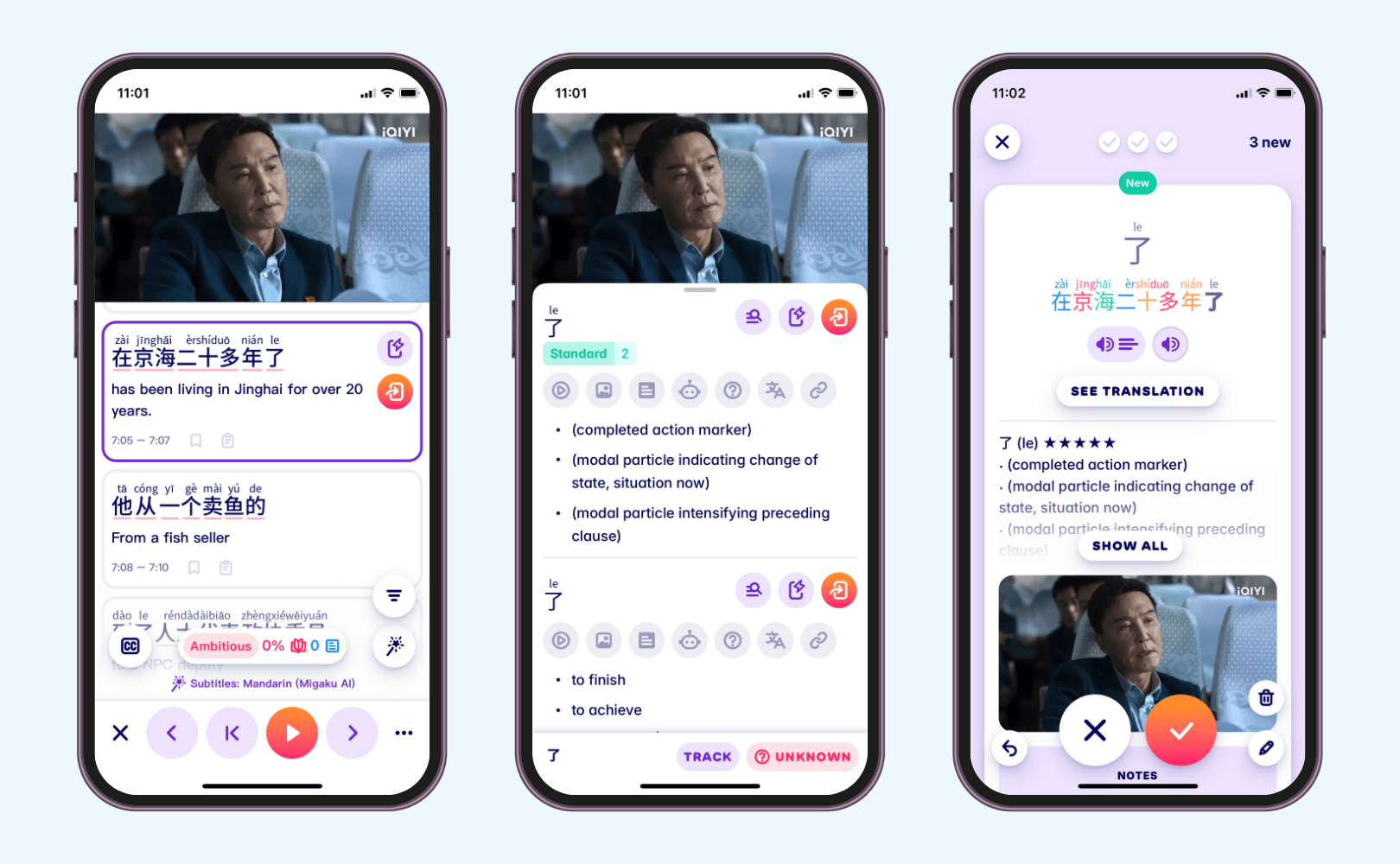
The good news is, Migaku app can help generate Chinese subtitles even when the video does not feature any. For example, Migaku app can generate subtitles for this cut from *The Knockout* with the English translation. You can also click the words or sentences to add them to your flashcard collections and review them later. It can assist you with collecting sentences related to the Mandarin particles.
1. Switch on YouTube and search for Chinese videos with the app
2. Click "Watch with Migaku", and the magic wand at the lower right corner to generate Chinese subtitles
3. Click on the new words or sentences in each subtitle and generate flashcards!
 ---
## FAQs
A Chinese particle is a function word that doesn't have a concrete meaning itself but instead adds crucial grammatical, emotional, or modal nuance to a sentence. Think of them as the essential spice and glue of the language — tiny words like , , , and that shape questions, indicate changes, show possession, or add feeling.
The most common sentence-final particles are (turns statements into questions), (softens questions or shows ongoing state), (makes suggestions or seeks agreement), and (expresses emotion or emphasis). They're essential for adding the right tone, mood, and nuance, transforming robotic statements into natural, fluent Chinese.
---
## The nuances of Chinese particles are as diverse as Chinese adjectives
The truth is, you won’t master these overnight. I certainly didn’t. You have to listen for them in dramas, podcasts, and conversations. Start by consciously using and , and adjusting your mindset when noticing , , in any media.
> If you consume media in Chinese, and you understand at least some of the messages and sentences within that media, you will make progress. _Period_.
Details are important, just like particles!
---
## FAQs
A Chinese particle is a function word that doesn't have a concrete meaning itself but instead adds crucial grammatical, emotional, or modal nuance to a sentence. Think of them as the essential spice and glue of the language — tiny words like , , , and that shape questions, indicate changes, show possession, or add feeling.
The most common sentence-final particles are (turns statements into questions), (softens questions or shows ongoing state), (makes suggestions or seeks agreement), and (expresses emotion or emphasis). They're essential for adding the right tone, mood, and nuance, transforming robotic statements into natural, fluent Chinese.
---
## The nuances of Chinese particles are as diverse as Chinese adjectives
The truth is, you won’t master these overnight. I certainly didn’t. You have to listen for them in dramas, podcasts, and conversations. Start by consciously using and , and adjusting your mindset when noticing , , in any media.
> If you consume media in Chinese, and you understand at least some of the messages and sentences within that media, you will make progress. _Period_.
Details are important, just like particles!