# Chinese Tone Changes: Commonest Tone Change Rules and Polyphonic Chinese Words
> Chinese tone changes exist in third tone pairs and many polyphonic phrases. Here is how to learn tone change rules and how to collect tone-change phrases.
**URL:** https://migaku.com/blog/chinese/chinese-tone-changes
**Last Updated:** 2025-12-15
**Tags:** pronunciation, grammar
---
Here's something different from English pronunciation. For English, you know more or less about how to pronounce words from the spelling. But for [Chinese learning](https://migaku.com/learn-chinese), you need to know pinyin, tones, and tone changes!😅 The bad news is, although you can learn the general rules and the common ones from a textbook, there are still so many tone change words that are not included in this net! So, buckle up. Let's see how to learn and practice these elusive words!
---
## The most common Mandarin tone changes: the third tone sandhi
This is the rule everyone encounters first, and for good reason — it's mandatory and everywhere. Here’s the straightforward law:
> 1. When two third tones appear together, the first one changes to a second tone.
> 2. When three third tones meet, if the first two characters form a meaningful pair, the first two characters should be changed to the second tones.
> 3. When three third tones meet, if the last two characters form a meaningful pair, the second character should be changed to the second tone.
### When there are two third tones in a row
The classic example for the first rule is . You don't say "nǐ hǎo"; you say "ní hǎo." The first third tone flips up into a second tone. This happens constantly in the common vocabulary. (Very good) becomes . (Fruit) becomes . (Boss) becomes .
Ignoring this rule is one of the quickest ways to mark yourself as a raw beginner. More or less, your brain needs to start scanning ahead. Before you speak a third tone, peek at the next character. If it's also a third tone, your mouth needs to automatically launch into a rising pitch instead of a dip.
### When there are three third tones in a row
What about longer chains, like in the second and third rules? The process usually works from left to right. Take the phrase (I am very good). You handle it in pairs. First, and are a pair: changes to a second tone.
In other words, if the first two characters form a pair, like and in (Exhibition hall), both of the first two characters will be changed to second tones.
---
## Other common tone change rules in Mandarin Chinese: 一, 不, and other chameleons
Now, meet the two most famous tone-changing characters: 一 (One) and 不 (Not). Their changes are perfectly logical and based entirely on the tone that follows them—the ultimate example of thinking in pairs.
Let's break them down.
### The pronunciation tone change of 一
> 1. 一 is a first tone by itself: 一.
> 2. Before a first, second, or third tone, it changes to a fourth tone.
> 3. Before a fourth tone, it does the opposite and changes to a second tone.
> 4. When it's used in ordinal numbers or at the end of a phrase, where it keeps its original first tone.
Basically, it avoids musical clashes, creating a smoother flow. Based on this rule, you can master the pronunciation of (One day), (One year), and (A little).
What about the exception? 一 stays as the first tone, when it comes to examples like (Only one), (The first), etc.
The word is a[ very romantic expression](https://migaku.com/blog/chinese/chinese-love) between lovers. You will encounter it in a Taiwan song called . Lyrics collection is also a crucial way to learn vocabulary!
### The Mandarin tone change rules of 不
The word 不 is similarly obedient. It's a fourth tone alone: .
> 1. It stays a fourth tone before the first, second, and third tones.
> 2. But before another fourth tone, it changes to a second tone to avoid the awkward double drop.
Some examples for the first case are (Not say), (Not come), (Not good). For the second rule, when it comes to the most commonly used word, (Is not) is always the second tone, so is (Not correct).
### More changes in Chinese tones for polyphonic words
Beyond these, Mandarin has (Polyphonic characters) — characters with set, different readings. This isn't sandhi; it's a fixed pronunciation tied to meaning. For example: 传 is pronounced as , for verb forms in (To pass the message); as , for noun forms in (Biography).
---
## When to use the neutral tone in pinyin?
If we're talking about change, we have to talk about the tone that isn't really a tone: the neutral tone. It's short, light, and has no independent contour. Here’s the twist: its pitch is entirely determined by the tone that came before it. This makes it the ultimate dependent sound — you cannot pronounce it correctly without mastering the pair.
Let me give you the patterns.
> 1. The neutral tone is used for grammatical particles like , , , ,
> 2. When two same characters are combined to form a word, the second character is usually changed to the neutral tone.
> 3. Some words feature a neutral tone for the second character.
According to these two rules, you can make up a sentence like this to internalize the idea:
*Those moms' bags on the desk are by no means cheap!*
In this example, the neutral tone is applied to particles like and , the second character when two same characters are combined like , and words like which usually use neutral tone for the second character.
---
## Learn Chinese tones and tone changes via media
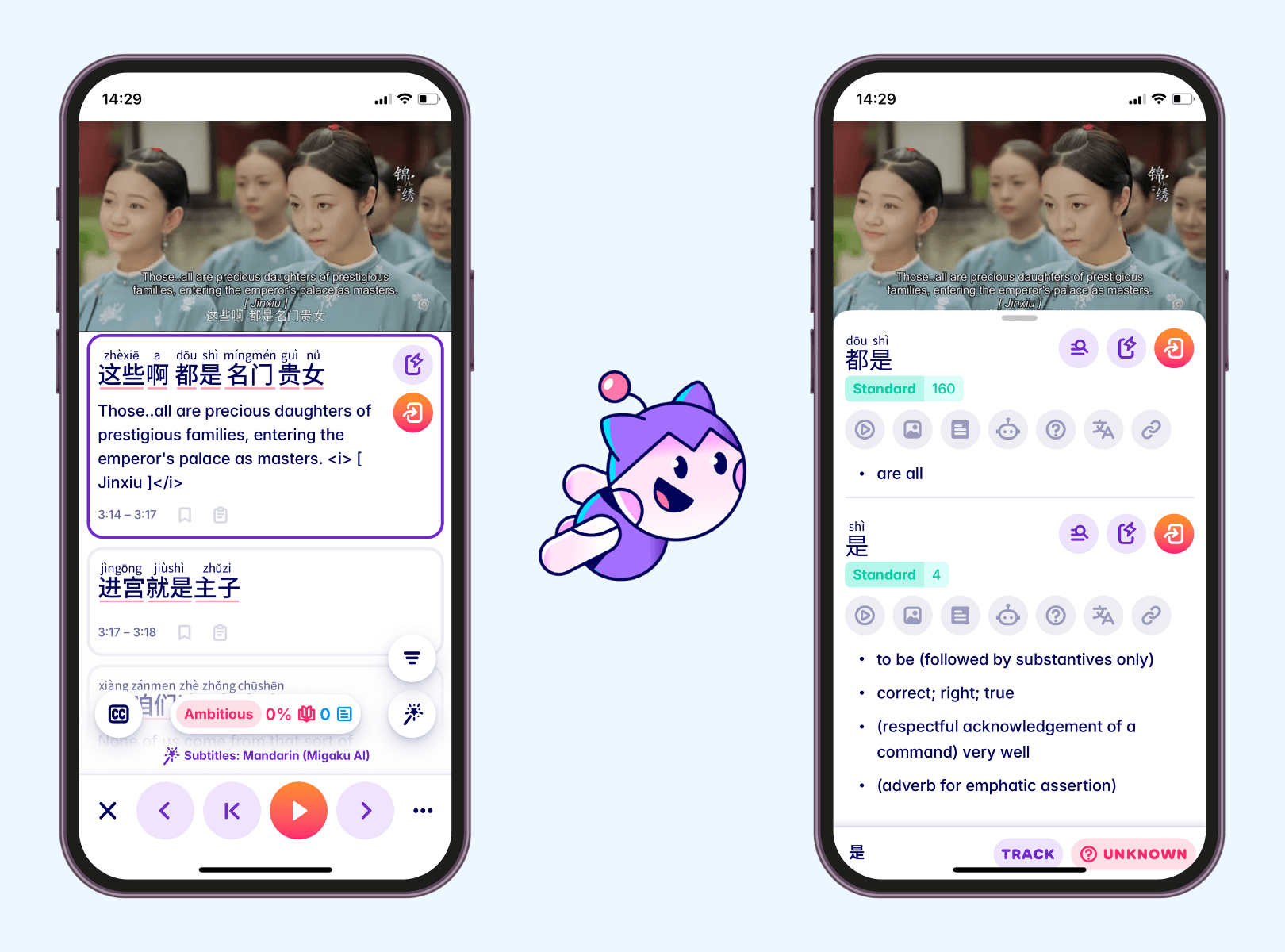
There is no better way to collect tone change examples and polyphonic words than watching videos, listening to songs, or reading. Migaku app can help you make full use of media resources to learn tones and generate Chinese pronunciation for subtitles, even when the video does not feature any. For example, Migaku app can generate subtitles for this cut from *Story of Yanxi* Palace with pinyin. You can also click the words or sentences to add them to your flashcard collections for tone pairs.
1. Switch on YouTube and search for Chinese videos with the app
2. Click "Watch with Migaku", and the magic wand at the lower right corner to generate Chinese subtitles
3. Click on the new words or sentences in each subtitle and generate flashcards!
 ---
## FAQs
The core rule is Third Tone Sandhi: when two third tones meet, the first one must change to a second tone. When three third tones meet, if the first two characters form a meaningful pair, the first two characters should be changed to the second tones. When three third tones meet, if the last two characters form a meaningful pair, the second character should be changed to the second tone.
It's the neutral tone — a short, light, unstressed syllable that loses its original tone contour. You hear it in the second syllable of words like (Mother) or with grammatical particles like . Its pitch isn't fixed; it's a quick, fading echo of the tone before it. Think of it as the "toneless" tone that makes speech sound natural and flowing.
Link each diacritic (ˉ ˊ ˇ ˋ) to a core sound-meaning pair. You can follow [this blog ](https://migaku.com/blog/chinese/pinyin-tone-marks)to learn the rules for Chinese tone marks.
---
## Rules exist in your mind, but it takes time to learn them by heart
The truth is, this is where you graduate from "correct" to "comfortable." You start to feel why (Can not) flows a certain way, blending the change of with the sandhi-ready third tone in . To achieve this goal, you need to keep watching, listening, and reading for years. The golden rule of learning Chinese is simple:
> If you consume media in Chinese, and you understand at least some of the messages and sentences within that media, you will make progress. _Period_.
Let the language melody sound in your head!
---
## FAQs
The core rule is Third Tone Sandhi: when two third tones meet, the first one must change to a second tone. When three third tones meet, if the first two characters form a meaningful pair, the first two characters should be changed to the second tones. When three third tones meet, if the last two characters form a meaningful pair, the second character should be changed to the second tone.
It's the neutral tone — a short, light, unstressed syllable that loses its original tone contour. You hear it in the second syllable of words like (Mother) or with grammatical particles like . Its pitch isn't fixed; it's a quick, fading echo of the tone before it. Think of it as the "toneless" tone that makes speech sound natural and flowing.
Link each diacritic (ˉ ˊ ˇ ˋ) to a core sound-meaning pair. You can follow [this blog ](https://migaku.com/blog/chinese/pinyin-tone-marks)to learn the rules for Chinese tone marks.
---
## Rules exist in your mind, but it takes time to learn them by heart
The truth is, this is where you graduate from "correct" to "comfortable." You start to feel why (Can not) flows a certain way, blending the change of with the sandhi-ready third tone in . To achieve this goal, you need to keep watching, listening, and reading for years. The golden rule of learning Chinese is simple:
> If you consume media in Chinese, and you understand at least some of the messages and sentences within that media, you will make progress. _Period_.
Let the language melody sound in your head!