# Mandarin vs Cantonese: Should I Learn Mandarin or Cantonese
> The difference between Mandarin and Cantonese is significant, just like the difference between any Chinese dialect... So, which one should you choose?
**URL:** https://migaku.com/blog/chinese/mandarin-vs-cantonese
**Last Updated:** 2025-12-11
**Tags:** culture, discussion
---
People often ask you this question: Do you speak Mandarin or Cantonese? (if you told them that you are [learning Chinese](https://migaku.com/learn-chinese) or from China.) The truth is, you’ll often hear Mandarin and Cantonese mentioned in the same breath, but they’re as different as a bustling Beijing boulevard and a vibrant Hong Kong night market. Basically, we’re talking about two languages that are connected with unique communities and global footprints. And before we dive in, we should address the elephant in the room: there’s no single “right” choice on which one to learn, only the right one for you. Let’s break it down.
---
## The core difference between Mandarin and Cantonese: tones and scripts
### Differences in pronunciation
Here’s something I’ve learned after years of exposure to both Mandarin and Cantonese environments: the “tone” argument is oversimplified. Yes, Mandarin has [four main tones](https://migaku.com/blog/chinese/pinyin-tone-marks) (plus a neutral one), while Cantonese famously has six. That’s the headline, but the real story is in how they feel.
In other words, as Cantonese features more tone types, it sounds more fluid and melodic, woven into the natural cadence of speech. The downside? It can be a nightmare for beginners to recognize what Cantonese speakers are talking about, and the beginning learning curve can take longer than Mandarin as well.
### Differences in scripts
But it goes deeper than pronunciation. Their written forms have a fascinating split:
1. Written Mandarin uses [Simplified Chinese characters](https://migaku.com/blog/chinese/simplified-vs-traditional-chinese) (mainland China standard).
2. Written Cantonese traditionally uses Traditional Chinese characters (Hong Kong, Macau, Taiwan), but is adapted to the phrase usage and pronunciation features of Cantonese. Therefore, even if you can read Traditional Chinese characters, in the case that you do not know how to speak Cantonese, you still will not be able to understand the written Cantonese.
So far as writing is concerned, you’re looking at three systems here:
1. Simplified Chinese for Mandarin speakers in mainland China
2. Traditional Chinese for Mandarin speakers in Taiwan
3. Traditional Chinese for Cantonese speakers in Hong Kong, Macau, and other Cantonese dialect regions in mainland China (Some Cantonese speakers in mainland China use Simplified Chinese to write Cantonese too...)
> Bottom line: Mandarin has a more straightforward sound system with a simpler writing script. Cantonese offers melodic complexity and preserves traditional characters, but demands that you navigate two written forms.
---
## Which Chinese language to choose, considering the geographical difference?
You’ll love this part if you’re a pragmatist. Let’s be straightforward advisors for a second: the sheer scale of Mandarin is undeniable. It’s the native language of over a billion people, the official tongue of China, Taiwan, and Singapore, and a colossal force in global business, diplomacy, and media.
What does that mean for you? If you're looking for career opportunities in international trade, tech, or the above-mentioned areas, you'll find more doors open with Mandarin. The content available for learners is also vast — from apps and textbooks to a universe of TV shows, movies, and podcasts. The access is unparalleled.
Now, for Cantonese. Its global footprint is tighter. It’s the heart of Hong Kong and Macau, dominant in Guangdong province, and the lifeline of massive overseas communities in places like Vancouver, San Francisco, and London. I’ve personally found that speaking Cantonese in these enclaves doesn’t just help you order food — it builds instant, genuine rapport, especially in Hong Kong and among the overseas Chinese communities. You’re speaking the language of home, family, and culture. The native Cantonese speakers feel more comfortable speaking to you as well.
> The honest take: Mandarin is your key to the mainland and the mainstream. Cantonese is your key to specific, vibrant hubs and diaspora communities. One is a master key to many doors; the other is a special key to some very rich, locked rooms.
---
## What kind of culture and media would you like to access to learn Chinese?
This is where personal passion often decides. Learning a language is a backstage pass to its culture, and Cantonese and Mandarin offer very different concerts.
So far as media is concerned, Mandarin, as the official language of mainland China, opens the gates to mainland China’s booming film industry, state TV dramas, the fascinating world of Chinese social media (Weibo, Douyin), and online dramas that are becoming more and more accessible on YouTube and Netflix. It’s the language of modern Chinese literature and news. The cultural landscape is vast, historical, modernizing, and rapidly expanding.
But — and here’s a big “but” — if you’re a fan of classic kung fu films, iconic Hong Kong cinema, and legendary stars like the late Leslie Cheung, Cantonese is your native tongue. The Cantonese entertainment industry has a gritty, cosmopolitan flair that’s influenced the world. There’s also a unique sense of identity and resilience tied to the language, especially in Hong Kong’s cultural output from the previous 20 years.
The reality check: Your media diet can fuel your learning. If you’re drawn to the sleek, expansive output of mainland China, learn Mandarin. If the gritty, fast-paced, and uniquely blended culture of Hong Kong speaks to you, Cantonese will make it all come alive.
Wong Kar-wai's films are among the iconic visual art pieces that you can enjoy after learning Cantonese, one of the main Chinese dialects.
 ---
## What are the differences between Mandarin and Cantonese learning curves?
To be honest, both are Category V languages (the hardest tier) for English speakers. They require serious commitment. But their challenges are distributed differently.
For Mandarin Chinese:
1. The initial hurdle: Tones and pronunciation. It’s a skill your ear isn’t trained for.
2. The long grind: Characters, characters, characters. You’ll need to learn thousands.
3. The silver lining: Grammar is relatively simple — no verb conjugations, tenses, or gendered nouns. Once you get the basic sentence structure, you can build quickly. Resources are also everywhere, from Duolingo to Media playing platforms like Migaku (It can help with subtitles and make absorbing characters and native content more efficient).
For Cantonese:
1. The initial hurdle: A more complex sound system (6 tones) and its pinyin combination is more complicated than standard Mandarin.
2. The long grind: All the challenges of characters (traditional ones, too!)
3. The silver lining: Immersion is incredibly rewarding in tight-knit communities.
My straightforward advice:
1. If you wish to communicate with more Chinese speakers, learn Mandarin, because most of the Cantonese speakers can speak Mandarin or at least understand Mandarin.
2. If you want to progress further, learn to listen to Cantonese and understand it.
3. (Optional) The end goal? - Master both languages.
---
## Migaku can generate subtitles for both Simplified and Traditional Chinese characters
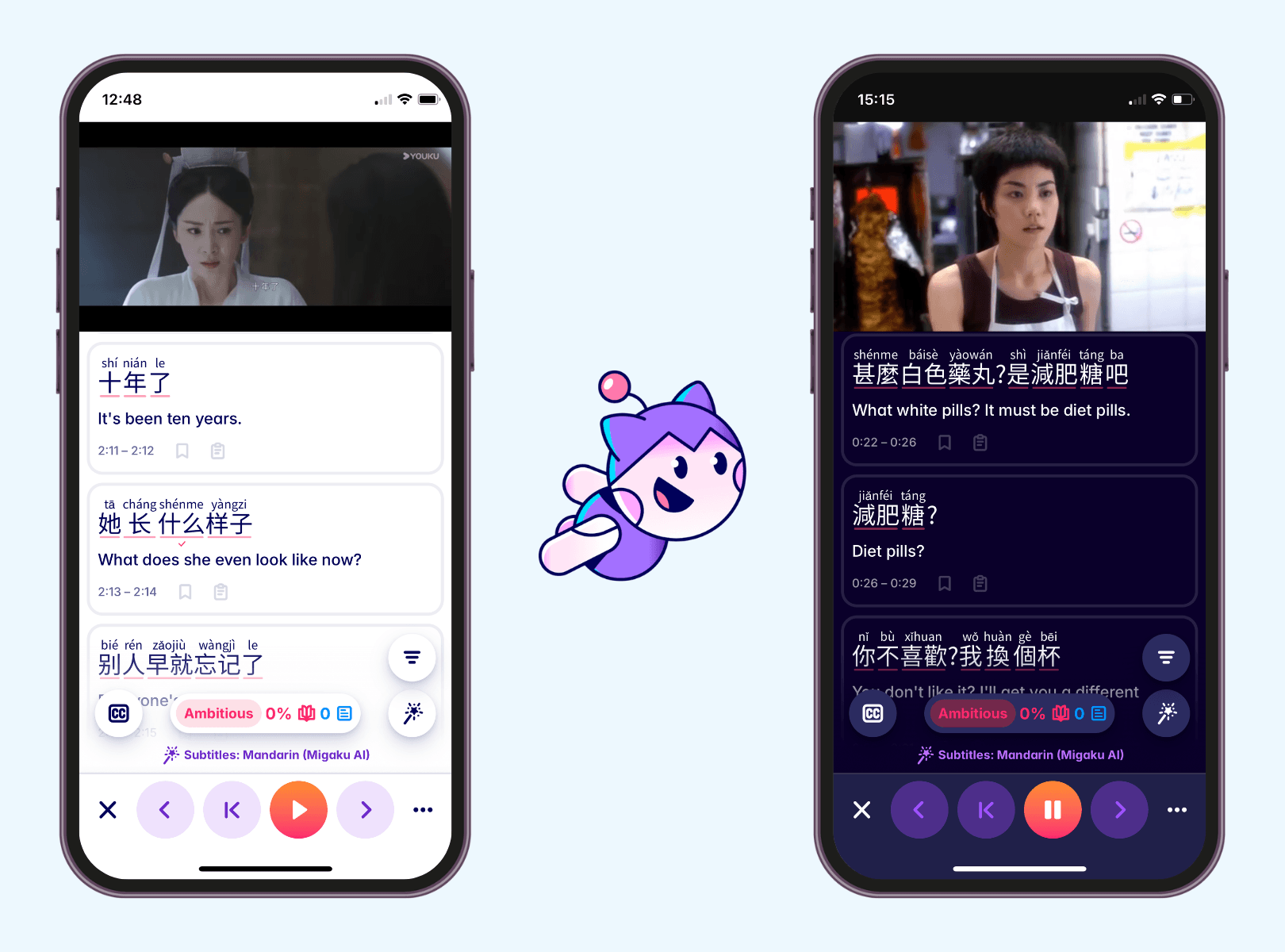
Be it for Cantonese or Mandarin, Migaku app can help you make full use of media resources to learn Chinese and generate Simplified or Traditional Chinese subtitles even when the video does not feature any, based on the detected speakers' language. For example, Migaku app can generate subtitles for the cut from *The Double* (a mainland Chinese drama), and the cut from *Chungking Express* (a Hong Kong movie). You can also click the words or sentences to add them to your flashcard collections and review them later.
1. Switch on YouTube and search for Chinese videos with the app
2. Click "Watch with Migaku", and the magic wand at the lower right corner to generate Chinese subtitles
3. Click on the new words or sentences in each subtitle and generate flashcards!
---
## What are the differences between Mandarin and Cantonese learning curves?
To be honest, both are Category V languages (the hardest tier) for English speakers. They require serious commitment. But their challenges are distributed differently.
For Mandarin Chinese:
1. The initial hurdle: Tones and pronunciation. It’s a skill your ear isn’t trained for.
2. The long grind: Characters, characters, characters. You’ll need to learn thousands.
3. The silver lining: Grammar is relatively simple — no verb conjugations, tenses, or gendered nouns. Once you get the basic sentence structure, you can build quickly. Resources are also everywhere, from Duolingo to Media playing platforms like Migaku (It can help with subtitles and make absorbing characters and native content more efficient).
For Cantonese:
1. The initial hurdle: A more complex sound system (6 tones) and its pinyin combination is more complicated than standard Mandarin.
2. The long grind: All the challenges of characters (traditional ones, too!)
3. The silver lining: Immersion is incredibly rewarding in tight-knit communities.
My straightforward advice:
1. If you wish to communicate with more Chinese speakers, learn Mandarin, because most of the Cantonese speakers can speak Mandarin or at least understand Mandarin.
2. If you want to progress further, learn to listen to Cantonese and understand it.
3. (Optional) The end goal? - Master both languages.
---
## Migaku can generate subtitles for both Simplified and Traditional Chinese characters
Be it for Cantonese or Mandarin, Migaku app can help you make full use of media resources to learn Chinese and generate Simplified or Traditional Chinese subtitles even when the video does not feature any, based on the detected speakers' language. For example, Migaku app can generate subtitles for the cut from *The Double* (a mainland Chinese drama), and the cut from *Chungking Express* (a Hong Kong movie). You can also click the words or sentences to add them to your flashcard collections and review them later.
1. Switch on YouTube and search for Chinese videos with the app
2. Click "Watch with Migaku", and the magic wand at the lower right corner to generate Chinese subtitles
3. Click on the new words or sentences in each subtitle and generate flashcards!
 ---
## FAQs
More or less, yes — but it's not guaranteed. Here's something I've learned: most younger Cantonese speakers understand Mandarin due to education and media exposure, and most people in the service sector can speak Mandarin, like overseas Cantonese restaurants.
He speaks both fluently. Born in Hong Kong, Cantonese is his native language. He learned Mandarin for his mainland China film career and public appearances. So far as public personas are concerned, you'll now see him switch effortlessly between both — though his Mandarin has a noticeable Cantonese accent.
There's no "best"—only "best for you." If you're aiming for global business or broad access, Mandarin's utility is unmatched. If your heart's in Hong Kong culture, family ties, or specific diaspora communities, you'll love diving into Cantonese. The upside? Whichever you choose opens a rich, fascinating world.
---
## The final word: which is right for you?
The truth is, you can’t make a bad choice here—only a different one. Both journeys offer immense rewards. From my own experience, understanding both languages opens up more career opportunities. If you aim to become a linguist, learning both definitely makes you more versatile in adapting to different situations! So, what’s your next move? Pick the language that aligns with your community, your content, and your curiosities. Then, enjoy the media that each language offers.
> If you consume media in Chinese, and you understand at least some of the messages and sentences within that media, you will make progress. _Period_.
Let's dive in!
---
## FAQs
More or less, yes — but it's not guaranteed. Here's something I've learned: most younger Cantonese speakers understand Mandarin due to education and media exposure, and most people in the service sector can speak Mandarin, like overseas Cantonese restaurants.
He speaks both fluently. Born in Hong Kong, Cantonese is his native language. He learned Mandarin for his mainland China film career and public appearances. So far as public personas are concerned, you'll now see him switch effortlessly between both — though his Mandarin has a noticeable Cantonese accent.
There's no "best"—only "best for you." If you're aiming for global business or broad access, Mandarin's utility is unmatched. If your heart's in Hong Kong culture, family ties, or specific diaspora communities, you'll love diving into Cantonese. The upside? Whichever you choose opens a rich, fascinating world.
---
## The final word: which is right for you?
The truth is, you can’t make a bad choice here—only a different one. Both journeys offer immense rewards. From my own experience, understanding both languages opens up more career opportunities. If you aim to become a linguist, learning both definitely makes you more versatile in adapting to different situations! So, what’s your next move? Pick the language that aligns with your community, your content, and your curiosities. Then, enjoy the media that each language offers.
> If you consume media in Chinese, and you understand at least some of the messages and sentences within that media, you will make progress. _Period_.
Let's dive in!