# Reading Chinese Books: Beginners to Advanced Chinese Reading Books Recommandations
> Confused about whether to start with the four classics or other novels? Let me introduce you to more Mandarin works that are friendly to language learning!
**URL:** https://migaku.com/blog/chinese/reading-chinese-books
**Last Updated:** 2026-01-29
**Tags:** culture, discussion, deepdive
---
Here’s something I’ve learned on my own Chinese journey: if you want to stop [studying the language](https://migaku.com/learn-chinese) and start living it, you need to find a story you can’t put down. Picking up a Chinese novel can feel like staring at a sheer cliff face. You know the characters, but the sentences are dense, the references are opaque, and the dictionary becomes your most thumbed-through companion. I’ve been there. But basically, the secret is not to start with the classics...
If you're ready to make the leap from learner to [reader](https://migaku.com/blog/chinese/chinese-reading-practice), you'll love the freedom and fluency that comes from turning those pages!
---
## Your first chapter: How to learn Chinese reading with graded readers
So far as beginning Chinese is concerned, the goal isn't literary mastery — it's momentum. You need reading material that builds confidence.
For any language learner, the best way to learn is often through a graded reader. These are books in Chinese specifically designed for learners of Chinese, with controlled vocabulary and grammar. Think of them as training wheels for your reading skills.
Here are three perfect reading resources to build that initial momentum and improve your Chinese:
1. [Mandarin Companion Chinese Graded Readers](https://mandarincompanion.com/products/). This series is a gold standard. They create original, compelling stories that feel like authentic Chinese content but are accessible. You can find graded Chinese readers at various levels, making your reading journey smooth. Start with their Breakthrough Level to learn to read with ease.
2. [Du Chinese](https://duchinese.net/). This is a fantastic reading app that offers a huge library of Chinese stories and articles, all fully graded. Each piece has pinyin, audio, and a built-in dictionary. It’s the ultimate tool for daily reading and listening and reading practice, helping you read the language naturally.
3. [Pleco](https://android.pleco.com/manual/310/reader.html). While primarily a dictionary, Pleco’s document reader is a game-changer. You can import any Chinese text (like a news article or a simple story) and tap on any word for an instant definition. It turns any Chinese content into a graded reader and is indispensable for reading Chinese novels later on.
---
## The translator’s bridge: A clever way for language learners to learn Mandarin
What if I told you there’s a secret weapon for language learning? Reading celebrated English-language books in Chinese translation is incredibly smart. You already know the plot, so you can focus on reading the Chinese language itself. This is a powerful way to learn vocabulary in a rich context.
Here are three fantastic translations to read in Chinese:
- 《》 (Harry Potter and the Philosopher’s Stone). The beloved story makes the reading experience enjoyable, and you’ll absorb natural dialogue and descriptions. If you're a fan of the Harry Potter series, there are many Chinese translation versions on the market!
- 《》 (The Kite Runner). The emotional, human story transcends language. Reading this Chinese text helps you see how complex feelings are expressed in Mandarin. This book has become trendy in recent years, and is highly recommended for high school students.
- 《》 (Pride and Prejudice). A classic translation that lets you appreciate sophisticated, formal writing Chinese patterns within a familiar narrative framework. Jane Austen's works are considered world classics in China. The language is simple and accessible.
> A touching and famous quote from The Kite Runner is:
。
*For you, a thousand times over.*
---
## Building fluency: Must-read intermediate Chinese novels
Once you’ve built confidence with graded readers and translated works for Chinese language, you’re ready for richer Chinese novels. At this stage, you’ll move from following a plot to appreciating an author’s voice. This is where extensive reading pays off to improve your reading speed and comprehension.
Here are three iconic popular Chinese novels that are rewarding for intermediate readers:
- 《》 (Fortress Besieged) by . This satirical novel is a masterpiece of marital wit in Mandarin Chinese. It’s a key text for anyone interested in reading deeper Chinese literature.
- 《》 (Ordinary World) by . This epic, beloved saga immerses you in 20th-century Chinese culture. The grounded language brings you face to face to the turbulent, struggling, yet resilient life of the people living in the countryside of China.
- 《》 (The Three-Body Problem) by . This sci-fi phenomenon uses clear, direct prose to explore huge ideas. It's one of the most interesting modern Chinese books to read for language learners. It was filmed into a TV series by Netflix in 2024. Liu has more sci-fi works that are very engaging if you're interested in this genre.
> Almost every Chinese reader knows this quote from Fortress Besieged:
。
*Marriage is like a fortress besieged; those who are outside want to get in, and those who are inside want to get out.*
---
## The advanced frontier: Challenging modern Chinese literature
For the advanced learner, the goal is to engage with Chinese literary works where language itself is the subject. You’re ready to tackle native Chinese speaker-level material and experience the depth of contemporary Chinese thought.
The Chinese author , is the only mainland Chinese novelist who has won the Nobel Prize in Literature so far. His works are satirical and representative of the deeply rooted Chinese culture, be it good or bad. The style features a blend of hallucinatory realism with Chinese contemporary history.
If you'd like to read something that reveals the core values and thoughts of Chinese society, here are three challenging but phenomenal works:
- 《》 (Red Sorghum). This is the novel that catapulted Mo Yan to fame. It’s a sprawling, visceral saga of a rural Shandong family across several tumultuous decades. The prose is raw and intoxicating, filled with vivid, often shocking imagery of love, war, and survival. It’s a masterclass in how to write Chinese with overwhelming sensory power.
- 《》 (Life and Death Are Wearing Me Out). This is Mo Yan’s most technically ambitious novel. It follows a landowner who is reincarnated over five times as a donkey, ox, pig, dog, and monkey, witnessing China's transformation. The narrative is a dizzying, darkly comic tour-de-force. The language shifts with each incarnation, offering a stunning variety of writing Chinese styles and perspectives within a single, epic framework.
- 《》 (Frog). This novel, which tackles China's one-child policy, is arguably his most structurally sophisticated. It blends letters, a play, and a straightforward narrative. The tone is more restrained but no less powerful, mixing personal tragedy with biting political allegory. It demonstrates Mo Yan's ability to use form as meaning, a challenging but rewarding concept for the advanced Chinese reader.
> 《》:
。
*The dead cannot return, but the living must go on. Whether you cry or smile, life goes on.*
---
## Your digital library: Essential Chinese reading resources
In other words, you don’t need a physical bookshelf. The Chinese digital ecosystem makes finding Chinese reading content easier than ever. Here are the top platforms:
- (WeChat reading). This is the leader. It’s a massive, Netflix-style library with seamless pop-up dictionary lookup powered by AI as well. It’s perfect for Chinese reading on the go and discovering popular Chinese and contemporary Chinese works.
- (Qidian Chinese web). This is the home of the Chinese webnovel. If you love endless, addictive serials, this platform offers vast reading material with contemporary, dialog-heavy language.
- (Douban reading). Associated with the intellectual review site, this platform caters to a more literary crowd, ideal for discovering new Chinese authors and short stories.
---
## How to read Chinese (Without giving up)
You may know that there are four classic novels in China: , , , . BUT! That's not what you should challenge, even as an advanced reader. The point is - your approach matters more than your vocabulary size. Don't start with the classics that even Chinese native speakers find hard to read!
1. First, use the right tools. Read with Pleco or on Du Chinese to make lookups instant.
2. Second, read for gist, not perfection. Your first goal is to follow the story’s flow.
3. Third, make it a habit. Even 15 minutes of daily reading is more effective than one long, frustrating session.
4. Finally, mix media. Pair your reading time with a related Chinese podcast or Chinese TV show. This listening and reading combo reinforces learning powerfully. Many classics have their Chinese dramas and movies. If those are still boring to you, go to Bilibili and find its Chinese interpretation video (For example, [many Chinese "YouTubers" made videos to explain details in Dream of the Red Chamber](https://www.bilibili.com/video/BV1RQvDBpEaw/?spm_id_from=333.337.search-card.all.click&vd_source=8f65c1c1b7018c90142faaa43d5e6e60)).
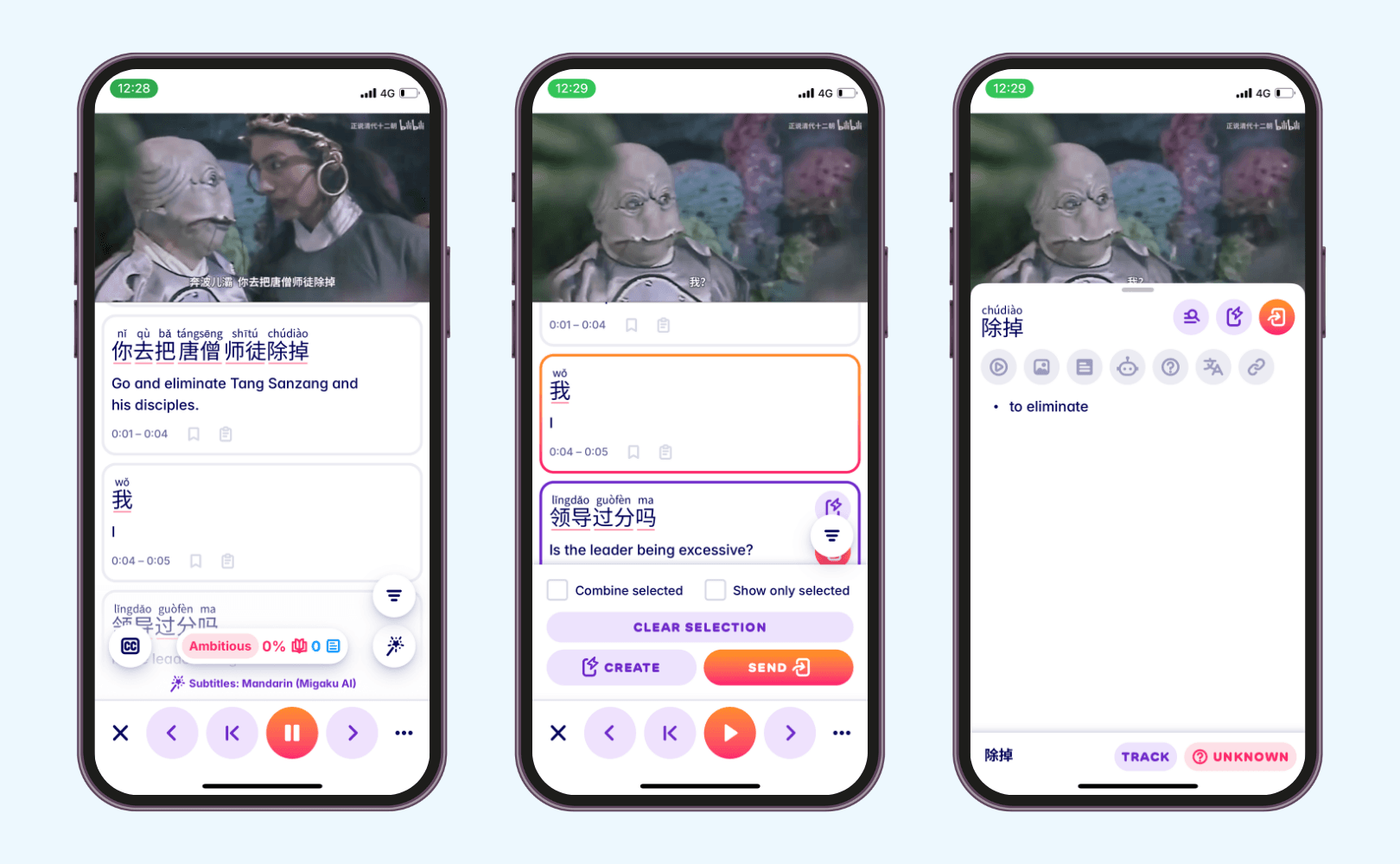
Anyway, if you want to make immersion reading more practical, Migaku's tools let you turn any Chinese content into a learning resource with instant lookups and automatic flashcard creation. There's a 10-day free trial if you want to check it out.
 ---
## FAQs
[Duolingo is a weak tool for learning to read Chinese.](https://migaku.com/blog/chinese/duolingo-chinese-review) While it can help with basic character recognition and simple sentences, it's heavily focused on isolated, gamified translation. To truly learn to read, you need extensive, connected text. Graded readers (Mandarin Companion, Du Chinese) and actual books are vastly more effective for building real reading skills.
The Four Great Classic Novels of Chinese literature are:《》 (Romance of the Three Kingdoms): Historical epic of war and strategy after the Han dynasty.《》 (Water Margin): Saga of 108 outlaws and rebels during the Song dynasty. 《》 (Journey to the West): Mythological adventure of a monk and his disciples traveling to India. 《》 (Dream of the Red Chamber): Profound family tragedy exploring love, society, and fate.
Wuxia (Martial heroes) is grounded in historical China. Its heroes are skilled martial artists bound by codes of honor, using swords and Qinggong (Lightness skill). Xianxia (Immortal heroes) is high fantasy. Its heroes cultivate spiritual energy to achieve god-like immortality, wield magic, and battle demons across celestial realms.
---
## What if I still feel daunted to read Chinese books
There are multiple ways to approach this. If you have a book that is beyond your level, you can watch dramas, movies, or even chapter explanations before reading the book. For classics, there are usually easier versions, like (Teenager version). Don't forget that you don't have to read if you're not into books. Consuming other relevant media is an efficient intake as well!
> If you consume media in Chinese, and you understand at least some of the messages and sentences within that media, you will make progress. _Period_.
Now, go find your next story.
---
## FAQs
[Duolingo is a weak tool for learning to read Chinese.](https://migaku.com/blog/chinese/duolingo-chinese-review) While it can help with basic character recognition and simple sentences, it's heavily focused on isolated, gamified translation. To truly learn to read, you need extensive, connected text. Graded readers (Mandarin Companion, Du Chinese) and actual books are vastly more effective for building real reading skills.
The Four Great Classic Novels of Chinese literature are:《》 (Romance of the Three Kingdoms): Historical epic of war and strategy after the Han dynasty.《》 (Water Margin): Saga of 108 outlaws and rebels during the Song dynasty. 《》 (Journey to the West): Mythological adventure of a monk and his disciples traveling to India. 《》 (Dream of the Red Chamber): Profound family tragedy exploring love, society, and fate.
Wuxia (Martial heroes) is grounded in historical China. Its heroes are skilled martial artists bound by codes of honor, using swords and Qinggong (Lightness skill). Xianxia (Immortal heroes) is high fantasy. Its heroes cultivate spiritual energy to achieve god-like immortality, wield magic, and battle demons across celestial realms.
---
## What if I still feel daunted to read Chinese books
There are multiple ways to approach this. If you have a book that is beyond your level, you can watch dramas, movies, or even chapter explanations before reading the book. For classics, there are usually easier versions, like (Teenager version). Don't forget that you don't have to read if you're not into books. Consuming other relevant media is an efficient intake as well!
> If you consume media in Chinese, and you understand at least some of the messages and sentences within that media, you will make progress. _Period_.
Now, go find your next story.