# Reading Chinese News: Comprehensive Guide to Reading News Articles From China
> There is more to Chinese news than just politics. Here is how to engage in public discourse in China via portals like China Daily.
**URL:** https://migaku.com/blog/chinese/reading-chinese-news
**Last Updated:** 2026-01-30
**Tags:** resources, culture, discussion
---
Want to understand Chinese news not as a curious person, but as a [Chinese learner](https://migaku.com/learn-chinese)? Want to dig into the Chinese culture with its original writings and journalists' perspectives? Here's something I've learned after years of wrestling with headlines: news isn't the final boss of Chinese language learning; it's actually the most exciting playground. From the news, [readers](https://migaku.com/blog/chinese/chinese-reading-practice) get a glimpse of what discourse in China is like and what trendy topics concern people. Let's ditch the textbook anxiety and talk about how to truly read Chinese news.
---
## Why Chinese news feels so hard to read
So, you open a news app from China and are immediately met with a headline like (The economic recovery is showing a stable and improving trend). Your eyes glaze over. It's not just the Chinese characters — it’s the sheer density of concepts you don't encounter in daily chit-chat.
The truth is, news language in China is a dialect of its own.
- It’s formal,
- packed with set phrases,
- and assumes a base level of cultural and political literacy, especially when covering politics or Beijing affairs.
This is where most learners quit. They feel like they need to understand every single word, every historical reference in a China news piece. And even if they can understand the text, the news piece full of jargon and set phrases is just too boring to read.
But here’s the upside to this struggle: cracking this code doesn't just teach you language; it gives you a skeleton key to how modern Chinese society thinks and communicates formally. The downside? You can't approach a long article like a textbook chapter. You need a different tactic entirely.
---
## Your new best friend: The “anchor word” strategy for global news
Basically, stop trying to swallow the whole article.
> Your goal for the first month isn't comprehension — it's pattern recognition. Start by hunting for what I call "anchor words." These are the heavy, repetitive nouns and verbs that form the backbone of Chinese news discourse.
Scan any piece on global affairs or China's market, and you'll see them everywhere:
| Chinese | English |
| - | - |
| 发展 | Development |
| 改革 | Reform |
| 政策 | Policy |
| 加强 | To strengthen |
| 促进 | To promote |
| 实现 | To achieve |
| 建设 | Construction |
| 合作 | Cooperation |
| 市场 | Market |
| 企业 | Enterprise |
Don't get bogged down by the surrounding filler at first. Just collect these anchors. Make a list. See them pop up in different contexts—finance, sci-tech, even lifestyle coverage.
In other words, you're learning the Lego bricks before you try to build the castle. Once these 50-100 core words become familiar, entire sentences start to snap into focus. You'll see (The government will strengthen environmental protection) and realize you know all the key pieces. The rest—the specifics of how — is detail you can gradually absorb.
 ---
## Beyond politics: Finding your “in” in sport and lifestyle
If you’re the type of person whose eyes glaze over at (The Two Sessions), you'll love this: you don't have to start with hard politics. The Chinese news landscape is vast.
What if I told you that the sport, technology, and lifestyle sections are written in a noticeably more accessible style? They deal with global topics, use more concrete vocabulary, and often borrow direct English translations for modern concepts, making them a perfect portal for learners.
Let’s look at real examples.
A tech headline from ([The Paper](https://www.thepaper.cn/)) might read: (Apple releases new iPad, equipped with faster chip).
You see that? (Apple), (Release), (New model) — these are direct, simple terms. The borrowed brand name iPad and the technical but universal word (Chip) make it instantly more approachable than a piece on macroeconomic policy from Beijing.
Or, dive into entertainment trends on ([Sina Entertainment](https://ent.sina.com.cn/comos_index_sll.shtml?from=wap)): (Sci-fi film *Dune Part Two* sees big box office sales in China). Here, (Sci-fi film) is a straightforward genre tag, (Box office) is a key finance term you'll see everywhere, and (Sells well) is a great, versatile verb. The film title itself is a cultural anchor you already understand.
Starting here builds confidence and functional vocabulary without the formal rhetorical burden. You’re learning how to talk about the world in Chinese, not just Chinese politics. It’s a backdoor into the language that feels more like fun and less like homework.
---
## The shortcut everyone misses: Bilingual news sources & translation tools
This is a pro tip I wish I’d known earlier. Your first stop shouldn't be the deep end of (People's Daily Online). It should be outlets that publish the same story in both languages, like [China.org.cn](http://www.china.org.cn/node_9013868.shtml). More or less, use the English version as your training manual for the Chinese one.
1. Read the English article first. Get the gist.
2. Then tackle the Chinese version.
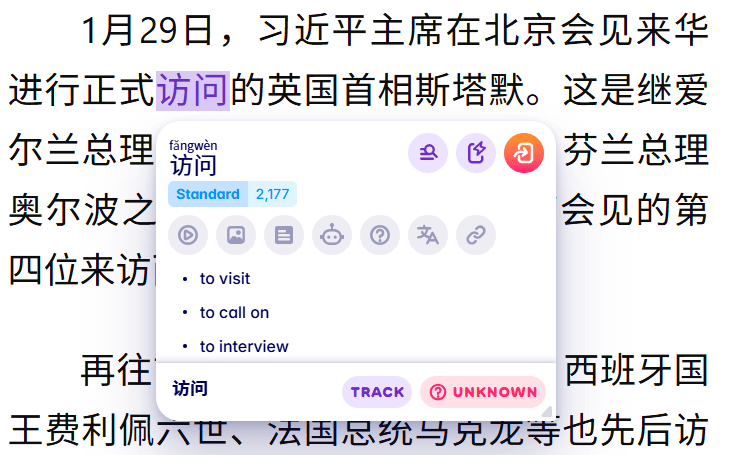
3. Use a pop-up dictionary to annotate as you go, but resist translating everything.
You’re no longer decoding mystery; you’re matching concepts. You'll see how "regional affairs" becomes . You’re learning translation equivalents in their natural habitat. This method teaches you how ideas are transposed, which is infinitely more valuable than memorizing [HSK lists](https://migaku.com/blog/chinese/hsk-vocabulary-lists).
---
## The real goal: From words to “frames” in comprehensive coverage
Okay, you’re collecting anchor words and using bilingual crutches. Great. But the magic happens when you start to see the "frames" — the standardized phrases that news outlets rely on across different levels of reporting, from regional to national.
For example, any report on a disaster will almost certainly include the frame:
- (After the accident occurred, the relevant departments quickly activated the emergency response mechanism).
- (To express strong condemnation towards...), often seen in coverage on overseas affairs.
- (Under the guidance of...), which you'll frequently encounter.
Spotting these isn't just about reading faster. It's about understanding the standardized narrative toolkit. You stop reading individual characters and start reading intentional blocks of meaning.
---
## Your comprehensive newsstand: 4 go-to portals for learners
Alright, so *where* do you actually go? Navigating China's media landscape can be a maze. Here’s a shortlist of authoritative sources I’ve found invaluable, each with a specific learner-friendly upside.
### [澎湃新闻 (The Paper) ](https://www.thepaper.cn/)– The modern mainstream hub
If you want to graduate to a primary Chinese news source, start here. , based in Shanghai, has a strong digital focus and covers a wide spectrum: politics, yes, but also fantastic sci-tech, finance, and art sections. Their headlines and leads (First paragraphs) tend to be slightly more direct. It’s a great platform to practice reading "real" news after getting your feet wet.
### [虎嗅网 (Huxiu)](https://www.huxiu.com/) – The tech & business pulse
Remember our "find your in" strategy? For tech and finance learners, is that "in." It’s a leading digital media outlet focused on technology, startups, and the internet economy. Articles are written for a professional, savvy audience but about inherently global topics: (AI), (Electric vehicles), (Social media). The vocabulary is modern and immensely practical.
### [南方周末 (Southern Weekly)](https://www.infzm.com/wap/#/) – The Long-form editorial benchmark
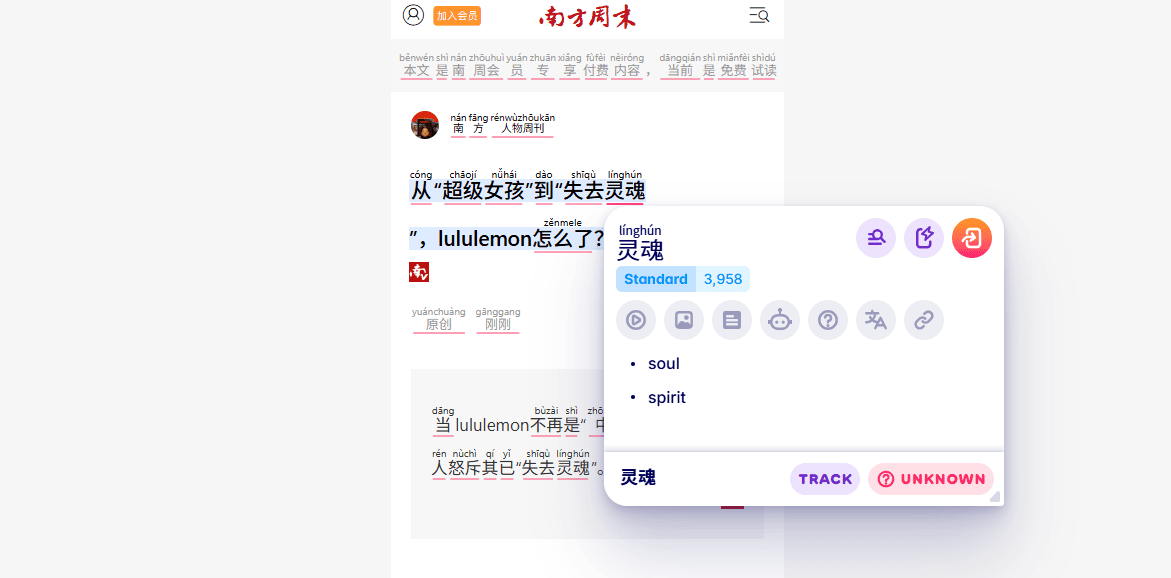
This one is for when you're feeling ambitious. is a prestigious weekly newspaper known for its investigative journalism and long-form narrative features. The language can be complex and literary. Why recommend it? Because the storytelling is compelling. If you find a feature on a topic you're passionate about, the narrative pull can help you push through linguistic barriers. It’s a goal to work toward — reading not just for information, but for the power of the writing itself. A recent trendy piece is: [从“超级女孩”到“失去灵魂”,lululemon怎么了?(From "Super Girl" to "Lost Soul", What Happened to Lululemon?)](https://www.infzm.com/wap/#/content/313744?source=133&source_1=998) Sounds interesting, right?
### [中国日报网 (China Daily)](https://www.chinadaily.com.cn/) – The bilingual workhorse
Let's be upfront about the perspective of China Daily: yes, China Daily is a state-owned news agency, and its English portal content has a specific angle. But for a language learner, its website is a uniquely practical tool. Its "Language Tips" section and its vast archive of bilingual news articles are a goldmine. You can often find the exact same story in both languages side-by-side. Use it strategically as a translation and pattern-matching gym.
---
## Don’t just bookmark: Use the apps and podcasts
Here’s the truth: you’re far more likely to read Chinese if the news lives on the same device as your social media. Installing the official apps turns passive intention into active habit. The interface becomes [an immersive practice](https://migaku.com/blog/chinese/chinese-immersion-learning) for reading and listening. Here are three with excellent apps that put everything we've discussed in your pocket.
### 澎湃新闻 (The Paper) App – Your daily driver
The app is sleek, fast, and perfectly embodies the "modern mainstream" vibe. Why it’s great for learners: its clean categorization lets you go straight to (Sci-tech) or (Culture & Lifestyle) sections. You can save articles for offline reading, perfect for a focused session. The push notifications for breaking news are like daily mini-flashcards.
### 新华社 (Xinhua News Agency) App – The wire service direct
This is for when you're ready to engage with the core narrative voice. is China’s official state news agency — the source where much formal politics and economic reporting originates. Their app is a powerhouse. This is the pure, unfiltered source of the "frames" and "anchor words." Using the app, you can follow specific (Special Topics) or watch short news videos with Chinese captions. It’s the most direct line to the formal dialect.
### CGTN App – For global news & podcasts
If you want a multilingual platform focusing on China's perspective on world news, CGTN's app is comprehensive. It offers coverage in multiple languages, but its Chinese-language podcasts and video reports are incredibly valuable. The audio content is fantastic for training your ear to the rhythm and pronunciation of news broadcast Chinese, complementing your reading.
---
## How to learn from a Chinese news article (A practical plan)
Let's get tactical. Here’s a simple, sustainable routine.
> What you’ll need: one short article (300 words max), a notebook, and 20 minutes.
1. **Skim for Gist & Anchor Words**: Don’t touch a dictionary. Just scan from a portal like GMW.cn or Youth.cn. Circle every word you do recognize, especially those heavy anchor nouns and verbs. Can you guess the absolute core topic?
2. **Decode One Key Sentence**: Pick the sentence that seems most central to the headline. Now, translate it fully. Look up every unknown word in that sentence. This focused, deep work on one unit of thought is worth more than skimming fifty.
3. **Harvest, Don't Hoard**: You’ll have a list of new words. Be ruthless. Only add 3-5 to your review pile — the ones that felt most central or that you’ve seen before. Ignore the super-specific jargon. Your goal is building a news foundation, not a specialist glossary.
4. **Re-read Tomorrow**: Come back to the same article 24 hours later. You’ll be shocked at how much clearer it is. This repetition cements the frames and vocabulary in context.
Anyway, if you want to make this whole process smoother, Migaku's browser extension and app let you look up Chinese words instantly while reading anything online. Works on news sites, web novels, wherever. You can save words directly to your study decks without breaking your reading flow. There's a 10-day free trial if you want to check it out.
---
## Beyond politics: Finding your “in” in sport and lifestyle
If you’re the type of person whose eyes glaze over at (The Two Sessions), you'll love this: you don't have to start with hard politics. The Chinese news landscape is vast.
What if I told you that the sport, technology, and lifestyle sections are written in a noticeably more accessible style? They deal with global topics, use more concrete vocabulary, and often borrow direct English translations for modern concepts, making them a perfect portal for learners.
Let’s look at real examples.
A tech headline from ([The Paper](https://www.thepaper.cn/)) might read: (Apple releases new iPad, equipped with faster chip).
You see that? (Apple), (Release), (New model) — these are direct, simple terms. The borrowed brand name iPad and the technical but universal word (Chip) make it instantly more approachable than a piece on macroeconomic policy from Beijing.
Or, dive into entertainment trends on ([Sina Entertainment](https://ent.sina.com.cn/comos_index_sll.shtml?from=wap)): (Sci-fi film *Dune Part Two* sees big box office sales in China). Here, (Sci-fi film) is a straightforward genre tag, (Box office) is a key finance term you'll see everywhere, and (Sells well) is a great, versatile verb. The film title itself is a cultural anchor you already understand.
Starting here builds confidence and functional vocabulary without the formal rhetorical burden. You’re learning how to talk about the world in Chinese, not just Chinese politics. It’s a backdoor into the language that feels more like fun and less like homework.
---
## The shortcut everyone misses: Bilingual news sources & translation tools
This is a pro tip I wish I’d known earlier. Your first stop shouldn't be the deep end of (People's Daily Online). It should be outlets that publish the same story in both languages, like [China.org.cn](http://www.china.org.cn/node_9013868.shtml). More or less, use the English version as your training manual for the Chinese one.
1. Read the English article first. Get the gist.
2. Then tackle the Chinese version.
3. Use a pop-up dictionary to annotate as you go, but resist translating everything.
You’re no longer decoding mystery; you’re matching concepts. You'll see how "regional affairs" becomes . You’re learning translation equivalents in their natural habitat. This method teaches you how ideas are transposed, which is infinitely more valuable than memorizing [HSK lists](https://migaku.com/blog/chinese/hsk-vocabulary-lists).
---
## The real goal: From words to “frames” in comprehensive coverage
Okay, you’re collecting anchor words and using bilingual crutches. Great. But the magic happens when you start to see the "frames" — the standardized phrases that news outlets rely on across different levels of reporting, from regional to national.
For example, any report on a disaster will almost certainly include the frame:
- (After the accident occurred, the relevant departments quickly activated the emergency response mechanism).
- (To express strong condemnation towards...), often seen in coverage on overseas affairs.
- (Under the guidance of...), which you'll frequently encounter.
Spotting these isn't just about reading faster. It's about understanding the standardized narrative toolkit. You stop reading individual characters and start reading intentional blocks of meaning.
---
## Your comprehensive newsstand: 4 go-to portals for learners
Alright, so *where* do you actually go? Navigating China's media landscape can be a maze. Here’s a shortlist of authoritative sources I’ve found invaluable, each with a specific learner-friendly upside.
### [澎湃新闻 (The Paper) ](https://www.thepaper.cn/)– The modern mainstream hub
If you want to graduate to a primary Chinese news source, start here. , based in Shanghai, has a strong digital focus and covers a wide spectrum: politics, yes, but also fantastic sci-tech, finance, and art sections. Their headlines and leads (First paragraphs) tend to be slightly more direct. It’s a great platform to practice reading "real" news after getting your feet wet.
### [虎嗅网 (Huxiu)](https://www.huxiu.com/) – The tech & business pulse
Remember our "find your in" strategy? For tech and finance learners, is that "in." It’s a leading digital media outlet focused on technology, startups, and the internet economy. Articles are written for a professional, savvy audience but about inherently global topics: (AI), (Electric vehicles), (Social media). The vocabulary is modern and immensely practical.
### [南方周末 (Southern Weekly)](https://www.infzm.com/wap/#/) – The Long-form editorial benchmark
This one is for when you're feeling ambitious. is a prestigious weekly newspaper known for its investigative journalism and long-form narrative features. The language can be complex and literary. Why recommend it? Because the storytelling is compelling. If you find a feature on a topic you're passionate about, the narrative pull can help you push through linguistic barriers. It’s a goal to work toward — reading not just for information, but for the power of the writing itself. A recent trendy piece is: [从“超级女孩”到“失去灵魂”,lululemon怎么了?(From "Super Girl" to "Lost Soul", What Happened to Lululemon?)](https://www.infzm.com/wap/#/content/313744?source=133&source_1=998) Sounds interesting, right?
### [中国日报网 (China Daily)](https://www.chinadaily.com.cn/) – The bilingual workhorse
Let's be upfront about the perspective of China Daily: yes, China Daily is a state-owned news agency, and its English portal content has a specific angle. But for a language learner, its website is a uniquely practical tool. Its "Language Tips" section and its vast archive of bilingual news articles are a goldmine. You can often find the exact same story in both languages side-by-side. Use it strategically as a translation and pattern-matching gym.
---
## Don’t just bookmark: Use the apps and podcasts
Here’s the truth: you’re far more likely to read Chinese if the news lives on the same device as your social media. Installing the official apps turns passive intention into active habit. The interface becomes [an immersive practice](https://migaku.com/blog/chinese/chinese-immersion-learning) for reading and listening. Here are three with excellent apps that put everything we've discussed in your pocket.
### 澎湃新闻 (The Paper) App – Your daily driver
The app is sleek, fast, and perfectly embodies the "modern mainstream" vibe. Why it’s great for learners: its clean categorization lets you go straight to (Sci-tech) or (Culture & Lifestyle) sections. You can save articles for offline reading, perfect for a focused session. The push notifications for breaking news are like daily mini-flashcards.
### 新华社 (Xinhua News Agency) App – The wire service direct
This is for when you're ready to engage with the core narrative voice. is China’s official state news agency — the source where much formal politics and economic reporting originates. Their app is a powerhouse. This is the pure, unfiltered source of the "frames" and "anchor words." Using the app, you can follow specific (Special Topics) or watch short news videos with Chinese captions. It’s the most direct line to the formal dialect.
### CGTN App – For global news & podcasts
If you want a multilingual platform focusing on China's perspective on world news, CGTN's app is comprehensive. It offers coverage in multiple languages, but its Chinese-language podcasts and video reports are incredibly valuable. The audio content is fantastic for training your ear to the rhythm and pronunciation of news broadcast Chinese, complementing your reading.
---
## How to learn from a Chinese news article (A practical plan)
Let's get tactical. Here’s a simple, sustainable routine.
> What you’ll need: one short article (300 words max), a notebook, and 20 minutes.
1. **Skim for Gist & Anchor Words**: Don’t touch a dictionary. Just scan from a portal like GMW.cn or Youth.cn. Circle every word you do recognize, especially those heavy anchor nouns and verbs. Can you guess the absolute core topic?
2. **Decode One Key Sentence**: Pick the sentence that seems most central to the headline. Now, translate it fully. Look up every unknown word in that sentence. This focused, deep work on one unit of thought is worth more than skimming fifty.
3. **Harvest, Don't Hoard**: You’ll have a list of new words. Be ruthless. Only add 3-5 to your review pile — the ones that felt most central or that you’ve seen before. Ignore the super-specific jargon. Your goal is building a news foundation, not a specialist glossary.
4. **Re-read Tomorrow**: Come back to the same article 24 hours later. You’ll be shocked at how much clearer it is. This repetition cements the frames and vocabulary in context.
Anyway, if you want to make this whole process smoother, Migaku's browser extension and app let you look up Chinese words instantly while reading anything online. Works on news sites, web novels, wherever. You can save words directly to your study decks without breaking your reading flow. There's a 10-day free trial if you want to check it out.
 ---
## FAQs
Read Chinese newspapers by starting with accessible topics like tech or lifestyle. Use bilingual sources to match English and Chinese articles. Focus on learning repetitive "anchor words" and set "frames." Aim for consistent, short daily sessions instead of infrequent long ones. Use apps for integrated practice.
Most major Chinese news websites have an English-language portal or section. Look for links labeled "English," "EN," or a globe icon. Sites like China Daily and CGTN offer parallel English content. Use your browser's translate feature or extension like Migaku for sites without an official English version.
---
## Why should you read Chinese news as a language learner
Think of the news not as a test, but as a window into Chinese culture and perspective on global events. Each article you decipher extends your world. You’re not just learning words; you’re learning what matters, how it’s discussed in Beijing, Shanghai, or Taipei, and the rhythm of public dialogue. This fluency turns media consumption from a passive chore into your most active teacher for language learning.
> If you consume media in Chinese, and you understand at least some of the messages and sentences within that media, you will make progress. _Period_.
Keep that window open, and be a truly informed reader.
---
## FAQs
Read Chinese newspapers by starting with accessible topics like tech or lifestyle. Use bilingual sources to match English and Chinese articles. Focus on learning repetitive "anchor words" and set "frames." Aim for consistent, short daily sessions instead of infrequent long ones. Use apps for integrated practice.
Most major Chinese news websites have an English-language portal or section. Look for links labeled "English," "EN," or a globe icon. Sites like China Daily and CGTN offer parallel English content. Use your browser's translate feature or extension like Migaku for sites without an official English version.
---
## Why should you read Chinese news as a language learner
Think of the news not as a test, but as a window into Chinese culture and perspective on global events. Each article you decipher extends your world. You’re not just learning words; you’re learning what matters, how it’s discussed in Beijing, Shanghai, or Taipei, and the rhythm of public dialogue. This fluency turns media consumption from a passive chore into your most active teacher for language learning.
> If you consume media in Chinese, and you understand at least some of the messages and sentences within that media, you will make progress. _Period_.
Keep that window open, and be a truly informed reader.