# How to Speak Japanese: Real Guide to Speak Japanese Naturally
> Learn how to speak Japanese with actionable steps: master kana, practice pronunciation, and start conversations fast. No fluff, just what works.
**URL:** https://migaku.com/blog/japanese/how-to-speak-japanese
**Last Updated:** 2025-12-20
**Tags:** fundamentals, vocabulary, phrases, grammar
---
As a [Japanese learner](https://migaku.com/learn-japanese), you hope to not just read texts, not just understand anime without subtitles, but actually open your mouth and have conversations with people. Good news: you can absolutely do this. This guide walks you through exactly how to start speaking Japanese from day one, what to prioritize, and what mistakes waste your time.
---
## Is learning how to speak Japanese hard?
Honestly? Japanese is challenging for English speakers. The Foreign Service Institute rates it as a Category IV language, meaning it takes about 2,200 hours of study to reach professional proficiency. That's roughly 2-3 years of serious daily study.
But here's the thing: conversational ability comes way before professional proficiency. You can have basic conversations about daily life after 6-12 months of consistent practice. You can watch anime and understand most of it after about a year. You can live and work in Japan with intermediate Japanese after 2 years.
The difficulty comes from:
- Completely different grammar structure
- Three writing systems to learn
- Pitch accent and new sounds
- Different cultural context for conversations
But the Japanese language also has advantages:
- Very regular pronunciation
- No articles (a/the)
- No plural forms for most words
- Predictable verb conjugation patterns
- Tons of learning resources available
Whether Japanese feels hard depends mostly on your approach. If you try to memorize everything before using it, you'll burn out. If you jump into using the language messily from day one, you'll progress steadily and actually enjoy the process.
---
## Learn hiragana and katakana first as a beginner
Before you speak a single word, you need to learn the Japanese writing systems called hiragana (ひらがな) and katakana (カタカナ). These are called kana, and they're phonetic alphabets with 46 basic characters each.
Why does this matter for speaking? Because Japanese pronunciation is incredibly regular once you know these sounds. Unlike English where "ough" can sound like "off," "oo," or "ow," Japanese kana always make the same sounds. Hiragana (ひらがな) represents native Japanese words, while katakana (カタカナ) represents foreign loanwords.
You can memorize both alphabets in about a week using spaced repetition. Write them out, sure, but focus on recognizing and pronouncing them. Apps like Anki work great for this. Once you know kana, you can actually read pronunciation guides and practice speaking real words instead of relying on romanization (English letters), which will mess up your pronunciation long-term.
Quick example: the word for "hello" is こんにちは. If you only see "konnichiwa" in English letters, you might pronounce it wrong. But if you learn that こ = "ko," ん = "n," に = "ni," ち = "chi," and は = "wa" (when used as a particle), you'll say it correctly from the start.
---
## Basic Japanese pronunciation works in your favor
Good news: Japanese pronunciation is way easier than you think. The Japanese language has only five vowel sounds compared to English's dozen-plus vowel variations.
The five vowels are:
- あ (a) sounds like "ah" in "father"
- い (i) sounds like "ee" in "see"
- う (u) sounds like "oo" in "food"
- え (e) sounds like "eh" in "bed"
- お (o) sounds like "oh" in "boat"
These vowels never change. They sound the same in every word, every time. Consonants attach to these vowels to make syllables: ka (か), ki (き), ku (く), ke (け), ko (こ). That's it.
The tricky part? Japanese has pitch accent, which means syllables go up or down in pitch. The word hashi (はし) can mean "bridge" or "chopsticks" depending on which syllable you stress. But honestly, native speakers will understand you from context even if your pitch is off. Focus on getting the basic sounds right first.
One common mistake: English speakers tend to add extra vowel sounds where they don't exist. The word desu (です), which means "is/am/are," should sound like "dess" (the u is almost silent), not "dess-oo." Listen to native speakers and mimic exactly what you hear.
---
## You need some kanji and vocabulary before speaking the Japanese language
Okay, let's talk about , the Chinese characters used in Japanese writing. Yes, there are over 2,000 common ones. No, you don't need to master them all before you start speaking.
Here's what you actually need: recognize common kanji when you see them in learning materials, and build a vocabulary of spoken words. When you're having a conversation, nobody cares if you can write (meaning "to eat") perfectly. They care if you can say "taberu" and use it correctly in a sentence.
Start with the most common 100-200 words. Things like:
| Japanese Words | Pronunciation | English Translations |
| - | - | - |
| ありがとう | arigatou | Thank you |
| すみません | sumimasen | Excuse me/sorry |
| はい | hai | Yes |
| いいえ | iie | No |
| おいしい | oishii | Delicious |
| たべる | taberu | To eat |
| のむ | nomu | To drink |
Learn these as spoken words first. See the kanji, sure, but prioritize hearing them and saying them out loud. Use spaced repetition flashcards with audio from native speakers.
As you progress, you'll naturally pick up more kanji because you'll see them repeatedly in context. But trying to memorize 2,000 characters before speaking is a massive waste of time.
---
## Grammar basics you need for speaking
[Japanese grammar ](https://migaku.com/blog/japanese/japanese-sentence-structure)feels backwards if you're coming from English. The verb goes at the end of the sentence. Instead of "I eat sushi," you say "I sushi eat" ().
For speaking, you need to understand a few core patterns:
**Particle system**: Little words like wa (は), ga (が), wo (を), ni (に), and de (で) tell you what role each word plays in the sentence. Wa marks the topic, wo marks the object, ni marks direction or time. Get comfortable with these because they're in every sentence.
**Verb conjugation**: Japanese verbs change based on tense and politeness level. is the dictionary form meaning "to eat." is the polite present tense. is past tense. You need to learn these patterns, but the good news is they're very regular.
**Politeness levels**: Japanese has casual and polite forms. With strangers, bosses, or customers, use polite forms (desu/masu style). With friends, use casual forms. Start with polite forms to be safe.
Don't try to master every grammar point before speaking. Learn one pattern, practice it in sentences, then move to the next. You'll make mistakes. That's fine. Native speakers make mistakes too.
---
## Immersion through listening before starting to speak
Here's where most learners mess up: they study for months without actually hearing Japanese spoken at natural speed. Then they try to have a conversation and realize they can't understand anything.
You need to immerse yourself in listening from day one. Not passive background noise, but active listening where you're trying to understand.
**Beginner resources:**
- Japanese podcasts for learners (spoken slowly with clear pronunciation)
- Children's shows in Japanese (simple vocabulary, clear speaking)
- YouTube channels teaching Japanese with Japanese audio
**Intermediate resources:**
- Anime with Japanese subtitles (not English)
- Japanese YouTube channels about topics you enjoy
- Japanese podcasts for native speakers at 0.75x speed
The goal is to train your ear to recognize sounds, words, and sentence patterns at natural speed. When you hear ありがとうございます 500 times, you'll start saying it naturally without thinking about each syllable.
Pretty cool thing about immersion: you'll pick up natural rhythm and intonation that textbooks can't teach. You'll learn how real people actually talk, including filler words, casual contractions, and conversational patterns.
---
## Speaking practice with real humans (and AI)
You can study forever, but if you never actually speak Japanese out loud with another person, you won't get fluent. Speaking is a separate skill from listening or reading.
Here are some options for speaking practice:
**Language exchange partners**: Find Japanese learners who want to practice English. You help them, they help you. Apps like HelloTalk or Tandem connect you with partners for free. Expect some awkward conversations at first. That's normal.
**Online tutors**: Sites like iTalki let you book 30-60 minute sessions with native Japanese tutors for $5-80. Having a native speaker correct your pronunciation and grammar in real-time is incredibly valuable. Book at least one session per week if you're serious.
**AI conversation tools**: ChatGPT and similar AI tools can hold basic conversations in Japanese, correct your mistakes, and explain grammar points. They're available 24/7 and don't judge you for mistakes. Use them for daily practice between sessions with real humans.
**Shadowing**: Play audio from a native speaker and repeat exactly what they say, matching their speed and intonation. This builds muscle memory for Japanese sounds and rhythm.
Start speaking from week one, even if you only know 20 words. Say those 20 words out loud every day. Record yourself and compare to native speakers. It feels weird at first, but this is how you improve.
---
## Potential strategy to study speaking Japanese on your own
This is totally possible. Thousands of people reach conversational fluency through self-study. Here's a realistic roadmap:
**Months 1-2**: Learn hiragana and katakana completely. Start basic vocabulary (200-300 words). Learn core grammar patterns (present/past tense, basic particles). Listen to beginner content 30 minutes daily. Speak out loud, even if just repeating phrases.
**Months 3-6**: Expand vocabulary to 1,000+ words using spaced repetition. Study intermediate grammar. Start reading simple manga or children's books. Watch shows in Japanese with Japanese subtitles. Find a language partner or tutor for weekly conversation practice.
**Months 7-12**: Push vocabulary to 2,000+ words. Consume native content (anime, YouTube, podcasts) for 1-2 hours daily. Have conversations 2-3 times per week minimum. Start thinking in Japanese for simple thoughts.
**Year 2+**: Focus on output. Speak as much as possible. Read novels. Watch shows without subtitles. Take the JLPT N3 or N2 exam for external validation if you want.
The key is consistency. Thirty minutes every single day beats 3.5 hours once a week. Your brain needs regular exposure to build the neural pathways for a new language.
---
## Common mistakes that kill your progress
**Mistake 1: Spending months on kanji before speaking**. You'll forget most of them anyway if you don't use them in context. Learn kanji as you encounter them in real content.
**Mistake 2: Only using romaji (English letters)**. This destroys your pronunciation. Switch to reading hiragana and katakana as fast as possible.
**Mistake 3: Studying grammar rules without speaking**. Grammar makes sense when you use it, not when you memorize tables. Apply each grammar point in actual sentences immediately.
**Mistake 4: Waiting until you're "ready" to speak**. You'll never feel ready. Start having simple conversations within your first month, even if you only know 50 words.
**Mistake 5: Ignoring listening practice**. You can't speak a language you can't hear. Listening and speaking develop together.
---
## Cultivating the habit of speaking in the long run
Learning to speak Japanese takes time. There's no magic app or secret method that gets you fluent in 30 days. Anyone promising that is lying.
What actually works is showing up every day and using the language. Read something in Japanese. Listen to a podcast. Say 20 sentences out loud. Have a 10-minute conversation. Repeat tomorrow.
Some days you'll feel like you're making huge progress. Other days you'll feel like you've forgotten everything. That's normal. Language learning isn't linear. Your brain is building complex neural pathways, and that takes time and repetition.
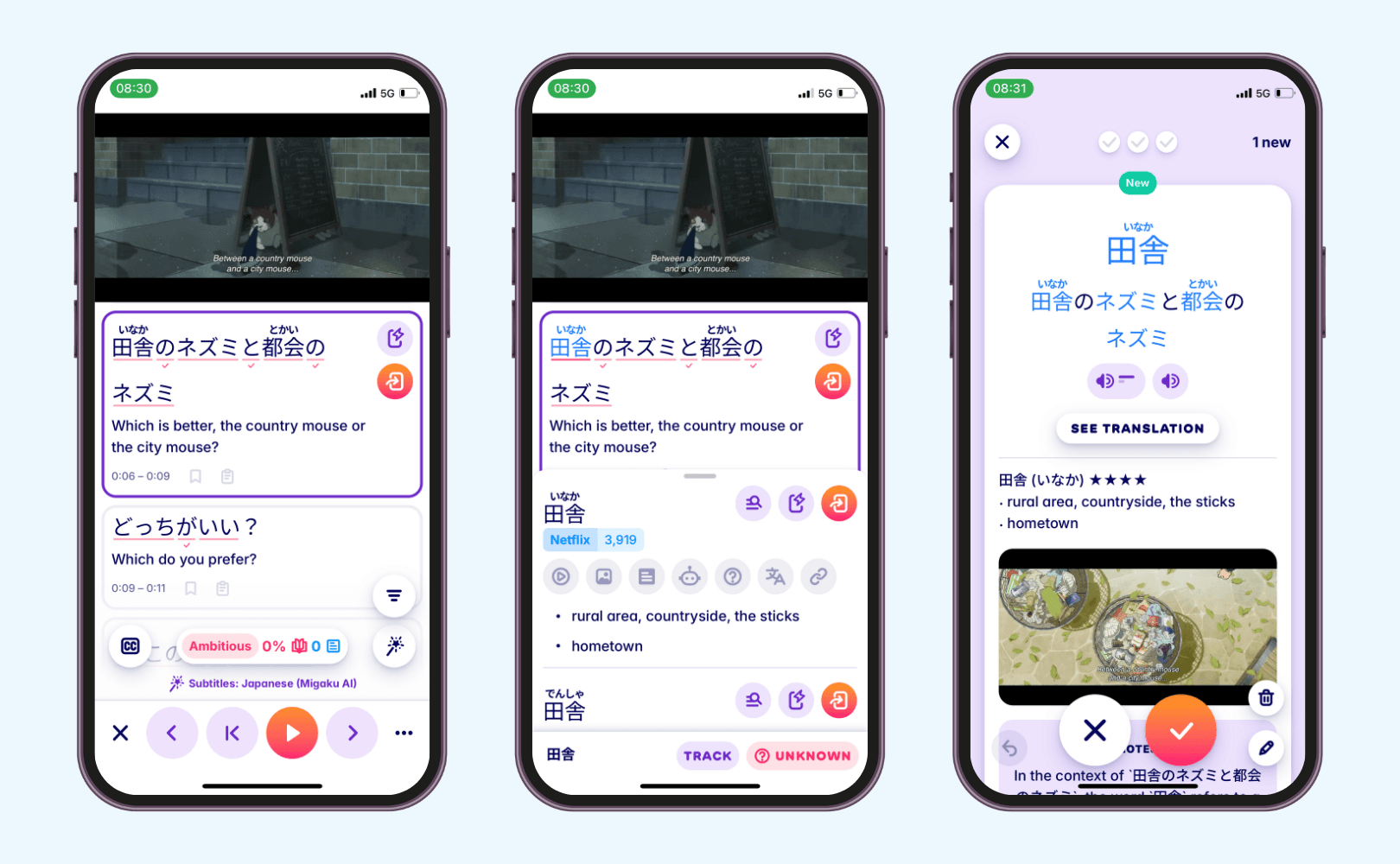
Anyway, if you want to speed up your learning with real Japanese content, Migaku's browser extension and app let you look up words instantly while watching Japanese shows or reading articles. You can create flashcards from sentences you encounter and actually learn vocabulary in context. There's a 10-day free trial if you want to check it out.
 ---
## FAQs
Japanese writing mixes kanji (Chinese characters) with hiragana and katakana (curvy phonetic scripts). Chinese uses only characters with no phonetic scripts. Japanese also has more "open" sounds while Chinese uses tones.
Say ごちそうさまでした, which means "thank you for the meal." It's polite and expected after finishing food.
Learn hiragana and katakana this week. Memorize 20 useful phrases. Find a language partner or tutor. Start having 5-minute conversations using just those phrases. Gradually add more vocabulary and grammar while continuing to speak regularly.
---
## Media is your most versatile friend to learn Japanese
Some people may assume that media like anime or movies are just for entertainment, but in fact, they can train your language ability as no textbook can do! A skilled learner knows how to use a video to train speaking through shadowing the adapting the brain to how the native speakers talk.
> If you consume media in Japanese, and you understand at least some of the messages and sentences within that media, you will make progress. _Period_.
Learn smartly!
---
## FAQs
Japanese writing mixes kanji (Chinese characters) with hiragana and katakana (curvy phonetic scripts). Chinese uses only characters with no phonetic scripts. Japanese also has more "open" sounds while Chinese uses tones.
Say ごちそうさまでした, which means "thank you for the meal." It's polite and expected after finishing food.
Learn hiragana and katakana this week. Memorize 20 useful phrases. Find a language partner or tutor. Start having 5-minute conversations using just those phrases. Gradually add more vocabulary and grammar while continuing to speak regularly.
---
## Media is your most versatile friend to learn Japanese
Some people may assume that media like anime or movies are just for entertainment, but in fact, they can train your language ability as no textbook can do! A skilled learner knows how to use a video to train speaking through shadowing the adapting the brain to how the native speakers talk.
> If you consume media in Japanese, and you understand at least some of the messages and sentences within that media, you will make progress. _Period_.
Learn smartly!