# Japanese Learning Resources for Self-Study: Vocab, Textbooks, and More
> Honest reviews of the best Japanese learning resources for self-study: WaniKani, Anki, and more. What actually works for kanji, grammar, and fluency.
**URL:** https://migaku.com/blog/japanese/japanese-learning-resources
**Last Updated:** 2025-12-19
**Tags:** fundamentals, vocabulary, phrases, grammar
---
Maybe you're into anime, planning a trip to Tokyo, or just fascinated by the language. Whatever your reason, you're probably overwhelmed by the sheer number of resources out there when trying to [learn Japanese](https://migaku.com/learn-japanese). I get it. Every app claims to be the "best way to learn Japanese," and every textbook promises fluency in months.
Here's the thing: not all Japanese learning resources are created equal. Some are genuinely amazing. Others are a complete waste of time. I've spent years testing these tools, and I'm going to break down what actually works for self-study. No fluff, just honest recommendations based on what helps you make real progress.
---
## Starting With the basics: Learn Japanese hiragana and katakana
Before you dive into anything else, you need to master the two basic Japanese writing systems. Hiragana (ひらがな) is used for native Japanese words and grammatical elements, while katakana (カタカナ) handles foreign loanwords and emphasis.
Good news: these are the easiest part of learning Japanese. Each system has 46 basic characters, and you can memorize them in a week or two with consistent practice.
**[Tofugu's hiragana and katakana guides](https://www.tofugu.com/japanese/best-hiragana-and-katakana-learning-resources/)** are completely free and genuinely excellent. They use mnemonic devices that actually stick in your brain. For example, they teach you that the character き (ki) looks like a key. Silly? Yeah. Effective? Absolutely.
Most learners rush through these thinking they'll pick them up naturally later. Bad idea. Spend the time now to get comfortable reading hiragana and katakana. Everything else builds on this foundation.
---
## Learning resources for mastering kanji in the Japanese language
Let's talk about kanji (漢字), the Chinese characters used in Japanese. This is where most learners either quit or find their stride. There are roughly 2,000 kanji you need to know for basic literacy, and each one can have multiple readings and meanings.
The traditional approach is to write each character 100 times until your hand cramps. Pretty miserable, right? Thankfully, there are better ways.
### WaniKani
**[WaniKani](https://www.wanikani.com/)** is hands down the best kanji learning tool available. Period. It teaches you kanji and vocab using an SRS (spaced repetition system) that schedules reviews right before you're about to forget something. The system is brilliant because it maximizes retention while minimizing study time.
What makes WaniKani special is the mnemonic stories. Instead of mindlessly drilling characters, you get memorable (often ridiculous) stories that link the meaning, reading, and visual components together. For example, the kanji means "rest," and WaniKani teaches it as "a person leaning against a tree to rest." You can literally see the person (亻) and tree (木) in the character.
The program takes you through 60 levels, starting with simple radicals and building up to complex kanji. It's structured so you can't rush ahead, which sounds annoying but actually prevents you from overwhelming yourself. Most people finish in about two years if they're consistent.
WaniKani costs $9 per month. The first three levels are free, so you can test it out before committing. For most serious learners, this is money well spent.
### Anki
**[Anki](https://apps.ankiweb.net/)** is free, open-source flashcard software that also uses SRS. It's incredibly powerful and customizable, which is both its strength and weakness. You can find thousands of pre-made Japanese decks, but the interface feels like it was designed in 2005 (because it basically was).
The **Core 2K/6K/10K decks** are popular for vocab building. These teach you the most common Japanese words in frequency order. The quality varies depending on which version you download, so do your research before committing to one.
Anki requires more setup and maintenance than WaniKani. You'll need to find or create good decks, adjust settings, and troubleshoot issues. But if you're on a tight budget and willing to put in the extra work, it's a solid choice.
---
## Japanese textbooks: Old school but still essential
Apps are great for kanji and vocab, but you need structured grammar instruction too. That's where textbooks come in.
### Genki I and II: The standard choice
**Genki I** and **Genki II** are the most widely used Japanese textbooks for a reason. They're designed for classroom use but work fine for self-study if you're disciplined. Each chapter introduces new grammar points, vocabulary, and practice exercises.
The dialogues use natural Japanese that people actually speak. The explanations are clear without being overly academic. The workbooks that accompany each textbook give you plenty of practice opportunities.
The main downside? They're expensive (around $50 per book) and you really need both the textbook and workbook for each level. You're looking at roughly $200 for the complete Genki series. Worth it if you're serious, but a significant investment.
### Tae Kim's Guide to Japanese Grammar
If you want a free alternative, **[Tae Kim's Guide to Japanese Grammar](https://guidetojapanese.org/learn/)** is available online and as a mobile app. It takes a different approach than traditional textbooks, explaining grammar in a more logical, building-block style.
Some people love Tae Kim's straightforward explanations. Others find the lack of exercises and structured progression frustrating. I'd recommend using it as a supplement to a textbook rather than your only grammar resource.
---
## Comprehensive Japanese online courses for beginners
Maybe you want something more structured than a textbook but more comprehensive than an app. Online courses fill that gap.
### Rocket Japanese: All-in-One package
**[Rocket Japanese](https://www.rocketlanguages.com/japanese/rocket-japanese-level-1?srsltid=AfmBOopY-m-WkVMb_nNM6CaEfKuW7QMuXsMGaTDx5GX0_JhlxRWdUVzo)** offers audio lessons, interactive exercises, cultural notes, and writing practice all in one platform. The audio lessons are conversation-focused, teaching you practical phrases and grammar in context.
The course uses native speakers and emphasizes pronunciation from day one. The voice recognition feature lets you practice speaking, though it's not perfect. Still, getting any speaking practice as a self-learner is valuable.
Rocket Japanese costs around $149.99 per level (they often run sales), and there are three levels total. You get lifetime access, which is nice compared to subscription models. The 60-day money-back guarantee lets you try it risk-free.
### Pimsleur: Audio-first learning
**[Pimsleur](https://offers.pimsleur.com/)** focuses almost entirely on listening and speaking. Each 30-minute lesson has you responding to prompts in Japanese, building conversational ability through repetition and recall.
The method works, especially for pronunciation and basic conversation. The downside? Pimsleur teaches almost no reading or writing. You'll be able to introduce yourself and order food, but you won't be reading manga anytime soon.
Pimsleur costs about $20 per month for their subscription service. It's best used alongside other resources that cover reading and writing.
---
## Dictionary tools: Your constant companions to learn vocab
You'll be looking up words constantly while learning Japanese. Having good dictionary tools makes this way less painful.
### Jisho.org: The free online dictionary
**[Jisho.org](https://jisho.org/)** is the go-to free online dictionary for Japanese learners. It handles kanji, vocab, example sentences, and even lets you draw kanji you don't know how to type. The search is forgiving, so even if you mess up the romanization, it usually figures out what you meant.
The example sentences come from the Tatoeba project, so quality varies. But for quick lookups, Jisho is hard to beat.
### Yomitan: Browser extension magic
**[Yomitan](https://yomitan.wiki/)** is a browser extension that lets you hover over Japanese words to see instant definitions. This is absolutely essential for reading Japanese content online. You can customize which dictionaries it uses and even create Anki cards directly from words you look up.
Setting up Yomitan takes a bit of work (you need to download dictionary files), but once it's running, it transforms your ability to read Japanese websites, manga, and light novels.
---
## JLPT preparation resources
The JLPT (Japanese Language Proficiency Test) is the standard certification for Japanese ability. Even if you don't plan to take the test, JLPT-focused resources provide clear progression markers.
### Bunpro: Grammar SRS
**[Bunpro](https://bunpro.jp/)** applies the SRS concept to grammar points. It teaches you grammar organized by JLPT level and tests you with fill-in-the-blank sentences. The explanations link to multiple grammar resources, so you can read different perspectives on tricky points.
Bunpro costs $5 per month or $120 for lifetime access. It pairs perfectly with WaniKani, covering the grammar side while WaniKani handles kanji and vocab.
### Migii JLPT: Comprehensive test prep
**[Migii JLPT](https://jlpt.migii.net/en/)** offers practice questions, mock tests, and study materials specifically designed for JLPT preparation. If you're planning to take the test, having resources that match the actual format and question types is super helpful.
---
## Free resources worth using
Not everyone can afford premium apps and courses. Here are some genuinely useful free resources.
### Renshu: All-in-One free platform
**[Renshu](https://www.renshuu.org/)** combines SRS flashcards, grammar lessons, reading practice, and progress tracking. The interface takes some getting used to, but for a completely free resource, it's impressively comprehensive. The community-created content means quality varies, but there's a lot to work with.
### NHK News Web Easy: Real Japanese, simplified
**[NHK News Web Easy](https://news.web.nhk/news/easy/list/)** publishes real news stories rewritten in simpler Japanese with furigana. This bridges the gap between textbook Japanese and native content. Reading actual news (even simplified) feels way more motivating than textbook dialogues about shopping for pencils.
---
## Audio and podcast resources
Listening practice is crucial but often neglected by self-learners.
### JapanesePod101: Massive audio library
**[JapanesePod101](https://www.japanesepod101.com/free-lifetime-account?src=gc_learn_search_brandedsearch_japanese-brand_global_g_japanesepod101_e_c__651171435059_&gad_source=1&gad_campaignid=229664311&gbraid=0AAAAAD5fzlH2SPxRCuG-DzyBlC5Gybf-v&gclid=Cj0KCQiAsNPKBhCqARIsACm01fQhCOKQ9YiA_jaaz0t5oYp3hpuzBYG7YsZRBwWBqJvLAoSxJCR2bmAaAie5EALw_wcB)** has hundreds of audio and video lessons covering beginner to advanced levels. The hosts are energetic (sometimes annoyingly so), but the content is solid. Each lesson includes dialogue, grammar explanations, and cultural notes.
The free version gives you access to some content, but you'll want a paid subscription ($4-$23 per month depending on features) to unlock everything. The sheer volume of content makes it good value if you actually use it consistently.
---
## Immersion resources: Manga and anime
Once you have some basics down, immersion with native content accelerates your learning like nothing else.
### Manga: Reading practice that doesn't suck
Manga is perfect for intermediate learners. The pictures provide context clues, the dialogue is conversational, and furigana often appears above kanji. Start with series aimed at younger readers (shounen or shoujo genres) before tackling adult-oriented manga.
Combining manga with Yomitan or a dictionary app on your phone makes the process manageable. Yeah, you'll be looking up a ton of words at first. That's normal. Stick with it.
### Anime: Listening practice (with caveats)
Anime can help your listening skills, but be aware that anime Japanese often uses exaggerated speech patterns, rough language, and expressions you wouldn't use in real conversations. Watch with Japanese subtitles when possible, which reinforces the connection between spoken and written Japanese.
Platforms like Netflix and Crunchyroll offer Japanese audio and subtitles for many shows. Use the Language Learning with Netflix extension to make the process more study-friendly.
---
## Putting it all together: A realistic study plan
Here's what a solid self-study approach might look like:
**Month 1-2:** Learn hiragana and katakana using Tofugu's guides. Start Genki I or Rocket Japanese for basic grammar and vocabulary. Begin WaniKani for kanji.
**Month 3-6:** Continue with your textbook or course. Keep up with WaniKani reviews daily. Add Bunpro for grammar reinforcement. Start reading NHK News Web Easy articles.
**Month 6-12:** Finish Genki II or equivalent. Maintain WaniKani and Bunpro. Begin reading simple manga with a dictionary. Listen to JapanesePod101 or watch anime with Japanese subtitles.
**Year 2+:** Focus more on immersion with native content. Use textbooks and apps as supplements rather than primary study tools. Join language exchange communities for speaking practice.
The key is consistency. Thirty minutes daily beats three-hour weekend cram sessions every time.
---
## The resources that didn't make the cut
I debated including some other popular resources but ultimately left them out. **[Duolingo](https://migaku.com/blog/japanese/duolingo-japanese-review-does-it-work)** is fine for absolute beginners who want something gamified and free, but you'll outgrow it quickly. **Rosetta Stone** is overpriced for what you get. **Memrise** has some good community-created courses, but the official content is mediocre.
**Lingodeer** is actually pretty decent for Japanese and worth mentioning as a Duolingo alternative with better grammar explanations. But it still falls into the "good for beginners, limited for intermediate+" category.
---
## The honest truth about self-study
Learning Japanese through self-study is absolutely possible. Thousands of people have done it. But it requires consistent effort over years, not months. The language is genuinely difficult for English speakers, with a completely different writing system, grammar structure, and cultural context.
The resources I've listed here work. They're used by successful learners worldwide. But the best resource means nothing if you don't actually use it consistently. Pick a few tools that fit your budget and learning style, then stick with them long enough to see results.
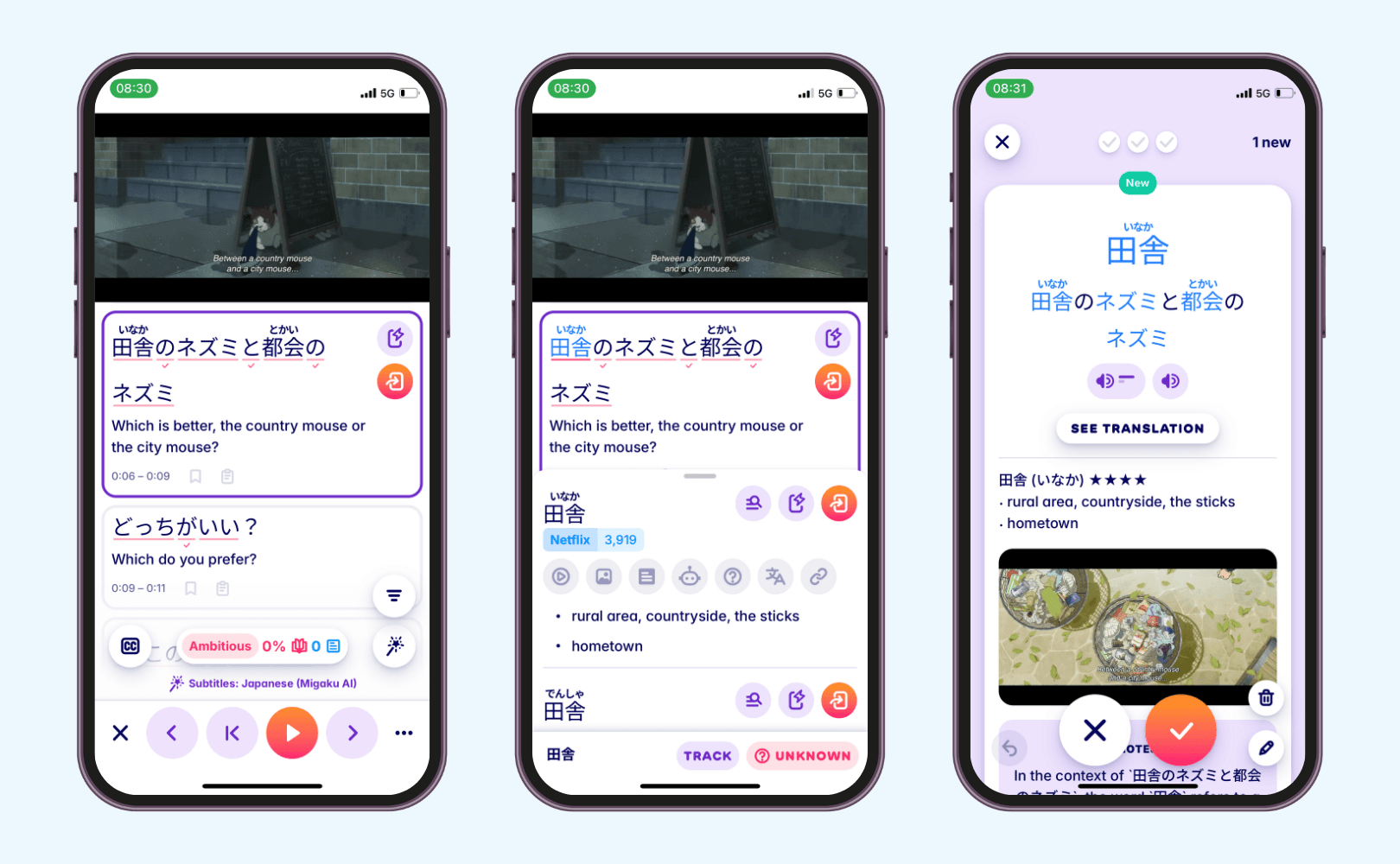
Anyway, if you want to supercharge your Japanese learning with real native content, Migaku's browser extension and app let you look up words instantly while watching Japanese shows or reading articles. The popup dictionary and one-click Anki card creation make immersion way more practical. There's a 10-day free trial if you want to check it out.
 ---
## FAQs
I've mentioned SRS (spaced repetition system) several times, so let me explain what that actually means. An SRS is a learning method that schedules review sessions based on how well you know something.When you learn a new word or kanji, the SRS shows it to you frequently at first. As you demonstrate that you remember it, the intervals between reviews get longer: one day, three days, one week, two weeks, one month, and so on. If you forget something, the interval resets and you see it more frequently again.
For grammar, Bunpro or a good textbook is essential. WaniKani doesn't teach sentence structure or particles. For listening, you need audio resources like JapanesePod101 or native content. For speaking, you'll want a language exchange partner or tutor (iTalki is great for finding affordable tutors). The best approach combines specialized tools.
If you're just starting out, here's my recommended beginner stack: 1. Tofugu's guides for hiragana and katakana. 2. Genki I with workbook for grammar and structured learning. 3. WaniKani for kanji and vocab. 4. Jisho.org for dictionary lookups.
---
## Enjoy the fun of self-studying Japanese
The best part about self-studying is that you can strategize your plan and pace according to your own liking. You don't need to force yourself to attend language classes when you can just enjoy the language input by sitting at home and enjoying your dramas!
> If you consume media in Japanese, and you understand at least some of the messages and sentences within that media, you will make progress. _Period_.
You're very brave to make the first step on your own!
---
## FAQs
I've mentioned SRS (spaced repetition system) several times, so let me explain what that actually means. An SRS is a learning method that schedules review sessions based on how well you know something.When you learn a new word or kanji, the SRS shows it to you frequently at first. As you demonstrate that you remember it, the intervals between reviews get longer: one day, three days, one week, two weeks, one month, and so on. If you forget something, the interval resets and you see it more frequently again.
For grammar, Bunpro or a good textbook is essential. WaniKani doesn't teach sentence structure or particles. For listening, you need audio resources like JapanesePod101 or native content. For speaking, you'll want a language exchange partner or tutor (iTalki is great for finding affordable tutors). The best approach combines specialized tools.
If you're just starting out, here's my recommended beginner stack: 1. Tofugu's guides for hiragana and katakana. 2. Genki I with workbook for grammar and structured learning. 3. WaniKani for kanji and vocab. 4. Jisho.org for dictionary lookups.
---
## Enjoy the fun of self-studying Japanese
The best part about self-studying is that you can strategize your plan and pace according to your own liking. You don't need to force yourself to attend language classes when you can just enjoy the language input by sitting at home and enjoying your dramas!
> If you consume media in Japanese, and you understand at least some of the messages and sentences within that media, you will make progress. _Period_.
You're very brave to make the first step on your own!