# Japanese Modality: How to Express Must, Should, May, Might in Japanese Language
> How does Japanese modality work to express must, should, may, and might? Understand epistemic vs deontic modality with practical examples you'll actually use.
**URL:** https://migaku.com/blog/japanese/japanese-modality
**Last Updated:** 2026-01-19
**Tags:** fundamentals, vocabulary, phrases, grammar
---
If you've been [studying Japanese](https://migaku.com/learn-japanese) for a while, you've probably noticed that expressing things like "must," "should," "may," and "might" feels totally different from English. The whole system of modality in Japanese works in ways that can mess with your head at first. Instead of simple modal verbs like English has, Japanese uses a bunch of different grammatical forms, [particles](https://migaku.com/blog/japanese/japanese-particles-guide), and sentence-ending expressions that change depending on context, politeness, and what kind of certainty you're expressing. Let's dig into how this actually works and what you need to know.
---
## What modality means in language
> Modality is basically how languages express things like possibility, necessity, permission, and obligation.
When you say "I might go" versus "I must go" in English, you're using modality to show different levels of certainty or requirement. Every language has ways to do this, but the specific grammatical tools vary wildly.
In English, we rely heavily on modal verbs like "can," "should," "may," "must," and "might." These little words do a ton of work. Japanese doesn't have direct equivalents, which is where things get interesting. The Japanese modal system uses auxiliary verbs, sentence-final particles, and entire grammatical structures to convey similar meanings.
Heiko Narrog, a major figure in Japanese linguistics, has written extensively about how modality developed as a concept in Japan. The Japanese term for modality is modariti (モダリティ), borrowed from English, though Japanese linguists have been studying these concepts using different terminology for decades before Western linguistic frameworks arrived.
---
## The two main types of modality
> Linguists generally split modality into two big categories: **epistemic modality** and **deontic modality**.
This distinction matters a lot when you're trying to understand Japanese grammar.
- Epistemic modality deals with **knowledge, certainty, and probability**. When you say "It might rain tomorrow" or "She must be home by now," you're making guesses about reality based on what you know. You're not certain, you're estimating.
- Deontic modality covers **obligation, permission, and necessity** that comes from rules or social expectations. "You must submit your homework" or "You may leave now" are deontic. Someone has authority or there's a rule creating the obligation or permission.
Japanese handles these two types pretty differently, and the forms you use depend heavily on which category you're working in. The language has developed specific grammatical patterns for each perspective on modality.
---
## How Japanese expresses "must" and "should"
Let's start with obligation and necessity since these are super common in daily conversation.
> For strong obligation (like "must"), Japanese uses **nakereba naranai** (なければならない) or the more casual **nakya** (なきゃ). There's also **nai to ikenai** (ないといけない), which carries a similar meaning but feels slightly less formal.
For example:
- 。
*I must study.*
> The form **beki** (べき) expresses "should" in the sense of moral obligation or what's proper.
Benkyou subeki () means "should study" with a sense that it's the right thing to do. This one's pretty formal and you'll see it more in writing or serious conversations.
> For softer suggestions, **hou ga ii** (ほうがいい) works great.
Benkyou shita hou ga ii () translates to "you should study" or "it would be better if you studied." This is way more common in everyday speech and sounds less pushy.
Here's something that trips people up: the interpretation of these forms depends massively on context. The same grammatical structure can shift between deontic and epistemic meanings. A sentence ending in **hazu** (はず), for instance, usually expresses epistemic certainty like "should be" or "supposed to be." Kare wa ie ni iru hazu da () means "He should be at home" in the sense of "I expect he's at home based on what I know."
---
## Expressing possibility with "may" and "might"
Possibility and uncertainty use different tools in Japanese.
> The most common form is **kamoshirenai** (かもしれない), which means "might" or "may." For more formal situations, **kanousei ga aru** (可能性がある) literally means "there is a possibility."
- 。
*It might rain."*
> The conditional form **tara** (たら) or **ba** (ば) can also express hypothetical possibility, though these work differently from English modals.
- 。
*If it rains, I won't go.* (The modality here comes from the conditional structure itself.)
> **Darou** (だろう) and its polite form **deshou** (でしょう) express probability or conjecture.
- 。
*It will probably rain tomorrow.* (The level of certainty with darou sits somewhere between "probably" and "I think.")
Japanese also uses evidential markers that English doesn't really have. **You da** (ようだ) and **sou da** (そうだ) both mean something like "it seems" or "it appears," but they work differently. You da is based on your own observation, while sou da (When used evidentially) is based on what you heard from someone else.
---
## What makes Japanese modality unique
The Japanese modal system has some features that don't map cleanly onto English or other European languages.
One big difference is how tightly modality connects to **politeness levels**. The same modal meaning can require completely different forms depending on whether you're talking to your boss or your friend.
The theoretical framework Japanese linguists use to study modality has its own history. The empirical study of modality in Japanese has had to bridge these two traditions, which is why you'll sometimes see different ways of categorizing the same grammatical forms.
Another language-specific aspect is how Japanese combines modality with **aspect** and **tense** in complex ways. Sentence-final particles like **ne** ([ね](https://migaku.com/blog/japanese/japanese-particle-ne)), **yo** ([よ](https://migaku.com/blog/japanese/japanese-particle-yo)), and **ka** (か) also carry modal meaning by showing the speaker's attitude or seeking confirmation. Iku deshou ne () adds a layer of "seeking agreement" that goes beyond just expressing probability.
---
## The role of context in Japanese modality
Here's the thing about studying modality in Japanese: context matters way more than it does in English. The same grammatical form can shift between different modal meanings depending on the situation, the relationship between speakers, and what's been said before.
Take **you ni** (ように), which can express purpose ("in order to"), manner ("in the way that"), or even a soft command when combined with other forms. Wasurenai you ni shite kudasai () means something like "Please make sure not to forget," blending obligation with request.
The interpretation of modal expressions also depends on whether the sentence is about the speaker, the listener, or a third party. Japanese has different constraints on who can express what kind of modality toward whom. You generally can't make strong statements about other people's internal obligations or desires without special grammatical marking.
---
## How this connects to Japanese learning theory
Japanese approaches to language learning have traditionally emphasized understanding these contextual and social aspects of grammar. The Japanese theory of learning, particularly for language, often focuses on pattern recognition and exposure to authentic usage rather than memorizing rules in isolation.
This empirical approach makes sense when you're dealing with modality, because the rules aren't always clean. You need to see how native speakers actually use these forms in different situations. Reading real content and listening to natural conversations shows you the patterns way better than [textbook](https://migaku.com/blog/japanese/best-japanese-textbooks) explanations alone.
The contrast between studying Japanese modality from a Western linguistic perspective versus a Japanese linguistics perspective can be pretty stark. Western frameworks might try to map Japanese forms onto familiar categories like "modal verbs," while Japanese linguists might emphasize the unique aspects of how the language expresses speaker attitude and social relationships through these forms.
---
## Practical examples you'll actually use
Let's look at some real sentences that show how modality works in practice.
- 。
*You don't have to go to the office tomorrow.* (This uses the permission/lack of obligation pattern with nakute mo ii.)
- 。
*I think he probably won't come.* (Here, tabun () adds epistemic modality showing uncertainty, combined with to omou () which explicitly marks it as the speaker's opinion.)
- 。
*You should probably go home now.* (The particle yo (よ) at the end adds assertiveness to the suggestion.)
- 。
*I heard the teacher said so.* (This uses the hearsay sou da to show the information came from someone else.)
These examples show how Japanese stacks multiple elements to create precise modal meanings that English often expresses with just one or two words.
---
## Learning tips on deontic modality and epistemic modality
Japanese modality gives you the tools to express everything from wild guesses to absolute certainty, from polite suggestions to strong obligations. The system uses grammatical forms, auxiliary verbs, sentence-ending particles, and contextual cues all working together.
1. Scholars like Narrog have explored how Japanese developed its own theoretical frameworks for understanding these patterns, which gives you a different perspective than just applying Western linguistic categories. Both approaches have value when you're trying to wrap your head around how the system works.
2. The more you study and immerse yourself in real Japanese, the more natural these patterns become. You start to feel which form fits which situation without consciously thinking through all the rules.
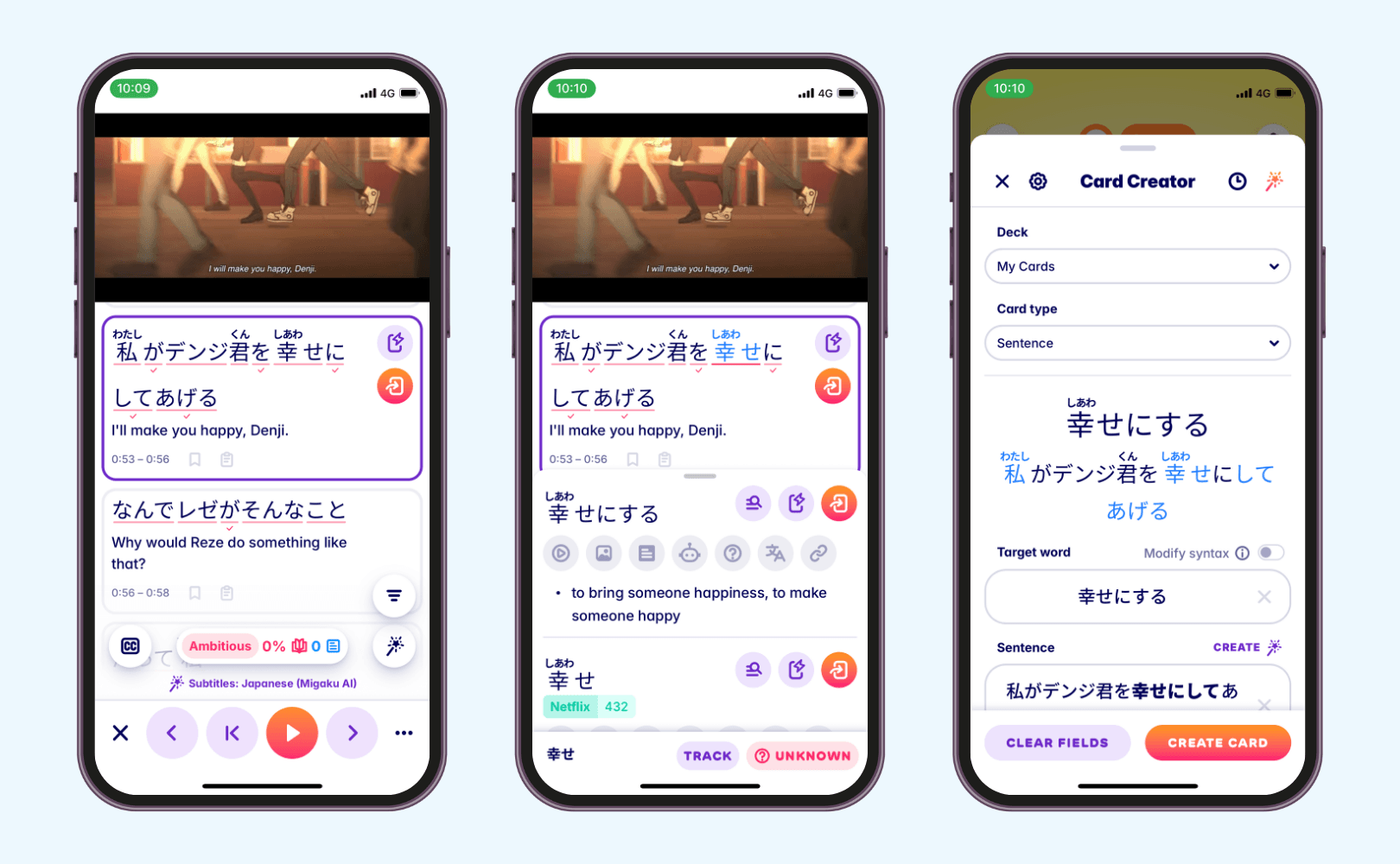
3. If you want to see these modal expressions in action while learning from real Japanese content, Migaku's browser extension and app let you look up words and grammar patterns instantly while watching shows or reading articles. Makes it way easier to catch these nuances in context. There's a 10-day free trial if you want to check it out.
 ---
## It's all about setting up the mindset
The language-specific aspects of Japanese modality mean you can't just translate English modal verbs directly. You need to think about what kind of modality you're expressing (Epistemic or deontic), how certain you are, what your relationship is with the listener, and how formal the situation is. The good news is, the more you listen and watch on media as to how Japanese natives use the modality, the more you can understand and use it actively.
> If you consume media in Japanese, and you understand at least some of the messages and sentences within that media, you will make progress. _Period_.
Rome was not built in one day.
---
## It's all about setting up the mindset
The language-specific aspects of Japanese modality mean you can't just translate English modal verbs directly. You need to think about what kind of modality you're expressing (Epistemic or deontic), how certain you are, what your relationship is with the listener, and how formal the situation is. The good news is, the more you listen and watch on media as to how Japanese natives use the modality, the more you can understand and use it actively.
> If you consume media in Japanese, and you understand at least some of the messages and sentences within that media, you will make progress. _Period_.
Rome was not built in one day.