# Japanese Particles Cheat Sheet: Quick Reference Guide to Common Particles
> Complete japanese particles cheat sheet with meanings, examples, and usage tips. Learn は, が, に, を, で and more with clear explanations that make sense.
**URL:** https://migaku.com/blog/japanese/japanese-particles-cheat-sheet
**Last Updated:** 2026-02-15
**Tags:** fundamentals, vocabulary, phrases, grammar, listicle
---
Japanese particles are those little words that show up everywhere and somehow change the entire meaning of a sentence. They're basically the glue holding Japanese [grammar](https://migaku.com/blog/japanese/japanese-sentence-structure) together, and honestly, they can feel overwhelming when you're starting out. This guide breaks down all the essential particles you need to know, with clear examples and explanations that actually make sense. Think of this as your go-to cheat sheet for [learning Japanese](https://migaku.com/learn-japanese) particles that you can reference whenever you're stuck.
---
## What are Japanese particles and why do they matter
> Particles are small words (usually just one or two characters) that attach to the end of other words to show their grammatical function in a sentence.
They tell you which word is the subject, which is the object, where something happens, and a bunch of other crucial information.
Here's the thing: English relies heavily on word order to convey meaning. Japanese uses particles instead. You could scramble a Japanese sentence around and as long as the particles stay attached to the right words, the meaning stays mostly the same. Pretty cool, right?
How many particles does Japanese have? There are over 100 particles if you count all the variations and combinations, but you only need to learn about 20-30 to handle most everyday situations. The rest you'll pick up naturally as you progress.
---
## Common particles reference guide with example sentences
### は (wa): The topic marker
This particle marks what you're talking about. Even though it's written as は, you pronounce it as "wa" when it's used as a particle.
-
*I am a student.*
The topic isn't always the subject of the sentence, which confuses a lot of learners. You're basically saying "as for me, I'm a student." It sets the stage for what comes next.
### が (ga): The subject marker
This particle marks the grammatical subject. The difference between は and が trips up basically everyone learning Japanese.
-
*I like cats.*
Use が when introducing new information, answering "who" or "what" questions, or when the subject is the focus of the sentence. Use は when the topic is already established or when contrasting things.
### を (wo/o): The object marker
Written as を but pronounced as "o," this particle marks the direct object of an action.
-
*I read a book.*
Whatever comes before を is what's receiving the action of the verb. Super straightforward once you get used to it.
### に (ni): Direction, location, and time
This particle does a lot of heavy lifting. It marks destinations, locations of existence, points in time, and indirect objects.
-
*I go to school.*
-
*There's a book on the desk.*
-
*Let's meet at 3 o'clock.*
### で (de): Location of action and means
While に marks where something exists, で marks where an action takes place. It also shows the means or method of doing something.
-
*I study at the library.*
-
*I go by train.*
### と (to): "And" and "with"
This particle connects nouns in a complete list and means "with" when doing something together.
-
*I bought apples and oranges.*
-
*I watched a movie with a friend.*
### も (mo): "Also" or "too"
Replace は or が with も to mean "also" or "too."
-
*I'm also a student.*
---
## Common Japanese particles for specific situations
### の (no): Possession and connection
This particle connects nouns, showing possession or relationships between things.
-
*My book*
-
*Japanese culture*
It's basically like the English apostrophe-s or "of."
### か (ka): Question marker
Stick this at the end of a sentence to make it a question. Easy.
-
*Are you a student?*
### ね (ne): Seeking agreement
This particle softens statements and seeks confirmation, kind of like "right?" or "isn't it?"
-
*Nice weather, isn't it?*
### よ (yo): Emphasis and assertion
Use this when telling someone something they don't know or emphasizing your point.
-
*It's going to rain tomorrow, you know.*
---
## Particles that show direction and movement in Japanese language
### から (kara): Starting point and "from"
This marks where something starts, whether in space or time.
-
*I came from Tokyo.*
-
*It starts from 9 o'clock.*
### まで (made): Endpoint and "until"
The opposite of から, this marks where or when something ends.
-
*I'm going as far as Osaka.*
-
*I work until 5 o'clock.*
### へ (e): Direction
Written as へ but pronounced "e" when used as a particle. It's similar to に but emphasizes the direction rather than the destination.
-
*I head north.*
Most learners can use に and へ interchangeably when talking about destinations without causing problems.
---
## Less common but still important particles explained
### や (ya): Non-exhaustive "and"
Unlike と, which lists everything, や implies there are other things you're not mentioning.
-
*I bought pens, pencils, and other things.*
### より (yori): Comparison
This particle means "than" in comparisons.
-
*Tokyo is bigger than Osaka.*
### ほど (hodo): Extent and degree
Shows the extent of something, often in negative comparisons.
-
*I'm not as good as him.*
### ばかり (bakari): "Only" or "just"
Indicates doing something exclusively or having just done something.
-
*I'm only playing games.*
### だけ (dake): "Only" or "just"
Similar to ばかり but more neutral in tone.
-
*Just one, please.*
---
## When to use は vs が in Japanese sentences
This is probably the most asked question when people [learn Japanese](https://migaku.com/blog/japanese/how-to-learn-japanese-vocabulary). Both can mark subjects, so what gives?
> Think about it this way:
> - は introduces what you're talking about (**The topic**),
> - while が identifies who or what is doing the action (**The subject**). They overlap sometimes, which is why it gets confusing.
Use は when:
- The topic is already established in conversation
- You're contrasting things
- Making general statements
Use が when:
- Introducing new information
- Answering "who" or "what" questions
- The subject is the new or important information
- After question words like (Who) or (What)
Example of contrast:
-
*I'm a student, but he's a teacher.*
Example of new information:
-
*Who came? Tanaka came.*
You'll mess this up sometimes. Everyone does. The meaning usually comes through context anyway.
---
## Combine particles for nuance
Sometimes you'll see particles stacked together. Common combinations include:
- には: Topic + location/time
- では: Topic + location of action
- とは: Quotation/companion + topic
- からは: Starting point + topic
-
*In Japan, you take off your shoes.*
These combinations let you express more complex relationships between ideas in a sentence.
---
## Common mistakes to watch out for
1. Mixing up に and で for locations is super common. Remember: に for existence, で for action.
2. Forgetting を entirely happens a lot to beginners. English doesn't mark objects explicitly, so it feels weird at first.
3. Using は when you should use が in answers to questions. If someone asks "who did it?" you answer with が, not は.
4. Overusing particles where Japanese doesn't need them, especially with time words like .
These mistakes are totally normal. You'll make them, notice them, and gradually stop making them as your brain adjusts to how Japanese grammar works.
---
## How to learn and remember particles
Reading about particles is one thing. Using them correctly is another. Here's what actually works:
1. Study them in context, not isolation. Don't just memorize "に = to/at/in." See how it works in real sentences. Notice patterns in the content you're consuming.
2. Make your own example sentences using things from your actual life. Way more memorable than textbook examples about generic students and apples.
3. Pay attention to particles when you're reading or listening. They're easy to gloss over, but actively noticing them builds intuition faster than drilling grammar rules.
4. Download a reference sheet you can check quickly. Having a cheat sheet on hand means you can verify your understanding without digging through [textbooks](https://migaku.com/blog/japanese/best-japanese-textbooks). You'll gradually need it less and less.
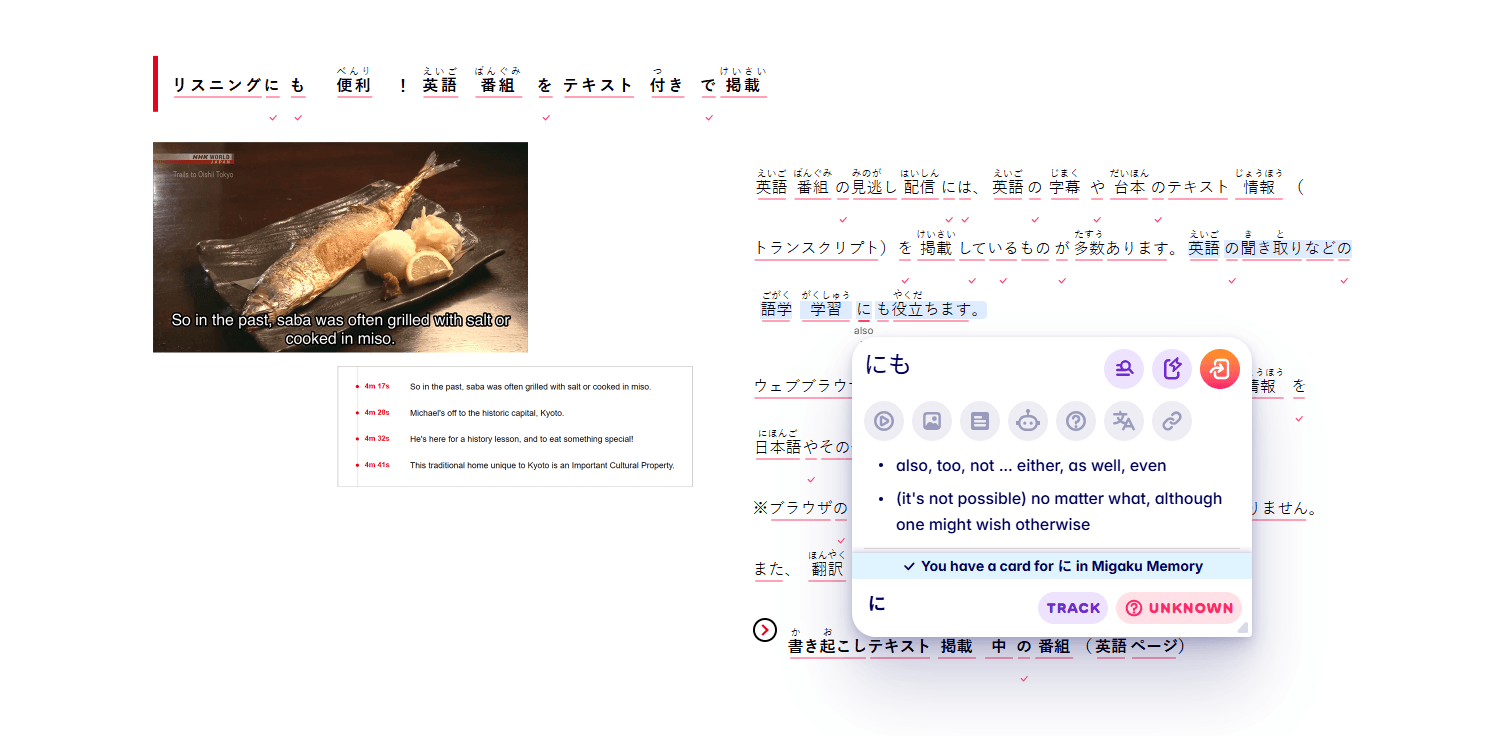
If you want to speed up the process, immersion with support tools makes a huge difference. Migaku's browser extension and app let you look up particles (and everything else) instantly while reading articles or watching videos in Japanese. You can build your understanding through real content instead of just drilling grammar tables. There's a 10-day free trial if you want to check it out.
 ---
## Are you ready to test your Japanese particle knowledge?
The best test is actually using Japanese. Try writing simple sentences about your day using different particles. Read manga or watch shows and pause to identify which particles appear and why. Particles aren't something you master in a week. They're something you get comfortable with over months of exposure and practice. Every sentence you read or hear is another data point helping your brain understand the patterns.
> If you consume media in Japanese, and you understand at least some of the messages and sentences within that media, you will make progress. _Period_.
Getting started before getting ahead!
---
## Are you ready to test your Japanese particle knowledge?
The best test is actually using Japanese. Try writing simple sentences about your day using different particles. Read manga or watch shows and pause to identify which particles appear and why. Particles aren't something you master in a week. They're something you get comfortable with over months of exposure and practice. Every sentence you read or hear is another data point helping your brain understand the patterns.
> If you consume media in Japanese, and you understand at least some of the messages and sentences within that media, you will make progress. _Period_.
Getting started before getting ahead!