# Japanese Speaking Practice: Practice Speaking Japanese with These Methods
> Discover effective Japanese speaking practice methods for beginners and intermediate learners. Apps, language exchange tips, and daily techniques that build fluency.
**URL:** https://migaku.com/blog/japanese/japanese-speaking-practice
**Last Updated:** 2026-01-09
**Tags:** fundamentals, vocabulary, phrases, grammar
---
Here's the thing about [learning Japanese](https://migaku.com/learn-japanese): you can memorize thousands of vocabulary words and understand [grammar](https://migaku.com/blog/japanese/japanese-sentence-structure) perfectly, but if you never practice speaking, you'll freeze up the moment someone actually talks to you. The good news? There are tons of ways to practice speaking Japanese in 2026, even if you live nowhere near Japan. Some methods work better than others depending on your level, and I'll break down what actually helps versus what wastes your time.
---
## Why practice speaking Japanese differently from other skills
Speaking uses a completely different part of your brain than reading or listening. When you read, you have time to think and process. When someone asks you a question in Japanese, you need to retrieve vocabulary, construct a sentence with proper grammar, and produce the right sounds, all within a few seconds.
Your mouth also needs physical practice forming Japanese sounds. Pronunciation in Japanese involves tongue positions and mouth shapes that don't exist in English.
The "r" sound, for example, sits somewhere between an English "r" and "l". You can know this intellectually, but your mouth won't cooperate until you've practiced it hundreds of times.
---
## Methods for beginner Japanese speaking practice
### Shadow speaking with native speaker content
This method works incredibly well for beginners who feel too nervous to talk to real people yet. You play audio from a native speaker and repeat what they say immediately after, matching their rhythm, intonation, and pronunciation as closely as possible.
1. Pick content slightly below your current level. Anime with Japanese subtitles works great, or podcasts designed for learners.
2. Play a sentence, pause, repeat it out loud.
3. Then play it again and try to say it simultaneously with the speaker.
I started doing this with a Japanese reality show called "Terrace House" and my pronunciation improved more in two weeks than it had in the previous six months. The key is actually speaking out loud, not just mouthing the words silently. Your brain needs to hear your own voice producing these sounds.
### Learn to speak to yourself in Japanese
Sounds weird, but this is how I built basic fluency. Narrate what you're doing throughout the day in simple Japanese.
Making coffee? Say "Koohii wo tsukutte imasu" () - I'm making coffee. Walking to the store? "Mise ni aruite ikimasu" () - I'm walking to the store.
You'll quickly discover which words and phrases you don't know yet. Write them down, look them up, then use them the next day. This method builds the mental habit of thinking in Japanese instead of translating from English.
Start simple. A beginner might just say single words: "Mizu" () - water, "Neko" () - cat, "Akai" () - red. That's totally fine. You're training your brain to access [Japanese vocabulary](https://migaku.com/blog/japanese/how-to-learn-japanese-vocabulary) automatically.
---
## Practice speaking Japanese with real people to improve fluency
### Practice speaking Japanese online
Language exchange means you spend half the time speaking Japanese while your partner helps you, and half the time speaking English while you help them. It's free, and you can find partners easily online.
Apps like [HelloTalk](https://www.hellotalk.com/en/partners/exchange/japanese) and [Tandem](https://tandem.net/) connect you with Japanese native speakers who want to learn English. The quality varies wildly though. Some people just want to chat casually and won't correct your mistakes. Others take it seriously and provide real feedback.
Here's how to do a language exchange effectively:
1. Set clear expectations upfront.
2. Tell your partner you want them to correct your mistakes, not just nod along.
3. Use a timer and actually split the time evenly (30 minutes Japanese, 30 minutes English).
4. Prepare topics beforehand so you're not just asking "how are you?" every time.
I've done language exchanges where we'd watch a short YouTube video together, then discuss it in Japanese for 15 minutes and English for 15 minutes. Having a specific topic made conversations way more natural than trying to force small talk.
### Online tutors on italki
If you can spend a bit of money, hiring a tutor on italki gives you structured conversation practice with someone who actually knows how to teach. You can find professional teachers for $15 to $60 per hour, or community tutors (Native speakers without teaching credentials) for $5 to $15 per hour.
Community tutors work great for conversation practice. You're basically paying for a language exchange partner who will focus entirely on you and your Japanese.
Professional teachers are better if you need help with specific grammar points or want structured lessons.
Book a few trial lessons with different tutors to find someone whose teaching style matches your learning style. Some tutors just chat freely, others bring materials and exercises. For speaking practice, I prefer tutors who let the conversation flow naturally but jump in to correct pronunciation and suggest better phrases.
### Japanese conversation groups
Many cities have Japanese conversation meetups, and in 2025, there are tons of online groups too. These usually involve 5 to 10 people at various levels chatting in Japanese for an hour or two.
The advantage is you hear multiple speakers and practice group conversation dynamics, which is different from one-on-one talking. The disadvantage is you get less individual speaking time, and beginners sometimes feel intimidated.
Look for groups specifically labeled for your level. Mixed-level groups often split into beginner, intermediate, and advanced tables. Don't try to punch above your weight here. You'll learn more in the beginner group where you can actually contribute than sitting silently in the advanced group.
---
## Intermediate speaking practice methods
Once you're past the beginner stage and can hold basic conversations, you need different practice methods to keep improving.
### Speak Japanese with complex topics
Intermediate learners often plateau because they keep having the same simple conversations. "Where are you from? What's your hobby? I like sushi." You need to push into uncomfortable territory.
Pick topics that require you to express opinions and use more complex grammar. Politics, philosophy, movie reviews, ethical dilemmas. These force you to use conditional phrases, express nuance, and build longer arguments.
Find a patient language exchange partner or tutor and say "I want to discuss whether AI will replace human jobs" or "Let's talk about the best way to learn a language." You'll struggle at first. That struggle is where improvement happens.
### Record yourself speaking
This feels awkward but reveals so many problems you don't notice while speaking. Set a timer for 2 minutes and talk about any topic. Record it. Listen back.
You'll catch filler words you overuse, grammatical mistakes, pronunciation issues, and places where you hesitate because you lack vocabulary. Make a list of these problems and focus on fixing them in your next practice session.
I recorded myself describing my daily routine and realized I said "ano" (あの) - um/uh, literally every third word. Once I heard it, I could consciously reduce it. You can't fix problems you don't know you have.
### Conduct Japanese conversation practice in professional contexts
If you're intermediate, challenge yourself with formal situations. Practice giving a presentation in Japanese, conducting a mock job interview, or explaining your work in detail. This builds a different register of language than casual conversation.
The Japanese language has multiple politeness levels, and intermediate learners need to master keigo () - honorific language. You won't learn this by chatting casually with friends. You need to practice business situations, customer service scenarios, or formal introductions.
---
## Apps for practicing speaking Japanese
Several apps target speaking specifically, though they work differently than talking to real people.
1. **Pimsleur** focuses almost entirely on speaking and listening. Each 30-minute lesson has you responding out loud to prompts, building sentences, and practicing conversations. The method works, but it's audio-only and gets repetitive. Good for building speaking confidence as a beginner.
2. **Speechling** lets you record yourself saying phrases, then native speakers provide feedback on your pronunciation. You get unlimited submissions on the paid plan. The feedback is genuinely helpful, though it's asynchronous so you're not having real conversations.
3. **Mimic Method** teaches Japanese phonetics through flow training, where you learn to produce sounds correctly before worrying about meaning. Pretty cool for fixing pronunciation issues, but it's a supplement to other methods, not a complete solution.
Honestly though, apps can't replace talking to actual humans. They're useful for building confidence and fixing specific pronunciation problems, but you need real conversation practice to develop fluency.
---
## Good schedule to practice speaking Japanese
The single best method combines multiple approaches. Here's what actually works:
1. **Daily solo practice** (10-15 minutes): Shadow speaking with content you enjoy, or narrate your activities in Japanese. This builds the habit and keeps your mouth familiar with Japanese sounds.
2. **Weekly conversation** (30-60 minutes): Language exchange partner or tutor. Real human interaction where you discuss topics that interest you and get feedback on mistakes.
3. **Monthly challenges**: Record yourself giving a 5-minute speech on a complex topic, or try to have an entire day where you think only in Japanese.
---
## Common speaking practice mistakes
1. **Only practicing with other learners.** You'll reinforce each other's mistakes and develop weird pronunciation habits. You need regular exposure to native speakers.
2. **Never speaking until you feel "ready."** You'll never feel ready. Start speaking from day one, even if you only know ten words. Beginners who speak badly from the start progress faster than perfectionists who wait.
3. **Not preparing topics beforehand.** Winging it with a language exchange partner leads to boring, repetitive conversations. Spend 5 minutes before each session thinking about what you want to discuss.
4. **Ignoring pronunciation early on.** Bad pronunciation habits become ingrained. A beginner should spend serious time on basic sounds before worrying about advanced vocabulary.
5. **Focusing only on speaking.** Speaking ability grows from overall language knowledge. Keep reading, listening, and learning vocabulary. Your speaking will improve as your overall Japanese improves.
---
## Making speaking practice enjoyable
If speaking practice feels like torture, you won't stick with it. Find ways to make it genuinely fun.
1. Talk about topics you actually care about. If you hate discussing the weather and hobbies, don't. Talk about video games, cooking, politics, sports, whatever interests you.
2. Practice with people you like. Some language exchange partners become real friends. The conversation stops feeling like practice and starts feeling like hanging out, which is when the best learning happens.
3. Use Japanese to do things you'd do anyway. Instead of watching English YouTube, watch Japanese YouTube. Instead of reading English news, read Japanese news. You'll naturally want to discuss and think about this content, which creates organic speaking practice opportunities.
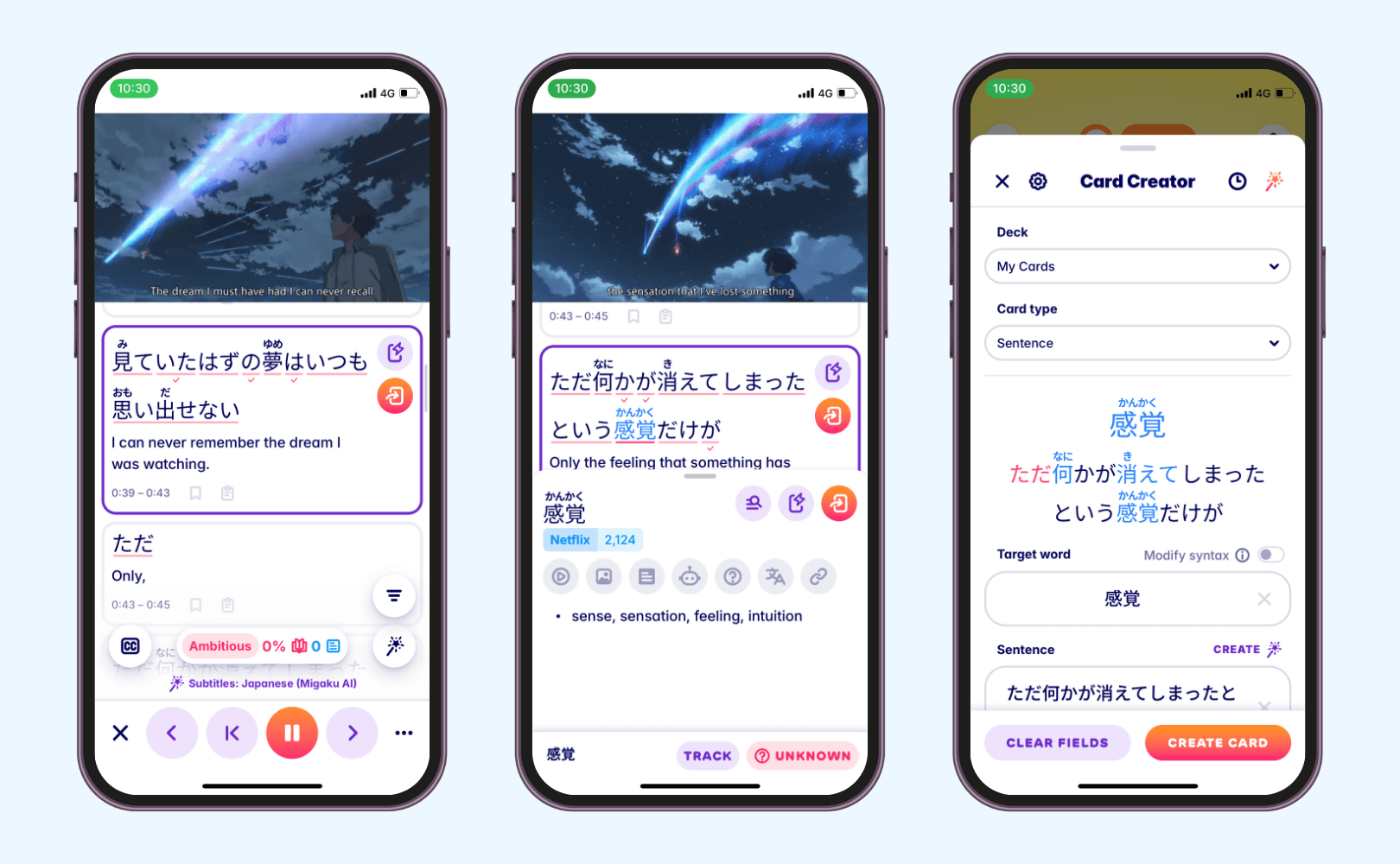
Anyway, if you want to support your speaking practice with better input, Migaku's browser extension and app let you look up words instantly while watching Japanese videos or reading articles. Makes immersion learning way more practical since you can learn vocabulary from content you actually enjoy. There's a 10-day free trial if you want to check it out.
 ---
## When to know that the speaking skills are improving
You'll know your speaking practice is paying off when you stop translating in your head. Instead of thinking "I want to eat" in English, then converting it to "Tabetai desu" (), you'll just think directly in Japanese. It depends on your previous language learning experience, your personality, and how much time you invest in media input.
> If you consume media in Japanese, and you understand at least some of the messages and sentences within that media, you will make progress. _Period_.
Extroverts make progress faster than perfectionists.
---
## When to know that the speaking skills are improving
You'll know your speaking practice is paying off when you stop translating in your head. Instead of thinking "I want to eat" in English, then converting it to "Tabetai desu" (), you'll just think directly in Japanese. It depends on your previous language learning experience, your personality, and how much time you invest in media input.
> If you consume media in Japanese, and you understand at least some of the messages and sentences within that media, you will make progress. _Period_.
Extroverts make progress faster than perfectionists.